OM in the News: Polyester Is Driving Up Fashion’s Emissions

Greenhouse gas emissions from clothing companies are mounting, reports The Wall Street Journal (July 24, 2025).  The spike is fueled by supercharged apparel production, as well as a mounting reliance on virgin polyester. Virgin polyester, a material made from fossil fuel-created plastic, is the latest industry trend.

Polyester now makes up 57% of total global fiber production. The market share of recycled polyester used in clothing has recently dropped, pointing out that the material costs more than its virgin counterpart.

Environmental concerns about apparel have proliferated since the arrival of ultrafast fashion companies, which churn out low-cost clothes direct-to-consumer to satiate lightning-quick trend cycles.
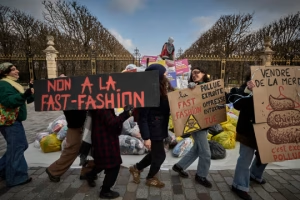
Activists hold banners as they gather in front of bags of textile waste delivered in Paris

Recycling clothing can be especially tricky when fibers are woven together, for example cotton and polyester, which are often blended to lower costs and provide stretch in fabric.

But consumers are growing worried about clothing shedding microplastics that could harm human health and the environment. There’s also been concern about “forever chemicals” in textiles used to make workout gear.

New technologies including artificial intelligence are helping brands to get a better handle on their clothing stock, piloting made-to-order methods that significantly reduce waste by producing only what is needed.

Some countries are taking swift action to try and blunt the harms of fast fashion. France recently adopted a bill to tax each fast fashion item €5 ($5.87 ) which will increase to €10 by 2030.

Classroom discussion questions:

  1. Why is fast fashion an OM issue?
  2. How else might AI be used to improve sustainability in the fashion industry?

OM in the News: Shein Markets Its Supply-Chain Technology to Global Brands

China-founded Shein has built a bargain fashion empire with a pioneering small-batch manufacturing model, reports The Wall Street Journal (March 21, 2024). Now it is planning to open that up to global brands and designers. It is calling the new initiative “supply chain as a service.”

Shein contracts with thousands of factories in China that churn out tens of thousands of new styles daily.

The move represents a shift in business strategy as Shein faces challenges in the U.S., its biggest market.  Under the plan, Shein would make its supply-chain infrastructure and technology available to outside brands and designers, allowing them to leverage Shein’s system for testing out new fashion items in small batches and track how popular they are with consumers.

Shein has rapidly expanded from a discount Chinese apparel seller to a global fashion brand with the help of its small-batch, on-demand manufacturing model, and now sells to more than 150 countries. It has revolutionized fashion manufacturing as it contracts with thousands of factories in China that churn out tens of thousands of new styles daily. It places orders to suppliers to be delivered in days, relies on real-time data to quickly analyze demand and replenishes orders as needed. That cuts down on the cost for storage and limits inventory waste, a primary reason for its ultralow prices.

By making its supply-chain ecosystem more widely available to brands, Shein is refocusing on its powerful capabilities to manufacture and distribute fashion products efficiently.

Shein’s popularity in the U.S. has drawn the attention of lawmakers, who have pressed Shein to address whether it sources cotton from China’s Xinjiang region, where the U.S. has accused Chinese authorities of committing genocide and of using forced labor in its repression of mostly Muslim Uyghurs, allegations Beijing denies. Shein has said it has a “zero-tolerance policy” for forced labor.

Classroom discussion questions:

  1. What is “supply chain as a service”? Why is Shein offering this service?
  2. How has Shein revolutionized the apparel industry?

OM in the News: Cutting the Environmental Footprint of Fast-Fashion

“Fast fashion is a problem,” said a European Union official in The Financial Times (July 5, 2023).  Lawmakers in the European parliament have called for an “end to fast fashion” and the setting of specific targets for textile waste collection, prevention and recycling. Fast-fashion brands such as the online retailers Shein and Boohoo and clothing giants H&M and Inditex (which owns Zara), have come under increasing pressure to move away from low-cost business models that have resulted in millions of tons of clothes being trashed.

Clothing companies are being pushed to improve the recyclability of their products

The EU wants the textile industry to pay for the processing of discarded clothing and footwear under new rules aimed at cutting the environmental footprint of fast-fashion brands. It proposes to push clothing companies to improve the recyclability of their products and catalyze a growing second market. The equivalent of over 26 pounds of clothes and footwear per EU citizen is discarded each year of which more than three-quarters is incinerated or goes to landfill.

Companies that sell to consumers in the EU would be responsible for paying for the treatment of any waste textiles with the amount charged dependent on the amount of processing required. The cost of making companies pay for clothing waste would amount to 12 cents per T-shirt but it would vary according to the product and what treatment was needed.

Companies say they want to sell more sustainable products, but are hampered by the lack of recycling infrastructure. H&M said it backed the measures and aimed for 30% of its clothes to be made from recycled fibers by 2025. Euratex, the EU textile industry body, said that it was working on pilot projects with small fabric manufacturers in 11 textile producing regions to create a closed loop system with clothes better designed for recycling.

Fast fashion was invented by companies such as Zara, in the late 1990s, when they took the latest styles seen on the catwalk and brought similar products to market. Zara took only 3-4 weeks to bring a simple T-shirt from design to the stores and 6-8 weeks for a jacket or a dress.

Classroom discussion questions:

  1. How do your students feel about fast-fashion its environmental impact?
  2. What is the role of OM in this issue?

OM in the News: Fast Fashion, Shein, and Inventory

Fast fashion was invented by companies such as Zara, and to a lesser extent H&M, in the late 1990s, when the companies took the latest styles seen on the catwalk and brought similar products to market. For companies such as Zara, it took 3-4 weeks to bring a simple T-shirt from design to the stores and 6-8 weeks for a jacket or a dress. But the category fell out of favor in recent years as consumers became more critical of the apparel industry’s impact on the environment.

If what Zara did in the ’90s was fast fashion, Shein’s version is “ultrafast fashion,” reports The Wall Street Journal (May 31, 2023).  Shein’s inventory on average takes around 40 days to turn over. That is about half of what it takes for Zara. The quick-turn strategy goes against industry trends. In general, apparel companies’ inventory turnover has lengthened over the past two decades. (Last year Shein accounted for 1.7% of apparel-industry sales in North America, making it the fourth-largest clothing seller behind Nike, Old Navy and Lululemon).

Shein’s pop-up store in Paris

With its supply base in China, Shein has a well-oiled test-and-scale model: It produces 100 to 200 pieces of any given product at launch and then increases production only if demand is strong. That results in little excess inventory, which in turn helps its bottom line. On the supply side, it milks efficiencies by using a digital manufacturing system. The system asks Shein’s extensive supplier base to share real-time capacity and tags each of them based on category strengths and weaknesses. To minimize costs, Shein selects master fabrics and requires designers to choose from the pool.

Shein’s meteoric rise shows that trendy and cheap have enduring appeal. While Gen Z cares about sustainability, it also values self-expression. Even though the company has said it has no suppliers in Xinjiang, China, where there are allegations of forced labor, the company is hedging its bets with plans to source more fabric from India.

Environmentally friendly resale platforms such as ThredUp and The RealReal made their debuts to great fanfare, but their appeal among shoppers has proven transitory. Allbirds, a footwear brand that boasts environmentally friendly practices, has seen its popularity fizzle, too. Shoppers like to see green credentials, but Shein’s popularity has shown that cash always looks greener.

Classroom discussion questions:

  1. What is Shein’s inventory advantage?
  2. Describe the firm’s production strategy.