OM in the News: Cutting the Environmental Footprint of Fast-Fashion

“Fast fashion is a problem,” said a European Union official in The Financial Times (July 5, 2023).  Lawmakers in the European parliament have called for an “end to fast fashion” and the setting of specific targets for textile waste collection, prevention and recycling. Fast-fashion brands such as the online retailers Shein and Boohoo and clothing giants H&M and Inditex (which owns Zara), have come under increasing pressure to move away from low-cost business models that have resulted in millions of tons of clothes being trashed.

Clothing companies are being pushed to improve the recyclability of their products

The EU wants the textile industry to pay for the processing of discarded clothing and footwear under new rules aimed at cutting the environmental footprint of fast-fashion brands. It proposes to push clothing companies to improve the recyclability of their products and catalyze a growing second market. The equivalent of over 26 pounds of clothes and footwear per EU citizen is discarded each year of which more than three-quarters is incinerated or goes to landfill.

Companies that sell to consumers in the EU would be responsible for paying for the treatment of any waste textiles with the amount charged dependent on the amount of processing required. The cost of making companies pay for clothing waste would amount to 12 cents per T-shirt but it would vary according to the product and what treatment was needed.

Companies say they want to sell more sustainable products, but are hampered by the lack of recycling infrastructure. H&M said it backed the measures and aimed for 30% of its clothes to be made from recycled fibers by 2025. Euratex, the EU textile industry body, said that it was working on pilot projects with small fabric manufacturers in 11 textile producing regions to create a closed loop system with clothes better designed for recycling.

Fast fashion was invented by companies such as Zara, in the late 1990s, when they took the latest styles seen on the catwalk and brought similar products to market. Zara took only 3-4 weeks to bring a simple T-shirt from design to the stores and 6-8 weeks for a jacket or a dress.

Classroom discussion questions:

  1. How do your students feel about fast-fashion its environmental impact?
  2. What is the role of OM in this issue?
OM in the News: Corporate Footprint Grows for Sustainable Packaging

Operations managers need to better understand modern consumer trends relating to sustainable products and packaging. According to McKinsey & Company (March 1, 2022), consumers believe that brands have as much responsibility as governments to create positive environmental change.

Over the past five years, there has been a 71% rise in online searches for sustainable goods globally, according to The Economist. Consumers are engaging with sustainable businesses in ways that they previously ignored. This trend isn’t just in first-world countries, please click on the graphic. Consumer satisfaction in developing and emerging economies is also tied to concerns around climate change, and many want businesses to commit to protecting nature and natural systems.

According to  McKinsey:

  • Consumers often consider a company’s environmental footprint before purchasing products.
  • 77% of the public thinks plastic is the least environmentally responsible type of packaging. Paper was deemed the most environmentally safe material.
  • 66% of the public (and 75% of millennials) say that they consider sustainability when they make a purchase.

Customers now align themselves with brands that are compatible with their values and priorities. With environmental stability as a high priority for many people, it’s important that operations managers do their part to lower their carbon footprint. “The shift in consumer buying, with more consumers willing to pay extra for environmentally friendly products, reinforces the need for companies to increase their commitments to responsible business practices,” said the head of sustainability at a large consulting firm.

Industries and companies are listening to their consumers about what they want. Over 50% of C-level executives in the fashion and textile industry have claimed that consumer demand is driving their brands to create sustainable products and best practices. Many of these companies have been sourcing sustainably produced raw materials to create their apparel. The trend of sourcing organic and sustainable materials has also been seen in the food, cosmetic and pharmaceutical sectors. These industries have been making a concerted effort to use sustainable materials.

Classroom discussion questions:

  1. What are some examples of successful product designs that are sustainable? (Hint: see pages 197-8 of your Heizer/Render/Munson text).
  2. Why is corporate social responsibility becoming more broadly accepted in C-suites?


OM in the News: Sustainability and eBay Packaging

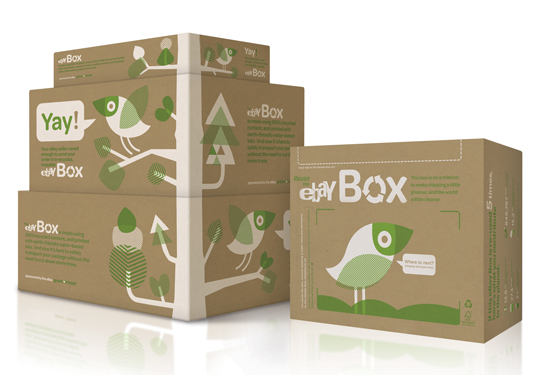
In Chapter 5 we discuss some of the easiest ways to make products more  sustainable. We can: (1) make them recyclable; (2) use recycled materials; (3) use less harmful ingredients; (4) use lighter materials; (5) use less energy; and (6) use less material. MITSloan Management Review (Aug. 11, 2011–E Newsletter) describes how eBay has made its packing boxes more sustainable by using almost all of these approaches. In doing so, the online auction company has come up with a solution that not only feeds on people’s desire to recycle, but helps brand the business as sensitive to the environment.

The eBay box is made of especially durable cardboard. Covered in graphics of birds and trees, it has text all over that basically says: “this box has been designed to be used over and over”. The inside of the lid even has spaces where users can leave notes where the box has been, essentially inviting recipients to celebrate the fact that the box has been used and reused.

The idea bubbled up internally. The firm’s Green Team is tasked with “inspiring the world to buy, sell and think green every day”. Out of the 250 suggestions submitted to eBay’s annual Innovation Expo, the grand prize winner was the eBay box. The project received a prestigious Clio design award a few months ago.

By May that the company had given away 100,000 of the boxes. The Green Team reports that “each box is made of 100% recycled material, printed with water-based inks, and designed to require minimal tape”. The 1,500 boxes reused so far have “conserved almost 7,000 gallons of water, energy to power 13 homes for a week, and reduced greenhouse gasses equivalent to taking 18 cars off the road for a week”.

Discussion questions:

1. Ask students to pick another product that can be redesigned to be greener.

2. Show the Frito-Lay video on sustainability (in Ch.7) and compare that company’s packing efforts to eBay’s.