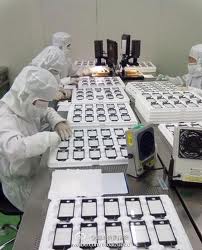
OM in the News: China Losing Edge as World’s Factory Floor

Chinese manufacturer

China is losing its competitive edge as a low-cost manufacturing base, suggests The Wall Street Journal (Jan.17, 2013), with makers of everything from handbags to shirts to basic electronic components relocating to cheaper locales like Southeast Asia. The shift—illustrated in weakened foreign investment in China—has pluses and minuses for an economy’s global growth. Beijing wants to shift to higher-value production and to see incomes rise. But a de-emphasis on manufacturing puts pressure on leaders to make sure other jobs are created. The shift is the result of a long-term trend of rising wages and other costs that have made China less attractive, especially for basic manufacturing.

Foreign capital helped build China into a low-cost manufacturing powerhouse and global growth engine. But its increasingly urban population now has higher expectations in terms of wages and working conditions and louder objections to the pollution that often comes with low-level manufacturing—demands that have eroded China’s cost advantage.   “We know we can’t keep relying on a low-cost competitive advantage. We need to accelerate the value-added upgrading of our products,” says the Commerce Ministry spokesman. “You couldn’t say we are happy to see this development.”

For China’s neighbors, the trend means more opportunities. Southeast Asian nations, which claimed 2% of global foreign investment in  1997, now account for about 7.6%.

Not all of the shift out of China involves low-end industries such as garment-making. Wintek Corp., with about 50,000 workers globally that makes smartphone components for companies including Apple, just said it will invest $930 million in four new plants in Vietnam to make displays and touch screens.

Discussion questions:

1. What are the advantages and disadvantages to this shift  for the U.S.?

2. What are the operations issues arising to companies that relocate manufacturing to other S.E Asian countries?

OM in the News: Manufacturing Jobs Begin the Long March Back (From China)

For more than a decade, deciding where to build a manufacturing plant to supply U.S. markets was simple: China was the  answer. But the International Business Times (June 2, 2012) estimates that in the next 10 years, increased production from manufacturing re-shored from China will add  $20-$55 billion annually to the U.S. economy. And in 5 years, U.S. exports could increase by  $65 billion annually, creating  1.8-2.8 million new manufacturing jobs here.  In the next few years, rising Chinese wages, higher U.S. productivity, a weak dollar, and other factors will virtually close the cost gap between the U.S. and China.

The article, a good starting point for the semester, looks at 4 issues:

Labor Costs. In 2000, factory wages in China averaged just 52 cents an hour,  3% of what average U.S. factory workers earned. Since then, Chinese wages have risen by double digits each year, while costs for U.S. production workers increased by less than 4% annually. Since wages account for 20- 30% of a product’s total cost, manufacturing in China will soon be only 10-15% cheaper than in the U.S. — before inventory and shipping costs are considered. After those costs are factored in, the total cost advantage will drop to single percentage digits or be erased entirely.

Logistics. Logistical issues — such as shipping costs, the time it takes get a manufactured product to the market, and the proximity of production lines to engineering and design teams — are big factors in comparing China vs. U.S. manufacturing.

Supply-Chain Threats. There are the many costs and headaches of relying on extended supply chains. These include inventory expenses, quality-control problems, and the threat of supply disruptions. For example, the floods in Thailand last year left Apple with a shortage of  hard drives.

Currency Risk. In the past, the risk of currency fluctuation was minimal in China because the central bank kept the yuan rigidly pegged to the U.S. dollar. But in 2005, Beijing allowed the yuan to fluctuate. Since then, the yuan has appreciated about 30% against the dollar.

Discussion questions:

1. How can OM help the US recapture manufacturing jobs?

2. What advantages does China retain in manufacturing, and what are the advatages of producing here?

Good OM Reading: Apple Doubles Down on Manufacturing in China

Fortune‘s (June 11, 2012) lead article features Apple’s new CEO, Tim Cook, whom the magazine calls “the master of operational efficiency”.  The article is a good one for your students to read at the start of a semester or when you treat the topic of supply chains (Ch.11).

Cook joined Apple in 1998 to revamp its badly broken system of factories, warehouses, and suppliers. He quickly strengthened Apple’s cooperation with its contract manufacturers in China. But it was a personal blow to Cook when the New York Times ran a prominent article in January critical of the working condition at Foxconn, the company that assembles most of Apple’s products. Though the criticism wasn’t new, the exposé painted a bleak portrait of the lives of workers in the factories. Cook’s response marked a distinct change in tone from Steve Jobs, who had been dismissive of the severity of the problem. The new CEO not only visited Foxconn personally, but Apple  joined the Fair Labor Association, a third-party monitoring group.

The news this week, though, is that Apple is doubling down on its manufacturing in China. Apple disclosed for the 1st time the dollar value of its assets there: $2.6 billion, meaning a massive value of  material and equipment Apple has bought on behalf of its suppliers. The firm is risking  its own capital, another $7 billion, as a way of financing massive upgrades in its manufacturing capabilities in Asia, even though its partners will operate the equipment.

Apple generally is mum on what the investments are for,  but “that’s got to be for volume,” says a portfolio manager at T. Rowe Price. He notes that Apple suppliers like Pegatron and Jabil have been buying sophisticated machine tools and that Japanese drill-bit manufacturers say they are moving into consumer electronics on Apple’s behalf. “The Apple supply chain is doing things no one else can,” given its abundance of cash and manufacturing know-how. Such operational efficiencies have been an underappreciated factor in Apple’s success for the past decade; all the attention has been on its beautiful designs and snazzy marketing overseen by Jobs.

OM in the News: Flat US Wages and the Manufacturing Rebound

After a 35% decline in the number of U.S. manufacturing jobs between 1998 and  2010, the total since has risen by 4.3% to 11.9 million. But The Wall Street Journal (May 29,2012) writes that “wages for many manufacturing workers aren’t keeping up with inflation. The absence of wage growth may make manufacturers more likely to hire. For workers, though, it means less income, and thus less to spend.”

This wage lag is a key factor contributing to the rebounding competitiveness of U.S. industry. The  uptick in factory employment and the return of some production to U.S. shores from abroad both added jobs that probably otherwise wouldn’t exist. The U.S. has held manufacturing wages in check while there has been strong wage growth in China and moderate wage growth in Mexico.

At American Axle & Manufacturing Holdings Inc.’s plant in Three Rivers, Mich., new hires for assembly start at $10 an hour. Those hired before 2008 get a “legacy” rate of about $18 an hour. Similarly, at the Big Three U.S. auto makers, veteran workers make  $29 to $33 an hour in base pay; recent hires earn $16 to $19. Some unions are agreeing to the use of lower-paid temporary workers. The temporary, or “casual,” assembly workers at the Harley Davidson motorcycle plant in Kansas City get about $14 an hour while union members get $22 an hour. GE announced plans to move production of electric water heaters to Louisville, Ky., from Mexico after U.S. unions agreed to a $13-an-hour starting wage for new hires, $8 to $10 or more an hour below the previous contract.

The sluggish wage growth coincides with an impressive burst of rising factory productivity. Output per hour in American manufacturing has increased by 13% in the past five years and 21% in the five years before that.

Discussion questions:

1.What are the negatives of slow wage growth in the manufacturing sector?

2. How have lower wages helped US manufacturing?

.

OM in the News: Japanese Manufacturing–Then and Now

When you are in the swamp and an alligator is nibbling on your leg, they say it’s hard to see the big picture. So today, despite the gnawing pain we feel from global competition, let us recall the world just 27 years ago, when Japan was the gator and US manufacturing was being threatened by the likes of  Toyota, Mitsubishi, Sony and many others.

Industrialist Matsushita on Time Cover in 1962

Here is a quote from an OM in Action box in the 2nd edition of our text 24 years ago, based on a 1985 speech by Konosuke Matsushita, CEO of Matsushita Electric Industrial Co., to a group of Western  managers. “We are going to win and the industrial West is going to lose: there is nothing much you can do about it.”

Those were heady days in Japan, when its quality products and overpowering automation were driving its export-led growth.  But The Wall Street Journal (Jan.24, 2012) reports that those days may be over, with a front page headline “End of Era for Japan’s Exports”. Japan  just announced  that it recorded its first trade deficit since 1980, a sign that one of the world’s greatest manufacturing  machines may be running low on steam.

It is a combination of three factors. First, a decline in corporate competitiveness that has been bubbling under the surface for years as Japan transitions into a nation of pensioners. Second, the disastrous earthquake and tsunami last March destroyed factories, crippled supply chains, and idled many of the country’s nuclear reactors. (Before the Fukushima accident, nuclear provided 30% of Japan’s electricity. Now just 4 of the nation’s 54 reactors are in service). And third, despite weaknesses in Japan’s economy, the  yen has remained a strong and safe haven for currency traders (meaning exports are very expensive and creating a need to move production offshore).

Discussion questions:

1. Is the era its leaders called the  “Japanese miracle”  over? Why?

2. What can the US do to protect its manufacturing power?

OM in the News: R&D Shifts Towards Asia

If yesterday’s blog about increased productivity in US factories provided some good news during these difficult economic times, today’s may take the wind out of our sails. It is based on with two separate articles in the Wall Street Journal (Jan.18,2012) about why we are losing critical (and high-paying) R&D jobs.

In the first, we find we are rapidly losing our research labs to China and Asia. Firms like GE and Caterpillar are spending billions to expand R&D overseas to: “tap a broader pool, of scientific talent, tailor products to overseas markets, and curry favor with foreign governments”. Here is what 3M’s CEO George Buckley has to say: 3M is expanding overseas labs “in preparation for a world where the West is no longer the dominant manufacturing power. Given the moribund interest in science in the US, this is strategically very important”. 

To a large extent, companies are setting up labs near factories (where ideas can be tested) and where engineering and scientific talent is becoming concentrated. Since 56% of the world’s engineering degrees are awarded in Asia–compared to 4% in the US — Caterpillar is hiring 500 engineers at its China R&D center while GE is setting up six product development centers there.

In the second Journal article, Harvard’s  Michael Porter answers that what is making us less competitive is “political gridlock, faltering schools, and a convoluted tax code”. Nearly 1/3 of the 9,750 execs he surveyed said “other countries offered better access to high-skilled workers and labor productivity”. More disquieting, of 607 site decisions resolved the prior year by respondents, work was moved out of the US in 511 (or 84%) of the cases–and many of these “involved R&D and engineering activities, belying the common perception that only low-skill jobs are at risk”.

Discussion questions:

1. What are the chief obstacles to retaining high-paying R&D jobs in the US?

2.  Why are the major manufacturers moving labs overseas?

Good OM Reading: Rethinking Manufacturing Strategy

The latest MIT Sloan Management Review’s (Winter,2012) article “Is It Time to Rethink Your Manufacturing Strategy” is a great piece to use as you start your new semester. It opens with this line: “For the past 10 years, China was the answer to many manufacturing questions. That’s no longer automatically the case”.

It seems that supply chain disruptions, fuel price jumps, rising labor costs in China, advances in technology, and being closer to customers are leading manufacturers to conclude they may be better off with a regional strategy that may not include China. This doesn’t necessarily mean more jobs for the US, as Mexico is a potential regional site, just as Eastern Europe is an alternative to Western Europe.  But it does mean that optimal manufacturing strategy must include raw materials, the product itself, and the location of the customer base.

While long supply lines were economically feasible 15 years ago because of cheap oil, transportation costs have risen, which has given rise to these 3 new cost-optimization realities:

1. Regional distribution centers have become more attractive as companies add warehouses to minimize distance between DCs and retail outlets.

2. Sourcing may need to move closer to demand, ie, on shore, when a company’s  total landed cost analyses includes not just unit costs, but transportation, inventory, handling, duties, and financing. Firms like Sharp (the Japanese TV maker), for example, started moving manufacturing from Asia to Mexico to be closer to American customers.

3. Supply chain flexibility becomes more critical. While “dedicated manufacturing”, where each plant specializes in producing only a few items, uses economies of scale to keep manufacturing costs down, it can also result in long delivery lags and higher transportation costs. “Flexible manufacturing”, where each plant can produce most or all of a firm’s products, protects operations from today’s economic volatility and supply chain disruptions.

The article concludes “corporate planners are on the verge of a leap from low-cost manufacturing to a more regional strategy”.

OM in the News: Apple’s Supply-Chain Secret?

 Businessweek (Nov.4-10, 2011) describes the “world of manufacturing, procurement, and logistics ” in which Apple excels.  “Apple has built a closed ecosystem where it exerts control over nearly every piece of the supply chain, from design to retail store”, writes the magazine. “The iPhone maker spends lavishly on all stages of the manufacturing process, giving it a huge operations advantage”.

This is a great article to ask students to read, as it describes the critical role of OM in one of their favorite companies. “Operations expertise is as big an asset for Apple as product innovation or marketing”, says the former head of SCM at HP. With its volume –and ruthlessness–Apple gets big discounts on parts, manufacturing, capacity, and air freight. This enables the company to handle massive product launches without maintaining huge inventories, all the while earning 25% profit margins.

As one example of details in the supply chain, Apple bought up all the available holiday air freight space  to ensure its new translucent blue iMacs would be widely available before Christmas–paying $50 million to do so. The move handicapped Compaq when it later wanted to book air transport.  Apple also decided to fly iPods directly from Chinese factories to consumers homes, allowing the buyer to track the phone’s progress around the world on its web site.

The company recently announced it plans to double capital expenditures on its supply chain to $7.1 billion next year, while committing $2.4 billion in prepayments to key suppliers. The tactic ensures availability and low prices. Because it  locked up all available screens to use in its iPhone4 debut last  year, competitors like HTC couldn’t buy the screens it needed. 

 While life as an Apple supplier may be lucrative because of volumes, Apple  does squeeze prices to the bone, and may require suppliers to keep 2 weeks of inventory within a mile of Asian assembly plants.

Discussion questions:

1. In what ways do Apple’s retail stores provide an OM advantage?

2. How does Apple use SCM as a strategic weapon?

OM in the News: Ten US Industries Still Hanging On

Although for much of the 20th century the US dominated global manufacturing, recent  years have not been as kind. We have seen the last US silverware company close its doors, as did the last coat-hanger maker, sardine cannery and shirt maker. But MSM Money (Oct.10, 2011) just found 10 pockets of  manufacturing that  are still hanging tough. It’s an interesting list to share in class when covering Chapters 1 and 2. The question is whether we should celebrate these limited successes–or are they dinosaurs that are still walking?

1. Bowling balls: Down from 12,000 bowling alleys in 1960, today 5,800 still operate as the sport has remained a  family pastime. Ebonite, in Hopkinsville, KY, makes 4 popular brands of bowling balls and is one of several small firms still  manufacturing in the US.

2. Sparklers: Diamond Sparkler, of Youngstown, is one of the few producers of fireworks to survive the onslaught of cheaper Chinese imports.

3. Compact discs: Although CD sales are falling, Sony just spent $72 million to expand its Terre Haute, Ind., plant where 1,300 employees plan to churn out disks for us old-timers for another decade.

4. Pianos: 98% of concert pianists still demand a grand piano from Steinway, consisting of 12,000 parts assembled by 450 workers in NYC.

5. Socks: Formerly known as the “Sock Capitol of the World”, Fort Payne, Ala., still has 20 mills and 600 employees–but certainly off from its peak of 120 mills and 8,000 workers.

6. Ironing boards: Indiana’s HPI-Seymour pumps out 720 boards/hour with 200 employees, thanks to steep tariffs to protect it from Asian competitors.

7. Pencils: General Pencil, of Jersey City, NJ, has ceded the yellow #2 pencil to China, but produces special graphic and colored drawing pencils.

8. Sneakers: With 1,000 workers in 5 New England plants, New Balance is the last standing athletic footware maker.

9. Electric relays: Struthers-Dunn, in SC, is also the final surviving maker of customized relays and controls. The rest have gone to India and other Asian nations.

10. Chopsticks: Georgia Chopsticks, as we blogged recently, is actually ramping up production, making millions per day for export to China.

Discussion questions:

1. What will OM managers have to do to help these businesses continue to operate in the US?

2. Why are many of these businesses surviving ? How many will be here in a decade?

Teaching Tip: Challenging the Theory of Comparative Advantage

An interesting article in The Wall Street Journal (Sept.27,2011), about the toll China is taking on US manufacturing, challenges the long-held Theory of Comparative Advantage which we discuss in Supp.11, Outsourcing as a Supply Chain Strategy. The theory, framed two centuries ago by a British economist, says that nations prosper by focusing on what they do best and trading with other countries that have different strengths. For years, economists have stated that  the benefits of trade with China far outweigh its costs. But in 2004,  Nobel Laureate Paul Samuelson argued that while  such “trade may benefit some Americans, it does so by ‘decimating’ the wages of blue-collar factory workers”.  So when you teach the topic of outsourcing, how should the Theory of Comparative Advantage be described?

A new MIT study of US-China trade suggests the damage to the US is even deeper than these economists like Samuelson have supposed. “A big portion of the ways trade with China has helped the US–such as inexpensive Chinese goods to consumers–has been wiped out”, reports the Journal. This is because increased government payments to unemployment insurance, food stamps, disability payments, and other benefits amount to 1/3 to 2/3 of the gains from trade. And these estimates don’t include the economic losses experienced by those who lost their jobs.

The reason? The breakneck pace of China’s development overwhelmed American communities that produced goods such as small appliances. Factory jobs were quickly lost without a long window to create replacement wages.  And with fewer high-paying factory jobs supporting the local economy, non-manufacturing wages were depressed as well. The research found that in communities that had industries such as heavy machinery production, Chinese competition was slower to enter and the US had more time to recover. The normal process of adaptation simply had more time to take place.

OM in the News: Why GE and Toyota Operations Managers Worry About “Rare Earths”

Here are 4 increasingly important manufacturing components you probably never heard of: (1) neodymium–used in magnets in wind turbines and Toyota Prius engines; (2) yttrium–used in wind-turbine blades and flourescent lamps; (3) lanthanum–used in batteries in hybrid cars and as a catalyst in gas and jet fuel;  and (4) europium–makes the color red in TV, laptop, and iPhone screens.

 As The Wall Street Journal (Sept. 12,2011) writes: “Manufacturers of high-tech products rely on a steady stream of metals–some of them scarce–to make their goods”. These “rare earth” metals, a collective name for 17 minerals used in products like these, have skyrocketed in price in the past 2 years as China (which controls 90% of global production) slashed exports to tighten control over the sector. Lanthanum, for example, jumped from $10/kg in 2009 to $160/kg today. Neodymium surged from $20/kg to $455/kg.

As a result, mining companies around the world, shut down by 20 years of cheap supply from China, are reopening. And companies like GE and Toyota are trying desperately to reduce or eliminate the need for the metals. GE, for example uses rhenium in engine blades. It has started experimenting with other hardening additives that are cheaper and more abundant. It has also started a global recycling program–pulling out old engines from scrap piles and dissolving them in acid baths to retrieve the scarce metal. Toyota is working with Tesla Motors to develop a new electric motor that does not use neodymium magnets.

Yet scientists have had little success in finding a replacement for the europium found in dozens of products from light bulbs to computer screens. This rare earth generates the color red, while terbium provides your iPhone’s green color.

Discussion questions:

1. Why are rare earths so important and now so rare?

2. How does an operations manager respond to changes in the supply chain such as these?

OM in the News: Why Amazon Can’t Make a Kindle in the US

This interesting article in  Forbes (Aug.17,2011) proposes that “decades of outsourcing have left US industry without the means to invent the next generation of high-tech products that are key to rebuilding its economy”.  Even if Amazon wanted to, says Forbes, the Kindle could not be made here because of the migration to Asia of: (1) the circuit connectors (to China); (2) the display (to Taiwan) ; (3) the case (to China), because the supplier base for toys, electronics, and computers went there; (4) the wireless card (to Korea), the center for mobile phone components; (5) the controller board (to China), when the US transferred printed boards to Asia; and (6) the battery (to China), when it migrated with the manufacture of notebook computers.

The main point, however is that the decline of manufacturing in a region sets off a chain reaction. Once manufacturing is outsourced, process-engineering expertise can’t be maintained, since it depends on daily interactions with manufacturing. In the long run, say two Harvard profs, “an economy that lacks an infrastructure for advanced process engineering and manufacturing will lose its ability to innovate”. Already lost are 2 dozen industries ranging from flat-panel LCDs to rechargeable batteries to desktop/notebook/netbook PCs to hard drives. The list of industries “at risk” is even longer and more worrisome.

Take the story of Dell Computer and its Taiwanese electronics manufacturer as an example of an  industry lost.  The supplier started by making the simple circuit boards inside the PC. It then proposed: “Why don’t you let us make the motherboard for you? Circuit manufacturing isn’t your core competence anyways and we could do it for 20% less”. On successive occasions, the supplier took over: (1) the PC assembly, (2) the supply chain, and finally (3) the design. Dell’s revenues were unaffected and its profits increased. But the next visit from the supplier wasn’t to Dell, rather  to Best Buy, offering its own brand PC at 20% less than the Dell!

Discussion questions:

1. What are some other industries lost to Asia?

2. What can the US do to reverse this decline?

OM in the News: Making Chopsticks for China in Georgia!

The shortage of chopsticks in China has become so acute that a firm in Americus, Georgia has begun exporting millions of pairs daily to the country, reports China Daily (Aug.22,2011).  Georgia Chopsticks, founded by Korean-American Jae Lee, is operating around the clock to meet demand. It currently puts out 2 million sets per day with 60 employees, but has plans to expand to 150 workers and 10 million pairs of chopsticks a day by year’s end.

Amid a shortage of wood in China, the abundant polar and sweet gum trees in Georgia were found to be ideal for chopsticks, producing straight, pliable, and light-colored implements. Being sold in supermarkets in China, they cost less than a penny each to make. In China, manufacturers produce 63 billion sets per year. But in some areas of that country  and Japan, they have simply run out of wood.

Says Jae Lee,”When I opened this business the reaction from my family and friends was ‘Are you crazy?’ But we’ve shown you can make something happen”. One of his workers adds: “Everywhere you see in America it says ‘Made in China’ and you wonder if in China they ever see ‘Made in America’ “. Each Box shipped has Made in USA in very large print to drive the point home.

Low-tech manufactured goods being shipped from high-tech America to China? Here is a 2 minute MSNBC video link you can use in class to make the point.

Discussion questions:

1. If the US can make chopsticks for export, why can’t the Amazon Kindle be made here?

2. Why did GE recently move its HQ for x-ray and MRI devices from Wisconsin to China?

OM in the News: “Frugal Engineering” Helps India Challenge Chinese Manufacturing

The Financial Times (May 20,2011) just published an interesting article on India becoming the world leader in what is known as “frugal engineering”.  Always behind China as the world’s low-cost manufacturer, India  has chosen the path of producing low-cost products that are resistant to tough environments such as Indian or African roads and weather–and have robust quality standards. India,  already known as the IT back office of the world, is now creating hubs for global manufacturing of small cars, wireless telecomm equipment, and low-cost innovative products  for emerging markets ( as well as such items as small decentralized power plants for areas of the world with no electricity).

“The story of India’s rise as a key contributor to the global supply chain is very different from the one that elevated China to ‘factory of the world’ status. India is putting less emphasis on hard-core manufacturing , but it’s taking a leadership position in research and product development”, writes the Times. Products developed by “frugal engineering” for Indian markets  fit well in other developing world markets in African and Latin America.

Ford, which has invested over $1 billion in a 200,000 auto/year state-of-the-art plant in Southern India, is making cars for emerging markets, where manufacturing costs are often higher than in India. “We now recognize it as a hub for small and fuel-efficient cars”, says the head of Ford-India.

India is also becoming a more popular destination for global manufacturers who want to decouple and de-risk from China, whose wages are rising, whose markets are highly regulated, and where intellectual property rights are often infringed.

Discussion questions:

1. What is India’s strategic advantage over China and what is China’s advantage over India as a global manufacturer?

2. Why is India a world center for frugal manufacturing?

Good OM Reading: Manufacturing in a Two-Speed World

A recent article published by Knowledge@Wharton raises the fascinating  OM topic of how companies are dealing with a “two-speed”  world. This world has 2 types of markets, each with different characteristics.  High-growth economies (such as China, India, Brazil) have growth rates of 8-12% and some 2.6 billion people with low average incomes. Slow-growth economies (US, Western Europe, Japan) have growth rates of 1-4%, but higher average incomes. What are the key challenges that global manufacturers face as they try to synchronize their worldwide operations to meet the demands of these 2 markets? The article interviews a series of Wharton profs and Boston Consulting Group execs to reach these conclusions:

1. In either market, companies need to have lean products and systems. In slow-growth world, “you need low costs and the ability to respond quickly to customer needs”. In the high-growth world, “you need to be lean to customize your products and create capacity to grow”. GE, for example, is making a $750,000 version of its MRI for emerging markets, while the sticker price of  a slightly more sophisticated model in the US is $1.6 million–see The Wall Street Journal (April 26,2011)

2. Companies need to have a shared platform for production of high-end and low-end products, often at the same factory. With cars, common components can be partly completed chasses.In pharma, it can be intermediate chemicals. In mobile phones, its partially kitted parts.

3. Networks  need to be restructured to serve local markets. “The global market means more languages, more rules, and different duty, tax, and patent issues–a new level of complexity. It’s a think local, act global thing”.

4. Companies need to balance the low-cost of labor with added logistical costs and risks inherent in lengthier supply chains. Although firms in slow-growth developed markets are tempted to manufacture in high-growth, low-cost markets and sell to both markets, “customers don’t just want the lowest cost, they want their products quickly too”.

 The bottom line in the article is that companies that are thriving in this two-speed world are really good at managing both mass production and JIT production.