OM in the News: Technology Supply Chains and the Shift From China

Rising costs, geopolitical tensions, and trade disruptions are causing tech giants like Apple, Samsung, Dell, and Nokia  to find suppliers at new locations across Asia, reports Material Handling & Logistics (June 19, 2025).

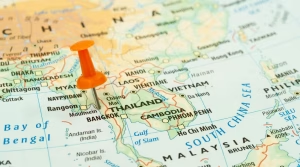
India, Malaysia, Thailand, Vietnam, and Taiwan have emerged as the most prominent alternative suppliers to China for the technology industry, despite Taiwan’s own geopolitical challenges.

The products most affected by these diversification strategies include smartphones, smart watches, computers, and laptops, representing core product lines for the world’s leading technology manufacturers.

Despite the rhetoric in support of nearshoring that was born out of the pandemic, U.S. companies like Apple have kept the largest share of their suppliers in Asia. This is because of the comparative advantage that exists in countries like India, Malaysia, Thailand, Vietnam, and Taiwan.

Here are the regional advantages of each:

India: Offers a large domestic workforce skilled in smartphone and laptop manufacturing at a fraction of the labor cost. The country has rapidly developed its technology manufacturing capabilities, particularly in smartphone assembly, where it has become a major production hub for both Samsung and Apple devices. India’s combination of technical expertise, lower wages, and massive domestic market makes it particularly attractive for technology companies.

Malaysia: Has well-established infrastructure and a low-cost workforce skilled in the back-end processes of semiconductor manufacturing. Malaysia has developed specialized expertise in semiconductor packaging and testing, making it a critical node in the global chip supply chain. The country’s established technology parks and government support for high-tech manufacturing have created a conducive environment for technology suppliers.

Vietnam & Thailand: Government incentives, including tax breaks for technology companies and funding for new facilities, have fostered an innovative environment for new suppliers. Vietnam has emerged as a particularly important alternative for smartphone and laptop manufacturing, while  Thailand has developed strengths in smartwatch and computer production. Both countries have benefited from their proximity to China’s supply ecosystem while offering lower costs and reduced geopolitical risk.

Taiwan: Taiwan is becoming increasingly prominent in the global computer parts supply chain. Taiwan’s world-leading semiconductor industry, centered around TSMC, gives it a unique and difficult-to-replicate advantage in high-end electronics manufacturing. The country’s technical expertise and established ecosystem for advanced electronics production make it an essential partner for many technology companies.

Classroom discussion questions:

  1. Does this article conflict with the the fact that reshoring continues to add jobs in the U.S.?
  2. What do these 5 countries have in common?

OM in the News: India Moves Up the Value Chain

The first trade war, in 2018, helped India rise—and this second one could be transformative, writes The Wall Street Journal (April 19-20, 2025). “Is this India’s moment?” says the CEO of a major Indian electronics supplier. “Yes. But the country still needs improvement on the most important quality for a global supply chain: consistency. ”

With most Chinese exporters cut off for now from U.S. consumers by high tariffs, companies are looking for alternative places to produce and export to the U.S.—adding up to a golden opportunity for India. Global high-tech firms and retailers say India is a harder place to do business than China or Vietnam, owing to government red tape, restive labor groups and an often-punitive approach to compliance and taxation. Vietnam, a country of 100 million people, exports $50 billion more in goods to the U.S. than India, whose population is 1.4 billion.

Smartphones offer an example of what India can do when it puts its mind to it.

But now India wants to emulate what has made China the world’s unparalleled manufacturing powerhouse by offering not just manual assembly of goods but also design, parts and other knowhow. “We are looking at building the entire value chain in India itself,” said a government official.

For the moment, most Indian goods face only the 10% tariff the U.S. has imposed globally, and certain exempted electronics such as iPhones have no tariff. The tariff on most Chinese goods is 145% while those electronics items are subject to a 20% rate.

Apple is already moving to export more iPhones to the U.S. from India, and the country currently accounts for about 20% of iPhone production. A decade ago, when India started focusing on building phones, its annual mobile-phone exports were only $250 million. Now the figure exceeds $22 billion.

A second factory operated by Taiwan’s Foxconn is coming on line this year which will add annual production of 20 million phones, rivaling Foxconn’s first Indian plant. Smartphones are benefiting from the government’s attention and support, including manufacturing subsidies and upgrading its freight terminals to address bottlenecks.

A network of suppliers is also growing up to feed the final assembly. New York state-based Corning, which has long made scratchproof glass for Apple phones, plans to start production in India this year.

Classroom discussion questions:

  1. What is needed in India to match China’s manufacturing prowess?
  2. What other companies have made moves to relocate to India?

OM in the News: China Finally Has a Rival as the World’s Factory Floor

Western companies are desperately looking for a backup to China as the world’s factory floor, a strategy widely termed “China plus one.” India is making a concerted push to be the plus one, writes The Wall Street Journal (May 10, 2023).

Employees test mobile phones at a Foxconn plant in Sriperumbudur, India

Only India has a labor force and an internal market (population) comparable in size to China’s. Western governments see democratic India as a natural partner, and the Indian government has pushed to make the business environment more friendly than in the past.

It scored a coup with the decision by Apple to significantly expand iPhone production in India.  Now it will boost iPhone production to around 20 million units annually in India and triple the number of workers to 100,000. Apple had previously built up a state-of-the-art supply chain almost entirely in China to make its laptops, iPhones and accessories. Its presence helped the entire manufacturing sector in China.

China still towers over every other country in global manufacturing, a position it cemented when multinationals flooded in after it joined the World Trade Organization in 2001. But a growing list of factors has prompted companies to search for a backup. First, there were rising labor costs in China and pressure from the Chinese government to transfer technology to Chinese competitors. Then there were President Trump’s tariffs on Chinese imports in 2018, Covid lockdowns from 2020 through last year, and now a push by Western governments to decouple their economies from China.

Many countries are competing to be the “plus one,” with Vietnam, Mexico, Thailand and Malaysia in particular contention.

India must still overcome entrenched problems that have kept it a bit player in global supply chains. Its labor force remains mostly poor and unskilled, infrastructure is underdeveloped and the business climate, including regulations, can be burdensome. Manufacturing remains small relative to the size of India’s economy. It can take longer to get land and approvals to set up a factory in India and getting visas for expatriate technicians, managers and engineers is time consuming.

Nonetheless, it is making progress. Its manufactured exports were barely a tenth of China’s in 2021, but they exceeded all other emerging markets except Mexico’s and Vietnam’s. The biggest gains have been in electronics, where exports have tripled since 2018.

Classroom discussion questions:

  1. Why are companies now looking to India and away from China?
  2. Compare India to Mexico as an alternative location for a U.S. manufacturer.

OM in the News: Foxconn’s Big India Expansion

Apple has identified India as a prime destination as it seeks to diversify the sites where its products are assembled.

Apple’s main manufacturer, Foxconn Technology, is considering a major expansion in India, including assembling millions more iPhones and setting up new production sites as it seeks to further diversify beyond China, reports The Wall Street Journal (March 6, 2023). It aims to boost iPhone production to 20 million units annually by 2024 and triple the number of workers to as many as 100,000 at its existing plant near Chennai. The plant currently produces 6 million units.

Foxconn also plans to build:  a new production facility in Karnataka, where it would make products including iPhones; a new production site in Hyderabad; and a silicon carbide fabrication plant for its semiconductor business. The Indian government has offered billions of dollars of incentives in recent years to lure global manufacturers to India, as part of a major push to boost advanced manufacturing jobs and decrease reliance on electronics imports.

Meanwhile, Apple has been pushing suppliers to diversify beyond China after many of them faced production disruptions in China multiple times during Covid lockdowns. Geopolitical tensions have been growing between the U.S. and China, as well as between Beijing and Taiwan, where Foxconn is based.

China has been the biggest manufacturing hub in the electronics supply chain for years, with Apple a major driver after building much of its supply chain and assembly in the country over the past two decades.  Concerns over that reliance heightened after protests erupted at the world’s biggest iPhone production site in central China late last year over tight pandemic control policies and wages. Still, expanding into India won’t mean companies such as Apple and Foxconn leaving China. The supply-chain infrastructure that these companies have built over the past decades there can’t be easily replaced by other countries.

Despite strides in local automobile and smartphone production in recent years, India has long trailed regional rivals in advanced manufacturing due to concerns over the country’s challenging bureaucracy, protectionist rules and underdeveloped infrastructure. India, alongside Vietnam, has already been identified by Apple as a prime destination with the company seeking to diversify the sites where its products are assembled. Apple has told its suppliers to plan more actively for assembling its products beyond China.

Classroom discussion questions:

  1. Why India and Vietnam? Why not the U.S?
  2. Chapter 8 lays out key success factors that affect location decisions (see page 337). Which of these factors is Apple considering?

OM in the News: Outsourced Jobs to India May Now Go To Indiana

For years, American companies have been saving money by “offshoring” jobs — hiring people in India and other distant cubicle farms. “Today,” writes The New York Times (July 31, 2017), “some of those jobs are being outsourced again — in the U.S.” Salaries have risen in places like South Asia, making outsourcing there less of a bargain. (A decade ago an American software developer cost 5-7 times as much as an Indian developer. Now the gap has shrunk to 2 times). In addition, as brands pour energy and money into their websites and mobile apps, more of them are deciding that there is value in having developers on the same continent.

Many of these domestic outsourcers are private, little-known companies, but IBM, one of the foremost champions of the offshore outsourcing model, has announced plans to hire 25,000 more workers in the U.S. over the next 4 years. As a result, the growth of offshore software work is slowing, to nearly half the pace of recent years.

“The nature of work is changing,” said the CEO of Infosys, the Indian outsourcing giant. “It is very local. And you often need whole teams locally. It’s not enough to have people offshore in India.” This is a departure from the offshore formula of having a project manager on-site but the work done abroad. Infosys just announced plans to hire 10,000 workers in the U.S. over the next 2 years, starting with centers in Indiana and North Carolina.

In the 1990s, the internet allowed tasks like payroll and financial reporting work to be sent to low-wage nations, especially India. That brought the rise of the big outsourcing companies like Tata and Infosys, which still excel at maintaining the software that runs back-office systems.

Classroom discussion questions:

  1. How has the outsourcing model changed?
  2. List the advantages and disadvantages of outsourcing abroad.

OM in the News: Why GE Builds More Factories Overseas

The GE factory under construction in Marhaura is scheduled to produce 1,000 locomotives for Indian Railways.

GE could hardly have picked a less hospitable spot for its new locomotive factory—but then again, it didn’t have much choice. The land in Marhaura, India regularly floods in the rainy season. The facility required concrete pilings poured 82 feet below ground, on account of earthquakes. When finished, the factory—the centerpiece of a $200 million investment—will sit 600 miles southeast of Delhi in the state of Bihar, a place with a rich history of government corruption scandals.

“To win big contracts, GE is trading a global footprint designed for maximum efficiencies of scale for one that means greater face-to-face exposure in local markets,” writes The Wall Street Journal (June 30, 2017). The remoteness of the Marhaura factory adds cost and complexity to the locomotive project. This is GE in the age of localization—a series of factors that are forcing manufacturers to put down deeper local roots to win business.

Once-impoverished nations such as India, China and Indonesia are becoming economic powers and demanding that companies not just ship them goods, but invest/build locally, teach local workers new skills and share technological know-how. GE has established engineering and research centers in nations such as Poland, Mexico and Qatar, and flexible factories in countries such as Brazil and India, which can easily switch production lines in case political winds or market preferences change.

In 1982, 80% of  GE’s revenue came from the U.S. Today, it’s only 30%. Back then, GE operated 135 factories in 25 foreign countries. Now it has 325 plants across 40 countries. Jobs have followed the changes. GE employs 104,000 workers in the U.S., compared 261,000 workers in 1982. In China, GE’s workforce has doubled in the past decade to 22,000.

Classroom discussion questions:

  1. Discuss GE’s decision to locate in Marhaura–plusses and minuses.
  2. What factors should a firm consider in global location decisions?

OM in the News: Outsourcing Accounting Jobs to India

Workers at Tata Consulting Services in India have replaced Americans

When Congress designed temporary work visa programs, the idea was to bring in foreigners with specialized, hard-to-find skills who would help American companies grow, creating jobs to expand the economy. “Now, though,” reports the New York Times (Sept. 30, 2015), “companies are bringing in workers on those visas to help move jobs out of the country”.

For four weeks this spring, a young woman from India on a temporary visa sat elbow to elbow with an American accountant at the New Jersey headquarters of Toys “R” Us. The woman, an employee of a giant Indian outsourcing company Tata, studied and recorded the accountant’s every keystroke, taking screen shots of her computer and detailed notes on how she issued payments for toys sold in the company’s megastores. “She just pulled up a chair in front of my computer,” said the accountant, 49, who had worked for the company for more than 15 years. “She shadowed me everywhere.” By June, 8 Tata workers had produced intricate manuals for the jobs of 67 people. They then returned to India to train Tata workers to take over and perform those jobs there. The Toys “R” Us employees were laid off.

Employers must sign a U.S. government declaration that the foreign workers “will not adversely affect the working conditions” of Americans or lower their wages. In recent years, however, global outsourcing firms have obtained thousands of temporary visas to bring in foreign workers who have taken over jobs that had been held by Americans. But the Toys “R” Us layoffs — and others underway now at the New York Life Insurance, Cengage Learning, and others — go further. They are examples of how global outsourcers are using temporary visas to bring in foreign workers who do not appear to have exceptional skills.

A spokeswoman for Toys “R” Us said that the staff reduction there was part of “designing a streamlined, more efficient global organization to make it fit for growth.The outsourcing resulted in significant cost savings.”

Classroom discussion questions:

  1. Discuss the legal and moral issues here.
  2. How is this different from outsourcing manufacturing jobs to China?

OM in the News: Churning Out Smartphones Like Fast Fashion

Micromax's HQ in Gurgaon, India
Micromax’s HQ in Gurgaon, India

In Chapter 5 (Design of Goods and Services), we discuss the importance of new product development. Industry leaders derive almost 50% of their sales from new products–those created in the past 5 years. But the smartphone market is a world apart–and India’s Micromax, writes The Wall Street Journal (June 5, 2015), sits at the bleeding edge of the global wars.

Early last year, Micromax decided consumers wanted a handset that could be operated in many of the country’s 20-plus official languages. Four months later, it unveiled the $110 Unite, which let users label their apps, type, send messages and interact on social media in 21 different scripts—rather than just English and Hindi, as is common for Indian phones. Many handset companies wouldn’t have released another smartphone for months. But the Unite was one of several handsets Micromax unveiled within weeks of each other, including the $150 Canvas Win, and the $131 Canvas Doodle 3, featuring a 6-inch screen.

While Apple launches only two new iPhone models a year and Xiaomi around four, Micromax shipped more than 30 new smartphones last year ranging in price from $50 to more than $300. The frenetic pace has made Micromax the smartphone equivalent of “fast fashion” chains like Zara or H&M, which refresh their shelves regularly with inexpensive clothes that reflect what is on fashion-show runways. Micromax says it can now take a phone from concept to store shelves in 3 months, 4 times as fast as when it first started. It does this by slapping together off-the-shelf hardware from China, making adjustments to follow fast-moving consumer trends, and shipping out a new model every few weeks. (The average selling price for smartphones world-wide fell to $299 last year versus $427 in 2010.)

Classroom discussion questions:

1. What is Micromax’s product strategy?

2. Why is it important for firms to continually introduce new products?

OM in the News: Disney Outsources IT to India — and Workers Cry Foul

The Team Disney building in Orlando which houses most of the company's IT operations
The Team Disney building in Orlando which houses most of the company’s IT operations

The employees who kept the data systems humming in the vast Disney fief here in Orlando did not suspect trouble when they were suddenly summoned to meetings with their boss. While families rode the theme park rides, these workers monitored computers, making sure millions of Disney ticket sales, store purchases and hotel reservations went through without a hitch. Some were performing so well that they thought they had been called in for bonuses. Instead, about 250 were laid off. “Many of their jobs,” writes The New York Times (June 4, 2015),  “were transferred to immigrants on temporary H-1B visas for highly skilled technical workers, who were brought in by an outsourcing firm based in India.”

Disney “made the difficult decision to eliminate certain positions, including yours,” as a result of “the transition of your work to a managed service provider,” said a contract presented to employees on the day the layoffs were announced. It offered a “stay bonus” of 10% of severance pay if they remained for 90 days. But the bonus was contingent on “the continued satisfactory performance of your job duties.” For many, that involved training a replacement, and the new workers took the seats at their computer stations.

Former employees said many immigrants who arrived were younger technicians with limited data skills who did not speak English fluently and had to be instructed in the basics of the work. HCL America, a branch of a global company based in Noida, India, won a contract with Disney. But the layoffs at Disney are raising new questions about how businesses and outsourcing companies are using the temporary visas to place immigrants in technology jobs in the U.S. These visas are at the center of a fierce debate in Congress over whether they complement American workers or displace them. According to federal guidelines, the visas are intended for foreigners with advanced science or computer skills to fill discrete positions when American workers with those skills cannot be found.

Classroom discussion questions:

1. Why did Disney make this change? Is it a common strategy?

2. Discuss the merits and problems with the H-1B program.

OM in the News: Yet Another Industry Being Outsourced to India

drug safety2Hundreds of workers sit at office computer terminals in Bangalore, poring over reams of medical records from the U.S. Their job: Monitoring drug safety. It is one of outsourcing’s newest frontiers, writes The Wall Street Journal (Feb.3, 2015), and the now $2 billion business is booming as regulators require closer tracking of rare side effects and interactions between medicines. Outsourcing companies such as Accenture, which runs its large drug-monitoring operation in Bangalore, are benefiting from a desire by big pharmaceutical companies to farm out safety checks so they can cut costs and focus on developing and marketing new treatments.

Critics of the practice say drug monitoring is difficult, requiring deep experience and a knack for detective work in addition to knowledge of biochemistry and pharmacology, and that the shift toward outsourcing carries risks that deadly side effects will go unnoticed. (Adverse reactions to medication are the 4th leading cause of death in the U.S., killing more than 100,000 people a year. Even drugs that have been on the market for decades can have unknown and deadly side effects). Drug-industry experts warn that if the so-called pharmacovigilance activities are treated like other forms of back-office work and not done by properly trained employees, the work won’t be effective.

Accenture’s drug-safety work has tripled in the past 7 years. It sent around 600,000 reports of drug side effects to regulators last year. Accenture said it performs all its drug-safety work in India, in part because labor costs are much lower than in developed countries. While the boom in the drug-safety business is a sign that the outsourcing relationship is working for companies, it is making safety regulators increasingly leery. Scientists employed by outsourcers may have the same degree qualifications and know as much biology as an in-house team, but they don’t know as much about that company’s products. That means that they may be less likely to find the source of a potential problem.

Classroom discussion questions:

1. Why are drug companies now outsourcing drug safety monitoring to India?
2. What are the minuses of such actions?

OM in the News: India vs. China As the Next Manufacturing Power

india vs chinaWith its chronic blackouts, crumbling roads, and other infrastructure woes, India should have no appeal for Abbott Laboratories’ VP John Ginascol, who is responsible for ensuring that the company’s food-products factories run smoothly worldwide. He can’t afford surprises when it comes to electricity, water, and other essentials. “People like me,” he says, “dream of having existing, good, reliable infrastructure.” Yet Abbott has just opened its first plant in India (producing Similac baby formula), and Ginascol has no complaints. The officials “were able to deliver very good, very reliable power, water, natural gas, and roads,” he says. “Fundamentally, the infrastructure was in place.” In an attempt to build its industrial base nationwide, India is pushing the Make in India campaign, easing restrictions on foreign investment in property projects and overhauling the railroad system., reports BusinessWeek (Nov. 6, 2014).

China became an export powerhouse because of its vast pool of low-wage workers, but it’s no longer so cheap to manufacture there. Pinched by double-digit increases in China’s minimum wages, many companies are looking for low-cost alternatives. Southeast Asian countries such as Vietnam and Indonesia are attractive, but they lack the deep supply of workers available in India. The hourly labor cost in India for manufacturing averages 92¢, compared with $3.52 in China. But, says U. of Maryland Prof. Anil Gupta, India hasn’t come close to matching China’s investments in the roads, ports, and power networks that companies want. “Lousy infrastructure essentially eats up any advantage the country may have on the labor front.”

Micromax, for example, is the top local smartphone brand in India. The company takes advantage of its Indian roots to win customers, but when it comes to putting its phones together, it looks to factories in China. To produce locally, a company such as Micromax would need to have lots of its suppliers nearby; that exists in China, not in India. “You need to have cameras, screens, touch panels, chip sets. You need all that to be around you,” says its Chairman. “If you are able to build that ecosystem, then the Make in India story comes true.”

Classroom discussion questions:

1. What factors have kept India behind China in manufacturing thus far?

2. What are the advantages and disadvantages of locating in India vs. Vietnam or Indonesia?

OM in the News: Will Chip Makers Locate in India?

Dell sells in India, but does not make components there

India, home to many of the world’s leading software companies, wants to replicate that success by creating a homegrown industry for computer hardware. But unlike software, which requires little infrastructure, building electronics is a far more demanding business, writes The New York Times (April 16, 2013). Chip makers need vast quantities of clean water and reliable electricity. Computer and tablet assemblers also depend on economies of scale and easy access to cheap parts. When you are discussing multinational location decisions in Chapter 8, this article will highlight many of the factors that are considered in Figure 8.1.

“Nobody disputes India’s need to build up manufacturing. But the government needs to not mandate this, but create an ecosystem,” says the head of the U.S.-India Business Council. Another executive doubted that India could provide a new chip-making facility with the basic infrastructure it needed to even keep the lights on.  Dot-matrix printers, outdated in most of the world, are one of the few electronic products that India manufactures. India’s import bill for semiconductors alone was $8.2 billion in 2012, and demand is growing at around 20% a year.

The big fish the government would like to land is a factory to produce microprocessors for computers. A computer processor typically accounts for 25% to 35% of the total cost of a PC or laptop. India hopes that such a plant, which could cost as much as $5 billion to build, would help spur a bigger high-tech manufacturing industry. Spurred by a new “Buy India” government requirement, Dell, the largest PC retailer in India, explored the possibility of setting up manufacturing facilities there. “They flew in their suppliers from China and Taiwan to see if they could set up facilities. They said no,” said an industry official. “Logistically it is a nightmare.”

Discussion questions:

1. Why do manufacturers hesitate to manufacture computers in India?

2. What are the key operations concerns?

OM in the News: Walmart’s Supply Chain Passage to India

Unrefrigerated truck goes 140 miles in 7 hrs.

Last fall, following a relaxation in India’s foreign-investment rules, Walmart announced it was planning to open its first stores in the country, tapping into a prized $490 billion retail sector. But to cash in, writes The Wall Street Journal (Jan.,12-13, 2013), Walmart will have to solve a fundamental supply chain problem: how to move goods into stores efficiently in a country that offers big retailers little in the way of modern logistics and is plagued by dilapidated infrastructure.

The hurdles are particularly daunting in the food sector. In the world of perishable goods perishing, India has few rivals. Lacking proper storage facilities, enough refrigerated trucks and adequate highways, the world’s second-largest fruit-and-vegetable producer loses about one-third of its produce ($10 billion) each year to spoilage. India also is bogged down by an entrenched system of government-imposed middlemen that can increase costs by 500%.

After passing through the agents and traders in the Chhutmalpur market, for example, produce moves in trucks on a 140-mile journey to New Delhi, often on a 2-lane road so pot-holed and bumpy that top speeds are 15 miles per hour. The trip may include a visit from local thugs demanding bribes for safe passage. It is just one of many human road hazards in India, such as farmer protests.

With a U.S. fleet of 55,000 tractor-trailer trucks, third-party shippers and its own massive distribution centers, Walmart is accustomed to fine-tooth tracking and direct sourcing. In the face of all this it is unlikely Walmart will try to replicate its U.S. supply chain operations, which are focused primarily around massive distribution centers supporting up to 100 stores.”It’s the least mature market they’ve ever had to enter,” says one expert. “They have to create a new playbook.'”

Discussion questions:

1. Compare Walmart’s efforts to those of Hard Rock (noted in Ch.8) when it entered the Russian market.

2. What will be Walmart’s biggest OM challenge in India?

OM in the News: Outsourcing’s Passage Out of India

“For years there was pretty much one choice for US firms seeking to move jobs offshore: India,” writes Businessweek (March  19-26, 2012). Outsourcing grew to a $69 billion business there that transformed backwaters such as Chennai and Hyderabad into teeming cities. But this wave has crested. Last year, companies in Latin America and Eastern Europe opened 54 new outsourcing facilities vs. 49 for India.

This change comes as American corporations  increasingly ship higher-level jobs (such as skilled positions in research, accounting, procurement, and financial analysis) offshore. Because these jobs are not the mass-processing functions that are India’s forte, there are greater opportunities for countries such as Argentina, Poland, Brazil, and Guatemala. An Argentinian accountant costs 13% less than one in the US (while an Indian is 51% less), but there are other considerations.  “If you’re working with a hedge fund manager where you interact 10-15 times a day, the same time zone is important,” says one CEO.

Brazil now has the most Java programmers in the world and the second most COBOL programmers. Poland’s Gen Y population is highly educated (50% of its 20-24 year olds are in college)–and prolifically multilingual. There are 26 languages spoken at H-P’s Polish center that serves its European, African, and Middle Eastern operations. They perform high-level services including finance, accounting, marketing, and supply chain analysis. Coca-Cola moved its finance and accounting centers in Paris, Brussels, and London to Poland as well. Other centers have been opened there by IBM, Microsoft, and Ernst & Young.

Even Tata Consultancy Services –India’s outsourcing leader (with 2011 sales of $9.8 billion)–has 8,500 employees in South America in an effort to “nearshore” to clients.

Discussion questions:

1. What are some advantages in moving higher-level functions to Eastern Europe and South America?

2. What are India’s outsourcing strengths and weaknesses?

Good OM Reading: Value Chain Localization for the “Next Billion”

According to the International Monetary Fund, the growth engines for the years to come will  be China and India (with rates of 7.5% and 9% in 2012). Multinationals, according to an article in the new issue of MIT Sloan Management Review (Spring 2012), are stepping up in these economies with more R&D labs and factories that can design and develop locally relevant products and services. In recent years, more than $24 billion has been invested in 1,000 R&D centers in the two nations. The result: more and more goods (like Buick’s LaCrosse in China and J&J’s reusable surgical staples in India) are being designed or built from scratch using local R&D talent.

This means that multinationals now aim to design and deliver goods that are both economical and better suited for the local customer, called “value chain localization.” The profit potential in reaching underserved consumers at the base of this pyramid is so great that the group has been dubbed the “next billion.”  This “next billion” may have more disposable income and want more, but it still has limited resources. The designing focus for the group needs to be on affordability: delivering more at less cost.

 Creating networks of local and global partners becomes essential for designing products and services for the “next billion.” Local partners help multinationals not only learn about local problems and gain insights into solutions: they also help create affordable access. Nokia, for example, a high-tech multinational pioneer, set up R&D and manufacturing facilities in India more than 15 years ago. Today most of its phones sold in India say: “Made in India” and its tools include a suite of offerings to deliver agricultural information to farmers for $1.20/month. Through its cell phone network, it has also provided mobile banking to 600 million Indian consumers who do not have access to banks. Likewise, GE Healthcare has worked closely with its Indian partners to create products like battery operated ultrasounds, EKG, and ECG machines.