OM in the News: A Devastating Fire at a Major Ford Supplier

A late-night fire leveled a key part of a New York aluminum plant in hours. Its absence is going to disrupt business at Ford Motor  and other automakers for months to come.

The plant’s operator, Novelis, supplies about 40% of the aluminum sheet used by the auto industry in the U.S. Novelis said a major portion of its Oswego, N.Y., plant has been knocked offline until early next year.
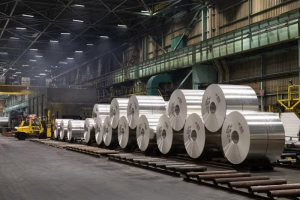
Novelis produces more than 350,000 metric tons of sheet aluminum annually for the automotive industry

Ford is the biggest user of the plant. Its F-150 pickup, the top-selling vehicle in the U.S. and the automaker’s main profit driver, is one of the industry’s biggest users of aluminum, writes The Wall Street Journal (Oct. 7, 2025). The setback is severe.

“This represents a serious question for the production of F-150 because that’s the aluminum that comes out of Oswego,” said an industry analyst. Ford switched the F-150’s exterior to aluminum from steel a decade ago.

“Since the fire nearly three weeks ago, Ford has been working closely with Novelis, and a full team is dedicated to addressing the situation and exploring all possible alternatives to minimize any potential disruptions,” stated Ford.

It is the latest supply-chain snafu for the global auto industry, roiled in recent years by trade wars, a global semiconductor shortage and a potentially crippling reliance on China for rare-earth magnets used in vehicles.

Though automakers and other major industrial manufacturers worked to diversify their supply chains in the wake of the coronavirus pandemic, which shut off access to Chinese factories, companies often remain largely dependent on one or two makers for critical parts because of the high cost tied to employing multiple suppliers.

 Around a dozen automakers get aluminum from Novelis, including Ford, Toyota, Hyundai, Volkswagen and Jeep maker Stellantis.

Classroom discussion questions:

  1. Which tool(s) in Supplement 11 could be used by Ford in this situation?
  2. What do other major car manufacturers do ?

OM in the News: Sustainability and the Ford F-150 Truck

ford“Bucolic upstate New York is an odd place to be building the future of the U.S. auto industry,” writes Forbes (Nov. 24, 2014). Yet here, in a factory that makes aluminum cans for the beverage industry, workers are gearing up for a crucial role in the launch of the next generation of America’s bestselling vehicle.The Novelis plant is the birthplace for Ford’s innovative new F-150 pickup, 700 pounds lighter–and thus more fuel-efficient to meet government requirements–because its steel body panels have been replaced by lightweight aluminum. The stakes could not be higher. The F-150 pickup is Ford’s crown jewel, generating $20 billion in revenue annually and 40% of its annual profits.

Novelis, the world’s largest aluminum recycler, showed Ford how it could afford the switch to higher-priced aluminum (adding about $750 per truck) by using recycled scrap instead of buying virgin aluminum mined from bauxite. Together they created an innovative supply chain that allows Ford to recover a big chunk of its aluminum costs by selling the scrap back to its suppliers and reusing it. The rest of the industry is watching closely. Tough new fuel-economy laws require automakers to double their fleetwide average to 54.5 mpg by 2025.

Here’s how it works: When a vehicle body panel is stamped, about 40% of the metal winds up as scrap. Instead of gathering up all the various metal scraps from its stamping plants, Ford installed pneumatic scrap-handling equipment that will separate the aluminum alloy on conveyors and deposit the scraps in dedicated containers. Novelis contracted a fleet of 150 trailers to ship the scrap back to its plant for reprocessing. The scrap is then melted in a 2,000-degree furnace. Once the molten metal is ready, it is cast into massive 30,000-pound ingots for subsequent processing. It’s then ready to be rolled into sheets 1/16 of an inch thick and shipped in giant coils back to Ford’s stamping plants, where the process begins anew.

Novelis’ goal is to have 70% recycled content in its automotive sheet by 2020, up from 10% five years ago.

Classroom discussion questions:

1. Why is the switch to aluminum a big risk for Ford’s F-150?

2. What are the advantages of this process?