OM in the News: The Electric F-150’s Short Life Cycle

The first Boeing 737 jet rolled off the assembly line 58 years ago, on April 9, 1967.  That is a long life cycle, given it has still not reached the “decline” phase in Figure 2.5 in your text. But the life cycle certainly looks a lot shorter for electric pickup trucks.

Ford is planning to scrap the electric version of its F-150 pickup, according to The Wall Street Journal (Nov. 7, 2025) which would make the money-losing truck America’s first major EV casualty. “The demand is just not there” for the F-150 Lightning and other electric trucks, said one dealer. Stellantis earlier this year called off plans to make an electric version of its Ram pickup. GM plans to  discontinue some electric trucks and sales of Tesla’s Cybertruck tanked this year. The trucks seemed a good bet amid booming EV demand and clean-air mandates that required automakers to sell fewer gas-guzzlers.

Ford halts production of the F-150 Lightning

The Lightning fell far short of expectations as American truck buyers skipped the electric version of the top-selling truck. Overall EV sales are plummeting in the absence of government subsidies.  Ford dealers sold 66,000 gas-powered F-Series pickups, and just 1,500 Lightnings, the fewest of any model. (Ford has racked up $13 billion in EV losses since 2023).

 When Ford launched the Lightning 5 years ago it promised a pickup as fast as a sports car and as affordable as a conventional truck. It would drive hundreds of miles on a single charge, and carry enough voltage to power a home for days. “It’s like a smartphone that can tow 10,000 pounds,” said  the CEO at the launch.

But truck buyers worried the pickups would run out of juice in the middle of a job or a long haul as their range is dramatically reduced when towing big loads or operating in cold weather.

GM has also lost billions on electric trucks after rolling out a string of them, including an electric version of the popular Chevrolet Silverado. GM has three electric pickups, and it sold about 1,800 of them last month.

Ford built up the capacity to make as many as 150,000 Lightnings a year. But the EVs cost billions to develop and manufacture, and are only profitable if they sell in large enough volumes, which they did not.

Classroom discussion questions:

  1. Where do you think all EVs are on the life cycle curve?
  2. Why did so many auto manufacturers misread the demand for electric pickups?
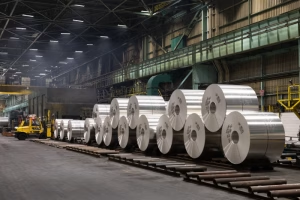
OM in the News: A Devastating Fire at a Major Ford Supplier

A late-night fire leveled a key part of a New York aluminum plant in hours. Its absence is going to disrupt business at Ford Motor  and other automakers for months to come.

The plant’s operator, Novelis, supplies about 40% of the aluminum sheet used by the auto industry in the U.S. Novelis said a major portion of its Oswego, N.Y., plant has been knocked offline until early next year.

Novelis produces more than 350,000 metric tons of sheet aluminum annually for the automotive industry

Ford is the biggest user of the plant. Its F-150 pickup, the top-selling vehicle in the U.S. and the automaker’s main profit driver, is one of the industry’s biggest users of aluminum, writes The Wall Street Journal (Oct. 7, 2025). The setback is severe.

“This represents a serious question for the production of F-150 because that’s the aluminum that comes out of Oswego,” said an industry analyst. Ford switched the F-150’s exterior to aluminum from steel a decade ago.

“Since the fire nearly three weeks ago, Ford has been working closely with Novelis, and a full team is dedicated to addressing the situation and exploring all possible alternatives to minimize any potential disruptions,” stated Ford.

It is the latest supply-chain snafu for the global auto industry, roiled in recent years by trade wars, a global semiconductor shortage and a potentially crippling reliance on China for rare-earth magnets used in vehicles.

Though automakers and other major industrial manufacturers worked to diversify their supply chains in the wake of the coronavirus pandemic, which shut off access to Chinese factories, companies often remain largely dependent on one or two makers for critical parts because of the high cost tied to employing multiple suppliers.

 Around a dozen automakers get aluminum from Novelis, including Ford, Toyota, Hyundai, Volkswagen and Jeep maker Stellantis.

Classroom discussion questions:

  1. Which tool(s) in Supplement 11 could be used by Ford in this situation?
  2. What do other major car manufacturers do ?

OM in the News: Recycling and the New Ford F-150 Truck

Scrap from the F-150 is shredded and shipped back to suppliers to be turned into new sheets

Ford’s decision to build a lighter-weight pickup truck using aluminum body-panels has been billed largely as a way to achieve better fuel economy, reports The Wall Street Journal (Dec.17, 2014). It is also a recycling play. The 2015 F-150, perhaps the most important vehicle to hit Ford dealerships in decades, goes on sale this month. By the time a new truck exits the factory and heads for the showroom, it will have left behind $300 worth of scrap aluminum on the plant floor.

That scrap is collected, cleaned, and sent back to the aluminum plant on the same trucks that delivered it fresh—creating what CEO Mark Fields calls a “closed loop” that helps offset the expense of building its best-selling vehicle with a material that is far pricier than steel. “Every single scrap of aluminum is reused,” says Fields.

Every day, 50 semi tractor-trailers drive out of Ford’s F-150 plant in Dearborn, Mich., with thousands of pounds of shredded aluminum, scrap that was stamped out of 6-foot-wide aluminum rolls used to make F-150 body panels. Only 60%-65% of a roll is actually used in the stamping process because many body panels have big holes, such as windows. Ford installed systems to separate the six different aluminum alloys it uses and return them to mills in Iowa or New York, to be turned back into aluminum sheet for delivery to its Dearborn stamping plant. Ford’s aluminum recycling system, installed as part of a $359 million overhaul of the Dearborn factory, allows the company to recoup up to $300 a truck, helping offset about 20% of its higher production costs.

Classroom discussion questions:

1. Why was an aluminum F-150 a big risk for Ford?

2. What is a “closed-loop” system?

OM in the News: Ford’s Epic Gamble on Aluminum

Alcoa's Iowa plant has expanded to meet the growing need for aluminum in the auto industry
Alcoa’s Iowa plant has expanded to meet the growing need for aluminum in the auto industry

Ford has a long-term plan to unify its global manufacturing, writes Fortune (July 24, 2014). But profits depend largely on a beefy truck that is sold only in N. America and will never find a market in Asia or Europe. Not that it needs to. The F-series has outsold every other car and truck in the U.S. for 3 decades, with some 33 million out the door. So when Ford decided in 2009 to fundamentally change the product it advertises as “Built Ford tough” by making it with a lightweight aluminum body, it was messing with a uniquely valuable franchise. Ford figured the change could reduce the weight of the F-series by 700 pounds, significantly improving its fuel economy (US standards require a fleetwide average of 54.5 mpg by 2025).

But aluminum is more expensive than steel, more complicated to assemble, and more difficult to repair. The changeover from steel would mean alterations to nearly every phase of the business. Aluminum can’t be easily welded and must be riveted and bonded with adhesives. New suppliers would have to be found and validated, plants refitted, production techniques changed, repair technicians hired and trained. Importantly, the changeover to the 2015 models would have to be extended, slowing production and denting profits. “It will be magic or tragic,” says the CEO of AutoNation.

Adds Ford’s CEO, “We had three alternatives: make incremental changes to the existing truck, add more aluminum parts, or make it all aluminum.” Ford created 4 work teams to investigate what it saw as the big unknowns surrounding aluminum: availability, manufacturability, serviceability, and likability. At the Dearborn Truck Plant, one of 2 plants where the F-150 will be built, the company is spending hundreds of millions of dollars to build and install new stamping presses and dies to produce the aluminum panels and replace today’s spot welders with rivet guns, advanced welders, and adhesive machinery in the body shop. With both plants currently producing the 2014 F-150, they will have to be taken down one at a time for a total of 13 weeks for refitting, depriving Ford of $2 billion in revenue.

Classroom discussion questions:

1. How is Ford’s production process changing?

2. What are the risks the company faces?