OM in the News: Maintenance Issues and Dead Workers

Wayne Rothering was a few months away from retirement when a machine killed him. He worked on a laminator line at a large Wisconsin furniture factory. He stopped the conveyor and stepped inside the line to fix a torn roll of paper. Behind him, powered rollers that fed 5-foot-by-6-foot slabs of fiberboard into the system continued to spin. As Rothering worked, the rollers caught hold of a board on the conveyor and propelled it into his back. Rothering was crushed to death.
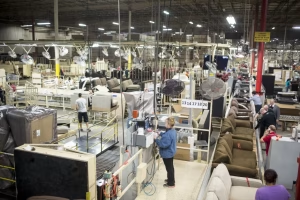
Ashley Furniture paid a fine in a settlement with OSHA after Rothering’s death but didn’t admit fault

He was among hundreds of U.S. workers to die over the past decade in mishaps that a regulation known as “lockout/tagout” is supposed to prevent. The concept is simple: Before an industrial machine can be serviced, an employee must shut it down and place a lock over its power source. If that isn’t possible, the employee should place a tag telling co-workers to leave the machine off.

Lockouts are designed to prevent employees from being hurt by machines that start unexpectedly. Every year, an average of 85 people are killed and 364 suffer amputations. Violations related to the lockout standard are the most common safety citations issued by OSHA.

Incidents usually happen because employers fail to implement adequate safety measures, writes The Wall Street Journal (Oct. 4, 2024). “They take shortcuts, figure it’s too much trouble to lock it out, or they get pressure to keep productivity moving,” said a former OSHA exec. Companies often minimize downtime with alternatives that allow machines to remain powered during minor servicing.

Sometimes machinery is still operating when workers enter dangerous areas. Two years ago, Leily Lopez-Hernandez was blowing dust off a pizza company’s cooling machine. She went beneath the machine and was decapitated. After, OSHA fined the firm $2.8 million for 29 violations, 17 of which were deemed “willful”—meaning an employer purposefully disregarded regulations or acted with indifference to safety.

“It’s easy to blame the working person for failing to heed a warning or follow a procedure, but we know that’s going to happen, not because they are lazy or stupid, but because there are competing motivations,” said an industry attorney. “If the employer emphasizes production above all, so will the employee.”

Classroom discussion questions:

  1. You are the operations manager at a manufacturer. What can you do to prevent such injuries and deaths?
  2. What is the role of the Occupational Safety and Health Administration (OSHA)?

OM in the News: The Danger of Working in an Amazon Warehouse

Nearly half of Amazon’s employees in the U.S. have reported sustaining injuries at the company’s famously fast-paced warehouses, with some workers reporting they have to take unpaid time off from their jobs to recover, reports CBS News (Oct. 25, 2023).

A new study found that 41% of the e-commerce giant’s workers have gotten hurt on the job. Of those employees, 69% had to take unpaid time off to recover from pain or exhaustion in the past month. Amazon workers’ self-reported injury rate is nearly six times higher than what some previous reports.

The survey data in the study of 1,400 current Amazon workers indicate that how Amazon designs its processes — including extensive monitoring and the rapid pace of work — are contributing to a considerable physical and mental health toll, including injuries, burnout and exhaustion. Amazon uses an electronic system to track its warehouse workers’ productivity, using specialized software, handheld scanning devices and other tools to track the time it takes employees to complete their duties.

According to the survey, that system contributes to the pressure some workers feel to work faster, making them more likely to suffer injuries or experience burnout. Previously collected data has also shown that the rate of injuries at Amazon’s warehouses is higher than industry averages. In 2022, one Occupational Safety and Health Administration (OSHA)  study found that there were 6.6 serious injuries for every 100 Amazon workers. That number is more than double the injury rate at all non-Amazon warehouses, which reported 3.2 serious injuries for every 100 workers. It means workers there sustained more than 34,000 serious injuries that year.
“This is not a ‘study’ — it’s a survey done on social media by groups with an ulterior motive,” said an Amazon spokesperson. The study does note that Amazon has taken measures to prioritize the safety of its workers. Still, many workers suffer injuries anyway, with those who struggle to keep up with the company’s fast pace of operations more likely to be hurt on the job.
California passed a bill regulating the use of production quotas in warehouse distribution centers, and Washington state has issued Amazon multiple citations for unsafe working conditions, including the company’s “very high pace of work.”
Classroom discussion questions:

  1. Chapter 10 discusses job design, ergonomics, and work measurement. (See pages 411-413). What tools could Amazon employ to make its warehouse jobs safer?
  2. Why do workers sustain such high rates at Amazon facilities?

OM in the News: Are Ruthless Quotas at Amazon Maiming Employees?

Amazon’s famous speed and technological innovation have driven the company’s massive global expansion and a valuation over $800 billion, writes The Atlantic (Nov. 25, 2019). It’s also helped make Amazon the nation’s second-largest private employer. But now the Center for Investigative Reporting has found that the company’s obsession with speed has turned its warehouses into injury mills, finding the rate of serious injuries for Amazon facilities more than double the national industry average: 9.6 serious injuries per 100 full-time workers in 2018, compared with an industry average of 4. Some centers, such as the Eastvale, California warehouse, were especially dangerous, with 422 injuries–more than 4 times the industry average.

The former head of OSHA states: “According to Amazon’s own records, the risk of work injuries at fulfillment centers is alarmingly, unacceptably high. Amazon needs to take a hard look at the facilities where so many workers are being hurt and either redesign the work processes, replace the top managers, or both.”

Many workers spoke with outrage about having been cast aside as damaged goods or sent back to jobs that injured them further. The company does instruct workers on the safe way to move their bodies and handle equipment. But former workers said they had to break the safety rules to keep up. They would jump or stretch to reach a top rack instead of using a stepladder. They would twist and bend over to grab boxes instead of taking time to squat and lift with their legs. They had to, they said, or they would lose their jobs. So they took the risk.

The root of Amazon’s success appears to be the root of its injury problem: the blistering pace of delivering packages to its customers. And during Amazon’s busiest (“peak”) season, employees face the exhaustion of mandatory 12-hour shifts where expectations are precise. Workers have to pick 385 small items or 350 medium items each hour and are expected to meet 100% of this productivity performance standard. Amazon CEO Jeff Bezos, meanwhile, is focused on customers. “We are ramping up to make our 25th holiday season the best ever—with millions of products available for free 1-day delivery,” he said.

Classroom discussion questions:

  1. What are the ergonomic issues discussed in this article (which we encourage you to read in full)?
  2.  What is the solution?

OM in the News: Life and Death on the Third Shift

Every day at Tyson Foods’ cavernous meatpacking plant in Holcomb, Kansas, 6,000 cows clamber off waiting 18-wheelers. They’re watered, then ushered into the kill box. After the heads, hides, and hooves are removed, the carcasses are sawed in half, checked by U.S.D.A. inspectors, and sent down conveyor belts to be butchered, boxed, and bar-coded by 3,800 workers in 2 shifts. The journey takes 40 minutes.

After 11 p.m. the procession halts, and the sanitation crews move in. The only slaughterhouse job worse than eviscerating animals is cleaning up afterward. These “third-shift workers” wade through blood and grease and chunks of bone and flesh, racing all night to hose down the plant with disinfectants and scalding water. The stench is unbearable.

The cleaning crew is not employed by Tyson, however. Packers Sanitation Services, the nation’s largest cleaning contractor to the food industry, staffs the hard-to-fill night shift jobs. Packers pays their workforce $11.86/hour, 1/3 less than what production employees earn.

“Such is the genius of outsourcing,” writes Businessweek (Jan.8, 2018). In an era of heightened concern about food safety, meat and poultry producers are happy to pay sanitation companies for their expertise. The sanitation companies also assume the risk of staffing positions that only the desperate will take—largely undocumented immigrants. And they relieve the big producers, such as Tyson and Pilgrim’s Pride, of responsibility for one of the most dangerous factory jobs in America.

No one knows exactly how many sanitation workers get injured on the job, as OSHA doesn’t require plants to report contractors’ injuries. Judging from Packer Sanitation’s record, the nightly storm of high-­pressure hoses, chemical vapors, blood, grease, and frantic deadlines, all swirling around pulsing belts, blades, and blenders, can be treacherous. Packers has the 14th-highest number of severe injuries—defined as an amputation, hospitalization, or the loss of an eye—among the 14,000 companies tracked by OSHA. Adjusting for size, Packers tops the danger list by a wide margin, with a rate of 14 severe injuries for every 10,000 workers. Its amputation rate of 9.4 dismemberments per 10,000 workers is 5 times higher than for U.S. manufacturing workers as a whole.

Classroom discussion questions:

  1. As the boom for cheap protein creates yet more demand, how can operations managers deal with the 3rd shift issue?
  2. Who is most responsible? OSHA? Tyson? Packers?

OM in the News: Ethical Dilemmas in U.S. Auto Parts Plants

Alabama has been trying on the nickname “New Detroit.” Its burgeoning auto parts industry employs 26,000 workers, who last year earned $1.3 billion in wages. Georgia and Mississippi have similar, though smaller, auto parts sectors. This factory growth, after the long, painful demise of the region’s textile industry, would seem to be just the kind of manufacturing renaissance the U.S. needs.

Except that it also epitomizes the global economy’s race to the bottom,” writes Businessweek’s cover story (March 27-April 2, 2017). Parts suppliers in the American South compete for low-margin orders against suppliers in Mexico and Asia. They promise delivery schedules they can’t possibly meet and face ruinous penalties if they fall short. Employees work ungodly hours, 6-7 days a week, for months on end. Pay is low, turnover is high, training is scant, and safety is an afterthought, usually after someone is badly hurt. Many of the same woes that typify work conditions at contract manufacturers across Asia now bedevil parts plants in the South. In 2015, the chances of losing a finger or limb in an Alabama parts factory was double the amputation risk nationally for the industry, 65% higher than in Michigan and 33% above the rate in Ohio–both union states.

Korean-owned plants, which make up roughly a quarter of parts suppliers in Alabama, have the most safety violations in the state, accounting for 36% of all infractions and 52% of total fines, from 2012-2016. According to OSHA, one of them, Matsu Alabama, had provided no hands-on training, routinely ordered untrained temps to operate machines, sped up presses beyond manufacturers’ specifications, and allowed oil to leak onto the floor. “Upper management knew all that. They just looked the other way,” said a staffing specialist. “They treated people like interchangeable parts.”

Classroom discussion questions:

  1. The Ethical Dilemma exercise in Chapter 10 describes Johnson Foundry. Have your students read this Businessweek article and compare the two stories.
  2. What does the article mean by “race to the bottom?”

OM in the News: Workplace Safety and OSHA

When a fire broke out in 1911 at the Triangle Shirtwaist Factory in New York, 146 workers died. Many jumped from windows because the doors that could have saved their lives were locked to stop them from stealing. “In the ensuing century, workplaces have been transformed,” writes BusinessWeek (Dec. 14, 2014). Since Congress created the Occupational Safety and Health Administration in 1970, the U.S. workplace death rate has dropped 81 percent, saving half a million lives. Economic and technological changes have swept workers out of the most deadly jobs and into comparatively safer ones. New state and federal standards have outlawed corner-cutting that formerly killed employees, imposing costs on companies that don’t comply.

workplace safetyStill, deaths from workplace injuries in the U.S. averaged 13 a day in 2012, and the number of work-related deaths—counting illnesses such as lung cancer—may be 10 times as large. Work can be far more lethal in developing countries; witness the April 2013 collapse of a facility housing garment factories in Bangladesh, which killed eight times the number who died in the Triangle fire. In many parts of the world, workplace safety is an idea whose time is yet to come.

Classroom discussion questions:
1. Why is this an OM issue?

2. What is the relationship between ergonomics and workplace safety?

OM in the News: Amazon Warehouse Jobs Push Workers To The Limit

The physical demands at the Amazon warehouse in Campbellsville, Ky. take a toll on employees, reports the Seattle Times (April 4, 2012). “Just as Amazon tracks and analyzes the habits of online shoppers, the company has created a hyper-efficient warehouse culture where worker performance is continually monitored and measured in pursuit of slashing costs and shipping times.” Three former workers at Amazon’s warehouse in Campbellsville told the Times there was pressure to manage injuries so they would not have to be reported to OSHA, such as attributing workplace injuries to pre-existing conditions or treating wounds in a way that did not trigger federal reports.

A former Amazon safety official in Campbellsville wanted to discuss reducing the work pace when temperatures pushed over 100 degrees, but says he never dared broach the subject with management. “I knew that was off the table — not an option,” he said.  Instead, he outfitted roving managers with backpacks full of Gatorade, which they served to workers so the workers wouldn’t have to leave their posts.”  Managers said the company created a work environment where employees who complained about such conditions risked retaliation and firing.

More than 15,000 full-time employees, earning stock and health benefits, work at Amazon’s fulfillment centers (warehouses) in the US. The firm is expanding at breakneck speed to staff its global network of 70 centers–17 opened just last year. And as we noted a few days ago in this blog, Amazon just bought Kiva Systems, a warehouse robot company which Amazon believes will increase employee productivity dramatically.

At Campbellsville, Amazon was viewed as an economic savior when it opened in 1999 with 700 jobs. The town’s biggest employer, Fruit of the Loom, had just shut its factory and unemployment topped 22%. Jobs at $14/hour are high in the region.

Discussion questions:

1. How do these conditions compare to companies in Asia?

2. What is Amazon’s position regarding unions?