OM in the News: Maintenance Issues and Dead Workers

Wayne Rothering was a few months away from retirement when a machine killed him. He worked on a laminator line at a large Wisconsin furniture factory. He stopped the conveyor and stepped inside the line to fix a torn roll of paper. Behind him, powered rollers that fed 5-foot-by-6-foot slabs of fiberboard into the system continued to spin. As Rothering worked, the rollers caught hold of a board on the conveyor and propelled it into his back. Rothering was crushed to death.
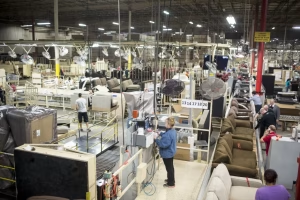
Ashley Furniture paid a fine in a settlement with OSHA after Rothering’s death but didn’t admit fault

He was among hundreds of U.S. workers to die over the past decade in mishaps that a regulation known as “lockout/tagout” is supposed to prevent. The concept is simple: Before an industrial machine can be serviced, an employee must shut it down and place a lock over its power source. If that isn’t possible, the employee should place a tag telling co-workers to leave the machine off.

Lockouts are designed to prevent employees from being hurt by machines that start unexpectedly. Every year, an average of 85 people are killed and 364 suffer amputations. Violations related to the lockout standard are the most common safety citations issued by OSHA.

Incidents usually happen because employers fail to implement adequate safety measures, writes The Wall Street Journal (Oct. 4, 2024). “They take shortcuts, figure it’s too much trouble to lock it out, or they get pressure to keep productivity moving,” said a former OSHA exec. Companies often minimize downtime with alternatives that allow machines to remain powered during minor servicing.

Sometimes machinery is still operating when workers enter dangerous areas. Two years ago, Leily Lopez-Hernandez was blowing dust off a pizza company’s cooling machine. She went beneath the machine and was decapitated. After, OSHA fined the firm $2.8 million for 29 violations, 17 of which were deemed “willful”—meaning an employer purposefully disregarded regulations or acted with indifference to safety.

“It’s easy to blame the working person for failing to heed a warning or follow a procedure, but we know that’s going to happen, not because they are lazy or stupid, but because there are competing motivations,” said an industry attorney. “If the employer emphasizes production above all, so will the employee.”

Classroom discussion questions:

  1. You are the operations manager at a manufacturer. What can you do to prevent such injuries and deaths?
  2. What is the role of the Occupational Safety and Health Administration (OSHA)?

OM in the News: The Danger of Working in an Amazon Warehouse

Nearly half of Amazon’s employees in the U.S. have reported sustaining injuries at the company’s famously fast-paced warehouses, with some workers reporting they have to take unpaid time off from their jobs to recover, reports CBS News (Oct. 25, 2023).

A new study found that 41% of the e-commerce giant’s workers have gotten hurt on the job. Of those employees, 69% had to take unpaid time off to recover from pain or exhaustion in the past month. Amazon workers’ self-reported injury rate is nearly six times higher than what some previous reports.

The survey data in the study of 1,400 current Amazon workers indicate that how Amazon designs its processes — including extensive monitoring and the rapid pace of work — are contributing to a considerable physical and mental health toll, including injuries, burnout and exhaustion. Amazon uses an electronic system to track its warehouse workers’ productivity, using specialized software, handheld scanning devices and other tools to track the time it takes employees to complete their duties.

According to the survey, that system contributes to the pressure some workers feel to work faster, making them more likely to suffer injuries or experience burnout. Previously collected data has also shown that the rate of injuries at Amazon’s warehouses is higher than industry averages. In 2022, one Occupational Safety and Health Administration (OSHA)  study found that there were 6.6 serious injuries for every 100 Amazon workers. That number is more than double the injury rate at all non-Amazon warehouses, which reported 3.2 serious injuries for every 100 workers. It means workers there sustained more than 34,000 serious injuries that year.
“This is not a ‘study’ — it’s a survey done on social media by groups with an ulterior motive,” said an Amazon spokesperson. The study does note that Amazon has taken measures to prioritize the safety of its workers. Still, many workers suffer injuries anyway, with those who struggle to keep up with the company’s fast pace of operations more likely to be hurt on the job.
California passed a bill regulating the use of production quotas in warehouse distribution centers, and Washington state has issued Amazon multiple citations for unsafe working conditions, including the company’s “very high pace of work.”
Classroom discussion questions:

  1. Chapter 10 discusses job design, ergonomics, and work measurement. (See pages 411-413). What tools could Amazon employ to make its warehouse jobs safer?
  2. Why do workers sustain such high rates at Amazon facilities?

OM in the News: Wearable Technology in the Warehouse

Your next load of groceries may be moved by a modern-day bionic man or woman writes,” The Wall Street Journal (June 30, 2021). The U.S. supply-chain arm of supermarket chains Stop & Shop and Food Lion is expanding its use of a newer type of wearable robotic technology that workers strap on to help ease the strain of lifting heavy boxes all day.

exoskeleton2

The devices known as exosuits (shown in the photo) are a tech-filled step beyond the back belts that blue-collar workers often wear, laced with sensors and algorithms that detect how workers move and help them lift and load as they work though warehouses.

The devices are the latest entry in a distribution sector wrestling with concerns over worker safety and health in warehouse operations that have boomed over the past year as consumers under pandemic lockdowns have turned to ordering goods online.

Amazon.com has stepped up injury-prevention programs amid criticism of working conditions in its big fulfillment centers and warehouse operators are testing other technology aimed at reducing injuries from repetitive tasks.

Companies have turned to more use of robots in warehousing operations but many tasks requiring fine-motor skills still must be performed by people. Cambridge, Mass.-based Verve Motion says its battery-powered devices can reduce 30% to 40% of the strain from lifting, helping relieve workers’ backs without restricting their movements.

Classroom discussion questions:

  1. Why are Amazon and food warehouses implementing exoskeletons in warehouses?
  2. What are the disadvantages of such devices?

OM in the News: Amazon and Injuries

Amazon recorded 5.6 injuries per 100 workers in 2019, the last full year of data, compared with the 4.8 rate nationally for the warehousing sector. So the firm, after years of criticism over worker safety at its depots, is establishing a program focused on improving the health and wellness of its hourly warehouse staffers, reports The Wall Street Journal (May 18, 2021).

The new program, called WorkingWell, aims to better educate employees on how to avoid workplace injuries and improve mental health on the job. The firm began testing parts of the program 2 years ago and plans to expand it to 1,000 facilities by the end of the year. Amazon said it aims to cut recordable incidents in half by 2025.

amazon2

Amazon, which employs about 950,000 people in the U.S., says it is acting because of the frequency of workplace injuries in the warehousing industry and because the coronavirus pandemic has heightened the awareness of healthcare needs. It is particularly concerned about musculoskeletal disorders, known as MSDs, which account for 40% of its work-related injuries.

Under the WorkingWell program, warehouse employees gather on a rotating basis near their work stations to watch videos about injury prevention, including how to lift items properly. Employees also are given hourly prompts at their stations that guide them through 30-60 second stretching and breathing exercises.

The company also is installing kiosks where employees can watch videos that show guided meditations and calming scenes and sounds. New wellness zones provide dedicated spaces for workers to stretch or meditate. The company also is developing staffing schedules that rotate employees among jobs that use different muscle groups to reduce repetitive-stress injuries. Amazon’s program does not include a significant reduction in the rate at which employees are expected to work. That pace has been a source of worker complaints. Employees, for example, are expected to take about 300 items off shelves each hour.

Experts say introducing educational tools in workplaces is often not enough to substantially reduce injuries, and that measures that provide mechanical lifts or reconfigure how a workplace is organized have a bigger impact.

Classroom discussion questions:

  1. Comment on Amazon’s new program.
  2. What else can the firm do to improve worker safety?

OM in the News: How COVID-19 Changed Warehouses

In the first flush of the COVID-19 pandemic, warehouses rushed to do what they could to keep their workers safe. Now that warehouse managers have had time to see what’s worked, what hasn’t, and what they could’ve done better, they’ve adjusted their workflows, making changes that keep workers safe. Changes for worker safety dovetailed with a surge in demand for e-commerce, which has pushed warehouses to adjust at the same time, reports Supply Chain Dive (Oct. 27, 2020).

Warehouse managers are making investments in finding the right PPE and shifting workplace design to accommodate social distancing. “How do I incorporate temperature monitoring so I can screen potentially sick workers? How do I look at sick leave policies? How do I leverage technology to trace and track movement and contacts, if someone reports that they’ve tested positive?” are some of the questions managers are asking.

Most warehouse design changes are today less about the spaces and more about how workers move through them. Technology has played an important role, from applications that have employees do check-ins about potential symptoms, to algorithms that create routes for workers that ensure social distancing. An algorithm can recognize within an aisle if employees are following the 6 feet rule separation. AI and machine learning can use data from cameras that are networked into a central hub. Such a system knows how many people should be within that aisle within a specific time and if too many tasks are going to that aisle. Technology can also sense when an employee is not working at usual capacity, which could be a sign of illness. 

With hiring at full force this holiday season, companies are trying to “pre-skill” those coming into their workforce with a basic understanding of inventory management, transportation, logistics and manufacturing. And they are also working to “upskill” leaders to be able to assimilate technology with the workforce.

Classroom discussion questions:

  1. Prior to COVID-19, what were the main issues facing warehouse managers? (Hint: see Chapter 9’s section on Warehouse and Storage Layouts on p.375-77 of your OM text).
  2. What are the new OM warehouse issues?

OM in the News: Wearable Technology is Changing Ergonomics

“The future of industrial ergonomics isn’t a person with a clipboard checking workers’ posture,” writes The Wall Street Journal (March 6, 2020). Warehouse operators and manufacturers are now testing wearable technology intended to stave off injuries from repetitive tasks like lifting boxes that can exact a significant toll on workers’ bodies over time. Overexertion in lifting or lowering was one of the most common events leading to occupational injuries.

Companies including Walmart and Toyota are experimenting with sensors that identify when workers engage in risky movements—say, bending their backs without squatting—and prompt them to change their form in real time. The devices also collect data that employers can use to assess how new equipment, tasks or changes in production volume affect worker safety. “It’s not about productivity or pick rates or any of that,” says an Australian exec. “It’s about reducing the chance of people getting hurt.”

Kinetic is a startup whose pager-like sensors clip on to workers’ belts to measure their body mechanics. Document-storage company Iron Mountain began using Kinetic’s devices 3 years ago to reduce at-risk postures that contribute to sprains and strains among warehouse staff and drivers who collect paper for shredding or storage. The technology takes the motion of the wearer’s hip and uses artificial intelligence and algorithms to reconstruct what that person’s body must have done to make it move that way, then determines whether the motion is high risk. Iron Mountain says it has experienced a 45% reduction in at-risk postures with the devise.

Direct observation, which we discuss in Chapter 10,  isn’t as precise because it can cause people to alter their movements.

Classroom discussion questions:

  1. Why is ergonomics so important in many jobs?
  2. Some firms are also testing “exoskeletons,” which we have blogged on recently. How do these exosuits differ from the sensor approach?

OM in the News: Are Ruthless Quotas at Amazon Maiming Employees?

Amazon’s famous speed and technological innovation have driven the company’s massive global expansion and a valuation over $800 billion, writes The Atlantic (Nov. 25, 2019). It’s also helped make Amazon the nation’s second-largest private employer. But now the Center for Investigative Reporting has found that the company’s obsession with speed has turned its warehouses into injury mills, finding the rate of serious injuries for Amazon facilities more than double the national industry average: 9.6 serious injuries per 100 full-time workers in 2018, compared with an industry average of 4. Some centers, such as the Eastvale, California warehouse, were especially dangerous, with 422 injuries–more than 4 times the industry average.

The former head of OSHA states: “According to Amazon’s own records, the risk of work injuries at fulfillment centers is alarmingly, unacceptably high. Amazon needs to take a hard look at the facilities where so many workers are being hurt and either redesign the work processes, replace the top managers, or both.”

Many workers spoke with outrage about having been cast aside as damaged goods or sent back to jobs that injured them further. The company does instruct workers on the safe way to move their bodies and handle equipment. But former workers said they had to break the safety rules to keep up. They would jump or stretch to reach a top rack instead of using a stepladder. They would twist and bend over to grab boxes instead of taking time to squat and lift with their legs. They had to, they said, or they would lose their jobs. So they took the risk.

The root of Amazon’s success appears to be the root of its injury problem: the blistering pace of delivering packages to its customers. And during Amazon’s busiest (“peak”) season, employees face the exhaustion of mandatory 12-hour shifts where expectations are precise. Workers have to pick 385 small items or 350 medium items each hour and are expected to meet 100% of this productivity performance standard. Amazon CEO Jeff Bezos, meanwhile, is focused on customers. “We are ramping up to make our 25th holiday season the best ever—with millions of products available for free 1-day delivery,” he said.

Classroom discussion questions:

  1. What are the ergonomic issues discussed in this article (which we encourage you to read in full)?
  2.  What is the solution?

OM in the News: Warehouses Are Tracking Workers’ Every Muscle Movement

Every morning when he goes to work in the freezer room of a warehouse in Pennsylvania, Jack Westley throws on  a new piece of equipment to wear, which he attaches to a harness over his shoulders. It’s a black device about the size of a smartphone that tracks his every move. For Westley, work means a full day of carrying boxes as ice slowly forms in his beard. The freezer is a treacherous areas because workers get sloppy when they’re cold. So each time Westley bends too deeply to pick up a box or twists too far to set one down, the device on his chest vibrates to send a warning that his chance of getting hurt is elevated. The device, made by a startup called StrongArm Technologies also sends the information it gathers about Westley to his employer.

“Wearable safety trackers are changing how warehouses handle employee safety, but some are concerned about potential surveillance applications,” reports New Equipment Digest (Nov. 11, 2019). The trackers could supplement existing safety programs by identifying employees who need extra coaching, while also helping single out locations in its operations that should be redesigned to reduce the chances of injury.

Unions worry that employers who begin gathering data on workers for whatever reason will be unable to resist using it against them. Productivity tracking is already widespread throughout the industry—and workers can be fired or punished if their performance dips. The opacity of data-analysis tools can make it difficult for workers to fully understand how much employers can see.

StrongArm acknowledges that concerns about workplace surveillance surround its work, but the company says its products are designed solely to improve safety and found users wearing them suffered 20% to 50% fewer injuries.

Classroom discussion questions:

  1. In this age of ever less privacy, where should the line be drawn? What do you consider a legitimate inquiry about your physical activity?
  2. The warehouse management has an obligation for a safe working environment. What should they (and their insurance company) consider legitimate data?


OM in the News: The Rise of the Exoskeleton

Exoskeleton at a Ford plant

In the weld shop of Toyota’s huge Ontario plant, workers inspect the steel frame of a RAV4. The men raise their arms overhead as they move ultrasonic wands over metal to test the integrity of dozens of welds. Until a few months ago, this task was performed by seated workers wielding hammers and chisels. But the latest RAV4 uses a lighter, stronger steel that requires ultrasonic testing. A new frame arrives every 60 seconds. The prolonged reaching is shoulder-breaking work, the kind that can lead to debilitating injuries and decreased productivity.

But these workers are assisted by exoskeletons, wearable devices made by Levitate Technologies. The upper-body frames use a system of springs, cables and pulleys to transfer weight from the arms to the outside of the hips, easing the strain of overhead work. When a worker raises his arms, the exoskeleton provides a counterweight that makes the arms feel buoyant, as if the upper body is suspended in water. The system gradually releases as the limbs are lowered, allowing the arms to hang unassisted.

Exoskeletons may one day become commonplace on factory floors, construction sites and film sets. Toyota is the first large manufacturer to require the use of exoskeletons, but Ford uses about 100 exoskeletons across 16 plants in 8 countries. BMW has 66 in use at its Spartanburg, S.C., plant, while Boeing will use a couple hundred by mid-year.

There are upper-body, lower-body and full-body models. Most range in price from $4,000-$6,000, weigh 5-10 pounds and require a one-time adjustment to a user’s frame. Factory workers who’ve tried exoskeletons report less back and shoulder pain, and go home at night more active and relaxed. “Ultimately,” writes The Wall Street Journal (Jan. 19-20, 2019), “the hope is that the devices will reduce work-related musculoskeletal disorders, which cost employers about $50 billion annually.”

Classroom discussion questions:
1. What is ergonomics and how is this an ergonomic device?

2. What other issues in the work environment can impact performance, safety, and quality of life?

OM in the News: Cobalt Mines, Supply Chains, and Ethics

Mine workers, move rocks containing cobalt in Kolwezi, Congo

Dozens of global manufacturers found themselves on the defense when Amnesty International reported that the cobalt in some of their batteries was dug up by Congolese miners and children under inhumane conditions, reports The Wall Street Journal (Sept. 13, 2018). Many of the companies said they would audit their suppliers and send teams to Congo to fix the problem. But at a Chemaf-owned cobalt mine in Kolwezi, Congolese workers could be seen descending underground without helmets, shoes or safety equipment. The mine’s owner is part of the global cobalt supply chain for companies including Apple and VW.

Miners there were using picks, shovels and bare hands to unearth rocks rich with the metal. Water sometimes rushes into holes and drowns miners, and an earth mover buried one alive last year. “Of course, people die,” said the mine’s owner’s CEO. “This is really shitty work.” He called the miners “barbarians” and said Chemaf had resisted giving them safety equipment because they would sell it. “I don’t care about supply-chain problems,” he added. “That’s a problem for Apple and Samsung.”

Global demand is soaring for cobalt, which is used to conduct heat in lithium-ion batteries in products from smartphones to electric vehicles. Cobalt prices have more than doubled since 2016, putting Congo in the spotlight. It isn’t easy for global manufacturers to trace cobalt’s source in Congo, because it passes through multiple companies and countries. Some mining operations mix industrially produced and hand-dug cobalt. Samsung says it is aware some of the cobalt it gets from Chemaf is produced by the miners. If companies stopped buying it, said Samsung, it would put people out of work.

Amnesty recently applauded Apple’s moves to weed out child labor from its supply chain, saying it is “the industry leader when it comes to responsible cobalt sourcing.” Amnesty said VW hadn’t addressed whether certain companies in its supply chain received cobalt from Congo. Its report added: “Some of the richest and most powerful companies are still making excuses for not investigating their supply chains.”

Classroom discussion questions:

  1. Why is this a complex OM issue?
  2. Why is cobalt so important to supply chains?

OM in the News: Life and Death on the Third Shift

Every day at Tyson Foods’ cavernous meatpacking plant in Holcomb, Kansas, 6,000 cows clamber off waiting 18-wheelers. They’re watered, then ushered into the kill box. After the heads, hides, and hooves are removed, the carcasses are sawed in half, checked by U.S.D.A. inspectors, and sent down conveyor belts to be butchered, boxed, and bar-coded by 3,800 workers in 2 shifts. The journey takes 40 minutes.

After 11 p.m. the procession halts, and the sanitation crews move in. The only slaughterhouse job worse than eviscerating animals is cleaning up afterward. These “third-shift workers” wade through blood and grease and chunks of bone and flesh, racing all night to hose down the plant with disinfectants and scalding water. The stench is unbearable.

The cleaning crew is not employed by Tyson, however. Packers Sanitation Services, the nation’s largest cleaning contractor to the food industry, staffs the hard-to-fill night shift jobs. Packers pays their workforce $11.86/hour, 1/3 less than what production employees earn.

“Such is the genius of outsourcing,” writes Businessweek (Jan.8, 2018). In an era of heightened concern about food safety, meat and poultry producers are happy to pay sanitation companies for their expertise. The sanitation companies also assume the risk of staffing positions that only the desperate will take—largely undocumented immigrants. And they relieve the big producers, such as Tyson and Pilgrim’s Pride, of responsibility for one of the most dangerous factory jobs in America.

No one knows exactly how many sanitation workers get injured on the job, as OSHA doesn’t require plants to report contractors’ injuries. Judging from Packer Sanitation’s record, the nightly storm of high-­pressure hoses, chemical vapors, blood, grease, and frantic deadlines, all swirling around pulsing belts, blades, and blenders, can be treacherous. Packers has the 14th-highest number of severe injuries—defined as an amputation, hospitalization, or the loss of an eye—among the 14,000 companies tracked by OSHA. Adjusting for size, Packers tops the danger list by a wide margin, with a rate of 14 severe injuries for every 10,000 workers. Its amputation rate of 9.4 dismemberments per 10,000 workers is 5 times higher than for U.S. manufacturing workers as a whole.

Classroom discussion questions:

  1. As the boom for cheap protein creates yet more demand, how can operations managers deal with the 3rd shift issue?
  2. Who is most responsible? OSHA? Tyson? Packers?

OM in the News: Chipmaking Moved to Asia–Miscarriages Followed


Koo Sung-ae has lupus. She worked in a Korean Samsung factory for 5 years. Three years ago her husband gave her one of his kidneys to save her life.

 Businessweek’s (June 19, 2017) feature story, “The Dark Side of Asian Microchip Production,”  reveals U.S. chipmakers realized they had a toxic problem, so they outsourced it–to Asia. Twenty-five years ago, U.S. tech companies pledged to stop using chemicals that were proven to cause miscarriages and birth defects. But they did not ensure their Asian suppliers do the same. The 8 page article, which you can use when discussing ethics in OM, explains that that chip production is mostly about chemistry.

Chemicals and light combine to print circuits onto silicon wafers.  Intel was “putting into industrial production a lot of really nasty chemicals. There was just no knowledge of these things, and we were pouring stuff down into the city sewer system,” said one of Intel’s founders.  Years later, when workers dug up the pipes beneath Intel, they discovered the bottom was completely eaten out. Authorities ended up creating more hazardous waste sites in the heart of Silicon Valley than in any other place in the U.S.

Making computer chips involves hundreds of chemicals. The women on the production lines work in “cleanrooms” and wear protective suits, but that is for the chips’ protection, not theirs. The women are exposed to chemicals that include reproductive toxins, mutagens, and carcinogens. The result: workers’ unborn children can suffer birth defects or childhood diseases, and the women can develop cancer that does not show up until long after exposure.

Thousands of women at chip plants across Asia are still exposed to toxins called EGEs. IBM studies, more than 2 decades ago, showed the risks could still persist overseas. IBM knew that EGEs were cheap, effective, and abundantly available and that less-dangerous alternatives were far more expensive.  Its published report cited the higher costs of safety.

Classroom discussion questions:

  1. What other industries has the U.S. outsourced that were dirty or dangerous?
  2. Why has it been so difficult to monitor the chip supply chain?

OM in the News: Ethical Dilemmas in U.S. Auto Parts Plants

Alabama has been trying on the nickname “New Detroit.” Its burgeoning auto parts industry employs 26,000 workers, who last year earned $1.3 billion in wages. Georgia and Mississippi have similar, though smaller, auto parts sectors. This factory growth, after the long, painful demise of the region’s textile industry, would seem to be just the kind of manufacturing renaissance the U.S. needs.

Except that it also epitomizes the global economy’s race to the bottom,” writes Businessweek’s cover story (March 27-April 2, 2017). Parts suppliers in the American South compete for low-margin orders against suppliers in Mexico and Asia. They promise delivery schedules they can’t possibly meet and face ruinous penalties if they fall short. Employees work ungodly hours, 6-7 days a week, for months on end. Pay is low, turnover is high, training is scant, and safety is an afterthought, usually after someone is badly hurt. Many of the same woes that typify work conditions at contract manufacturers across Asia now bedevil parts plants in the South. In 2015, the chances of losing a finger or limb in an Alabama parts factory was double the amputation risk nationally for the industry, 65% higher than in Michigan and 33% above the rate in Ohio–both union states.

Korean-owned plants, which make up roughly a quarter of parts suppliers in Alabama, have the most safety violations in the state, accounting for 36% of all infractions and 52% of total fines, from 2012-2016. According to OSHA, one of them, Matsu Alabama, had provided no hands-on training, routinely ordered untrained temps to operate machines, sped up presses beyond manufacturers’ specifications, and allowed oil to leak onto the floor. “Upper management knew all that. They just looked the other way,” said a staffing specialist. “They treated people like interchangeable parts.”

Classroom discussion questions:

  1. The Ethical Dilemma exercise in Chapter 10 describes Johnson Foundry. Have your students read this Businessweek article and compare the two stories.
  2. What does the article mean by “race to the bottom?”

OM in the News: Reshaping Factory Floors with Collaborative Robots

Collaborative robots work on parts as employees assemble dishwater racks along an assembly line at a Whirlpool Corp. factory in Findlay, Ohio
Collaborative robots work on parts as employees assemble dishwater racks along an assembly line at a Whirlpool factory in Ohio

Companies around the U.S. are reshaping their factory floors around “collaborative robots” that can stop if a person bumps into them. That precaution allows them to operate in tight spaces with little or no protective boundary. Collaborative robots stack spare tires and apply hot glue inside Chevys and Buicks at the GM plant in Lake Orion, Mich. They help install doors and windshields at BMW ’s plant in Spartanburg, S.C. They smooth riveted parts on 787 jets at a Boeing factory in Australia.

A long-term decline in U.S. factory jobs is due in part to automation. But manufacturers claim the automation trend isn’t intended to cut head count–instead it is aimed at improving safety and increasing productivity. “And as robots help manufacturers increase efficiency, they make U.S. factories more competitive versus countries with cheaper wages,” writes The Wall Street Journal (Nov. 9, 2016). If lower costs leads to more sales, factories could expand and add more of the higher skill jobs that remain.

North American manufacturers installed more than 28,000 robots last year. The market for collaborative robots is expected to grow to more than $1 billion by 2020, up from about $95 million in world-wide sales in 2015.

Universal Robots of Denmark sells one-arm robots for $45,000. The robot can work around the clock, taking the place of workers on 3 shifts. The average production worker makes $36,220 year. Manufacturing executives also say the robots save on materials costs because they apply materials like glue more efficiently. The robots also spare their workers from monotonous, laborious tasks that can cause injuries. Factory workers are the most likely to be injured at work by repetitive motion, and manufacturing ranks high among workplaces for injuries stemming from lifting and lowering.

Classroom discussion questions:

  1. What are the advantages of collaborative robots?
  2. What are their limitations?

OM in the News: Human Rights and Overseas Factory Workers

Bangladeshi volunteers and rescue workers at the scene of the Rana Plaza building collapse in April 2013 that killed 1,135 people.
Bangladeshi  rescue workers at the scene of the Rana Plaza building collapse in 2013 that killed 1,135 people.

After more than 1,100 deaths exposed dangerous labor conditions in Bangladesh in 2013, brands like H&M, Walmart and Gap were among the most powerful companies that pledged to improve the safety of some of the country’s poorest workers. “But 3 years later,” The New York Times (May 31, 2016) writes, “those promises are still unfulfilled, and that safety, labor and other issues persist in Bangladesh and other countries where global retailers benefit from an inexpensive work force.

A new report by the Asia Floor Wage Alliance has put another spotlight on the conditions. In Bangladesh, tens of thousands of workers sew garments in buildings without proper fire exits. In Indonesia, India and elsewhere, pregnant women are vulnerable to reduced wages and discrimination. In Cambodia, workers who protested for an extra $20 a month were shot and killed.

The brands say that in recent years they have made significant progress in structural repairs and monitoring of factories. But the report accuses Walmart of benefiting from forced labor and other abusive practices in a number of Asian countries. In Cambodia, for instance, workers at factories who make Walmart products are required to work 10-14 hours a day in sweltering heat, without access to clean drinking water or breaks — conditions that have contributed to “mass fainting episodes.” Workers who refuse or who try to speak up for themselves risk being fired.

Factories in many developing countries are under enormous pressure to churn out billions of dollars worth of goods at costs low enough to beat out the competition for business from foreign companies. H&M, with $25 billion in sales, is one of the biggest beneficiaries of the so-called fast-fashion craze, relying on factories in many countries to help quickly refresh its clothing offerings.

Classroom discussion questions:

  1. What are the ethical responsibities of OM managers whose supply chains are in developing countries?
  2. Why is it difficult to meet labor condition commitments?