MyOMLab: Our Four New OM Simulations

We are thrilled to announce that our learning package now includes some pretty sophisticated OM simulations. Here is a bit of background information.

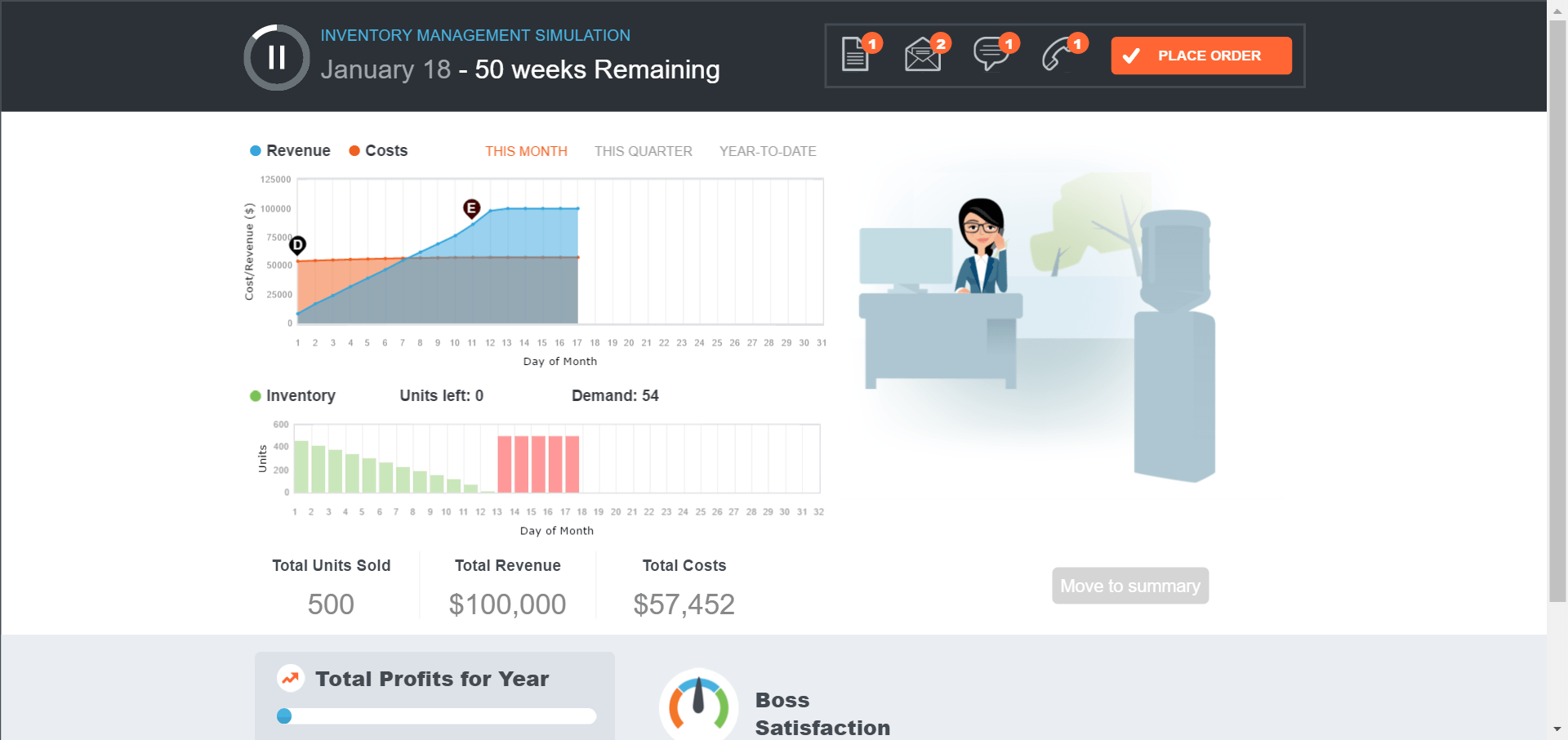
  • How many simulations will be part of OM Simulation?  We have four gaming simulations: inventory management (chapter 12), quality control (chapter 6), forecasting (chapter 4), and project management (chapter 3). A fifth, supply chain management (chapter 11), will be available in late Fall.
  • Are these simulation to be done in class or outside of class?  The OM simulations are fully assignable through MyOMLab, so students could complete this as homework presumably after completing their reading. It would also work as an in-class activity, either working as an individual or as part of a team.
  • Are the OM simulations smartphone compatible?  The OM sims are compatible for mobile devices including smartphones in landscape orientation.  However the simulations are optimized for desktop/laptop devices.  Our research suggests that for activities of this length, most students still prefer desktop/laptop use.
  • Are the OM simulations accessible?  Yes, the OM simulations have been developed with a number of accessibility features including compatibility with screen reader devices.
  • Can you pause the simulations?  Yes, you can pause all of the simulations to review the artifacts (documents, emails, voicemails, texts) or make a decision.
  • What is the price of the OM simulations?  Access to simulations is through MyOMLab and included in that purchase cost. There is no additional fee to purchase these simulations on top of the MyOMLab purchase.simulation


OM in the News: How the Panama Canal Project Collided With Reality

Construction on the new locks in August 2014. They were supposed to be completed for the original canal’s 100th anniversary that year
Construction on the new locks in 2014. They were supposed to be completed that year.

The New York Times is at its best when it tackles journalistic investigation, as it did with its front page, 5 page feature called “The New Panama Canal: A Risky Bet” (June 23, 2016). The article is the perfect way to introduce the critical topic of project management (Chapter 3). It is the tale of an intense 2-year competition, and how Sacyr, a Spanish company in severe financial distress, learned that its rock-bottom bid of $3.1 billion had won the worldwide competition to build a new set of locks for the historic Panama Canal.

What can go wrong in a massive project like this–or like so many of the others we note in Chapter 3’s Global Company Profile featuring Bechtel (which lost the bid they thought they had wrapped)?  Here are just a few answers: (1) disputes over how to divide responsibilities; (2) executives who did not fully grasp how little money they had to complete a complex project with a tight deadline; (3) a multicultural team whose members did not always see things the same way; (4) work stoppages, porous concrete, a risk of earthquakes, and at least $3.4 billion in disputed costs (more than the budget for the entire project)!

For more than 100 years, the canal has been a vital artery nourishing the world economy. The new locks were sold to the nation and the world as a way to ensure that the canal remained as much of a lifeline in the hyperglobalized 21st century as it was in the last. But 7 years after the contracts were signed, and the locks declared ready for use, the expanded canal’s future is cloudy at best, with its safety, quality of construction and economic viability in doubt. The bid by the winner was 71% lower than that of Bechtel. Shocked Bechtel executives were incredulous, saying Sacyr “could not even pour the concrete for their bid amount.”

Classroom discussion questions:

  1. Where did the project go wrong?
  2. What ethical issues did the project managers face?

OM in the News: Stuck in Seattle With Big Bertha

Inside the Seattle tunnel last year

Megaprojects almost always fall short of their promises—costing too much, delivering underwhelming benefits, or both, reports BusinessWeek (April 6-12, 2015). Yet from the London-­Paris Chunnel to Boston’s Big Dig, cities still fall for them, seduced by new technologies and the lure of the perfect fix.

Back in Seattle, everything about the new project to build a tunnelled roadway though the heart of the city is gargantuan, starting with the underground drilling machine called Bertha. Bertha is as tall as a 5-story building. Her job is to bury a highway that runs on a structurally unsound elevated road smack in the middle of an earthquake zone. The viaduct, as it’s called, follows the shoreline, effectively barricading downtown Seattle from what could be a beautiful waterfront. Bertha runs on a 25,000-horsepower motor and has a head weighing 1.7 million pounds, with 260 steel teeth designed specifically to chew through Seattle’s silty soil.

But Bertha broke abruptly in December 2013 after boring through just 1,000 feet, a small portion of her job. Her seals busted, and her teeth clogged with grit and pieces of an 8-inch steel pipe left over from old groundwater tests. She stopped entirely. Now the tunnel, with a budget of $1.4 billion and originally scheduled to be finished in November 2015, is 2 years behind schedule. The contractor has spent months digging to reach Bertha and crane her to the surface, where a weary Seattle awaits. After Bertha got stuck, she couldn’t back up because she builds the concrete walls of the tunnel as she drills forward.

Bertha may be a lemon, but there is no Plan B. The state and the contractor say they’re not abandoning ship. Bertha has become too big to fail. Nine times out of 10, though, massive infrastructure jobs go over budget. Tunnels on average cost 34% more than anticipated. No country or state is any better at predicting costs, and over the past 70 years, less than half of the world’s megaprojects have delivered their promised monetary benefit.

Classroom discussion questions:

1. Why do large projects tend to run late and over budget?

2. What tools in Chapter 3 can be used to control projects better?

Good OM Reading: What Successful Project Managers Do

mit coverIn today’s dynamic and competitive world, a project manager’s key challenge is coping with frequent unexpected events. Despite meticulous planning, the manager may daily encounter such events as the failure of workers to show up at a site, the bankruptcy of a key vendor, a contradiction in engineering guidelines, or changes in customers’ requirements. Some of these events were anticipated but whose impacts were much stronger than expected, some could not have been predicted, and others could have been predicted but were not. All three types of events can become problems. A new research article in MIT Sloan Management Review (Spring, 2015) describes how successful project managers cope with these challenges with 4 approaches.

1. Since project progress depends on individuals who represent different disciplines and parties, collaboration is crucial for the early detection of problems as well as the quick implementation of solutions. But the various parties to the project are loosely coupled, whereas the tasks themselves are tightly coupled. When unexpected events affect one task, many other interdependent tasks are quickly affected. Thus, project success requires both interdependence and trust among the various parties.

2. Project managers faced with unexpected events employ a “rolling wave” approach to integrate planning/reviewing with learning. Recognizing that firm commitments cannot be made on the basis of volatile information, they develop plans in waves as the project unfolds and information becomes more reliable. They develop detailed short-term plans with firm commitments, while also preparing tentative long-term plans (that include redundancies, such as backup systems or human resources).

3. Successful project managers never stop expecting surprises, even though they may effect major remedial changes only a few times during a project. They’re constantly anticipating disruptions and maintaining the flexibility to respond proactively. The book Great by Choice describes one of the core behaviors of great leaders as “productive paranoia.” 

4. When unexpected events affect one task, many other interdependent tasks may also be quickly impacted. Thus, solving problems as soon as they emerge is vital. Corrective action is possible only during a brief window. One study of construction project managers found that they addressed 95% of the problems during the first 7 minutes following problem detection.

Good OM Reading: The Pitfalls of Project Management Reporting

mit sloan  coverWill every corporate project be on time and deliver what was promised? Maybe — but maybe not, write four profs in MIT Sloan Management Review (Spring, 2014). Accepting 5 inconvenient truths about project status reporting can greatly reduce the chance of  unpleasant surprises.

 INCONVENIENT TRUTH 1: Executives can’t rely on project staff and other employees to accurately report project status information and to speak up when they see problems. Most executives expect and assume that employees will report when they see problems that might adversely impact a project. In negotiations between the U.S. and the Soviet Union, President Reagan’s signature phrase was “trust, but verify.”

INCONVENIENT TRUTH 2: A variety of reasons can cause people to misreport about project status; individual personality traits, work climate and cultural norms can all play a role. Executives tend to attribute misreporting to poor ethical behavior on the employee’s part. But one of the best remedies is building diverse teams, which can help balance out culturally specific behavior that might inhibit accurate project reporting.

INCONVENIENT TRUTH 3: An aggressive audit team can’t counter the effects of project status misreporting and withholding of information by project staff. The importance of promoting trust between those who report project status and those who receive the reports is the solution.

INCONVENIENT TRUTH 4: Putting a senior executive in charge of a project may increase misreporting. Research actually suggests that the stronger the perceived power of the sponsor or the project leader, the less inclined subordinates are to report accurately.

INCONVENIENT TRUTH 5: Executives often ignore bad news if they receive it. Executives should not only listen to a variety of stakeholders but should also take the warnings they receive seriously. If they do not, they may unwittingly contribute to a climate of silence in which employees grow even more reluctant to report bad news.

This research study nicely complements our treatment of Project Controlling in Chapter 3.


OM in the News: Behind The Tour de France


This is a sample master schedule which shows every event, staff member, team vehicle

The large behind-the-scenes operations which support a football World Cup or Formula One racing team are well-known, but a Tour de France team also needs major support, reports BBC News (July 6, 2014). “A Tour de France team is like a large traveling circus,” says the coach of the Belkin team. “The public only sees the riders but they could not function without the unseen support staff.” The base to the team’s cycling pyramid includes everything from osteopaths to mechanics, from logistics staff to PR people. Their task is to ensure that riders are in peak physical, nutritional and psychological condition. This can mean deciding which snack bars to give the cyclists before, during and after race stages, while ensuring there are scientifically-based cooling regimes in place for the riders. The team’s huge truck, coach, 3 vans and 5 cars resemble the sort of traveling convoy more associated with an international music act. Here are just some of the supplies the project management team for Belkin handles:

  • 11 mattresses
  • 36 aero suits, 45 bib shorts, 54 race jerseys, 250 podium caps
  • 63 bikes
  • 140 wheels, 220 tires
  • 250 feeding bags, 3,000 water bottles
  • 2,190 nutrition gels, 3,800 nutrition bars
  • 10 jars of peanut butter, 10 boxes of chocolate sprinkles, 20 bags of wine gums, 20 jars of jamBelkin team
  • 80 kg of nuts, raisins, apricots and figs, plus 50 kg of cereals

The OM behind a world-tour team is complex:  These top teams often compete in 2-3 races simultaneously, in different countries and sometimes on different continents. Each team has 25-35 riders (9 compete in any single race), coming from different parts of the world, going to different races at different times, each with his own physique and strengths.  They have customized bikes, uniforms, and food preferences. The support staff can include another 30 people.

Classroom discussion questions:
1. Why is project management important to a racing team?

2. Why does each team have 9 riders in one race?


Video Tip: Watching The Chinese Build a 30-Story Hotel in 15 Days

Here is a great 6 minute video to show your class when covering Project Management (Chapter 3), as we watch a 30-story hotel being built in a record 15 days in the Hunan Province of China. The Los Angeles Times (March 7, 2012) describes the process and provides the video link.

Builders in China completed the 170,000 square foot, prefabricated hotel, ending on New Year’s Eve – and posted a time-lapse video (above) to show off their impressive feat.

Construction workers bolted together the new hotel from pre-made modules put together in a factory and then placed them on steel structures at the construction site.  It can reportedly withstand an 9.0-magnitude earthquake.


The Chinese company behind the speedy process, Broad Sustainable Building Corporation, has some former success with building quickly. Once the world’s largest producer of air conditioning equipment, it previously built the 15-story Ark Hotel in Changsha, China, in just six days.

The implications of the latest project go beyond simply adding to the Chinese skyline in a speedy fashion. “Construction is just about the only industry that has not been exported,” one architect explained. “But now the Broad Sustainable Building Corporation has designed a system that will let them build anywhere, to construction tolerances of +/- 0.2 mm. It completely changes the way buildings are constructed and, I believe, is about to change the entire industry.”

Will this mean that American hotels will soon be added to the growing list of things that come with a “made in China” stamp?

Good OM Reading: What Great Projects Have in Common

Every once in  a while, a “great” project comes along. The last one I have memories of was the rebuilding of the Pentagon after the 9/11 terrorist attacks. Jay and I wrote about “Project Phoenix” in Ch.3, describing how the estimated 3-year, $3/4 billion  project was completed in 11 months for only $501 million with handshake contracts, creativity, teamwork, and ingenuity.

So when the MIT Sloan Management Review article (March 23,2011), “What Great Projects Have in Common”  just came out, it caught my eye as a good teaching tool. Authors Dov Dvir and Aaron Shenhar use the creation of the IBM AS/400 computer and the Apple iPod as their examples of “great projects”, and then ask:  “Why are such projects so rare”? 

Their answer after analyzing 400 projects: 7 managerial characteristics were held in common.

Here they are: (1)They all created a unique competitive advantage or exceptional value for stakeholders. (2) They had lengthy periods where the project was defined. (3) There was a revolutionary (and different)project culture. (4) The project leader was highly qualified and had support of top management. (5) The project maximized use of existing knowledge, often with the cooperation of outside organizations. (6) The projects had integrated development teams with fast problem-solving capability. (7) The teams had a strong sense of partnership and pride…which was indeed the case when the Pentagon was being rebuilt.

This 3-page article is short enough to ask your students read it when you cover Chapter 3 and it complements our coverage of this important topic.

To see other articles in MIT Sloan Management Review go to sloanreview.mit.edu.

Teaching Tip: Why Do So Many Large Projects Overrun?

While most OM texts cover Project Management (see Chapter 3), there is little discussion as to where the time estimates for activities  in PERT and CPM come from or how accurate they are. This question arises in, of all places, an easily overlooked article in The Wall Street Journal (Oct.16-17,2010).

Here we learn that “planners underestimate costs in nearly 9 out 0f 10 projects” and “cost overruns for building projects are typical”. From my decades of teaching MIS and working as a consultant in IT, I can add that completion times in software development projects are also regularly underestimated.

Why is this the case? Research, according to the WSJ, shows that “people allow their best hopes to dominate the planning process”. This case of  “irrational optimism” suggests that project managers would do well to keep data from prior projects. “Looking forward makes you more optimistic”, says a Norwegian researcher in the article. “Looking backward makes you more realistic”.

So when you and your students are discussing large projects that suffered major overruns (like Boston’s “Big Dig” and others they will bring up), you may want to remind students that doing PERT charts and running MS Project is all well and good, as long as the inputs are meaningful.

Finally, did you ever wonder about the  the empirical basis of PERT’s 3 time estimates and the use of the Beta distribution in project management? If large projects do consistantly underestimate activity times, should we be giving more weight in the PERT formula to the “pessimistic” time estimate, b? Perhaps the formula in Equation (3-6) in our text should be  t=(1a+3m+2b)/6  instead of  t=(1a+4m+1b)/6?

Video Tip: Project Management at Hard Rock’s Rockfest


          I cover Project Management and MS Project (Chapter 3) early in the semester and always show the video “Managing Hard Rock’s Rockfest” (9-1/2 minutes).    Of all the 30 videos we have filmed, this has been one of the most popular from the students’ perspective… mostly because it shows a lot of heavy rock bands and it is a rather unique and exciting nine month project.

          I would also recommend assigning the case study by the same name.  It is large (33 activities), yet easily handled by POM for Windows or Excel OM. 

          If you also want to include MS Project in your class (full-blown, but time limited copies are available free from Prentice Hall), look at the “Project Crashing using MS Project” exercise in our IRM.  Professor Gary LaPoint, at Syracuse U., has developed this excellent exercise, with data files already prepared at our website.  Thanks, Gary!