MyOMLab: Our Four New OM Simulations

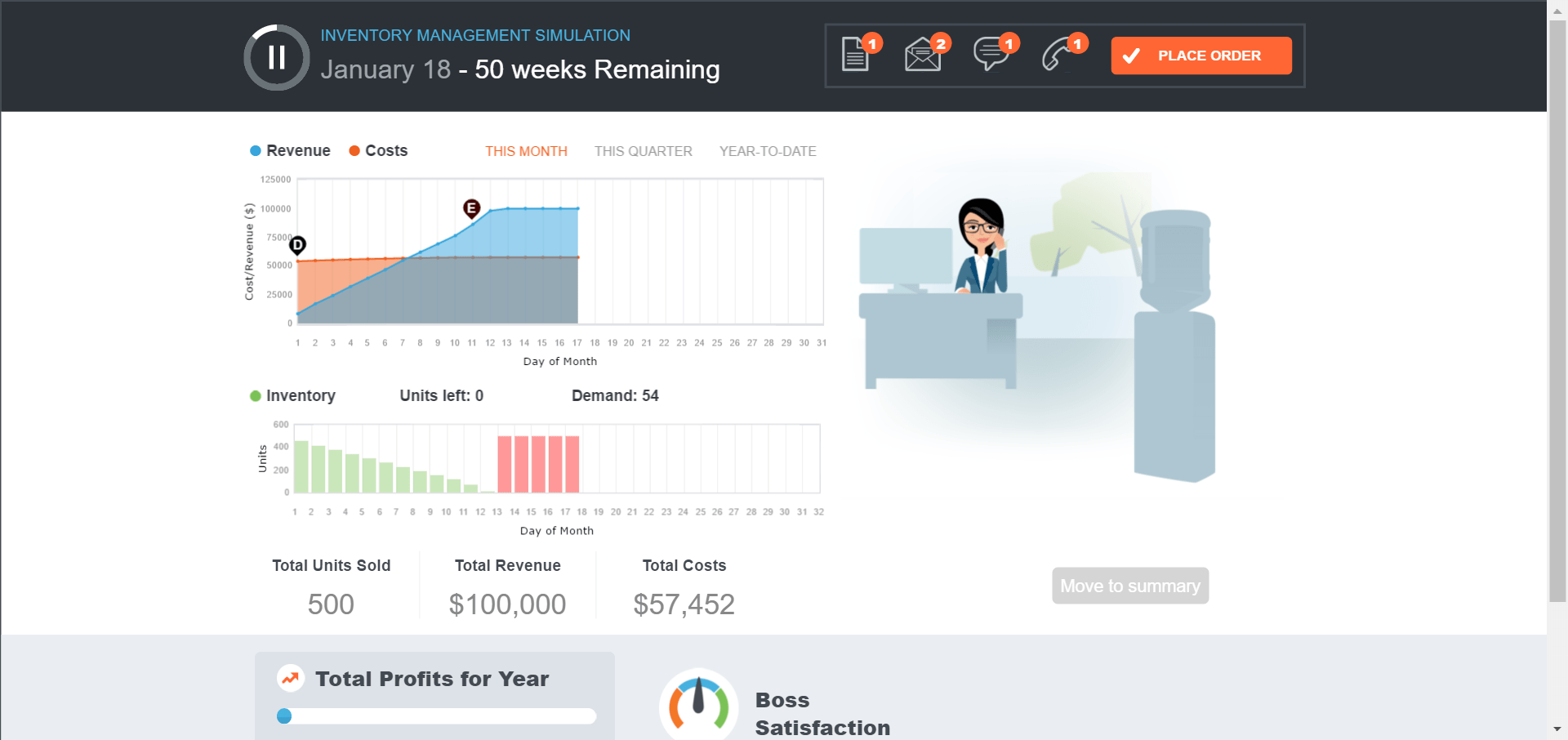
We are thrilled to announce that our learning package now includes some pretty sophisticated OM simulations. Here is a bit of background information.

  • How many simulations will be part of OM Simulation?  We have four gaming simulations: inventory management (chapter 12), quality control (chapter 6), forecasting (chapter 4), and project management (chapter 3). A fifth, supply chain management (chapter 11), will be available in late Fall.
  • Are these simulation to be done in class or outside of class?  The OM simulations are fully assignable through MyOMLab, so students could complete this as homework presumably after completing their reading. It would also work as an in-class activity, either working as an individual or as part of a team.
  • Are the OM simulations smartphone compatible?  The OM sims are compatible for mobile devices including smartphones in landscape orientation.  However the simulations are optimized for desktop/laptop devices.  Our research suggests that for activities of this length, most students still prefer desktop/laptop use.
  • Are the OM simulations accessible?  Yes, the OM simulations have been developed with a number of accessibility features including compatibility with screen reader devices.
  • Can you pause the simulations?  Yes, you can pause all of the simulations to review the artifacts (documents, emails, voicemails, texts) or make a decision.
  • What is the price of the OM simulations?  Access to simulations is through MyOMLab and included in that purchase cost. There is no additional fee to purchase these simulations on top of the MyOMLab purchase.simulation


Guest Post: A Pareto Exercise Using M&M’s

Today’s Guest Post comes from Coleman R. Rich, who is Chair of Elon University’s  Marketing and Entrepreneurship Department. Coleman is also  Senior Lecturer in Operations and Supply Chain Management.

I used many quality tools in the textile industry before coming to academia and I wanted to create an exercise where students could understand the use of two common tools, the check sheet and the Pareto chart.

Here are the items needed:  Blank check sheet, Graph paper, paper plates, and a 1.69 oz bag of M&M’s for each student.

Instructions:  I tell the students they are finished goods inspectors and each color of M&M is a defect.  They are to count the number of defects using tick marks and record that information on their check sheet.  Then they are to rank each color from high number of occurrences to the lowest number of occurrences and calculate the cumulative percent.  From this information, draw a Pareto Chart of the colors on the graph paper and correctly label the chart.

Discussion:  After the exercise, I call on students to tell me the number of blue, green, orange, etc. defects in their bag and the total number of M&M’s in their bag.  I record this information on the board for the class to see the randomness of the different colors in each bag.  I focus on the total number of M&M’s in each bag which you’ll see will vary between 63 and 57 M&M’s per bag.  This leads to a discussion of variation and SPC.  I also discuss what is Critical to Quality to the manufacturer and the Consumer.  Finally I have the students visually inspect the M&M’s for chips, cracks, shapes, etc.,  and ask why the Mars company doesn’t try to create a perfect M&M.  I think you know the answer to that.

Dr. Matt Valle, Professor of Management, here at Elon University has taken this exercise a step further using other quality tools in our paper, “Quality Tools for Project Management:  A Classroom Exercise” to be published in Business Education Innovation Journal, Vol. 4, No. 2, December 2012.


Good OM Reading: What Really Happened to Toyota?

Consumers in the US were surprised in Oct., 2009, by the 1st of a series of highly publicized recalls of Toyota vehicles. It began with 3.8 million cars brought back  for uncontrolled acceleration. Over the next 4 months, 3.4 million more  recalls followed for gas pedal and software glitches. Then from Feb.-Aug., 2010, 13 more recalls followed. Just as things seemed to be settling down, 2 more recalls were announced in Jan.-Feb., 2011. The total had now reached 20 million vehicles!

How could this happen to the company that shaped the modern approach to quality improvement, asks UC-Berkeley Prof. Robert Cole  in his excellent article in MIT Sloan Management Review (Summer, 2011). Had auto execs all over the world “been chasing after the wrong manufacturing model”? And to what extent did the problems originate with product design and assembly and to what extent to Toyota’s manufacturing systems?

One factor Cole found was a “reverse halo effect”. Toyota buyers in 2010 had heard a barrage of negative news and became far less forgiving about minor quality flaws than previous owners. A 2nd factor was that competitors’ products were improving to the point that Toyota didn’t look as outstanding by comparison as it had in the past.

Cole’s analysis found 2 root causes for Toyota’s problems: (1)management’s ambitious plans for rapid growth (which did not focus on quality issues already arising), and (2) the increasing complexity of the actual auto product.

I think this is an article that you will enjoy reading and that you will be able to use in your OM class.

Teaching Tip: What Can You Expect From Your Hotel?

When you are teaching  TQM in services (Ch.6), you might ask your students to consider how they would rate the quality of hotels they have stayed at. We write in the chapter about the intangible differences between products (hotels) and the intangible expectations customers have of these products. Certainly, we all have lower expectations of service quality when we stay at a Motel 8 versus when we are guests at a Ritz Carlton or Four Seasons. (See in our video case study “Quality at the Ritz”).

I bring this up because my family and I  just returned from our big vacation of the summer– a 3-night stay at what some claim to be the premier resort hotel in the Caribbean. The “product” was really on the  expensive side, so our expectations ran high. World class facilities, food, service, and activities were all on the list.  The people/services were extraordinary. Every single employee we came in contact with was gracious, smiling, helpful, and courteous.

But one of the reasons we came in contact with so many hotel staffers was that so many things went wrong with the tangibles. My wife counted over a dozen repair people (all warm and friendly) in our rooms during the 3 days– yet the problems kept coming. First the broken shower head was replaced. Then a deadbolt that locked my 13-year-old in and us out (which had to be drilled out). Then no sound on the TV, as well as a missing remote. To boot, the sink was dirty (brown) when we arrived. But the real issue was the unflushable toilet! After 4 visits to first replace the insides, then to repair it over and over, the toilet still ran all night long. I worked on it myself a few times, then gave up and put 4 towels and a bathrobe over it to mask the noise.

How did the manager handle service recovery? The LEARN routine was followed perfectly, and a discount was even applied. But would we return to a hotel that had such problems? Very doubtful.

Video Tip: Arnold Palmer Hospital’s Culture of Quality

A few weeks ago, I visited my neighbor Artie while he was in the hospital. It was a typical large facility, with long hallways, nice private rooms…some of which had great views of the lake. But when I entered his room, the first thing I noticed was that the trash can was not only filled, it was overflowing!  As I left, I stopped at the nurses’ station to report this “defect”. The response: “Maybe you should call management to let them know”.

I can say that at Arnold Palmer Hospital for Women and Children (APH) this would never have happened. When you show this 10 minute video in class, you will see why. The culture of quality is ingrained deep at APH.

Let me give you a little off-the -record background about our filming experience, which was a fantastic learning exercise that resulted in 7 APH video cases in the text. I first sat through the  new employee orientation period. One of the 1st cultures I learned was that hospital employees always keep a positive face in all public spaces. No one may be heard talking about how bad their day is, problems at home, or troubling patients. The hospital has private staff corridors that parallel the public ones. Only there can staff speak openly. Second, all top administrators at APH are former nurses, who worked their way up. Kathy Swanson, the director, has an MBA, and others also have business training. I believe they have a culture of caring about patients above all else. Note in the film how they each take calls from patients 24/7.

We have 2 videos dealing with service TQM in Ch.6, the other being Quality at the Ritz-Carlton Hotel (7.5 min.). I prefer to show the APH film because the hospital incorporates several Ritz concepts, including empowering any staff member (even janitors) to hand up to $200 in gift cards to any patient with a complaint. My friend Artie could have gotten rich if his hospital had such an attitude!

Jay and I are especially proud of this APH video as it took 1st place in the annual Addy video competition in 2005. Out of 13,000 entries, it won the highest award, the Silver Telly.

Teaching Tip: Helping Your Students Find Jobs

We all know the economy is still weak ( to put it mildly), and this means our students are  in  tough positions to find their first jobs. Where we stand in Florida, it seems as though the alligators are nipping at our economic feet. With a quarter of the economy here in Orlando driven by construction, you can buy a nice condo that sold for $160,000 in 2007 for $20k today!

So what can we do to help our OM students to be more competitive as they enter the job market?  Since everyone graduating already has the same basic set of skills (eg., Excel, Powerpoints, etc.), how can OM  add value?  Here are 2 suggestions:

1.Project management is an interesting topic (Ch.3) that is certainly useful in so many jobs. We cover MS Project lightly towards the end of the chapter. But I am convinced that mastering MS Project can give a competitive edge. Last year, I provided all 75 of my students the chance to build their resumes by offering a 1-credit independent study course called “Using MS Project in Project Management”. All they had to do was find a project with at least 30 activities, and create a series of MS Project charts, along with a 1-page report. Our publisher’s reps at  Pearson will provide you with as many free copies of the full-blown MS Project ( time limited) as you request. It includes an excellent Tutorial, which picks up where the text leaves off. Amazingly, 25 students signed up to build their transcripts/resumes. They produced some impressive reports and picked up a useful skill.

2. The 2nd hot button I like is to get a Six-Sigma Green Belt while in school. My colleague Jim Gilbert offers his TQM course every Fall semester.  As an option, Jim arranges (at an extra lab fee of  $900) for students to get certified as Green Belts. Over 30 students a year take this option and enter the workforce with a wonderful credential.