OM in the News: Digital Twins and Nuclear Fusion

Digital twins, which we cover in Module F (Simulations and Digital Twins), is a big topic at Nvidia and Siemens as they work together to make nuclear fusion a commercial reality. In that chapter (see p. 847), we define a digital twin as:  “an electronic virtual replica of an operation that allows organizations to mimic how a product, process, or system will perform.”

Workers at Commonwealth Fusion Systems’ campus in Devens, Mass

Fusion engineers at the Nvidia/Siemens venture, called Commonwealth Fusion Systems (CFS), will use its digital twin to run simulations, ultimately to hasten the goal of producing fusion energy at a commercial scale. CFS “will be able to compress years of manual experimentation into weeks” with the AI assistance, said its CEO.

Nuclear fission, which splits atoms to produce energy, is already in use in power plants, reports The Wall Street Journal (Jan. 7, 2026).  But many companies see fusion, the energy process that powers the sun by joining atoms together, as a longer-term bet because it can provide much more energy in a cleaner process. Nuclear energy appeals to tech giants because it releases minimal carbon emissions while providing round-the-clock power—particularly as they look to fuel their AI ambitions.

CFS said it was working with Google on an AI project, and explained that that effort has created something like a co-pilot for its fusion machine, while the digital twin plan “is the virtual airplane.” Google also recently signed a power purchase agreement with CFS to secure energy from what could be the first grid-scale fusion plant.

“The race is on for AI. Everyone is trying to get to the next frontier,” said Nvidia’s CEO.

Classroom discussion questions:

  1. Provide other examples of how digital twins can be used.
  2. Why is this fusion project so important as an OM tool?

OM in the News: What Is a “Digital Twin”?

A digital twin is a virtual representation of an object or system that spans its lifecycle, is updated from real-time data, and uses simulation, machine learning and reasoning to help decision-making.

NASA tested an early iteration of a digital twin in response to the Apollo 13 disaster in 1970, using training simulators to match the conditions on the crippled spacecraft and test potential strategies for bringing the astronauts home safely. Today’s digital twins are much more advanced, writes The Wall Street Journal ( March 20, 2023). Not only do they pull in real-time data, but also use AI to capture insights and make predictions, such as identifying potential problems before they happen. The technology also can eliminate the need for physical prototyping of products such as automobiles, and offer a way to test different configurations for spaces such as warehouses and stores, potentially saving time and money.

Companies in every industry are looking at the technology to help them improve processes, reduce costs, conserve resources, boost employee safety and productivity: 17% said they have or plan to deploy digital twins.

San Francisco Airport’s digital twin of its Terminal 2.

For example, the massive San Francisco Airport relies on a digital twin to keep the facility running smoothly. It is a 3-dimensional virtual replica of the airport that is continuously updated with data gathered from embedded sensors throughout the airport. If the maintenance team were to receive a request to change door locks, for example, it could consult the digital twin to find the locations of all the doors that need service.

Another growing area is construction. Modern buildings are already layered with sensors and data-gathering systems that building operators can combine in a digital twin to help them improve a structure’s efficiency, sustainability and security. Building managers can use digital twins to keep track of systems—such as EV charging, smart glass that darkens to reduce energy costs and even soap dispensers with built-in sensors that know when it’s time for a refill—all in one place.

Other complicated systems might benefit from connected digital twins, too. A collection of twins representing everything from stadiums to freeways to public parks has the potential to change the way governments build cities and provide services. Cities might use the technology to create more efficient trash-pickup schedules and routes, for example, or to change traffic patterns when there is a spike in additional people getting on the road from, say, a stadium event.

Classroom discussion questions:

  1. How might a digital twin be used at your university?
  2. Why are twins so useful?

OM in the News: How the Famous Book, “A Million Random Digits,” Wasn’t So Random

“A Million Random Digits” was the largest table of random digits ever published

For 65 years, Rand Corp.’s reference book “A Million Random Digits with 100,000 Normal Deviates” has enjoyed a reputation as the go-to source for random numbers. Simulation and sampling problems are facilitated by these random numbers, as are many problems in our text. (See Table F.4 on page 799 of Module F, Simulation, for a small excerpt).  As Gary Briggs of Rand Corp. noted in The Wall Street Journal (Sept. 25, 2020) “it was really hard to get really high-quality random numbers.”

Well, after all of these years and worldwide usage, Briggs found some errors. While many of us would consider the errors minor, he found them “soul crushing,” adding, “the idea that I’m finding errors that we’ve ignored for 65 years is upsetting.” Before modern computers, he says, “it was really hard to get high-quality random numbers.” The book changed that for a generation of pollsters, lottery administrators, market analysts and others who needed means of drawing random samples.

Here is a bit of history: Rand collected a million digits using Douglas Aircraft Co.’s machine that registered random fluctuations in voltage and converted them into strings of 1s and 0s. A circuit board converted sets of 1s and 0s into digits 0 to 9, which a third machine translated into holes punched into 20,000 computer cards. Technicians fed the cards into an IBM data-processing machine, which generated a million-digit number filling 400 pages of tables.

How did the digits lose their “randomness?” Briggs thinks a technician dropped cards and put them back in the wrong order!

“A Million Random Digits,” by the way, became less relevant as powerful computers generated instant randomness.

Classroom discussion questions:

  1. How much difference would such errors in the Rand book make in your problems in Module F?
  2. Why are random numbers an important tool?

Guest Post: Student Perspectives on the MyOMLab Inventory Management Simulation

Wende Huehn-Brown is Professor of Supply Chain Management at St. Petersburg College in Florida. She continues her review of our five OM simulations.

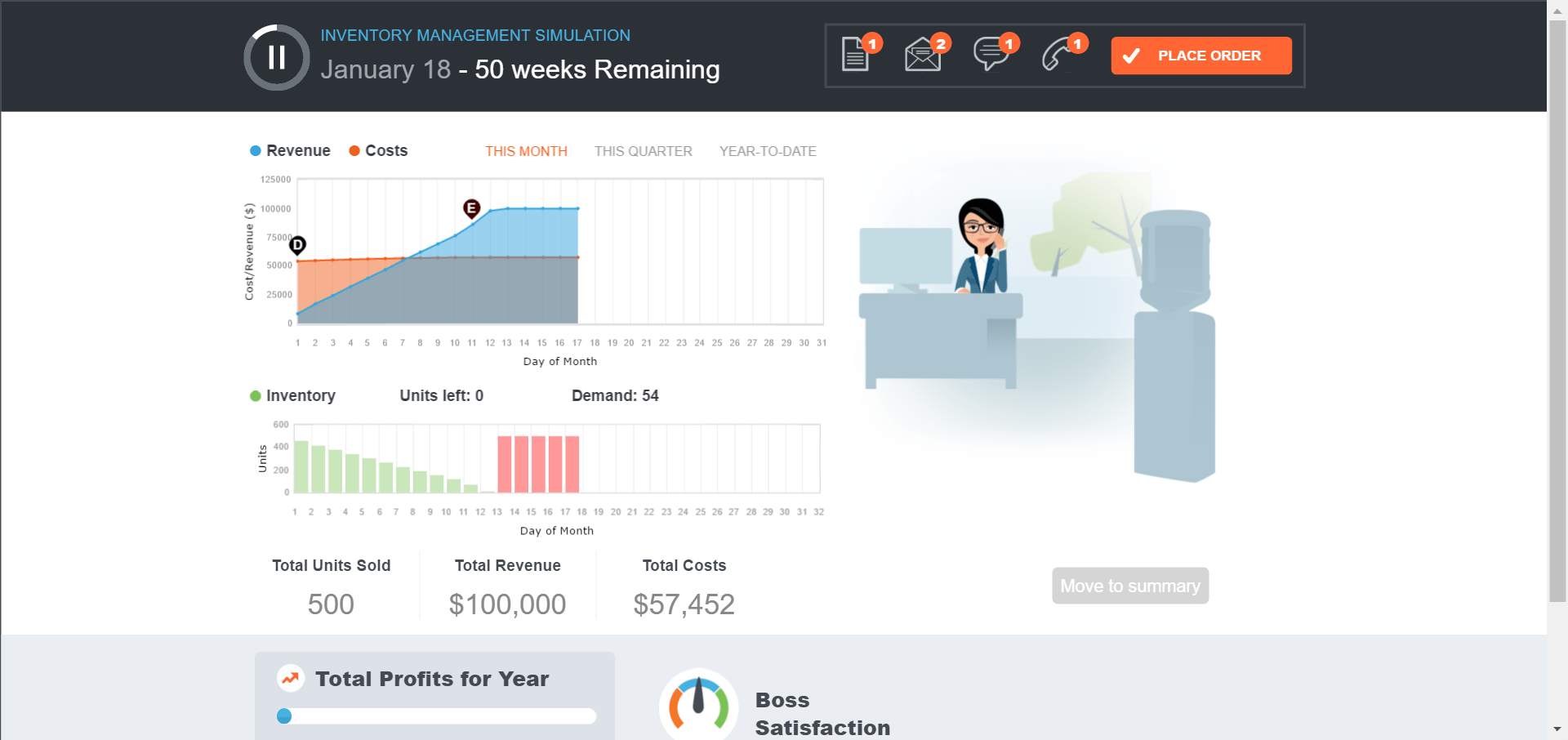
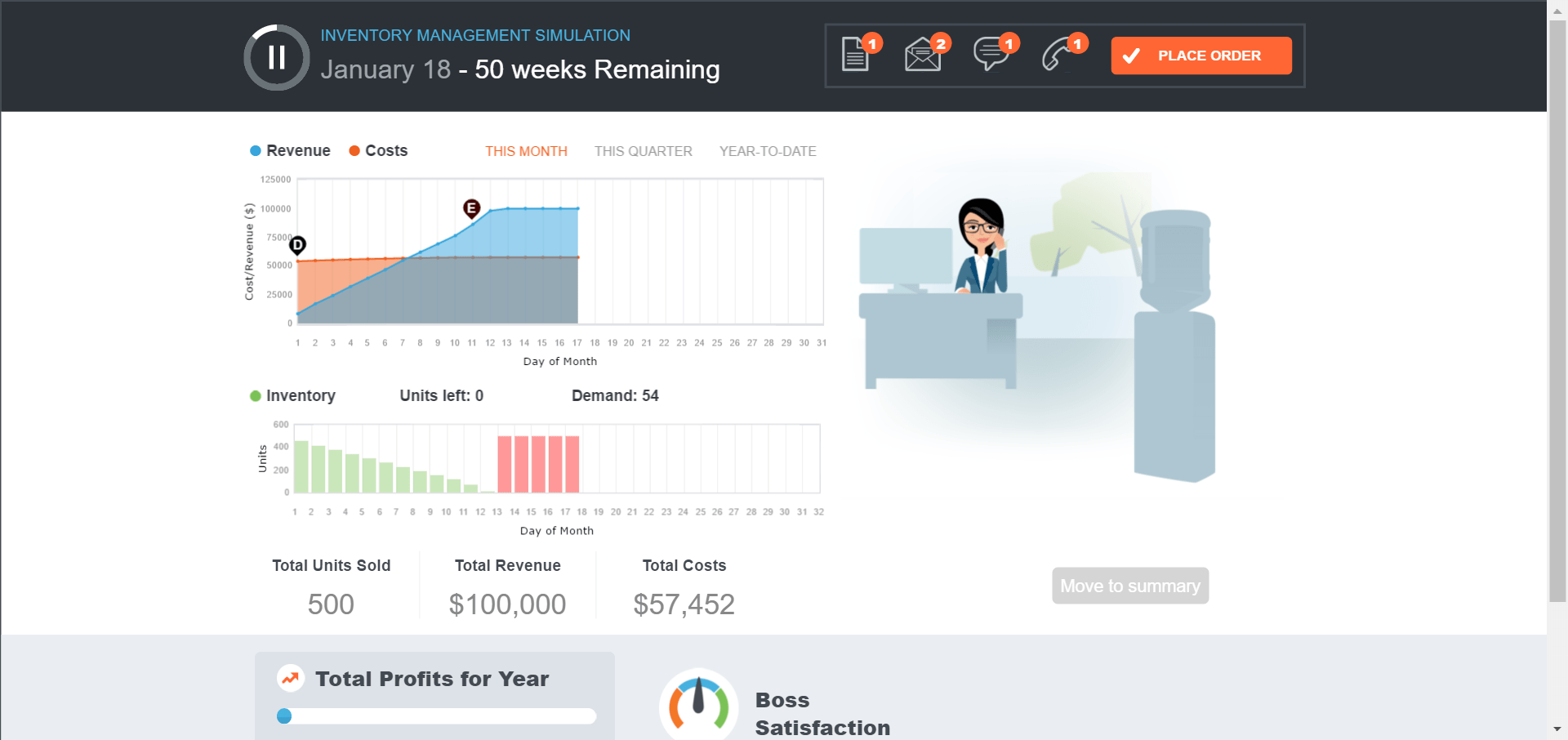
In prior guest posts, I evaluated 3 of the 5 simulations that are available free in MyOMLab with the Heizer/Render/Munson text. Today, I look at the Inventory Management simulation. I like that it deals with the retail industry, from the store manager perspective, because students feel more comfortable thinking about the physical needs of products in a retail scenario. The simulation quickly takes them from that initial comfort level as they get calls, emails, etc. about issues to manage decisions. Finding that balance between too much and too little inventory to achieve profitability goals is key in this simulation, just as in many real businesses.

This simulation requires students to apply holding and ordering costs, as well as watch for sales trends and think about forecasting orders. Many students often buy too much or too little until they start to think about EOQ and ROP to find a rhythm. They also see how their decisions impact profits as they work toward a $1 million goal. While difficult, students often say it is the best of the 5 MyOMLab simulations. Some even use the word fun!

Why? Because they feel the practical aspect of a simulation experiencing the needs and issues in these kinds of positions, with a chance to practice and not impact actual money. Inventory is always a delicate balance to keep customers happy and align to profit goals. Students often do this simulation more than once to challenge themselves to get the best results–building pride and confidence in making these managerial decisions.

Many students have work experiences in retail or hospitality and easily relate to this simulation. For example, this product does not perish as food items, so the cost of having too much inventory is a bigger challenge for them. Others find the simulation helps to refresh their skills or builds on past experiences to further learn some key skills employers need. Be sure to include these simulations in your lessons!

Guest Post: A Case for Supply Chain Simulation in Your OM Class

Our Guest Post today comes from Chuck Nemer, who has taught operations management for 16 years at Metropolitan State University in Minneapolis. He is also a SCM trainer and can be reached at http://www.theguruofbiz.com

Here is what I often hear about supply chain management simulations from colleagues teaching OM:

• I want to provide a hands-on approach rather than get lost in theory
• I need to get more engagement from my students
• I need to present real-world challenges and the associated complexities

Using simulations, such as the ones that come free with the Heizer/Render/Munson text, in your classroom gives you all the above, as well as the opportunity to see for yourself that students “get it.” Students get to see not only how vital supply chain is to organizations today, but they can build a career where they touch all aspects of the organization and develop the ability to lead organizations successfully.

My experience has been simulation in the classroom aligns with and supports both the textbook and the body of knowledge for supply chain quite easily and successfully. Exciting to me, is that students walk away from the experience with confidence, and the ability to demonstrate to prospective employers they understand not just what supply chain is. But they also see what needs to be done to make a supply chain improve, grow, and compete successfully at a level greater than just from a textbook and lecture alone. Together, your knowledge, your class content, and the use of a simulation make a very powerful combination that you just have to consider these days where learners live and exist in a technology rich world and thirst for “an experience.” I really hope you will investigate the use of supply chain simulations and consider making them part of your classroom.

OM in the News: Kroger Thrives on OM Innovation

Kroger was able to decrease average check-out wait times from 4 minutes to 30 seconds with no additional labor.

Back in 1883 when Barney Kroger invested his life savings of $372 to start his first store, the second purchase he made was a horse and carriage so he could deliver goods to his customers. One could make the argument that Barney knew the importance of delivery before Domino’s, Amazon or Blue Apron ever existed. OM innovation has long been a tradition at Kroger, writes ORMS Today (Dec., 2017). In the early part of the 20th century, Kroger was the first grocery store to introduce self-shopping and the first to surround its stores with parking lots. It became the first company to test electronic scanners in the 1970s, and in the 1990s, one of the first with self-checkouts. Now, with 2,800 stores, Kroger serves 9 million customers a day. Here are just 2 of its latest OM advances:

Kroger developed the industry’s first real-time solution for queueing to answer the question, “What if we could open another lane the moment queueing conditions required it?” Simulation models led to a system of sensors above each entrance and register that measures the number of customers walking into stores, as well as the number of customers standing in line at each lane. Combined with a real-time POS feed, Kroger is able to make predictions on the number of customers arriving at the front end by day of week and time of day. The system tells managers on a big screen hanging above the registers how many lanes are open, how many lanes should be open now, and how many should be open in 30 minutes, in order to proactively meet the rush of customers about to arrive.

Its inventory control model, Pharmacy Inventory Optimization, helps set Min/Max re-order points for the ordering system, reducing annual out-of-stocks by 1.7 million prescriptions, labor ordering costs by $10 million, and annual inventory costs by $120 million, while increasing sales by $80 million. It was a finalist for the INFORMS Franz Edelman award.

Classroom discussion questions:

  1. How has OM helped Kroger become an innovator?
  2. Where else can OM tools be used to increase productivity in a supermarket?

Teaching Tip: Our New Inventory Management Simulation

Inventory Simulation is the 4th of our four new classroom gaming exercises. It accompanies Chapter 12, Inventory Management and is free within our MyOMLab learning system.

Goal: Manage stock of electronics device to minimize costs and maximize profits.

You are the store manager at a local branch of DigiLife, a large electronics retail chain. A new version of a popular consumer electronics device called the Amulet is coming out this year. It is your job to sell as many Amulets as you can while minimizing your costs in order to maximize your store’s profits.

Learning Objectives

Primary Objectives:

  • Understanding how EOQ is calculated
  • Understanding the limits of EOQ

Ancillary Objectives:

  • Use EOQ formula = sqrt(2ds/h)
  • Where d = qty demanded, s = ordering/setup cost, h=holding cost
  • Understand what the answer means and what the inputs mean.
  • Knowing how EOQ can help guide you towards better decisions about order size and time between orders.
  • Understand that demand is variable (Sales/marketing give you their best forecast but no one can predict the future. Also, you may be given an average demand where actual demand will fluctuate from day to day.)
  • Understand that h has fixed and variable components (if you already have a fridge you might as well fill it. But if you’re paying for storage by the square foot, that’s going to vary).
  • Understand ordering costs aren’t always obvious (going to the gas station every day to top off your tank doesn’t mean you may more for your gas, but it’s a huge waste of time).
  • Understanding the economic impacts of defects and damage, stockouts and rush orders.
  • Understanding the limitations of using EOQ to guide your decisions–that EOQ doesn’t give you an exact answer, but it gets you close.
  • inventory simulation

Teaching Tip: Our New Quality Management Classroom Simulation

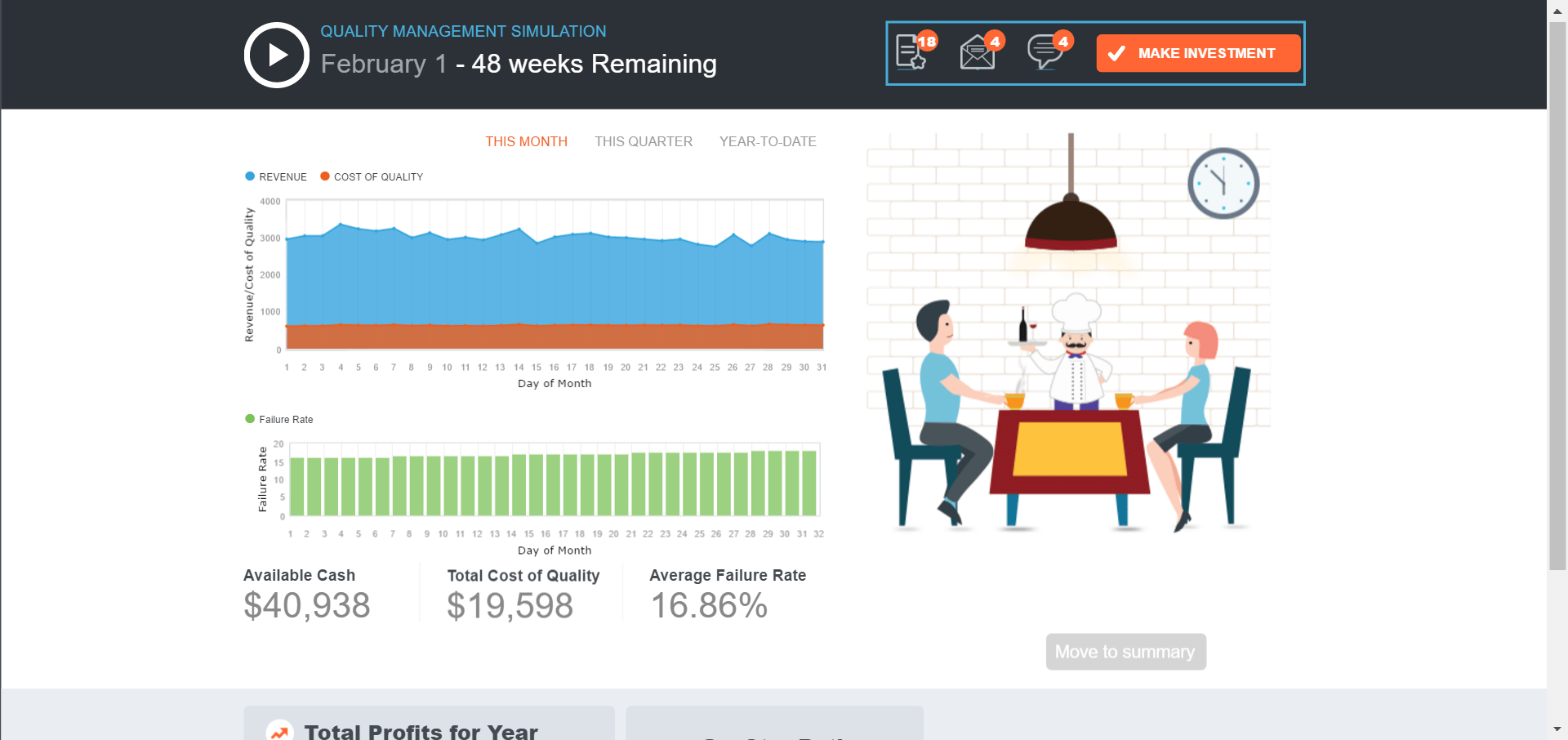
Quality Management Simulation is the 3rd of our four new classroom gaming exercises. It accompanies Chapter 6, Total Quality Management, and is free within our MyOMLab learning system.

Goal: Make quality investments with good ROI in terms of profits and customer ratings.

You are the manager of Cibare, one of the hottest Italian restaurants in town. You manage a full service staff and work closely with the Chef and the restaurant owner to ensure Cibare is providing a high-quality experience for customers. It is your job to make sure daily operations are running smoothly and that the investments you make to improve or maintain quality provides a return that exceeds the cost.

Learning Objectives

  • Understand that quality is an investment. There is a cost to investment and often a return. When managers allocate resources appropriately, the return on an investment should exceed the cost.
  • Understand that quality is a continuous pattern of activities and not a one-time event.
  • Develop a more complete understanding of total cost concepts.
  • Help the student realize that exact numbers and are not always available as on an exam and acknowledge that outcomes have uncertainty associated with them and that decisions must be made with imperfect information.

    Industry: Food service/ Hospitalityquality simulation

Teaching Tip: Our New Project Management Classroom Simulation

This Project Management Classroom Simulation is the 2nd of our new classroom gaming exercises. It accompanies Chapter 3, Project Management, and is free within our MyOMLab learning system.

Activity Brief

Select and manage subcontractors to achieve schedule and profitability goals of home-building project.

You are the general contractor for a high-end, private residence construction job. You manage teams of subcontractors who work on various aspects of the house, from plumbing and electrical to drywall and landscaping. The homeowners, Robert and Maggie Applebaum, want to be in their new house in 7 months and will check in with you regularly about its progress. It is your job to make sure daily operations at the site are running smoothly and that the house is completed on time and within budget, without negatively affecting your other building projects

 Industry: Constructionproject managemnt sim 2project management sim 1

Teaching Tip: Our New Forecasting Classroom Simulation

This Forecasting Classroom Simulation is the 1st of our new classroom gaming exercises. It accompanies Chapter 4, Forecasting, and is free within our MyOMLab learning system.

Activity Brief

As an operations consultant, you have just signed a 2 year contract to provide monthly forecasts of customer demand for a new gas station.  The gas station will sell 3 types of gas: Regular, MidGrade, and Premium. The gas station will have a total of 8 pumps offering all three types.

The gas station will also have a modest convenient store with a standard selection of snacks, beverages, and other miscellaneous items. However, the ownership group believes the station will attract business primarily due to its prime location near a major highway. Pricing for gas will be comparable to alternatives in the area and will predominantly be driven by market conditions relating to the price of crude oil per barrel.

The ability to forecast the next month forecast is critical for the station’s inventory management and other business planning. It will be necessary to gather various sources of information and ultimately analyze data in order to make the best forecast for each of the 24 months of the contract.

Your performance will be based on the collective mean absolute percentage error (MAPE) among the three types of gas. If you are able to forecast at less than or equal to 5% MAPE, you will receive a $10,000 bonus for your work. If your forecast are between 5% and 20% MAPE, you will not receive the bonus, but you will secure the position and receive a contract renewal. If the MAPE exceeds 20%, you will not receive a contract renewal.

Learning Objectives

  • Understand and break down patterns of customer demand
  • Generate forecasting models based on judgement, causal, time-series methods, or seasonal methods
  • Evaluate the quality of a forecast model using error metrics (specifically mean absolute percentage error).
  • Help students understand the distinction between the “signal” and the “noise” (Students are encouraged to also read The Signal and the Noise: Why So Many Predictions Fail, but Some Don’t. by Nate Silver). Many aspects of customer demand variation are explainable – the signal, but there needs to be an acceptance of unexplainable variation – the noise. In other words, students have to make a concession that their models will not predict customer demand with 100% accuracy.

Industry: Retailforecast sim 2forecast sim 1

MyOMLab: Our Four New OM Simulations

We are thrilled to announce that our learning package now includes some pretty sophisticated OM simulations. Here is a bit of background information.

  • How many simulations will be part of OM Simulation?  We have four gaming simulations: inventory management (chapter 12), quality control (chapter 6), forecasting (chapter 4), and project management (chapter 3). A fifth, supply chain management (chapter 11), will be available in late Fall.
  • Are these simulation to be done in class or outside of class?  The OM simulations are fully assignable through MyOMLab, so students could complete this as homework presumably after completing their reading. It would also work as an in-class activity, either working as an individual or as part of a team.
  • Are the OM simulations smartphone compatible?  The OM sims are compatible for mobile devices including smartphones in landscape orientation.  However the simulations are optimized for desktop/laptop devices.  Our research suggests that for activities of this length, most students still prefer desktop/laptop use.
  • Are the OM simulations accessible?  Yes, the OM simulations have been developed with a number of accessibility features including compatibility with screen reader devices.
  • Can you pause the simulations?  Yes, you can pause all of the simulations to review the artifacts (documents, emails, voicemails, texts) or make a decision.
  • What is the price of the OM simulations?  Access to simulations is through MyOMLab and included in that purchase cost. There is no additional fee to purchase these simulations on top of the MyOMLab purchase.simulation


MyOMLab: Some Exciting New Resources for Fall 2016

There have been many enhancement to MyOMlab that we will share with you in the coming days. Here are just two that we are very excited about. If you have not tried out MyOMLab as a learning and assessment tool, let your Pearson rep (or me) know and we will set up a private tutorial for you. More than half of our adopters are using this fantastic package already.

Dynamic Study Modules help students study effectively on their own by continuously assessing their activity and performance in real time.

  1. Instructors now have the ability to remove questions from a module to add additional personalization.
  2. Changes are now retained when copying a course for future semesters.

OM Simulations
Interactive and robust, these simulations were designed for our Operations Management students to provide hands-on experiences in real-world roles, helping them to link course concepts to on-the-job application.  Using real-life myomlab simulationsituations, students evaluate information and then engage in decision-making and critical analysis.

  • Four new simulations are available this month as part of MyOMLab: Inventory Management (Chapter 12), Quality Management (Chapter 6), Forecasting (Chapter 4), and Project Management (Chapter 3).
    • 90% of students who piloted the simulations in 2016 would recommend their instructors use them in the course.

OM in the News: How the McLaren Racing Team Sped Up Heathrow Airport

mclarenThe McLaren Formula 1 Racing Team has long had a reputation as a data-obsessed racing operation, writes BusinessWeek (Oct. 6-12, 2014). So the company decided 5 years ago that the highly specialized expertise it’s developed in data analysis, simulation, and decision support is something that businesses would profit from and pay for. Among its projects, McLaren’s Applied Technology Group has designed health monitoring systems for sick children, helped data center operators to better manage spikes in demand, and created a scheduling system for Heathrow Airport that reduces flight delays.

Air travel, like racing, is a realm where things often don’t quite go right. The limited supply of Heathrow airport gate slots and runway space and the inevitability of poor weather combine to create a tightly coupled network where delays and bottlenecks can quickly ripple across continents. The managers at airports who coordinate arrivals and departures have to deal with planes that took off the day before—some already late or rerouted—and to figure out how best to bring them in. Heathrow presents a particularly intricate puzzle. It moves more people than all but a couple of airports in the world, yet it has only 2 runways—Chicago’s O’Hare, by comparison, has 8. And local environmental and noise regulations restrict flights to between 6 a.m. and 11 p.m.

Prior to McLaren, scheduling had relied on a computer program that looked at a few “study days” from the past season, usually idealized days in which little went wrong. McLaren created a software tool that models bad days as well as good ones and simulates the effects on global air traffic of events such as a blizzard in Frankfurt or fog in Singapore. That’s enabled the airport to better plan for delays and, as a result, to increase its capacity.  For example, if it becomes clear by midafternoon that Heathrow simply won’t be able to handle all of its remaining scheduled arrivals before the 11 p.m. cutoff, the software will recommend how to proceed based on Heathrow’s priorities. Cancel the fewest flights? Preserve the most connections? Favor long-haul flights over shorter ones?

Classroom discussion questions:

1. To what other elements of airport operations can simulation be applied?

2. Why is simulation important to McLaren?

OM in the News: Can You Help TSA Shorten Security Queues?

TSA checkpoint in Atlanta

In anticipation that more fliers will be eager to pay for expedited checkpoint screening, the Transportation Security Administration has promised to award $15,000 in cash prizes to whomever can design a faster waiting line system, reports Nextgov (July 18, 2014). The competition is on InnoCentive, a website for crowdsourcing solutions to problems, which enables individuals and teams to submit proposals. “There is a guaranteed award,” the contest overview states. “The total payout will be $15,000, with at least one award being no smaller than $5,000.”

The challenge aims to solve expected problems with TSA PreCheck, a program where passengers who undergo a background check and pay $85 get access to fast lanes that don’t require removing shoes, coats, liquids and laptops. “Current queue layouts at TSA Pre✓ airports will need to adapt to support the increasing population of TSA Pre✓ passengers,” the competition states. “TSA is looking for the Next Generation Checkpoint Queue Design Model to apply a scientific and simulation modeling approach to meet queue design and configuration needs of the dynamic security screening environment with TSA Pre✓.” TSA also is asking for approaches that would help speed standard, “free” waiting lines.

Competitors must supply a proposal that considers physical logistics, peak hours and staffing schedules, among other constraints. The “line” extends from the point where a passenger joins the end of the queue to the metal detector or body scan machine. Wait times cannot be more than 5 minutes for PreCheck and 10 minutes for standard lines. Also, the model should enable TSA to apply a “Computer Aided Design drawing to define the physical space available for queuing.”

Competitors are required to provide an animation of a computer screen that shows passengers flowing through lines. It must display real-time reporting during the animation, and allow a user to pause a simulation run when necessary for analysis or evaluation. What a great example of a complex, real-world queuing problem to ask your students to discuss!

Classroom discussion questions:

1. Why is TSA turning to crowdsourcing?

2. What ideas do you have for speeding the lines?


OM in the News: The Revolution in Vehicle Design

Design software produces ideal shapes for vehicle parts like this motorcycle frame

A revolution in vehicle design that has been sweeping the auto industry, writes The Wall Street Journal (Oct. 21, 2013) . Advances in computer-aided engineering (CAE) and big investments in computing power have given manufacturers new tools to create designs and the ability to test their ideas in a fraction of the time and at far less cost than they could before. The result: many more design ideas are being conceived and tested, and the best are being adopted quickly, helping manufacturers improve the fuel efficiency and their vehicles. “This new process is allowing us to do a lot of innovation,” says Ford’s head of CAE.

Car makers are using computers to run through dozens of design possibilities in the time it once took to produce a single prototype. Only a few years ago, it might have taken as long as 8 months to get from the idea for a new cylinder head to the building of a prototype, and it would have cost millions of dollars. Today, the part is created in a computer simulation that comes up with the most efficient design possible. Engineers then alter that design to account for manufacturing constraints and test the revised design virtually in models that use decades of data on material properties and engine performance as a guide. The firm then creates the mold to make a real part that can be bolted onto an engine for further testing. The entire process takes days instead of months and costs only thousands.

In the past 4-5 years, car makers have been ditching physical prototypes as computer simulations of real-world conditions improved. Costs, performance and safety designs have been digitized so they can be weighed by design programs. The vehicle can be built, run through snow banks, started in frozen or hellishly hot conditions and crashed repeatedly—all inside a network of computers.

Classroom discussion questions:

1. Why is CAE such an important OM tool?

2. What role does simulation now play in vehicle design?