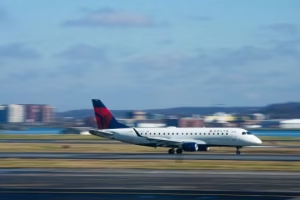
OM in the News: Delta’s Vertical Integration Risk Pays Off

Vertical integration is an interesting topic in Chapter 11 of your Heizer/Render/Munson text. There are plusses and minuses, and we warn: “Most organizations are better served by concentrating on their own specialty and leveraging suppliers’ contributions.”

But Delta Air Lines, facing billions of dollars of pain at the fuel pump (because of Iran’s blockage of the Straits of Hormuz) along with all the other carriers, is unique. It happens to own its own gas station, writes The Wall Street Journal (April 10, 2026).

Jet-fuel prices have roughly doubled since late February, pushing up airlines’ costs.

Since 2012, Delta has been the owner of a Pennsylvania refinery that processes crude into fuel. Over the years, the investment has looked like either a stroke of genius or a boondoggle, generally depending on the price of oil. Since the U.S. and Israel began carrying out strikes on Iran, the refinery is set to pay off again for Delta. With it, Delta has an asset that can help it offset some of the recent surge in fuel prices.

Energy experts rolled their eyes when Delta plunked down $150 million for the refinery. If the plant was such a good investment, why was ConocoPhillips, its previous owner, shutting it down? Rival airline executives scoffed that they would benefit from increased jet-fuel output on the East Coast without the headaches of refinery ownership.

Now even United, one of Delta’s top rivals, has acknowledged that the refinery benefits Delta. Its CEO Scott Kirby states: “Right now the crack spread (the gap between the price of jet fuel and the price of crude oil) is much higher…and so they’ll get real benefit from the higher crack spread that will be unique to them.”

Delta has said that the refinery makes an operating profit most years. The airline has said owning the refinery insulates it from supply disruptions in the Northeast and helps mitigate risk from volatile prices—effectively lowering its jet-fuel costs, often by several cents a gallon. In 2022, when fuel prices surged after Russia began its invasion of Ukraine, the refinery helped it save $785 million.

But the airline has had to pour money into the plant, which is more than a century old, to keep it running smoothly, investing $1.6 billion in capital expenditures over the years.

Classroom discussion questions:

  1. Did the purchase make sense for Delta?
  2. Many economists think the refinery was a costly mistake. Why?

OM in the News: Measuring the The Best and Worst Airlines

There’s been enough drama in the past year to impact U.S. airlines quality rankings. An Alaska Airlines blowout grounded dozens of planes. There was a failed JetBlue-Spirit merger and Spirit’s bankruptcy. A summer tech outage crippled Delta. Southwest Airlines faced investor pressure and said it’s switching to assigned seating. All while planes remained packed and air traffic congested.

Delta took the crown again in The Wall Street Journal’s 17th airline scorecard (Jan. 23, 2025), standing out in nearly every category. This is Delta’s 4th consecutive win and 7th in eight years. It prides itself on reliability and customer service—it displays this and other accolades on stickers near its cabin doors—and commands a premium for it. There’s a reason those Delta tickets often cost more. Southwest finished a mere point behind Delta, with Alaska in third.  In the ratings cellar? Frontier. Spirit placed 8th and American Airlines finished 7th.

The  9 major U.S. airlines are ranked on 7 equally weighted operations metrics: on-time arrivals, flight cancellations, delays of 45 minutes or more, baggage handling, tarmac delays, involuntary bumping and what the Transportation Department calls passenger submissions (which are mostly complaints).

Delta finished first in on-time arrivals and was the only airline in the ranking to exceed 80%. It canceled far fewer flights than in 2023, giving it the lowest cancellation rate besides Southwest. “It’s a testament to our people, along with the resiliency, reliability and efficiency we’ve purposely built into our operation, that we canceled fewer than 1% of our scheduled flights and improved or held steady in nearly every category,” said Southwest’s COO.

Delta’s weak spot: bag handling. The airline’s mishandled bag rate trailed those of Allegiant, JetBlue, Frontier and Southwest. Frontier, the airline that draws you in with $19 tickets and piles on fees galore, finished at or near the bottom in all but two categories, dropping a spot in on-time arrivals and extreme delays from 2023. It did best in baggage handling, where it ranked third.

The overall scores fall off fairly dramatically after Delta and Southwest. Third-place finisher Alaska finished nine points below Delta, Allegiant 11.

Classroom discussion questions:

  1. In Chapter 6 of your Heizer/Render/Munson OM text, we discuss TQM. Which of the many tools are used in the quality ranking metrics?
  2. What would you do if you were Frontier’s operations manager?

OM in the News: Delta Air Lines and the Exoskeleton

Delta Air Lines is partnering with Sarcos Robotics to explore new employee technology fit for a superhero—a mobile and dexterous exoskeleton designed to boost employees’ physical capabilities and bolster their safety, reports New Equipment Digest (Jan. 15, 2020). Sarcos, the world’s leader in exoskeleton development, has developed a battery-powered, full-body exoskeleton designed to increase human performance and endurance while helping to prevent injury.

This robotic suit, designed for employees to wear, does the heavy lifting. By bearing the weight of the suit and the payload, the exoskeleton may enable an employee to lift up to 200 pounds repeatedly for 8 hours at a time without strain or fatigue. The Sancos model is designed for use in industries where lifting and manipulation of heavy materials or awkward objects are required and aren’t easily handled by standard lift equipment. (This is a topic we discuss in the Ergonomics section of Chapter 10 in our text).

Potential uses at Delta could include handling freight at Delta Cargo warehouses, moving maintenance components at Delta TechOps or lifting heavy machinery and parts for ground support equipment. Exploring how advanced tools and tech can better support employees is one way Delta aims to improve workplace safety.

In addition to enabling superhuman strength for extended periods, the robotic suit may also level the playing field in terms of physical capacity. Roles that have historically been limited to those who meet specific strength requirements could potentially be performed by a more diverse talent pool, thanks to wearable robotics.

Classroom discussion questions:

  1. Discuss the OM implications of such an exoskeleton.
  2.  Identify other potential industries/applications.

OM in the News: The Airlines’ On Time Flight Game

Today’s pop quiz: If Delta and American both have flights from Dallas to Detroit leaving at 11 a.m., and both flights take 2 hours, 53 minutes to get to the gate in Detroit, which one is late? The answer: American Flight 43. American schedules that trip at 2 hours, 38 minutes. Delta Flight 653 is scheduled to make the trip in 2 hours, 47 minutes, with 9 minutes of extra cushion. The same travel time could leave American 15 minutes late—tardy in DOT statistics. Delta, only 6 minutes overdue, would be considered on time.

“Every airline gives itself extra cushion in its schedule to account for weather delays, mechanical repairs, air-traffic control slow-ups and a thousand other things that leave planes and passengers stewing,” writes The Wall Street Journal (June 29, 2017). In 2016, 86.5% of Delta domestic flights arrived on time under the DOT’s definition, which is at the gate within 14 minutes of scheduled time. That was best among the 4 biggest U.S. carriers. This on-time performance is a competitive battle. Reliability matters to frequent fliers. Several airlines pay employees bonuses based on on-time arrivals.

This year, Delta’s flights have been scheduled about 9 minutes longer than they actually took, on average, a 6% cushion. In 2009, Delta’s scheduled just 2 minutes of padding, or 1.4%. That year only 78.6% of Delta flights arrived on-time. Better-managing maintenance and employees played a major role.

The airline says it increased scheduled time and decreased ground time for planes. Often airlines bolster ground time, so a 15 minute delay doesn’t impact the next flight. Delta chose the opposite approach: increasing scheduled time– called “block time,” so 80% or more of its flights arrive exactly on schedule, then shortening ground time between flights.

Every minute added to schedules can increase costs: higher crew pay for trips at many carriers, more planes and gates needed to fly the same number of trips. Adding one minute to every flight costs about $10 million in annual expenses.

Classroom discussion questions:

  1. What OM tools can be used to deal with airline scheduling problems?
  2. Why do airlines increase their block time?

OM in the News: The Solution to the Lost Luggage Problem

An unclaimed bag at the Charlotte N.C. Airport

The airline industry says its rate of mishandled baggage is lower than ever, down more than 12% from 2015 and the lowest ever recorded. “Much of the reduction is due to investments by airlines in technology improvements,” writes The New York Times (May 16, 2017).  Still, that is small comfort to the lone traveler waiting by a deserted carousel with a sinking feeling.

There are myriad reasons a bag can go missing. “Weather and missed connections are by far the largest proportion of causes for bags not arriving on time,” says Delta’s VP. “We’ve invested about $50 million in deploying baggage tech across our organization,” he said. That investment includes integrating baggage data into the Delta mobile app. “If you’re traveling and you check a bag, you get a push notification when your bag is loaded.”

New technology and better baggage handling procedures had paid off, but the drop also coincided with the major carriers beginning to charge passenger fees for checking a bag. Those fees reduced the number of travelers checking bags.

Bag tags are now embedded with RFID chips, which means the location of bags is tracked and electronically crosschecked against a database to make sure that they are in the right place at the right time. This increases security, since each bag is linked to a ticketed passenger. It also speeds up the discovery of a bag in the wrong place so the process of reconnecting a bag to its owner can begin sooner.

At most U.S. airports, the airlines have operational control of their terminals, so it is incumbent on them to add new technology. By June, 2018, all airlines must maintain an accurate inventory of passenger baggage by tracking when each piece of checked luggage moves on, off or between planes.

Classroom discussion questions:

  1. Discuss how Alaska Air guarantees its 20 minute baggage delivery. (See the Video Case Study in Chapter 7).
  2. What is the role of RFID in baggage tracking?

OM in the News: Delta’s Epic Scheduling Meltdown


Delta’s Atlanta hub had dozens of long lines with thousands of passengers waiting for help on Friday, April 7, as thousands of flight cancellations wrecked Spring Break travel plans.

Spring break for hundreds of thousands of Delta Air Lines passengers was disrupted by April thunderstorms in Atlanta that led to an epic OM meltdown, writes The Wall Street Journal (May 4, 2017). At the root of 4,000 canceled flights: telephone busy signals. The biggest problem was that Delta’s 13,000 pilots and 20,000 flight attendants calling in for new assignments couldn’t get through to the people in Atlanta on the front lines of rebuilding the schedule.

Though puzzling in the age of instant digital communications, it turns out employees were dependent on dialing and circuits were overloaded. Computers told gate agents rescheduled crews would be there; customers waited at gates for hours. Then flights would end up canceled for lack of a crew member lost in Delta’s communications fiasco, unaware of the assignment. When crew members called in, they got busy signals since there were too few people to answer calls.

A recovery that should have taken the airline a day or two stretched into the following week. In Atlanta, flights were canceled well after midnight, after airport trains had shut down. That forced dazed vacationers to walk more than a mile through corridors littered with sleeping bodies like a zombie apocalypse. 

One problem was that many positions were short-staffed for holiday crowds because so many Delta employees had themselves taken spring-break vacation. A second problem was trying unsuccessfully to keep more crews together with the same plane all day to minimize disruption. (If a plane, pilots and flight attendants are all scheduled to reshuffle to different flights, a single delay can impact three other flights). A third problem was the undersized crew-tracking team and its phone lines. Delta now plans a system to send crews information about their trips electronically.

Classroom discussion question:

  1. What were the operations issues that Delta failed at?
  2. What OM tools can be used to minimize such breakdowns?

OM in the News: Airlines Still Mastering the Role of Technology

A Delta employee hands out snacks to passengers waiting to check in at Newark airport this week

Just as we have seen rapid advances in technology in the manufacturing sector (see Ch. 7), so do we see the critical role of technology in services. This week, for example, a power outage at Delta Air Lines grounded thousands of passengers, wreaking havoc on the carrier’s reservations system and drawing attention to antiquated technology that has plagued many airlines. The outage canceled hundreds of flights and snarled Delta’s efforts to alert passengers to the problems via its apps and on airline flight-information displays.

When departing flights can’t take off, tie-ups at hub airports follow because gates aren’t available for arriving flights. Further delays arise because planes and crews are out of position to follow the published schedule. It can take days for a carrier to recover and get all of its passengers to their destinations.

The technical problems will cost Delta millions of dollars in lost revenue and damage its hard-won reputation for reliability, reports The Wall Street Journal (Aug. 9, 2016).  The meltdown highlights the vulnerability in Delta’s computer system, and raises questions about whether a recent wave of U.S. airline mergers that created 4 large carriers controlling 85% of domestic capacity has built companies too reliant on IT systems that date from the 1990s. Delta merged with Northwest Airlines 8 years ago.

These IT systems—which run everything from flight dispatching to crew scheduling, passenger check-in, airport-departure information displays, ticket sales and frequent-flier programs—gradually have been updated but are still vulnerable. Following the loss of power, some critical systems and network equipment didn’t switch over to Delta’s backup systems. Delta aimed to limit customer backlash, but customers unleashed their frustration with 43,000 social media complaints.

Classroom discussion questions:
1. What did Delta do wrong IT-wise?

2. Why is a technology error more damaging in an airline than in a restaurant or university?

OM in the News: Speeding Up the Airline Boarding Process

delta airAirlines are trying to save time by speeding up a part of flying that creates delays even before the plane leaves the gate: the boarding process,” writes US News &World Report (June 1, 2015). This summer, Delta plans to preload carry-on bags above passengers’ seats on some flights. Southwest wants to get families seated together more quickly. No perfect boarding method has ever emerged.

Most airlines let first-class and elite customers board first. After that, some fill the rear rows and work toward the front. Others fill window seats and work toward the aisle. Airlines have also tried letting people board early if they do not have carry-on bags. Slow boarding creates delays, which mean missed connections, unhappy customers and extra costs. Researchers figure that every extra minute a plane stands idle at the gate adds $30 in costs. About 1 in 4 U.S. flights runs at least 15 minutes late. With 1,000s of flights each day, costs quickly add up.

Delta’s Early Valet service will offer to have airline employees take carry-on bags at the gate and put them in the bins above assigned seats. The airline wants to see if its own workers can load the bins faster than passengers. The service began Monday on 2 dozen flights, and that number is expected to rise steadily, adding departures from Atlanta, New York, Los Angeles, Detroit, Minneapolis, Salt Lake City and Seattle. Delta tested the process last summer and saw some reduction in boarding time.

Meanwhile, Southwest Airlines wants to reduce complaints that families can’t find seats together because flights are so crowded. Southwest passengers line up at the gate by group — first “A,” then “B” and finally “C” — and pick their seat once they are on the plane. The system lets families board together after the “A” group, but only with children up to 4. Some families pay extra for priority boarding to improve their odds. Southwest recently tested expanding family boarding to include children up to 6, 8 or 11.

Classroom discussion questions:

1. What other processes can airlines use to speed boarding?

2. What process and design techniques in Chapter 7 can be used for this process?

OM in the News: Delta’s Unorthodox Scheduling System

Delta's Control Room
Delta’s Control Room

“The crew of Delta Air Lines  Flight 55 last Thursday couldn’t legally fly from Lagos, Nigeria, to Atlanta unless they waited a day due to new limits on how much pilots can fly in a rolling 28-day period,” writes The Wall Street Journal (April 3, 2014). The trip would have to be canceled. Instead, Delta headquarters told the captain to fly to San Juan, which they could reach within their duty limits. There, two new pilots would be waiting to take the Boeing 767 on to Atlanta. The plane arrived in San Juan at 2:44 a.m., quickly took on fuel and pilots, and landed in Atlanta only 40 minutes late.

The episode, unorthodox in the airline industry, illustrates the fanaticism Delta now has for avoiding cancellations. Last year, Delta canceled just 0.3% of its flights. That was twice as good as the next-best airlines, Southwest and Alaska, and five times better than the industry average of 1.7%.

As it cut cancellations with a more-reliable operation, overall on-time arrivals improved and Delta has fewer delays. Managers in Delta operations center (featured in our Global Company Profile  in Chapter 15) move planes, crews and parts around hourly trying to avoid canceling flights. How well an airline maintains its fleet and how smartly it stashes spare parts and planes at airports affect whether a flight goes or not. Delta’s new analytical software and instruments that can help monitor the health of airplanes and predict which parts will soon fail. Empty planes are ferried to replace crippled jets rather than waiting for overnight repairs. Typically the airline has about 20 spare airplanes of different sizes each day. About half are stationed in Atlanta and the rest spread around other domestic hubs and two in Tokyo.

Classroom discussion questions:

1. Why have Delta’s operations managers focused on cancelling fewer flights?

2. How does Delta’s fleet age (one of the oldest in the industry) impact this strategy?

OM in the News: Comparing Operations Strategies at Delta and Southwest

If there were ever two airlines that had different OM strategies, it would be Southwest and Delta. When you discuss operations strategy (see Southwest’s activity map in Figure 2.8), note that a major part of Southwest’s approach to achieving low-cost competitive advantage is its standardized fleet of Boeing 737’s. This  allows for pilot training on one aircraft, reduced maintenance, constant updating of its fleet (only 11 years old on average), and close relations with Boeing.

The Wall Street Journal (Nov.16, 2012) provides a totally different–and industry unique–approach by Delta.  Delta, the nation’s 2nd biggest carrier, stunned the industry by becoming the first airline to buy an oil refinery, in a bid to trim its highest operating cost, aviation fuel. It runs a huge maintenance subsidiary that tends to its own planes and does third-party work, while other airlines have scaled down or bailed out of that business. But it also  has focused on an asset most airlines avoid: older planes. Today, Delta’s fleet is both old and complex. It has 10 different models among its 725-aircraft, and the fleet’s average age is over 16.6 years. Its 19 DC-9s, which came from the merger with Northwest, clock in at more than 34 years old!

Most of Delta’s rivals already have fewer aircraft types to simplify their fleets because that reduces the cost of training, maintenance and spare parts. They also are chasing every incremental reduction in fuel costs that new aircraft promise to deliver. Delta, by contrast, is picking up the 88 aging Boeing 717s that Southwest is shedding on planes it inherited in its merger last year with AirTran. Southwest was so anxious to maintain its single plane OM strategy that it took a $137 million charge to retrofit them for Delta. Yet even with the planes’ higher fuel and maintenance costs, Delta figures it is saving at least $1 billion on procuring these and other used planes, compared with buying new ones, making them roughly 10% cheaper to operate per seat than new 737s.

Discussion questions:

1. What are the plusses and minuses of Delta’s OM strategy?

2. Why does Delta prefer to purchase, rather than lease, its planes?

OM in the News: How Delta Manages Airline Capacity

The Wall Street Journal’s (Oct.25, 2012)  two articles describing how Delta Air Lines is effectively addressing capacity issues are useful classroom tools as you cover Capacity Planning in Supplement 7. In the first, Delta describes its plan to cut $1 billion from its costs through a revamp of its domestic fleet, maintenance savings and productivity initiatives–with no layoffs. Delta has been one of the most aggressive in the U.S. industry at cutting capacity to retain pricing power.  In the 3rd quarter, it offered 1.5% less capacity than a year earlier, and it expects its capacity to fall by  1% -3% in this quarter.

Delta is also the first U.S. carrier to buy its own jet fuel refinery to reduce the volatility of its largest expense. And as part of its  realignment, Delta will begin taking delivery of used Boeing 717s next year, along with new Boeing 737-900s. It will reduce the number of unprofitable 50-seat regional jets.

The second article describes how Delta uses sports charters to help keep planes occupied in the winter, when regular passenger travel slows. The planes fly regular service in the busy summer months, then convert to charter planes. This year, Delta has been flying 21 of the 30 NBA teams, 15 of the 30 Major League Baseball teams and 15 of the 32 NFL teams. The airline also carries 2 NHL teams, 35 college football teams and 40 college basketball teams. “We wanted planes for only four months a year. It was a perfect fit,” says Delta. Delta takes 8 of its Airbus A319 jets out of regular passenger service in October and installs special interiors. Instead of 126 seats, there are only 54. The plane is segregated into three cabins—the front for players, with seats that fold out into beds,  seats in the middle for coaches, and the rest in the rear for team staff, security and reporters.

Discussion questions:

1. Why is capacity a critical OM decision for airlines?

2. What are the dangers of vertically integrating, such as buying a refinery?

OM in the News: Delta Wants to Pump Its Own Fuel

When we discuss vertical integration in Chapter 11 and core competencies in Supplement 11, we never considered an airline buying an oil refinery to slash its fuel bills. But as The Wall Street Journal (April 6, 2012) reports, that is exactly what Delta Air Lines is trying to do. Delta’s unconventional proposal to acquire a Pennsylvania refinery is a bet that world’s second-largest airline can save $20-$25 a barrel on jet fuel, a big advantage as industry costs now approach $140 a barrel, up 11% so far this year.

Delta’s plan is being dismissed by aviation and energy industry experts, who said owning a refinery is a risky and potentially costly undertaking for an airline. “We are a little uncomfortable about the company going outside its core expertise,” says an analyst who follows Delta. “I can’t recall any other airline buying a refinery.”

The estimated $100 million to $150 million price tag for the refinery is about the cost of a new, wide-bodied aircraft. Delta’s plan would involve using an energy company partner that would handle day-to-day operation of the midsize refinery.  Its deliberations are the boldest step yet in an airline industry struggling to mitigate rising fuel prices that are expected to continue long term. Delta, which paid more than $11 billion for fuel last year–about 36% of its operating cost– has ongoing cost-saving efforts and is investing heavily in more fuel-efficient planes.

Other carriers, of course, also work hard to control their largest cost. Air Canada scours the globe for vessel shipments of jet fuel that it brings to its home airports in an elaborate supply chain of fuel-storage depots, pipelines and docks, leased rail cars, barges, and trucks. Fuel costs are up about 25% over last year.

Discussion questions:

1. What is Delta’s core competency and what are the chances this approach will be successful?

2. What are some other examples of vertical integration in major businesses?

OM in the News: Matching Supply (of seats) with Demand at Delta Air Lines

Have you ever been bumped from a flight that was over capacity? It’s a drama that plays out at departure gates every day in airports around the world. Typically, gate agents on overbooked flights embark on last-minute negotiations with passengers who might be willing to take a later plane. The agents broadcast their offers– vouchers worth $200-$400–and keep ratcheting up the price until enough passengers accept. Customers involuntarily bumped get an $800 voucher ( which the Transportation Dept. is proposing to raise to $1,300).

With 541,000 US passengers bumped in the 1st 9 months of 2010 (53,000 involuntarily), there must be a better way to manage capacity (Supp.7) and manage revenue (Ch.13). According to today’s Wall Street Journal (Jan.14,2011),  Delta Air Lines thinks it has the answer.

Delta’s high-tech new system (opened last month) asks passengers who check in online or at kiosks before going through security, what dollar amount they would accept to be bumped from their (overbooked) flight. Delta can then accept the lowest bids, eliminating a lot of uncertainty early. Not only does this give Delta a negotiating edge–passengers won’t know how low others are willing to go. But, in addition, “saving 3 or 4 minutes at the gate has a big operational impact”, according to Delta.  Delta calls it a “win-win” for both consumers and the airline.

Is this good customer service–or do any one of us even expect customer service when we fly? The topic fits well when discussing capacity and yield management issues in both Supp.7 and Ch.13. Given that 8-10% of passengers with reservations do not show for their flights, what other suggestions do students have?

Discussion questions:

1. Which system is better–Delta’s or its competitors?

2. What options do airlines have for capacity and demand?