OM in the News: Amazon Skates To Where The Puck Is Going To Be

Evidently,  Amazon.com has read hockey great Wayne Gretzsky’s famous quote: “I skate to where the puck is going to be, not where it has been.” Amazon thinks it knows you so well it wants to ship your next package before you order it. The Wall Street Journal (Jan. 17, 2014) writes: “The Seattle retailer gained a patent for what it calls anticipatory shipping, a method to start delivering packages even before customers click buy.”

The technique could cut delivery time and discourage consumers from visiting physical stores. Amazon says it may box and ship products it expects customers in a specific area will want – based on previous orders and other factors — but haven’t yet ordered. The packages could wait at the shippers’ hubs or on trucks until an order arrives. In deciding what to ship, Amazon said it may consider previous orders, product searches, wish lists, shopping-cart contents, returns and even how long an Internet user’s cursor hovers over an item.

Today, Amazon receives an order, then labels packages with addresses at its warehouses and loads them onto waiting UPS, USPS or other trucks, which may take them directly to customers’ homes or load them onto other trucks for final delivery. It has been working to cut delivery times, expanding its warehouse network to begin overnight and same-day deliveries. The patent demonstrates one way Amazon hopes to leverage its vast trove of customer data to edge out rivals.
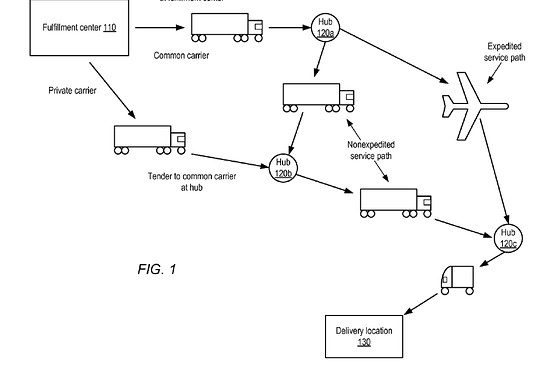
A possible Amazon logistics trail

Discussion questions:

1. What are the dangers in this concept?

2. Is this more realistic than using drones to ship packages?
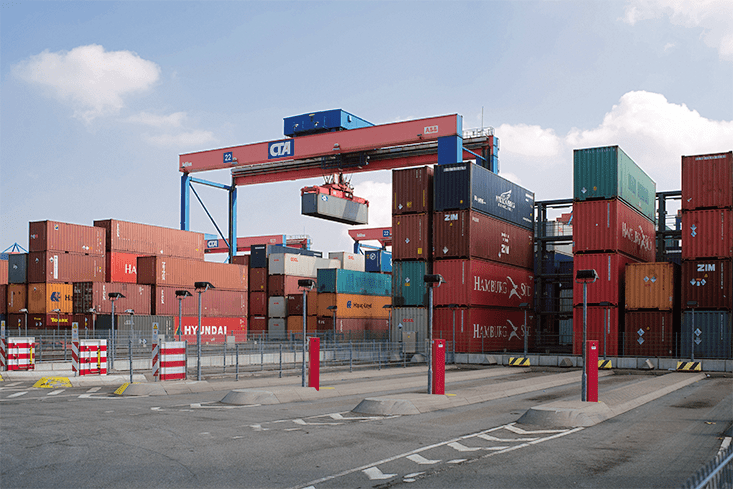
 

Good OM Reading: The Box That Built the Modern World

shipping containersFor a fascinating story called “The Box That Built the Modern World,” enjoy this article in In Transit (Issue 3, 2013). The piece follows the Hong Kong Express, docked at Hamburg’s Container Terminal for 33 hours. “Already, the ship was half empty. Cargo from Asia was stacked in neat rows of shipping containers on the dock. The ship is nearly a quarter of a mile long; from side to side it’s 157 feet. It can carry 13,167 20-foot-long containers, the standard box used in commerce around the world.” In less than 2 months the Hong Kong Express will call at 11 ports and travel more than 12,500 miles. Circling the world 4-5 times a year, it can move 1.4 million tons of cargo annually.

More than any other single innovation, the shipping container epitomizes the enormity, sophistication, and importance of our modern transportation system.  Fundamental to how practically everything in our consumer-driven lives works, it is the Internet of things. Just as email is disassembled into bundles of data you send, then re-assembled in your recipient’s inbox, the boxes are designed to be interchangeable, their contents irrelevant.

Once they enter the stream of global shipping, the boxes are shifted and routed by sophisticated computer systems that determine their arrangement on board and plot the most efficient route to get them from point to point. The exact placement of each box is critical: ships make many stops, and a box scheduled to be unloaded late in the journey can’t be placed above one slated for offloading early.

The In Transit article traces a T-shirt sewn at a factory near Beijing. Tagged, folded, and boxed, the T-shirt is stuffed into a container with 33,999 identical shirts at the factory. The merchandise passes through 36 steps before arriving at a discount clothing retailer’s distribution center near Munich. There’s the trucker who moves the box to a waiting ship in Xinjiang, the feeder ship that moves it to Singapore to be loaded onto a bigger Europe-bound freighter, the crane operator in Hamburg, customs officials, train engineers, and more. The total time in transit for a typical box from a Chinese factory to a customer in Europe might be as little as 35 days. Cost per shirt? “Less than one U.S. cent,” says a shipping exec. “It doesn’t matter anymore where you produce something now, because transport costs aren’t important.”

OM in the News: Mexican Truck Drivers and the Supply Chain

July 6, 2011 marked the resolution of a long-simmering NAFTA dispute between the US and Mexico over long-haul, cross-border trucking. Although NAFTA came into effect 17 years ago, the trucking deal was still bogged down over two legitimate issues: (1) border security and (2) union and independent trucker opposition to the loss of high-paying jobs to lower-priced Mexican drivers (who earn about 1/2 of their US counterparts).

Businessweek (July 20-27, 2011) reports that transporting goods across the Mexican border is a complicated business, involving customs brokers, warehouses, and lengthy inspections for drugs and illegal immigrants. Under the current system, Mexican trucks haul their merchandise to the border, where a transfer truck takes it across. A US truck picks it up on our side. In time, a Mexican driver will be able to haul goods from any Mexican city straight through to Chicago or New York. To qualify for service on US roads, Mexican drivers will have to learn rudimentary English and US highway laws.

Is it a good trade-off?  Businessweek strongly endorses the idea. With trade among Canada, Mexico, and the US at$1 trillion (triple since the start of NAFTA), the magazine writes: “US potato farmers, along with producers of pork, cheese, and other goods, can look forward to reduced Mexican tariffs with the resolution of the trucking deal. Higher wages and wider prosperity in Mexico are very much in the US national interest”.

US truckers will strongly disagree. While Mexican drivers will surely benefit, American drivers are loath to travel into Mexico. The country lacks the smooth roads, fuel stations, and accommodations available in the US–and has violent drug gangs to boot. In effect, the trade-off balances a more efficient supply chain with the disruption of workers in this industry. It’s no wonder the Obama administration announced the agreement with little fanfare.

Discussion questions:

1. Is the lower transportation cost good, or bad, for OM?

2. How does this change impact the supply chains served by the truckers?