OM in the News: The Popcorn Arrives Via Amazon Drone

Drone used to make Amazon's first commercial delivery, in England
Drone used to make Amazon’s first commercial delivery, in England

This week, Amazon made its first commercial drone delivery, to an Amazon shopper in Cambridgeshire, England, a major step forward in its experiments with automated shipments. The flight — to deliver an Amazon Fire device and popcorn to a customer — took off from a nearby Amazon warehouse and lasted 13 minutes, covering 2 miles.

The company says it wants to expand the number of consumers who could participate in the trial to dozens in the coming months, eventually allowing hundreds to use the drone service. The start of customer trials for the drone delivery service, which Amazon calls Prime Air, is a milestone for a technology that could eventually automate an important part of Amazon’s business.

The advent of widespread drone deliveries, even if technically possible, would take years, and regulators from the U.S. and elsewhere could block the plans. “But even if drones end up handling only a small portion of Amazon’s overall deliveries, the implications could be far-reaching,” writes The New York Times (Dec. 15, 2016). The company, for instance, might not need as many truck drivers or other costly logistical operations. Drones could also have environmental benefits, by reducing reliance on pollution-belching vehicles. The biggest boon may be to customers, who could be able to receive their orders more quickly.

In England, Amazon has been allowed to fly drones without a human pilot at the controls, navigating to destinations solely by GPS. The company says it has developed “sense-and-avoid” technology to help the machines fly around towers, birds and other obstructions.

Classroom discussion questions:

  1. What are the limitations of drone use for deliveries?
  2. Why is Amazon pursuing the drone approach?
OM in the News: Amazon and its Prime Now

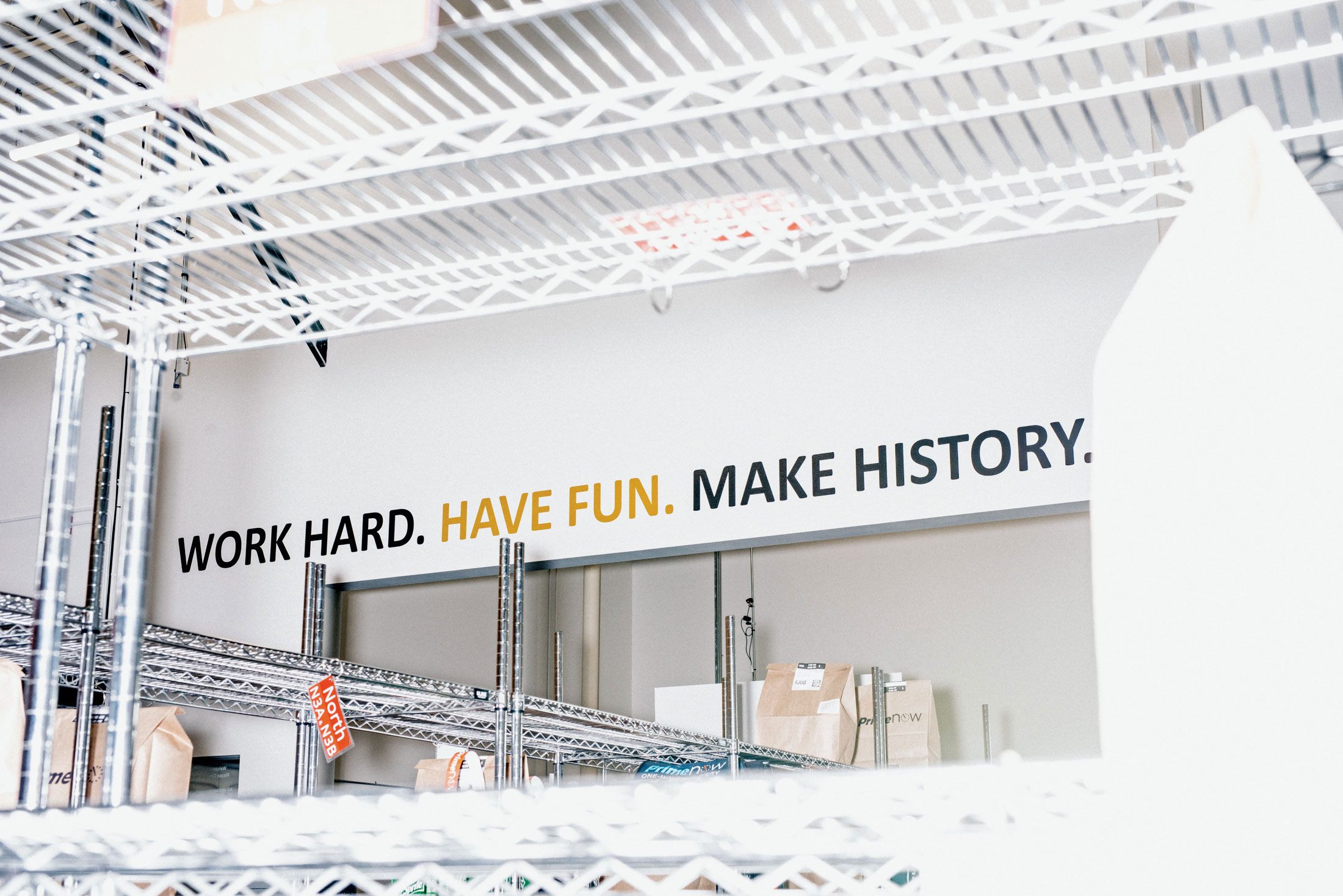
One of many corporate mantras on display for workers at a Seattle Prime Now hub.

“Amazon’s growth has been preposterous,” writes Businessweek‘s cover story (Sept.5-11, 2016). In 2010 its annual revenue was $34 billion; last year, $107 billion. In 2010, the company employed 33,700 workers. By this June, it had 268,900. For years, Amazon lost money but poured billions into such initiatives as e-readers, robot-enhanced warehouses, smartphones, tablets, and TV shows. Yet the company just posted its 5th straight quarterly profit. Amazon Web Services, its cloud computing division, alone had 2015 sales of $7.9 billion.

Amazon’s ambitions depend on the continued success of its Prime service. For $99 a year, Amazon Prime customers get 2-day delivery at no extra charge. Those who sign up tend to spend almost 3 times as much as their non-Prime peers. Amazon had 63 million Prime members as of June—19 million more than the year before. Prime members get that fast shipping, which keeps getting faster. In many large cities, subscribers can now get free 2-hour delivery on more than 25,000 items they might otherwise have bought at Walgreens or 7-Eleven. For an additional $7.99, orders arrive within 1 hour.

Providing near-instant gratification on Amazon’s scale isn’t cheap. Last year the company spent $11.5 billion on shipping—nearly twice what it did 2 years ago. Along with leasing jets and buying trailers, Amazon has opened more than 28 sorting centers, 59 delivery stations that feed packages to local couriers, and 65 Prime Now hubs stocked with best-selling items that can be rushed to customers around the world. Amazon has a patent for “anticipatory package shipping” technology: When some Prime subscriber buys more deodorant, Amazon already has the box standing by, ready to label and ship. “It’s just one giant math exercise,” Deutsche Bank wrote, adding that Amazon has “hundreds of Ph.D. mathematicians” who spend their days optimizing logistics.

Classroom discussion questions:

  1. What OM topics are discussed in this article about Amazon?
  2. Why is prime so important to the firm?

OM in the News: Amazon’s New Delivery Strategy

An Amazon Prime Air drone.

“Over the last few years, Amazon has left a trail of clues suggesting that it is radically altering how it delivers goods,” writes The New York Times (Aug.11, 2016). Among other moves, it has set up its own fleet of trucks; introduced an Uber-like crowd sourced delivery service; built many robot-powered warehouses; and continued to invest in a plan to use drones for delivery. It made another splash last week, when it showed off an Amazon-branded Boeing 767 airplane, one of more than 40 in its planned fleet.

These moves have fueled speculation that Amazon is trying to replace the 3rd-party shipping companies it now relies on — including UPS, FedEx and the U.S.P.S. — with its homegrown delivery service. Its logistics investments have also fed the theory that Amazon has become essentially unbeatable in American e-commerce.

The company, it appears, has a 2-tiered vision for the future of shipping. First, it’s not trying to replace 3rd-party shippers. Instead, Amazon wants to add as much capacity to its operations as possible, and rather than replace partners like UPS and FedEx, it is spending heavily on delivery services to add to its overall capacity and efficiency. Amazon’s longer-term goal is more potentially transformative. It wants to escape the vicissitudes of roads and humans, going fully autonomous in the sky. The company’s drone program could be combined with warehouses manned by robots and trucks that drive themselves to unlock a new autonomous future for Amazon.

If Amazon’s drone program succeeds (and Amazon says it is well on track), it could fundamentally alter the company’s cost structure. A decade from now, drones would reduce the unit cost of each Amazon delivery by about half.  According to Amazon, we will see drones in action within 5 years.

Classroom discussion questions:

1. Why does Amazon wish to enhance its shipping strategy?

2. What are the advantages and disadvantages of the drone program?

OM in the News: Wal-Mart Decides to Challenge Amazon

Wal-Mart is building a regional delivery network and will also tap carriers to deliver more of its packages.

Wal-Mart is testing a 2-day shipping subscription service and building a regional delivery network, in the boldest attempt yet by a major traditional retailer to compete head-on with Amazon Prime. As part of the project, Wal-Mart will shift more inventory to 8 massive e-commerce warehouses around the U.S., the last of which will be built by year’s end. It is part of a $2 billion investment the company is making in technology and logistics to boost e-commerce sales, reports The Wall Street Journal (May 13, 2016).

The company will also put its major transportation fleet and logistics know-how up against Amazon as it makes a play to meet Amazon on its own turf. Wal-Mart will tap regional carriers to deliver more of its packages. But it will also use its 6,000 tractor-trailers, one of the 5 largest private trucking fleets in the country, along with its 4,600 U.S. stores, to take on what has become one of its biggest rivals.That could make Wal-Mart less reliant on FedEx, which handles the bulk of Wal-Mart’s parcels.Trucking more of its own packages closer to the shipping destinations for what’s known as last-mile delivery would allow the company to save on one of the higher-cost elements of shipping a package across the country.

A large part of Wal-Mart’s success is its ability to move all those products cheaply and efficiently around the country. Since 2014, Wal-Mart’s online sales increased 12% to $13.7 billion. But Amazon still sends out about 7 times the number of packages Wal-Mart does in North America.

Classroom discussion questions:

  1. What OM advantages does Amazon have over Wal-Mart in this battle for e-commerce sales?
  2. What advantages does Wal-Mart have?

OM in the News: Automated Driving for the Big Rigs

Platooning: Two trucks follow a lead driver in a semiautonomous convoy from Stuttgart to Rotterdam.

A new automated driving technology called platooning, which links trucks via Wi-Fi, GPS, sensors, and cameras so they can travel semiautonomously behind one another is being developed in Europe, reports Business Week (April 25-May 1, 2016). The leading rig dictates speed and direction, while the rest automatically steer, accelerate, and brake in a closely spaced convoy. “It was a little eerie to hand over part of my role as driver,” says one caravan driver. “But it was really comfortable, especially in heavy traffic or boring stretches of road.”

Although driverless cars grab headlines, it may take decades before truly autonomous vehicles rule the road. In the meantime, semiautomated convoys can help manufacturers hone the technology while cutting emissions and fuel consumption. Drivers will still be needed by law. But letting the rig do some of the work will result in less passing, quicker braking, and fuel savings of about 10% for the following trucks (and a smaller gain for the lead vehicle). And it will help reduce congestion. When a human is at the wheel, a truck in some countries must maintain a distance of about half a football field from the vehicle in front. With automation, that distance shrinks to about 50 feet.

Half the European fleet of big rigs—750,000 trucks—could be platoon-ready by 2025. Convoys will be able to form on an ad hoc basis, with drivers following a leader for anywhere from a few exits to hundreds of miles as individual vehicles pull off to make deliveries. Even though the initiative started in Europe, truck manufacturers say platooning may be even more relevant in places with wide-open roads such as Australia or the western U.S., where distances traveled are greater.

Classroom discussion questions:

  1. Why has this technology advanced so quickly?
  2. What is the main operations advantage to platooning?

OM in the News: Amazon Revamps its Logistics Chain

amazon“Amazon,” writes The Wall Street Journal (March 10, 2016), “is taking to the air with a fleet of planes, part of a broader effort to reduce its inflated shipping costs.” The Seattle retailer plans to shuttle merchandise around the U.S. using 20 Boeing 767 aircraft. Amazon has also taken steps to reduce its reliance on carriers such as UPS and FedEx by building out a ground network of couriers and new warehouses near urban centers for faster and cheaper delivery. The new logistics chain would give Amazon control over roughly 15% of the packages it ships annually.

“Amazon clearly wants to grow, and they need capacity to do so,” said an industry expert. “UPS and FedEx are hesitant to build it out solely for one customer.” The firm has been planning an in-house logistics network for years, but the project took on added urgency when customers received gift orders late after the Christmas holiday in 2013. Amazon blamed the carriers for the embarrassing episode.

Amazon feels UPS’s traditional hub-and-spoke system is growing obsolete and is a particular liability during the crucial holiday selling season. The effort is already visible. White delivery vans with Amazon’s logo are an increasingly common sight, and customers say they are receiving more packages directly from uniformed Amazon deliverymen. The online retailer has added thousands of semitrailer trucks for delivery between warehouses and is experimenting with citizens making deliveries. Over time, Amazon is likely to turn its delivery network into a business in its own right, charging other shippers to ferry packages and drop off merchandise.

Classroom discussion questions:

  1. Evaluate Amazon’s new strategy.
  2. What are the advantages of third-party logistics (3PL)?

OM in the News: Is Fast Shipping Fast Enough?

Everlane, an online clothing and accessories brand, offers one-hour shipping in New York at no extra charge and in San Francisco for $2

“Free shipping isn’t enough any more,” writes The Wall Street Journal (Jan. 28, 2016). Online shoppers want fast shipping, too, and their expectations of an acceptable delivery window are shrinking. The new demands are largely a result of Amazon Prime, rival retailers say. Tens of millions of Amazon Prime members pay $99 a year and get unlimited 2 day shipping on millions of products, from snow boots to dog food. Now, the retailing giant is upping the ante, offering same day shipping in some markets. Other retailers, whose default shipping option is often 5 business days or more, are scrambling to keep up. Customers for the most part are no longer willing to pay extra for expedited delivery.

With shipping an increasingly expensive part of the business equation, operations managers are looking for cost effective ways to ship faster. They are building more distribution centers, fine tuning ship-from-store logistics and devising more creative delivery options. “Amazon kind of set the path for everyone with Prime. People just expect things faster,” says a luxury competitor. Cole Haan offers free 2 day shipping to online shoe shoppers who spend more than $250. Nearly 1/4 of customers either meet the threshold or pay $15 extra for 2 day shipping. Next month, Gap will narrow its free shipping window to 5-7 business days, down from 7-9 days. To shave off those 2 days, the company is relying on new technology to better manage logistics and routing.

Even just a few years ago, online shoppers were content to wait a week or two. Last year, the average delivery time for online orders was 4.1 days, down from 4.6 days in 2013. To speed up their delivery times, retailers are putting product closer to customers. Some of the biggest companies have a distribution center within a 10-hour drive of anyone in the country.

Classroom discussion questions:

  1. What are the advantages and disadvantages of adding distribution centers (see Figure 11.3 in the text)?
  2. Why does a shoe company, like Cole Haan, offer expedited shipping?

OM in the News: West Coast Port Disputes and Global Supply Chains

Some ships are anchored offshore because of West Coast port delays

“Shipping companies say West Coast ports could shut down if a new contract isn’t reached with dock workers,” writes the Los Angeles Times (Feb. 14, 2015). A flotilla of ships — filled with cars, electronics and clothes from Asia — have anchored off the coast waiting for the docks to clear. Both sides blame each other for the severe traffic jam. A shutdown promises to delay numerous products from Asia including furniture, cars, toys, clothes and electronics. About 12.5% of U.S. gross domestic product is tied to goods that flow through the 29 West Coast ports. The ports of Los Angeles and Long Beach together handle 40% of the nation’s incoming container cargo. The dispute centers on a new contract for roughly 20,000 dock workers at the ports.

Businesses that rely on the ports for their goods are likely to face rising costs from delays and possibly lost sales. The last time the ports closed, in 2002, some manufacturing plants were idled because they relied on timely shipment of parts. Businesses can re-route some products by air or to East Coast ports. But that’s costly.  If customers ordered Asian-made electronics or other goods, they probably won’t receive them as quickly if they have not already arrived in the country. If the products did arrive, however, but are stuck on the docks, customers may have to wait even longer.

The impact on supply chains is massive. Honda and Toyota are cutting back production at several North American plants. Honda reduced production at plants in Ohio, Indiana and Ontario as the labor tension has slowed delivery of critical parts to keep the production lines running smoothly and efficiently. Parts such as electronics and transmissions are in low supply. Honda has been working to maintain the flow of parts to North American plants utilizing alternative means of transportation.

Classroom discussion questions:

1. What are the impacts on supply chains?

2. Why are the shipping alternatives limited?


Video Tip: How Cargo Ships Transformed the World Economy

containerships_v2_0“The MSC Oscar, launched earlier this month, has the greatest capacity of any container ship on the planet,” writes Vox (Jan.22, 2015). It can carry over 19,200 20-foot shipping containers. That’s enough space for 117 million pairs of sneakers or 39,000 cars or 900 million cans of dog food. And it’s just the latest stage in the explosive growth of container ships since they debuted in the 1950s.But it probably won’t hold the title for long: For the last several years, the record has been broken every year. To understand how container ships got so huge, you have to go back 60 years, when overseas shipping was so cumbersome and expensive that many companies simply choose not to try. This short (2.5 min.) video explains the origins of the container ship and how they drastically changed the world.

Until 1956, most international cargo was manually packed in the holds of shipping boats by dock workers, and manually unloaded when it reached port. That year, a North Carolina trucking company owner had the idea to use cranes to directly load truck trailers onto the ship and debuted the Ideal X — the very first container ship, a converted tanker that could carry 58 containers. In 1957, he launched the much-larger Gateway City, which could hold 226 containers, stacked in racks. Other companies copied his methods, and shipping containers now come in standardized sizes (they are now 8 feet wide, 20 or 40 feet long). By the end of the 1970s, the majority of consumer goods coming to the US were being shipped by container.

It’s hard to overstate how much all of this has changed the world economy. Before the container ship, transoceanic shipping was so expensive that it didn’t make sense to send most goods around the world. Now, it’s cheap — which, combined with-free trade policies, means that vendors in wealthy countries can efficiently take advantage of cheap labor abroad. For the American consumer, it means that the vast majority of goods — shoes, clothes, flat-screen TVs, basketballs, even toothbrushes — come from abroad, via container.

Classroom discussion questions:

1. How have these cargo ships changed global economies?

2. What are the complications from the growing sizes of the ships?

Guest Post: The Uberization of Trucking

roseanneOur Guest post today comes from Roseanne Stanzione, who is CEO of LaneHoney, the Marketplace for Trucks On Demand

Uber’s taxi service is cool, right? Moving dots on a map tell you the location of the nearest taxi. Hop in and off you go, without handling cash.  And now venture investors have placed bets that the $60 billion truck brokerage industry of agents and phones can be disrupted with applications like Uber.

So what is the Uber magic anyway? Three things: 1) set up, 2) transact, 3) done. Uber is first and foremost a logistics application, one that eliminates transaction friction and makes better use of assets. The current truck shortage is the biggest real-time asset problem in America needing a smart, uncluttered answer. The current state of industry technology? Unfilterable bulletin boards, incomprehensible transportation management software that requires training to use, no price information and everyone drowning in paper.  It is no wonder 30% of backhauls go empty.

Set-Up is about simplifiying and automating the complexity of a transaction and placing it behind the scenes so that the transaction is front and center. To do that you need great data and handling, standard processes and documents, and of course, real time location. Transact is the real Uber magic. It’s genius Uber Experience (UX) that places the complex stuff behind the scenes and makes it effortless for users to oft in and hit “go.” UX will be a brand new competency required of logistics professionals to compete going forward. Done is realtime location that means trace for mobile dispatch, time-stamped delivery and accrued detention, putting “fuel surcharges” (a catch-all for additional brokerage charges) on death notice.  Better visiblilty means actionable data for enterprises, better margins, shorter miles, and the chance to be home for dinner.

Once all this Uber magic is in place, hard to do by the way, carriers get more offers, shippers get faster, cheaper shipments. That broker taking the most out of a transaction with an unknown spread fee becomes a relic.


OM in the News: Gearing Up Capacity at FedEx and UPS

fedexFacing an even bigger mountain of packages this holiday season, FedEx and UPS are hiring more workers to avoid the delays that frustrated shoppers and gift-recipients a year ago. Last December, the delivery giants were caught off-guard by bad weather and a surge in last-minute online shopping, writes Supply & Demand Chain Executive (Oct. 24, 2014). An estimated 2 million packages were late at Christmas. FedEx expects deliveries between Thanksgiving and Christmas Eve to rise 8.8% over last year, to 290 million shipments. Volume is expected to surge in December, with FedEx predicting a peak of 22.6 million shipments on Monday, Dec. 15.

The delivery companies are benefiting from a strengthening economy and optimism about consumer spending. At the same time, they’re dealing with consumers who increasingly enjoy the ease of shopping on computers and mobile devices but expect the goods to show up almost as quickly as if they had shopped at a store. “Every single year the percentage of retailers offering free shipping goes up,” said an industry expert. “The consumer expects it. The retailer may or may not be able to afford it.” Target has started offering free holiday shipping for any item on its website, a first for the retailer as it tries to compete better against online rivals such as Amazon.com.

FedEx plans to hire 50,000 seasonal workers, up from 40,000 last year. UPS will add 95,000 people, up from 85,000. Last year, both companies wound up scrambling to hire more seasonal employees than they had planned, which increased costs and cut into profits. FedEx also expects to invest $1.2 billion in its ground-shipping network this fiscal year, with most of that going to increase capacity and automation. The improvements have sped up ground delivery by a day or more in 2/3 of the U.S. UPS has also invested to boost shipping capacity during the holidays, and has improved its forecasting and package tracking.

Classroom discussion questions:

1. Which techniques (see Supplement 7) for managing capacity and demand do FedEx and UPS employ?

2. How will the shippers be able to improve over last year’s backlog?

Guest Post: Allocating Risks and Costs Between Shippers

andrew stapleton Our guest post today comes from Dr. Andrew Stapleton, who is Professor of Supply Chain Management at the University of Wisconsin-La Crosse. This is a great follow up to our post on the shipping industry two days ago.

When buyers and sellers (i.e., shippers) transact to move goods in containers across the globe, the shippers must concern themselves with who will take the risk and cost of delivering those goods from the seller’s factory to the buyer’s door. Since the 1930’s conference on maritime and admiralty liability in The Hague, the carrier’s liability has been limited to $500 per container or “package.” So if the carrier loses your container overboard in a storm (i.e., flotsam), or purposefully jettisons your container (i.e., jetsam) to save other assets, that carrier simply owes the shipper $500.  Who covers the remainder of the value?

That is where INCOTERMS come in. INCOTERMS are a set of 11 shipping terms that clearly outline the rights, duties, obligations, and responsibilities of both buyers and sellers in transportation. FAS (Free Alongside Ship), FOB (Free On Board), CFR (Cost and Freight paid), and CIF (Cost, Insurance, Freight paid) are INCOTERMS to be used for water transport. EXW (Ex Works), FCA (Free Carrier), CPT (Carriage Paid To), CIP (Carriage, Insurance Paid to), DAP (Delivered At buyer’s named Place), DAT (Delivered At buyer’s named Terminal), and DDP (Delivery Duty Paid) are INCOTERMS for use in any mode or modes of transport.

The most commonly used INCOTERM is FOB, but this is also the most often misused term. Under Free on Board, the seller is free of obligation once the goods are on board the departing vessel at the port of export. The vast majority of shippers continues to use/misuse FOB, creating a “risk gap” and leaving themselves vulnerable. Ex Works represents the most obligation to the buyer and the least obligation to the seller.  Firms such as Wal Mart and John Deere prefer transacting under EXW because it allows their supply chains the greatest visibility and control.  For instance, under FOB, the inland Chinese supplier has the option of designating any land carrier to move the goods to the port, often leading to unnecessary surcharges and questionable kickbacks.  EXW eliminates this opportunity.


Video Tip: Maersk’s Floating Empire State Buildings

maerskBreakfast in your home is a global affair. While your eggs may be from a nearby farm, your cooking pan could be from Germany, the refrigerator, toaster, and table from China, the fruit salad from 4-5 different countries, your newspaper from Indonesian wood pulp, and the coffee from Ethiopia. Regardless of national origin, pretty much all of it came from outside your town, by means ranging from 1,200-foot-long container vessel to railroad to truck. And that’s just breakfast. For all of our activities, the average American requires the movement of 57 tons of cargo per year!

“Ninety percent of the world’s freight goes by sea, and the vessels that transport it are the largest vehicles on Earth,” writes The Atlantic-CityLab (Oct.2, 2014).  The more containers that can fit on a ship (measured in 20-foot equivalent units, or TEUs), the cheaper it is to move them. Today, the Triple E class container ships built for Maersk Line are the world’s largest ships. The Triple E class can hold 18,000 TEUs, enough to transport 111 million pairs of sneakers, or enough to shoe over 1/3 of the U.S. in a single trip. The Triple E is 1,300 feet long (which is the height of the Empire State building), 194 feet wide, and 240 feet high. This 6 minute video provides a perfect interface when you discuss logistics in Chapter 11.

As ships bring bigger swells of goods and ask for quicker turnaround times, the ports are focusing on how to get those goods off the ship and on the roads or rails faster. So while ships are maximizing economies, ports are focusing on efficiency. At this point, rail proves to be the most efficient mode of land transport. In 2013, railroads moved a ton of freight an average of 473 miles on a single gallon of diesel fuel. Rail is widely considered to be 3-4 times more fuel efficient than trucks, and especially vital for moving bulk cargo—2/3 of U.S. coal shipments move by rail, for example.

OM in the News: FedEx Jolts E-Commerce Companies

fedex2“The joy ride is over,” said the president of a shipment-tracking software company. FedEx is changing the way it charges to ship bulky packages, jolting e-commerce companies with price increases for delivering items as diverse as diapers, shoes and paper towels (The Wall Street Journal –May 7, 2014). Instead of charging by weight alone, all ground packages will now be priced according to size. In effect, that will mean a price increase on more than 1/3 of its U.S. ground shipments. The move will greatly affect bulky but lighter weight items which many people have delivered on a regular basis, as well as Zappos.com shoes, which ship for free, including free returns. Indeed, shoe shoppers are encouraged to buy multiple pairs, keep what fits and return the rest. Avid Web shoppers do the same with sweaters, dresses, and jackets at retailers like J. Crew, Macy’s, and Banana Republic.

Under FedEx Ground’s current pricing, a one-pound square package with 12-inch sides—which might hold several shirts would be priced by weight and cost $6.24 to ship. After the changes, the same box would be priced at $8.83, a 41% increase. If an item is heavier than its “dimensional weight,” the customer will be charged the higher amount.

The change in pricing could dramatically affect both online shoppers and retailers. Someone will have to swallow the estimated hundreds of millions of dollars in extra shipping costs. Shipping is already one of the biggest and most rapidly increasing costs for big online retailers. For FedEx, it comes down to efficiency. Lightweight e-commerce orders take up a lot of room in the truck, and Amazon and other shippers don’t always match the box size to what is inside. (Companies like Zappos do use elaborate algorithms to determine exactly how many items should ship in a box to minimize the cost.)

Classroom discussion questions:

1. How does this decision impact operations managers at online sellers?
2. How will this effect large chains like Wal-Mart and Walgreen?

OM in the News: The Logistics of Valentine’s Day Roses

Valentine_RoseU.S. consumers buy the most flowers on Valentine’s and Mother’s Days–and getting fresh roses to market takes speed, the right temperature, and skill. Like all perishable products, flowers require specific temperatures to maintain freshness, without which they will lose their bloom.

Complicating this need for the ideal temperature, flowers travel a long way from field to store reports Supply Chain 24/7 (Feb. 13, 2014). Eighty percent of all flowers sold for Valentine’s Day are shipped from Latin America, with 12% coming from domestic production and 8% arriving from other locations. In 2013, there were over 231,000  bushels of roses imported into the U.S. from Latin America. Most of these came from Colombia (142,000) and Ecuador (79,000).

Shipping starts weeks before the holiday and the best flowers arrive early. The graphic shows the 2-week path of a rose, from the fields of Latin America to the hands of its recipient.

Classroom discussion questions:

1. What are the risks to this supply chain (see Chapter 11)?

2. How does the supply chain for flowers differ from that of clothes made in Asia?