OM in the News: How AI Consumes–and Saves–Energy in Transportation

We all know AI’s dirty secret: It gobbles up a huge amount of electricity—and spits out a large volume of greenhouse gases in the process. But what if using AI can also save energy?

AI has the potential to drastically slash energy demand across a swath of industries and cut down on their carbon emissions. And it may be so effective, writes The Wall Street Journal (Sept. 16, 2025), that it will easily balance out its own power demands and carbon emissions.

In our blog today, we discuss how AI is remaking transportation, planning routes and timetables.

AI-driven route planning has helped major U.S. freight companies cut fuel use in ground vehicles—in some cases by 5% to 10%—by simply lowering the miles they travel. The whole ground-freight industry could cut its emissions by 10% to 15% by using AI-led dynamic route optimization in all vehicles.

Getting stuck in traffic adds up to a lot of pointless emissions. AI-driven route planning has cut fuel use in ground vehicles as much as 10%.

AI can analyze traffic in real time, and is starting to get better at guiding vehicles away from busy areas, reducing the fuel wasted by stop-and-go driving.  (Sitting in traffic adds up to a lot of pointless emissions: Americans wasted 3.3 billion gallons of gasoline and diesel fuel in 2022—over 215,000 barrels a day of petroleum).

 Also, e-tailers cluster deliveries together to save miles traveled. A crucial form of routing goes on behind the scenes. AI-enabled logistics predicts what goods people will be ordering, and where and when. That way, e-tailers can stock their distribution centers according to probable local demand, which means fewer miles spent on deliveries.

Further, marine freight is using AI to calculate the best times for ships to “slow steam”—lower their speed—which can greatly boost efficiency: A 10% drop in speed cuts fuel use by 20%. Improving traffic at ports can also cut down on wasted fuel. Ships burn as much as 7-10 tons a day of fuel while anchored near ports, waiting for congestion to clear. AI-assisted programs help shippers lower the waiting period by timing their arrivals at port efficiently.

The International Energy Agency says the spread of AI in the transportation sector alone could slash 900 million metric tons of carbon emissions by 2035. In comparison, the agency expects emissions from data-center electricity use to rise to 300-500 million metric tons by 2035, up from 180 million metric tons today.

Classroom discussion questions:

  1. How might AI be used in the commercial aviation industry?
  2. How else can AI be of benefit to delivery firms like Amazon?

Guest Post: An Inside Look at Santa Claus’ Supply Chain Issues

Dr. Misty Blessley provides monthly guest posts from her position as Associate Prof. of Supply Chain Management at Temple U.

Santa Claus “manages the world’s largest customer base, the world’s most complex planning and logistics environment, and the world’s largest manufacturing and distribution center,” reports Richard Howells, VP at SAP software, in a recent LinkedIn article (Dec. 14, 2023). So how does one of the most beloved people of the season bring it all together to deliver Christmas delight?

Here are some of the secrets to Santa’s success:
 Prioritizes Timely and Accurate Information in Decision Making – by relying on digital technologies and old school techniques such as face-to-face meetings
 Understands his Customer’s Needs and Wants – by leveraging feedback from “Elves on the Shelve”, predictive analytics and generative AI, he is able to deal with his customer database of over 8 billion records
 Mitigates Sourcing Risk – by distinguishing key materials and procuring accordingly, one approach of which includes using local suppliers
 Scales Productivity – by having a single production facility where millions of presents are produced daily
 Recognizes the Human Element – by assuring Elf Health and Safety in addition to the corporate culture Santa has long been known to promote
 Manages Distribution and Inventory – by reviewed distribution center locations and setting inventory optimization strategies
 Controls Transportation – by having has own private logistics fleet consisting of one sleigh and 8+1 reindeer
 Promotes Delivery as Promised – by sharpening the sleigh’s runners, helping the reindeer achieve peak fitness, making sure that Rudolph’s nose is shining brightly
 Minimizes His Environmental Impact – by having a practically emissions free means of transportation
 Assures Good Working Order – by stationing elf maintenance teams around the world
 Competes in E-Commerce Like No Other Firm – by having a well-established direct-to-chimney delivery model

Operations managers are responsible for 10 strategic OM decisions that can be implemented in ways that provide a competitive advantage for their firms. Santa has clearly built a world class operations and supply chain management that is unmatched, but his success leaves clues!
No matter what holidays you celebrate, may Santa bring you a Happy Holiday Season and a Happy New Year!

Classroom  Discussion Questions:
1. In your Heizer/Render/Munson text, 10 strategic OM decisions are identified. What actions does Santa take that are instrumental to making sound OM decisions?
2. How are Santa and Amazon’s systems similar? Different?

Guest Post: Operations at a Public Transit Authority

Professor Howard Weiss, recently retired from Temple U., shares his insights with us monthly.

The Southeast Pennsylvania Transit Authority (SEPTA) is responsible for the buses, trains and trolleys in Philadelphia and its suburbs. There are several operations issues that can be seen in SEPTA’s decision to replace trolleys manufactured in the 1980s with new trolleys.

Capacity: SEPTA is purchasing 130 streetcars. The new trolleys will be 80 feet long as compared with the current trolleys which are 53 feet long. This will increase the seating capacity of each trolley to 44 and yield a total capacity of 120 passengers including standing. The current trolleys can carry half as many passengers. (Supp.7 of your Heizer/Render/Munson text)

Project Management: The first trolleys will be completed in 2027 and the last of the new trolleys will be completed by 2032. (Ch. 3)

Quantity Discount: Each of the 130 cars will cost roughly $5.5 million. SEPTA has the option to purchase 30 additional trolleys at roughly $5 million dollars apiece. (Ch. 12)

Suppliers: A recent blog discussed the change in focus from global suppliers to regional and national suppliers. As an example, SEPTA is using a New York company to build the new trolleys. The previous trolleys were built in Japan. (Ch. 11)

Product Design: In the current trolleys, riders must climb four steps to get in. The new ones will be more accessible by having low floors and ramp extensions. In addition, the aisles will be wider than current aisles in order to make it easier to maneuver wheelchairs, bikes and strollers. (Ch. 5)

Standardization: Chapter 1 notes that Eli Whitney popularized interchangeable parts. In the 1930s a group of executives from American streetcar companies developed a standard design for trolleys.

Service Life Cycle: In its mature stage of the life cycle in the 1980s, trolleys covered 69 miles in Philadelphia. In the current decline stage, trolleys currently cover only 40 miles. These 40 miles are still more than any other U.S. city. (Ch.2)

Service Processes: The new design of the trolleys will require SEPTA to rebuild the boarding platforms for the trolleys and make other adjustments to the infrastructure. (Ch. 7)

Facility Location: SEPTA needs a new trolley barn for the new trolleys. SEPTA is planning to repurpose a facility. It had lost out to Amazon on a bid for a former GE plant, but is hoping to acquire a different industrial property. (Ch. 8)

History: In addition to purchasing the new trolleys, SEPTA is refurbishing 18 trolleys originally built in 1947 in order to keep a link to Philadelphia history.

Guest Post: Supply Chains and Transportation Options

Prof. Howard Weiss is providing Guest Posts while I am travelling abroad.

There have been many articles detailing the supply chain problems at the California coast. In particular, this blog has an article detailing the ship backup at ports and an article detailing the recent unclogging at those ports. There are three main methods for manufacturers to acquire capacity for shipping their goods. They can contract out for space from a shipping company; they can charter an entire vessel; or they can own their own container ships.

Several large companies have recently changed from booking space with a shipper to chartering entire vessels. These include Amazon, Ikea, Walmart, Costco, Target and Home Depot for some of their shipping. For example, chartering accounts for roughly 25% of Costco’s shipping from Asia to North America. Chartering a ship gives these companies control over the sailings because as Target states, “As co-managers of the ship, we can avoid delays from additional stops and steer clear of particularly backed-up ports.” Another possible problem with contracting space is that the shipping company may not honor a contract as OJ Commerce, a furniture distributor, found out when Hamburg Süd shipping said it had no room on its vessels even though OJ Commerce had a contract with Hamburg Sud.

To gain even more control, some companies, such as Walmart, are chartering smaller ships in order to be able to use smaller ports. The tradeoff to chartering smaller ships is that it increases the shipping costs, which range in the area of $40,000 per day for vessels carrying 3,000 twenty-foot containers. In addition, some of these companies are also purchasing their own containers, which gives the company more flexibility but is costlier.

Others are going a step further than chartering by starting their own shipping line. For example, Lidl, the giant German retailer (with 11,000 stores in 32 countries and more than 200 warehouses in 30 countries), is starting its own shipping line in order to have more control over the transportation of its goods. It decided that this was preferable to other options. The obvious purpose is to reduce shipping delays but the new line should also reduce freight costs and increase shipping consistency and flexibility.

Classroom discussion questions:
1. Use Google to name Lidl’s major competitors.
2. What is a possible downside of chartering or owning your own ship?

Guest Post: Location Factors Revisited–Trucking

Prof. Howard Weiss provides today’s guest post. Howard is the creator of the Excel OM and POM software that comes free with our text.

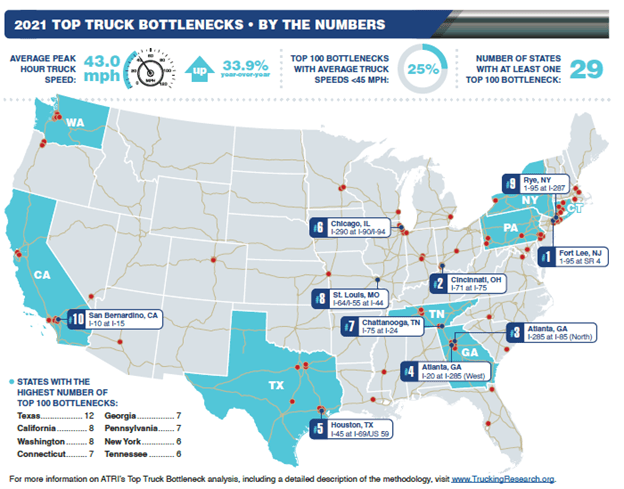
Bottlenecks cost the U.S. economy more than $42 billion in 2019, according to Federal Highway Administration data, and freight shipments suffered almost 660 million hours of delay on the nation’s roadways. Trucks experienced over 27 million days of delays with 1/3 occurring on interstates.

The American Transportation Research Institute (ATRI) has recently issued a report detailing the top 100 traffic bottlenecks in the U.S. based on GPS data from more than one million trucks at 300 specific locations. Figure 8.1 of your Heizer/Render/Munson textbook points out that one of the important site location factors is “air, rail, highway, and waterway systems” and Chapter 11 notes that “the vast majority of manufactured goods moves by truck” –which is 73% of the value of the freight. This makes the information in the ATRI report one of the critical factors when selecting a location and/or trying to reduce costs in the supply chain. The figure below shows the top 10 congestion sites in the report.

Of course, COVID has had a major effect on congestion. One study indicated that in February 2020 congestion increased due to panic-buying consumer demand. Another study showed that in March 2020 congestion decreased due to less volume of traffic on the road. On the other hand, congestion increased in 2020 because more road construction projects were able to begin and move at a faster pace due to the reduction in travel. Overall, truck speed was up 34% in 2020 compared to 2019.

Classroom Discussion Questions

  1. Amazon has chosen to locate its HQ2 on the East Coast where there is a great deal of congestion. What reasons aside from transportation would lead Amazon to make this regional decision?
  2. Does proximity to markets explain some of the reasons for the bottlenecks?


Guest Post: China Delivers Belt and Road Project to Reshape Global Trade

Dr. Steven Harrod is Associate Professor in the Department of Management Engineering at Technical University of Denmark.

China is the world’s manufacturing heartbeat, and its“ One Belt, One Road” seeks to maintain that dominant position. China has 1.4 billion people (vs. 327 million in the U.S.) and 9.38 million square kilometers of land (larger than the U.S., and twice as large as the EU). In spite of recent U.S. import tariffs against China, many manufacturers have not “reshored” production because some processed materials and components are simply not available anywhere else in the world.

The Chinese Belt and Road Initiative (BRI) was launched in 2013, and is a comprehensive plan to, by 2049, expand and strengthen international land and maritime transportation connections. The program is criticized by some for its investments in ports and transport infrastructure in other countries, especially if those countries are financially weak.

A significant component of BRI is to expand the use of railways to trade with Europe. Already today, BMW ships one full trainload of car parts to China daily for final assembly. This is a game-changer, because since the opening of China in the 1970s, China trade was synonymous with ocean shipping. A famous HBS case, Sport Obermeyer, demonstrates the supply chain problems that follow from a 30-day transportation link. Rail service today is able to deliver freight containers to Europe in half that time, and forecasts are that traffic in the EU-Asia corridor will quadruple by 2027.

In addition to the faster speed, rail service between China and Asia offers a potentially more sustainable transport service. Even though ocean ships are very fuel efficient, they still run on fossil fuels.. Railways on the other hand can easily be 100% electric. Such a large increase in traffic from China would have a dramatic effect on the EU’s railway network, which is already operating with very heavy traffic. In response, the EU also has an infrastructure development policy for freight, called TEN-T. Together, these two economic powers, China and the EU are taking steps to bring their manufacturing and consumer bases closer, and to grow their mutual trade.

OM in the News: The Psychology of Queuing at the Bus Stop

busAnyone who’s ever relied on public transportation knows that waiting can be the worst part. Even with apps that provide arrival estimates, riders can still find themselves at a loss—straining in hopes of seeing train lights in the distance, or checking phones while wondering what on earth is holding up a delayed bus. But a new study, reports The Atlantic (Aug. 18, 2015), suggests that the feelings of frustration associated with waiting can differ significantly depending on how filthy a station is, and that simple improvements could make wait time seem much shorter.

In general, the U. of Minnesota study found that riders typically overestimate shorter wait times and underestimate longer wait times (i.e. riders who waited for about 2 minutes felt like they’d waited for 5, but riders who waited for 10 minutes felt like they’d only stood around for 9.)

But that general principle was beholden to strong external factors: Riders who waited at stops where there was lots of pollution and traffic significantly overestimated their wait times. The effect was especially pronounced for those who were waiting for longer than 5 minutes, with those who waited for their rides for 10 minutes in areas that they felt were noisier and dirtier reporting that they had waited for over 12 minutes. Researchers also found a simple mitigating factor: trees. The presence of mature trees helped make wait times feel less painful, for both short and long waits, and even in areas where other negative factors were present.

Coping with tardy, inefficient, and dilapidated transit is the reality of commuters in many of America’s major metro areas. And in some places, things seem to be getting worse, not better. For instance, train delays increased 45% between 2013 and 2014 in New York City. Improving the experience of public transportation could start with something as simple as sprucing up aging and dilapidated stops, increasing their safety, and adding greenery. It might not lessen the queue time, but it may seem shorter.

Classroom discussion questions:

  1. Provide other examples of how a queue can seem to move faster.
  2. What else can operations managers do to lower the traveler’s frustration level?

OM in the News: High-Speed Rail in China and the U.S.

Why is high-speed rail an important topic in OM?  The New York Times (June 23,2011) writes of  “the very real economic benefits that the world’s most advanced fast rail system is bringing to China–and the competitive challenges it poses for the U.S. and Europe”.  Just as the interstate highway system Eisenhower built out 60 years ago made modern, national commerce more feasible in the U.S., China’s ambitious rollout of  high-speed rail is integrating that sprawling nation–though on a faster timetable at much higher speeds than anything we envisioned here.

Do we have a problem in the U.S.? After I spent 4 1/2 hours driving 90 miles from Orlando to Tampa on  a jammed interstate last week , I think we do. The last Amtrak run between the 2 cities died a decade ago. The high-speed rail proposed by the present administration (offered with a full $2 billion-plus incentive) was turned down by our new governor who feared the trains would draw few riders.

Meanwhile the new Beijing-to-Shanghai line will run at 190 miles per hour (going to 220 mph next year) and take 5 hours –while a comparable trip, say from Atlanta-to-New York– takes 18 hours on Amtrak. The Chinese railroad plans to run 180 trains a day on the route.

Work crews of  100,000 per line have built about half of the 10,000 mile network in China so far, often ahead of schedule. As the 200 mph trains link China’s provinces and cities that were previously 24 trips by road or rail, the country’s “manufacturing might and global export machine are likely to grow more powerful”, writes the Times. This makes it more convenient to base businesses in places like Hunan Province, previously isolated from the economic mainstream, but where land, electricity, and labor are cheaper.The other plus of high-speed passenger travel: older rail lines are freed up for freight. This has allowed coal mines and shippers to switch to rail from trucks.

Discussion questions:

1. Do we need bullet trains in the U.S.?

2. What are the implications of the Chinese rail plan for Europe and the U.S.?