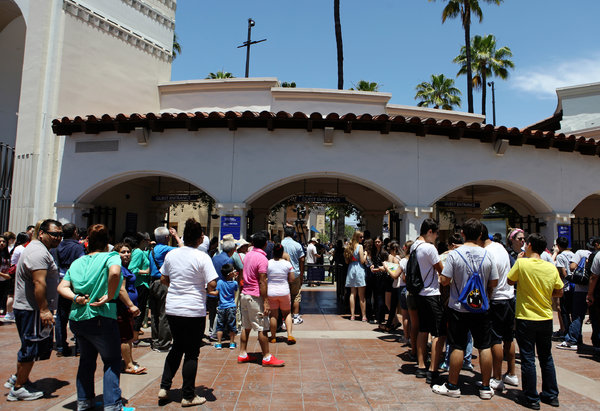
OM in the News: Orlando’s Theme Park Cluster

When organizations make location decisions (see Chapter 8), being near competitors (“clustering”) is often seen as a plus. Here in Orlando, the capital of theme parks, we take our cluster very seriously. After all, the parks are the main economic drivers and top employers. Disney’s 5 parks employ some 77,000 “cast members.” Universal Studios parks another 28,000, and SeaWorld has 22,100. Then there is Legoland, Gator Land, and others.

Riders on the Expedition Everest roller coaster at Walt Disney World’s Animal Kingdom park.

When the Universal Epic Universe theme park opens next year, it will add 750 acres populated by Harry Potter, Donkey Kong and dragons to the company’s Central Florida resort, which now includes 3 theme parks: Universal Studios, Islands of Adventure, and Volcano Bay Water Park.

Less than 10 miles down the road is Walt Disney World, the biggest part of Disney’s most important profit engine, and the stuff of dreams for tens of millions of visitors a year. Its 5 parks include: Magic Kingdom, Animal Kingdom, Epcot, Hollywood Studios, and Typhoon Lagoon Water Park.

The competition is intense, writes The Wall Street Journal (April 13-14, 2024). To understand the stakes for both companies, consider this: A common vacation itinerary includes 3-4 days at Disney World and 1-2 days at Universal. If Universal can now persuade families to spend one more day at its parks instead of at Disney, it could nab hundreds of millions of dollars in annual revenue. A family of four visiting Disney World for a 5-day, 4-night stay with Park Hopper tickets, a quick-service dining plan and a room in a moderate-tier hotel would spend upward of $5,000, not counting the cost of souvenirs or add-ons such as the Genie+ line-skipping service. Shortening the Disney leg by even a day would trim hundreds of dollars from their spending at the company’s parks and resorts.

When Walt Disney World opened in 1971, about 5 years after the death of the company’s namesake founder, adult admission cost $3.50. Visitors could roam Magic Kingdom—the only theme park on the property at the time—and take in dozens of free attractions and performances.

Attendance has since snowballed. Universal’s first theme park first opened in 1990. Islands of Adventure now attracts more than 11 million visitors a year, while Universal Studios has about 10.8 million guests. Disney’s Magic Kingdom, which has more than 17 million annual visitors, has long been the world’s most-visited theme park.

Classroom discussion questions:

  1. Why is clustering important in theme parks?
  2. Describe a different cluster, one close to your college or home.

OM in the News: Capacity Planning for Harry Potter’s World

harry potterUniversal Studios Hollywood is putting a price tag on the demand for fun, reports the New York Times (March 21, 2016). The theme park is anticipating huge crowds for the April 7 opening of the Wizarding World of Harry Potter. If you want to be one of the first to experience it, be prepared to pay more than if you want to go, say, on a slow Tuesday in September. Such variable pricing is nothing new to airlines and hotels. They have long charged higher prices on holidays and during popular seasons. Disney, as we noted in our March 1, 2016 blog is also experimenting with yield management.

Under the new Universal pricing policy, tickets bought at the gate remain $95. But visitors who book tickets online for low-demand days — such as a weekday in February before Harry Potter opens — can save up to $20. During weekends and peak demand days during spring break or summer, parkgoers save only $5 by booking online.

Harry Potter has already been wildly successful at Universal’s other parks. After a Harry Potter ride made its U.S. theme park debut at Universal’s Islands of Adventure here in Orlando 6 years ago, attendance jumped 30%.  But the initial experience was less than magical. The main attraction, a simulated broom ride, left entire families with motion sickness. At one point, the line to get into Hogsmeade village was 9 hours long. Yes, nine! When my family and I toured the attraction, there were no lines–just a mass of humanity that could not move at all.

Universal seems determined to make this introduction smoother. It chose a quieter time of year for the unveiling (spring instead of summer). Management started letting in small numbers of people in February for “technical rehearsals.” Not only is demand-based pricing designed to prevent overcrowding, but 50% more capacity has been added to the Hollywood Hogsmeade.

Classroom discussion questions:

  1. Describe yield management.
  2. What else can Universal do to improve throughput?


OM in the News: Jumping the Queue at Universal Studios

Universal StudiosSince I live in Orlando, the theme park capital of the world, the recent New York Times article (June 10, 2013) “At Theme Parks, A VIP Ticket to Ride”, caught my eye. Theme parks have traditionally been the ultimate melting pots. Tourists, retirees, rowdy teenagers, families and fathers who would rather be golfing are all thrown together in an egalitarian experience in which the queue for one is the queue for all, and cotton candy is the food of the masses. Not anymore.

As stratification becomes more pronounced in all corners of America, from air travel to Broadway shows to health care, theme parks in recent years have been adopting a similarly tiered model, with special access and perks for those willing to pay. Now Universal Studios has pushed the practice to a new level. It has introduced a $299 V.I.P. ticket (the regular admission is about $85), just in time for the summer high season, that comes with valet parking, breakfast in a luxury lounge, special access to Universal’s back lot, unlimited line-skipping and a fancy lunch.

Fearful of puncturing its utopian image, Disney has stuck to a single class of ticket. V.I.P. tour guides are available, but Disney charges an exorbitant price — $380 an hour, with a minimum of six hours — to limit demand. Business is good at both companies. Universal’s 3 theme parks in the U.S. attracted 20 million people last year, a 19% increase from 2010. The Magic Kingdom at Walt Disney World recently recorded the busiest day in its 41-year history.

The amusement park industry urgently wants to expand profits without introducing costly new rides every summer. Universal, which recorded $953 million in profit from its parks in 2012, has no major new attractions planned until next year; the V.I.P. Experience, in the meantime, is a relatively low-cost way to generate revenue and send a message of bigger and better into the marketplace.

Discussion questions:

1. What are the ethical implications in the new VIP system?

2. Explain how Universal’s model relates to Figure D.5, “The Trade-off Between Waiting Costs and Service Costs”.