Guest Post: The Dangerous State of Air Traffic Control in the U.S.

Temple U. Professor Misty Blessley brings up a very timely OM issue-air safety.

Newark Liberty International Airport (EWR) has recently experienced multiple air traffic control outages, during which radar and communication systems used to track aircraft temporarily went offline. These disruptions have lasted up to 90 seconds in several incidents. Flights into and out of EWR have decreased by approximately 35% as a result.

When an outage occurs, air traffic controllers may issue a ground stop, essentially a pause in departures, similar to a real-life game of “red light, green light”—for planes awaiting take off. While Module D of your Heizer/Render/Munson textbook introduces queuing theory, the real-
time queues at EWR are available here. In practice, incoming planes may be directed into holding patterns that resemble stacked racetracks in the sky.

However, when radar and communication systems go dark, there’s no safe way to guide aircraft into these stacks or maintain proper separation. Once communication is restored, controllers must work through the resulting queues to safely sequence and clear aircraft for landing. Outages lead to flight delays and cancellations while also raising serious safety concerns. How can the skies be stabilized?

Modernize Technology – Many Federal Aviation Administration (FAA) systems still rely on outdated technology, including some that operate on decades-old hardware such as floppy disks. The federal government is actively working to modernize these systems by investing in updated
software, hardware, and communication networks.

Support and Expand the Workforce – During the recent incidents at EWR, some air traffic controllers have taken trauma leave, underscoring the high-stress nature of the profession. The U.S. has been facing a persistent shortage of qualified air traffic controllers, due in part to limited training capacity—currently, only one FAA facility is responsible for training controllers. With low acceptance rates and rigorous requirements, meeting demand has been challenging. However, efforts are underway, including the involvement of new schools, to expand training opportunities and help grow the workforce.

Classroom discussion questions:
1. In Ch. 17, Maintenance and Reliability is discussed and Ch. 6 covers Managing Quality. What lessons can be applied to make the skies safer?
2. What domino effects are likely to ensue once the plane has safely landed? What do you think can be done to attract more air traffic controllers?

Teaching Tip: The Vaccination Assembly Line

The Orange County Convention Center, here in Orlando, is a massive and magnificent building.  At 7 million square feet (something like 146 football fields over 22 acres), it is the second largest facility of its kind in the U.S. The main exhibit hall alone seats 139, 857 people, enough to easily handle conventions such as MegaCon (68,940 in attendance), NCAA Volleyball Championships (72,000), and Design Week (85,000). But during COVID, the Center has largely sat empty, as tourism and its 125,000 related jobs in Orlando have declined dramatically.

But alas. The Convention Center has a new purpose. Its underground unloading area has been turned into a COVID-19 vaccination drive-thru assembly line! Here is an interesting example of a service assembly line (Ch.9) and a multichannel, multiphase queuing system (Module D) that you can share with your students. I just went through the system this week and was impressed by the operations planning and execution.

Work Station 1: Outside the building, a single channel queue greets you, with the server checking the bar code on your cell phone to be sure you are eligible to enter.

Work Station 2: Inside the building, the medical team scans your barcode again, takes your temperature, and attaches a barcode sticker to your arm. You drive forward 10 yards.

Work Station 3: Your arm barcode sticker is scanned and you are asked a series of medical questions. The brand of shot you will receive is announced (no choice) and you are provided informational material. You drive forward 10 yards to parallel Bays A, B, or C as directed.

Work Station 4: Your arm barcode is scanned again, you get the shot, with band aid applied. You are told to exit the building and wait in your car in the adjacent lot to see if there is a negative side effect. You are to honk your horn if you are ill.

Work Station 5: You sit in the lot for 15 minutes.

Work Station 6: You are scanned again as you exit the property and asked if you had any side effects. You never leave your car.

Total time in system, including 15 minutes in parking lot, is 25 minutes.

Classroom discussion questions:

  1. Clearly the system is efficient, but can it be made more so?

2. Can it be easily replicated in every city?

OM in the News: Kroger Thrives on OM Innovation

Kroger was able to decrease average check-out wait times from 4 minutes to 30 seconds with no additional labor.

Back in 1883 when Barney Kroger invested his life savings of $372 to start his first store, the second purchase he made was a horse and carriage so he could deliver goods to his customers. One could make the argument that Barney knew the importance of delivery before Domino’s, Amazon or Blue Apron ever existed. OM innovation has long been a tradition at Kroger, writes ORMS Today (Dec., 2017). In the early part of the 20th century, Kroger was the first grocery store to introduce self-shopping and the first to surround its stores with parking lots. It became the first company to test electronic scanners in the 1970s, and in the 1990s, one of the first with self-checkouts. Now, with 2,800 stores, Kroger serves 9 million customers a day. Here are just 2 of its latest OM advances:

Kroger developed the industry’s first real-time solution for queueing to answer the question, “What if we could open another lane the moment queueing conditions required it?” Simulation models led to a system of sensors above each entrance and register that measures the number of customers walking into stores, as well as the number of customers standing in line at each lane. Combined with a real-time POS feed, Kroger is able to make predictions on the number of customers arriving at the front end by day of week and time of day. The system tells managers on a big screen hanging above the registers how many lanes are open, how many lanes should be open now, and how many should be open in 30 minutes, in order to proactively meet the rush of customers about to arrive.

Its inventory control model, Pharmacy Inventory Optimization, helps set Min/Max re-order points for the ordering system, reducing annual out-of-stocks by 1.7 million prescriptions, labor ordering costs by $10 million, and annual inventory costs by $120 million, while increasing sales by $80 million. It was a finalist for the INFORMS Franz Edelman award.

Classroom discussion questions:

  1. How has OM helped Kroger become an innovator?
  2. Where else can OM tools be used to increase productivity in a supermarket?

OM in the News: Why Hospital ER Wait Times Are Often Wrong

Driving down the highway, you’ve undoubtedly seen a new kind of digital sign advertising local hospitals. “Current wait 5 minutes,” they say, with the wait time updating in real time to reflect the current conditions in the ER. It’s an effective form of advertising, and it gives consumers a sense of transparency about making the choice to go to the ER. Yet if you head to that nearest ER, don’t be surprised if you end up waiting longer than the sign says. “The truth behind these numbers is that they’re often wrong,” according to Insights by Stanford Business (Aug., 2017). Looking at the ERs of 4 LA hospitals and testing the effectiveness of the method for estimating wait times, the study by Stanford U. professors found the method extremely unreliable in all cases–off by as much as 1.5 hours. Drawing on queuing theory, a new model, Q-Lasso, was able to cut the margin of error by as much as 33%.

The trouble with most wait time estimates is that the models these systems use are often oversimplified compared to the complicated reality on the ground. One of the most common ways of arriving at a wait time estimate is to simply give a rolling average of the time it took for the last few patients to be seen. This works well if every patient is the same, they arrive at a steady rate, and all of their ailments take the same amount of time to diagnose and remedy. But that’s rarely the case in the real world.

So the researchers came up with a large number of potential factors to look at. Q-Lasso would then select the best of them from the data. For example, it was initially assumed that the number of nurses working would be an important criterion for assessing wait time. But the data showed this was mostly irrelevant. Q-Lasso could provide wrong times, but the model tended to overestimate wait times, rather than underestimate them, making the experience more acceptable.

Classroom discussion questions:

  1. Why are advertised wait times often wrong?
  2. Describe the Q-Lasso model.

OM in the News and Video Tip: The Psychology and Math of Queuing in Supermarkets

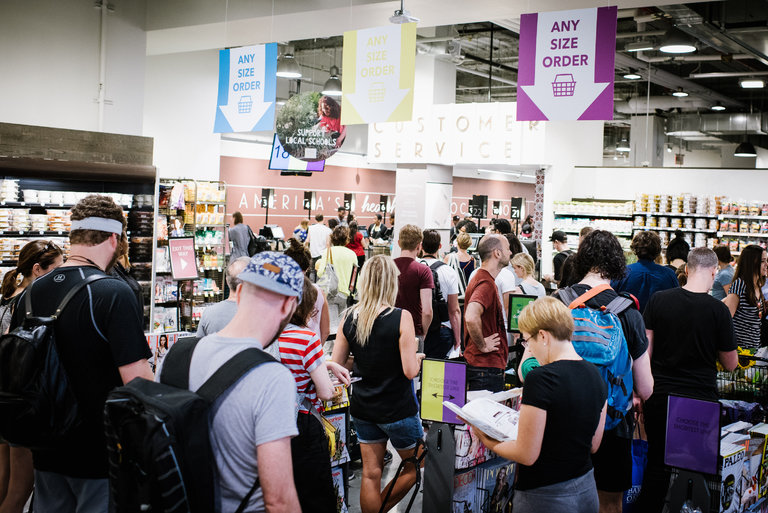
Inside a Whole Foods in Brooklyn

You dash into the supermarket for a few quick items. But when you get to the checkout lanes, they are full. Your plan for a quick exit evaporates. For anyone who has ever had to stand in line at a supermarket, here are some tips from The New York Times (Sept.8, 2016) for picking the line that will move the fastest.

  1. Get behind a shopper that has a full cart. That may seem counterintuitive, but every person requires a fixed amount of time to say hello, pay, say goodbye and clear out. That takes an average of 41 seconds per person and items to be rung up take about 3 seconds each. So getting in line with many people who have fewer things can be a poor choice. (One person with 100 items will take an average of 6 minutes to process. A line with 4 people who each have 20 items will take an average of 7 minutes).
  2. Study the customers ahead of you. It is not just the number, but their age and what they are buying. Older people will take a bit longer because they can have technical difficulties that delay the process. Also consider the number of different items they are buying. Six bottles of the same soda will go faster than 6 totally different items, some of which cannot be scanned, such as vegetables.

  3. Choose a line that leads to several cashiers. In Module D of the text, we show that this approach, known as a serpentine line, is the fastest. The person at the head of the line goes to the first available server in a system often seen at airports or banks. Getting into a single line also provides psychological relief because it eliminates the choice of where to go and second-guessing about the best line to choose. Your students will love this 90 second queuing video.

  4. The psychology of queuing has also found that waits seem shorter when you are distracted. Try talking to the person next to you or reading the magazines in the store’s racks.

 Classroom discussion questions:

  1. Why is the “serpentine” line faster on average?
  2. What does Disney do to keep visitors happy during 45-minute lines?


OM in the News: Smart Queues at Disney

Toy soldier characters greet Disney visitors

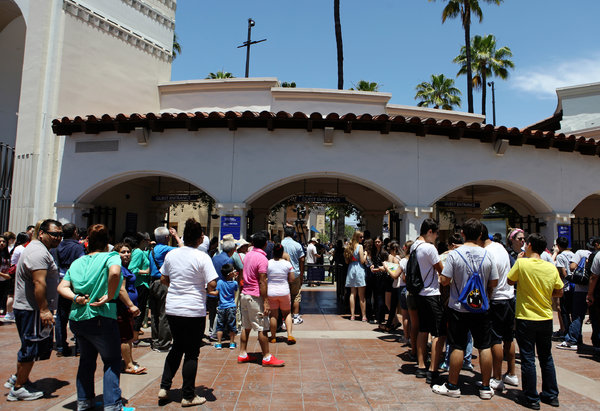
It’s one of theme parks’ biggest challenges, reports the Orlando Sentinel (Oct. 12, 2014): finding ways to ease the pain of waiting in line. Disney tried something unusual last week, when it required FastPass reservations for anyone boarding the Toy Story Midway Mania ride. Amusement parks have plenty of motivation to lessen waits, or at least make them less boring. Guests leave happier — and are more likely to return. Shorter lines at popular rides mean tourists have more time to visit secondary attractions. And time not spent in line means more cash at the registers in a park’s shops and restaurants.

A few years ago, Disney created a new underground center here in Orlando in which employees monitor crowds via computer and video camera, then decide which congestion-fighting weapons to deploy. A ride might launch more vehicles, for example, or a restaurant could open more registers. The parks’ arsenal of crowd-control tactics also includes distractions, which have grown increasingly elaborate. At Disney World’s Fantasyland, for example, kids frolic in an indoor playground until buzzers alert their families it’s time to board the Dumbo ride.

Disney has also encouraged more widespread use of the passes through its MyMagic+ billion-dollar technology project. Guests can now reserve rides and shows up to 2 months before their visits: 75% of Walt Disney World guests use FastPasses now. But don’t expect to see a lineless theme park anytime soon.Ushering guests through too many attractions too quickly, and a new set of problems is created. Visitors might get bored if they see everything too fast. “The flow within a park assumes a certain number of people will be standing in line, more so during peak periods than nonpeak periods,” says a former Disney VP. “You take them out of line, and where do they go?”

Classroom discussion questions:

1. Why are queues such an important OM issue at all theme parks?

2. What other options does Disney have for capacity planning?

OM in the News: Canada’s Psychology of Queuing

Queuing in Canada
Queuing in Canada


When Israeli-born author Ayelet Tsabari first immigrated to Canada in 1998, a strange sight caught her eye on the sidewalks of Vancouver. Beneath every Canadian bus stop sign, as if commanded by an invisible drill sergeant, citizens young and old automatically formed into neat, ordered lines. “I was wondering, ‘Why are people standing like that?’” she said. And the phenomenon is not only baffling to Israelis, writes Canada’s National Post (July 25, 2014). Ms. Tsabari described bonding with an Iraqi friend over the “foreign and strange” practice.

But from Russia to China to Italy to the entire Middle East, there are billions of people around the world who are genuinely confused by the penchant of English-speaking people to constantly form into queues. At the Canadian School of Protocol and Etiquette, lineup training comes on the same day students are taught about North American-style introductions. Students are taught where to line up, how to maintain one’s proper place in the lineup and — most importantly — how close to stand. “In certain cultures, queue etiquette is just not on the radar,” said the school director. Particularly among students from China and the Middle East, Canadian queuing norms simply would not jibe with the crowded train stations and marketplaces of their home countries.

Non-queuing in China

In China, queue-jumping is so widespread that in the lead-up to the 2008 Beijing Olympics, the Chinese Communist Party began posting queue monitors to city streets and establishing “Queuing Days” each month in which citizens were asked to “voluntarily wait in line” at shops and transit stations. Similar anti-queuing norms hold in India, where the simple act of boarding a train can become the scene of a miniature stampede. “We live in a hugely-populated, resource-constrained country … in this environment, he who hesitates is lost for sure,” wrote a New Delhi writer in a 2012 piece for the Wall Street Journal.

Classroom discussion questions:

1. What is the US culture with regard to queues?

2. Why is the psychology of queuing so different across the globe?

OM in the News: Queuing Theory at Goldman Sachs?

goldmanGoldman Sachs’ cafeteria has been described as something out of Gattaca, the 1997 science fiction film, reports The Washington Post (Oct.18, 2013).  It’s a wide-open space full of furniture that looks like it was smuggled from a utopian future in which nothing is ever dirty, broken or unintentionally asymmetrical. It isn’t just the physical design of the 11th-floor space that creates this impression. It’s the way Goldman administers it with a clever policy designed to economically engineer efficient eating.

The most crowded time of the day to eat lunch is, naturally, during lunch time. For most people, this falls around noon. This creates the phenomenon of the lunchtime rush hour. Goldman didn’t like the idea of its people waiting on long lines to get their lunch. People are capital to Goldman. It wants to use its capital efficiently. Standing on line waiting for a burger is not an efficient use of Goldman’s capital. So the cafeteria has a set of timed discounts. If you show up before 11:30 or after 1:30, you get a 25% discount on your food.

As it turns out, Goldman folks are both especially attuned to economic incentives and ruthless about capital efficiency. Some take pride that they’ve never eaten lunch inside the “cost penalty window,” as one trader referred to the 2 hours when the discount isn’t in effect. In the cafeteria around 1:20 pm, the lines at the pay registers are empty. So are many of the tables. But the area between where the food is collected and where you pay is quite crowded. The Goldman lunchers are chatting with each other, waiting for the final minutes to tick down until they can save a dollar or two.   When its spokesman was called about Goldman’s lunch market manipulation, neither he nor anyone else in his office was available around 1:30. “Goldman approves of employees using their capital efficiently,” he said later.

Classroom discussion questions:

1. What other restaurants incentivize diners like this cafeteria does?

2. Why is this system not as effective as it could be from the firm’s perspective?

OM in the News: Jumping the Queue at Universal Studios

Universal StudiosSince I live in Orlando, the theme park capital of the world, the recent New York Times article (June 10, 2013) “At Theme Parks, A VIP Ticket to Ride”, caught my eye. Theme parks have traditionally been the ultimate melting pots. Tourists, retirees, rowdy teenagers, families and fathers who would rather be golfing are all thrown together in an egalitarian experience in which the queue for one is the queue for all, and cotton candy is the food of the masses. Not anymore.

As stratification becomes more pronounced in all corners of America, from air travel to Broadway shows to health care, theme parks in recent years have been adopting a similarly tiered model, with special access and perks for those willing to pay. Now Universal Studios has pushed the practice to a new level. It has introduced a $299 V.I.P. ticket (the regular admission is about $85), just in time for the summer high season, that comes with valet parking, breakfast in a luxury lounge, special access to Universal’s back lot, unlimited line-skipping and a fancy lunch.

Fearful of puncturing its utopian image, Disney has stuck to a single class of ticket. V.I.P. tour guides are available, but Disney charges an exorbitant price — $380 an hour, with a minimum of six hours — to limit demand. Business is good at both companies. Universal’s 3 theme parks in the U.S. attracted 20 million people last year, a 19% increase from 2010. The Magic Kingdom at Walt Disney World recently recorded the busiest day in its 41-year history.

The amusement park industry urgently wants to expand profits without introducing costly new rides every summer. Universal, which recorded $953 million in profit from its parks in 2012, has no major new attractions planned until next year; the V.I.P. Experience, in the meantime, is a relatively low-cost way to generate revenue and send a message of bigger and better into the marketplace.

Discussion questions:

1. What are the ethical implications in the new VIP system?

2. Explain how Universal’s model relates to Figure D.5, “The Trade-off Between Waiting Costs and Service Costs”.

Guest Post: Teaching Inter-Arrival Times in Queuing Models

steve harrodDr. Steven Harrod is Assistant Professor of Operations Management at the University of Dayton and can be reached at steven.harrod@udayton.edu. Here is a link to his syllabus.

The single greatest challenge in teaching queuing in Module D of the Heizer/Render text is getting students to comprehend the difference between inter arrival and rate of flow. There is something deeply psychological and subconscious about this. Students frequently skim over the text and do not distinguish between the two expressions. Here is an in class exercise to practice this concept:
For each scenario in the table below, ask students to calculate the inter-arrival time and the flow rate (with answers shown in the right columns). Clearly state the unit of time measure for each answer. Each description refers to a random flow.

Inter-Arrival=time/(arrival count)       Flow, λ=(arrival count)/time=1/inter-arrivalSrteve Harrod mod. D graphic

Description

Inter-Arrival

λ

The ticket taker at the roller coaster   collected 45 tickets in 3 hours.

4 m

15/h

Cars arrive at the car wash once every 3   minutes.

3 m

20/h

Customers arrive at McDonald’s at the rate of   100 per hour.

0.6 m

100/h

Customers were recorded entering the store at   12:05, 12:07, 12:15, 12:22; 12:30: 12:31, 12:33, 12:40, and 12:50.

5 m

12/h

Fifteen passengers arrived for the 1 pm bus,   then twenty-five passengers arrived for the 2 pm bus, and then ten passengers   arrived for the 3 pm bus.

3.6 m

16.66    /h

OM in the News: Queuing Up at Heathrow

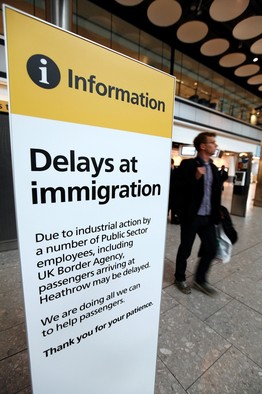
The great unknown for international travel: How long will I have to wait at immigration when I arrive? At Bangkok’s airport, it can be 2 hours. At New York’s JFK,  its 23 minutes at 3 am, but 37 minutes at 5 am.  And at London’s Heathrow,  25% of non-EEU passengers wait more than 45 minutes. (Heathrow’s target that 95% of passengers  clear with 45 minutes was breached at least 107 times during the 1st 2 weeks in April).

The Wall Street Journal (May 5-6, 2012) reports that the biggest cause of long delays is that arriving flights aren’t spaced out evenly, and that there aren’t always enough border agents to process long lines when arrivals are clumped together. “It’s simply a matter of a saturated queue, and you solve that with either more servers or shorter processing time,” says Carnegie Mellon’s Prof. Alfred Blumstein.

Since shorter processing times could mean less attention paid to security checks to keep illegal migrants or terrorists from crossing borders, airports need to add more agents to minimize wait times. Part of the challenge with staffing, of course, is that demand for passport checks varies widely throughout the day.  “We know at times queues have been too long,” says a Heathrow spokesman. He said the agency is adding 80 agents at peak times, and 480 during this summer’s Olympics.

With budgets tight, however, expanding the workforce can be difficult. Prof. Blumstein, for example, who waited for over an hour at Heathrow two weeks ago, suggested moving people sooner from the main queue into shorter lines before each desk to “shorten the dead time.” As we teach in Module D, however, if the person already at the desk takes longer than average to clear, this can increase the overall average time in queue. That can lead to frustration if others who were further behind in the queue get served first.

Discussion questions:

1. Identify which queuing model Heathrow uses now.

2. How can you improve on Blumstein’s suggestion?

Teaching Tip: Queuing Up at Disney on Thanksgiving

Having lived in the Orlando area for over 2 decades, everyone assumes my family and I are regular visitors to the Magic Kingdom and the 5 other  Disney World properties here. After all, Disney World is a powerhouse,with over 62,000 local employees (called “cast members”)  and 48 million visitors last year. So when they find I have yet to take my 13 year old son to the Magic Kingdom, I appear to be some sort of ogre. (To my defense, my kids have been to Universal, Sea World, Wet n’ Wild, Blizzard Beach, Animal Kingdom, and on and on). To overcome this pressure, we all went to Disney today, Thanksgiving, 2010.

Here is what we learned. Thanksgiving is one of the  busiest days of the year. And Disney has a clear plan for dealing with this capacity situation (Supp.7): All free passes are cancelled, all cast members are called in, extra parades are scheduled, more refreshment booths are opened, and hours are extended…the Park didn’t close till 1am!

But the queues–oh the queues! Where else would a rational family of 4 pay $340 in entrance fees, $12 to park, and $50 for water and ice cream, only to wait in a series of 45 minute lines for 5 or 6 rides and shows…and then walk away happy as can be?

Here is the secret to the psychology of queuing theory…something Disney’s flock of Ph.D.s in OR and IE have mastered: (1) Keep your customers informed of how long each queue will take,with signs posted frequently…and overestimate, don’t underestimate. (2) Entertain them while they wait, with videos, music, and cartoon characters. (3) Keep the lines moving so progress seems to be taking place. And (4), make people walk long distances between the most popular features, with plenty of interesting activities en route.

I hope this leads to some useful class discussions about how how queues can be managed. Happy Thanksgiving to all!