OM in the News: Amazon Goes Rural

In dozens of thinly populated regions across the country, Amazon is building new delivery hubs to deliver packages in around 2 days. That might not seem especially rapid at a time when the e-commerce giant is introducing one-hour delivery in some areas, but residents of some far-flung Montana hamlets were used to waiting up to a week for their orders. It is part of a $4 billion investment by Amazon to push its signature speedy delivery further into the rural recesses of the U.S., writes The Wall Street Journal (March 22, 2026)
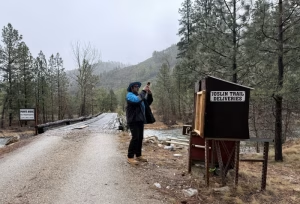
An Amazon driver taking a photo after dropping off a package in Connor Montana

The effort helps Amazon reduce its reliance on the U.S. Postal Service, a relationship that has become rocky following a dispute over contract terms. Amazon says it aims ultimately to have 200 rural delivery hubs serving around 13,000 ZIP Codes covering around 1.2 million square miles of America—an area the size of Texas, California and Alaska combined.

Delivering packages within Amazon’s signature 2-day frame means drivers contend with backcountry challenges such as bighorn sheep on the road, dangerously high winds in mountain passes and roads that are impassable during parts of the year.

Over the past decade, Amazon has expanded from major cities to regional urban centers by drawing ever larger circles of coverage. That is now allowing the company to lean on those urban hubs to speed up deliveries in ranch country. There are signs that Amazon customers in remote areas are just as likely to get hooked on speedy delivery as city slickers.

Amazon is experimenting with speedier delivery across its network as it competes with longtime rival Walmart and delivery upstarts such as Uber and DoorDash. In urban areas, the company has started offering 1-hour and 3-hour delivery as premium options. Amazon recently acquired a Swiss startup called Rivr, which is building 4-legged robots that could drop packages off on doorsteps. The e-commerce giant is also dipping its toe in the big-box retail business, with plans for a 230,000-square-foot megastore outside Chicago.

Classroom discussion questions:

  1. What are the complications in trying to serve remote locations with 2-day delivery?
  2. Why does the firm think the extra expenses will pay off?

OM in the News: Postal Package Deliveries ‘Bogged Down’ With Delays, Backlogs

Surging e-commerce volumes during the coronavirus pandemic are straining the U.S. Postal Service’s parcel network as staffing shortages and backlogs in hard-hit areas slow deliveries, reports The Wall Street Journal (June 1, 2020). The problems have delayed some packages for days and even weeks, shippers and consumers say, holding up orders at a time when many people are shopping more online to avoid infection with the virus.

The slow deliveries have complicated business for e-commerce sellers who rely on the Postal Service to ship packages at affordable rates, and tracking services have added to the frustrations, with some items appearing to get stuck at certain locations or vanishing altogether. Transit times for USPS shipments to customers in some cases doubled or even tripled in recent weeks. Like private delivery giants UPS and FedEx, the Postal Service is coping with unexpected holiday-level package volumes as the pandemic adds to operational and financial stresses. UPS is imposing extra fees to help offset those costs, while FedEx is limiting the number of items some retailers can ship.

Coronavirus has also taken a toll on postal workers. About 2,830 of the Postal Service’s 630,000 employees have tested positive for Covid-19. Between April 19 and May 23, USPS delivered 89.5% of priority mail packages on time, compared with 87.4% the prior month. (UPS delivered 96.5% of business-to-consumer shipments on time that same period). “The parcel volumes have gone up, we are probably working at a holiday volume rate, but we’re doing it with about a 74% staffing level,” said a USPS union official.

Classroom discussion questions:

  1.  Why is the USPS struggling to keep up with competition?
  2.  What can be done to meet budget deficits?

OM in the News: FedEx Goes the “Last Mile” on Sundays

FedEx just announced it would start offering Sunday deliveries to most U.S. homes, the latest sign that online shopping habits are pressuring companies to revamp their operations to fulfill orders as they are placed. With people ordering everything from saunas to sandwiches online and expecting to have them quickly appear at the door, retailers and carriers are racing to adapt to service the last mile, writes The Wall Street Journal (May 31, 2019).

And Amazon, whose sprawl of warehouses has upped the ante, is promising 1-day delivery on many items later this year. “Online shopping is 7 days a week,” says FedEx’s CEO. “So there is increasing demand from online shoppers and e-commerce shippers for 7-day service.”

With the change, FedEx plans to deliver many of the packages it currently drops at local post offices. The shift will seek to lower costs by building density along FedEx Ground routes, while also shifting 2 million packages daily out of the U.S.P.S’s network.

FedEx and UPS have invested heavily in recent years to manage the volume of e-commerce packages moving through their sorting facilities. Until recently, the companies have taken steps to outsource last-mile delivery to the Post Office, worried that home deliveries would be less profitable than shipments between businesses. But as the volumes climb—to 50 million domestic packages a day—the companies are adjusting their operations to boost market share and handle weekend deliveries. They are also experimenting with more immediate delivery options, including drones and robots (both the subjects of recent blogs).

At the same time, FedEx’s traditional business of rushing deliveries by jet across the globe has slowed. Amazon, Walmart, and others have expanded their warehouse networks, adding locations near more U.S. cities where they can store goods and ship them shorter distances.

Classroom discussion questions:

  1. What major market shifts caused FedEx to add this Sunday service?
  2. What new OM issues will FedEx face now?

OM in the News: The Self-Driving Postal Truck

The U.S. Postal Service is testing self-driving trucks on a 1,000-mile mail run between Phoenix and Dallas, the post office’s first use of the technology for long hauls. The move comes as investors and vehicle makers are spending millions on trucking automation, reports The Wall Street Journal (May 22, 2019).

The pilot uses big rigs supplied by autonomous trucking firm TuSimple to haul trailers on five round trips between distribution centers. The 22-hour trip along three interstate highways is normally serviced by outside trucking companies that use 2-driver teams to comply with federal regulations limiting drivers’ hours behind the wheel. The vehicle can continue operating without the hours-of-service restrictions of a human driver.

The Postal Service, which has been losing money for several years as letter volume has declined, is trying to restrain operating costs and is seeking ways to cut fuel expenses, improve truck safety and use its fleet more efficiently. Proponents of autonomous vehicle technology believe long-haul trucking, where operators say they have difficulty recruiting and retaining drivers, is a promising market for expanded use of the technology.

The TuSimple system uses cameras that the company says see more than half a mile ahead to spot emergency vehicles, pedestrians and road hazards. TuSimple’s technology allows “driveway-to-driveway” autonomous runs and its trucks navigate surface streets on delivery routes in Arizona for other customers..

Classroom discussion questions:

  1. What is driving this USPS initiative?
  2. How will this affect the trucking industry, if successful?

OM in the News: The “Last Mile” and USPS

As consumers demand ever-quicker and convenient package delivery, the US Postal Service wants to boost its business this holiday season by offering what few e-commerce retailers can provide: cheap next-day service with packages delivered Sundays to your home. Retail giant Walmart says it is considering the Sunday option, which could reshape weekend shopping trips to the mall.

The program, available in 20 major US cities, allows consumers to place online orders with participating retailers before a cutoff time Saturday. Postal carriers pick up merchandise from local stores for delivery the following day, similar to the Sunday package deliveries it now handles almost exclusively for Amazon in much of the US.

“The next-day weekend service is part of the Postal Service’s aggressive push into the parcel business at a time when its more lucrative first-class mail is declining in the digital age,” writes the Boston Globe (Nov. 4, 2017). With Amazon continuing to raise the bar of ‘‘free shipping’’ conveniences, from 1- or 2-day package arrivals to keyless in-home delivery via couriers, the financially beleaguered post office is billing itself as the trusted, low-cost carrier already serving every US household.

Bolstered by e-commerce growth and its Sunday operations, the Postal Service will reach new highs this year in holiday package delivery, with nearly 850 million parcels delivered from Thanksgiving to New Year’s. That 13% increase from 2016 would exceed the single-digit growth for UPS and FedEx, putting the post office on track to capture 45.6% market share in peak holiday deliveries. The post office’s growth is due in large part to its established network in the ‘‘last mile,’’ the final and usually most expensive stretch of a package’s journey to a customer’s door. UPS and FedEx already subcontract a chunk of their last-mile deliveries to the post office.

Classroom discussion questions:

  1. Why is the “last mile” an important OM issue?
  2. What are the strengths and weaknesses of the USPS model to Sunday deliveries?

OM in the News: Replacing the Postal Service With Digitized Mail

outboxJust because the USPS isn’t making mail a profitable business doesn’t mean it can’t be done, reports CNN Tech (Feb.26, 2013), as it describes the driver of a white Prius with a giant, red plastic flag affixed to its side, undelivering mail from mailboxes. The driver and the car are part of  Outbox, a company that is  picking up where the embattled  Postal Service leaves off — by digitizing physical mail. The driver visits Outbox subscribers’ homes three times a week,  collecting the letters, bills, magazines and advertisements that were deposited there by official postal workers and delivers them to a warehouse. There they are opened and photographed, and the resulting digital files are sent electronically to the recipient.

For $5 a month, this makes physical mail disappear. Using a mobile device or computer, Outbox customers can ask to be unsubscribed from junk mail, have unwanted items destroyed or request that important mail be re-delivered to their home. Not surprisingly, Outbox has met resistance from the USPS, which has refused to collaborate. “The Postal Service is focused on providing an essential service in our mission to serve the American public and does not view Outbox as supporting that mission,” says the USPS.

The USPS has been slow to innovate and adapt to new technology on its own. It also faces serious financial issues, with $15.9 billion in losses last year –and it just announced plans to cease Saturday mail delivery in an attempt to save $2 billion. Technology has steadily eaten away at its core business for years. The volume of mail handled by the USPS dropped from 203 billion pieces a year in 2002 to 160 billion in 2012, as bill payments, statements and marketers migrate online.

After its first two cities, Austin and San Francisco are fully staffed, Outbox plans to bring its service to New York, Boston, Chicago, Los Angeles and Washington. This is a great example of service technology (Chapter 7) that your class will enjoy.

Discussion questions:

1. What can the USPS do to compete in an increasingly digital world?

2. What are some major operations issues Outbox faces in its business?