OM in the News: The Inventory Return Scam

Retailers nationwide have seen online returns skyrocket over the past four years after rolling out generous returns policies to attract customers amid a pandemic-driven surge in e-commerce. The returns policies have helped change shopping habits: Consumers have grown accustomed to ordering items online in several sizes and colors, then returning what they don’t want.
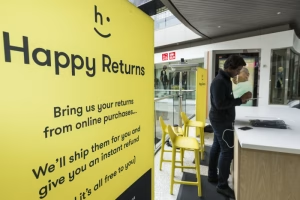
Shoppers last year returned 17.6% of items they purchased online, valued at more than $247 billion and more than double the percentage of goods returned in 2019. Returns have become such an entrenched part of online commerce that companies have sprung up to handle the growing business. UPS acquired one of those specialized operators, Happy Returns, for $465 million.

The ease of shipping goods back has also given criminals new tools to exploit in an online environment in which buyers don’t need to interact with store employees–and the scale and organization of the fraud is getting more ambitious, and organized.  More than $100 billion in merchandise was returned fraudulently in the U.S. last year, estimated to be 9-15% of the $850 million returned goods retailers received in 2024-2025, reports Supply Chain Brain (Feb. 2, 2026). 

Organized criminal groups “are taking advantage of the omnichannel retail environment,” said on industry expert. In some cases, fraudsters are returning knockoffs in place of designer goods and sending back boxes full of bricks or other filler rather than the original items. Others are manipulating shipping labels to receive a refund just from mailing back an empty envelope. Fraudsters marketing their services on Telegram and through other websites often sell their services in return for a cut of customers’ refunds.

Apparel retailer PacSun recently noticed a sharp increase in returns of online purchases, including one customer who had returned some 250 orders worth $24,000.  PacSun had issued the refunds, but the company never received the actual merchandise at its warehouse. Instead, workers found “used or different merchandise returned in the box, or even empty shoeboxes.”

Some retailers such as Amazon are taking legal action. It just sued the refunding-services group REKK that it claimed was “responsible for stealing millions of dollars of products from Amazon’s online stores through systematic refund abuse.”

Classroom discussion questions:

  1. How can the quality control inspections engaged during returns processing be defrauded?
  2. How has e-commerce made this fraud easier?

Guest Post: From No Frills to Trendy Food, Fashion and Home, Walmart’s New Product Assortment 

Professor Misty Blessley, at Temple U., cohosts many of our podcasts, as well as sharing her insights with our readers monthly.

 Value retailer, Walmart, known for focusing on price-sensitive shoppers, has moved into premium products and broader brand assortments, with the goal of winning over customers with more buying power. Appealing to higher-income customers (those earning over $100,000), requires the firm to shift from a no-frills mindset. 

The firm remains committed to everyday-low-pricing (EDLP), thus it must continue managing this highly effective strategy while integrating broader lines. This requires a supply chain flexible enough to support both high-turn grocery and slower fashion and lifestyle products, for example. 

On the inbound supply chain side, Walmart diversifies its supply base to procure new products. As is outlined in Chapter 11 of your Heizer/Render/Munson book, this requires identifying, vetting and selecting new suppliers as well as a host of supply-side tasks like vendor and contract management. 

Managing inventory requires additional adaptations. Walmart refreshed the look of its website and stores while avoiding alienating its historical customers. It did so by keeping flagship items in stores and premium lines at distribution centers. Chapter 12 outlines inventory concerns Walmart faces, from the importance of inventory record accuracy to strategies for managing inventory. 

On the outbound side, the firm’s e-commerce and fulfillment operations must be capable of satisfying wealthier customers, who often expect faster, higher-service delivery options, such as same-day delivery or premium curbside pickup. Meeting these expectations puts pressure on Walmart’s fulfillment network for more micro-fulfillment centers and localized inventory pools to reduce delivery times. Facility, inventory, and transportation cost trade-offs are also covered in Chapter 11.

Walmart is an exemplar in omnichannel retailing because it seamlessly integrates its physical stores, online platforms, supply chain, and last-mile services into a unified customer experience. Its customers purchase and receive products when, where and how desired. Walmart is offering frills next to its no-frills strategy.

Classroom Discussion Questions:

  1. How would you call upon Ch. 11 and 12 as a Walmart supply chain manager? 
  2. Some firms target different customer segments under different brand names. For example, Gap Inc. owns Gap, Old Navy, Banana Republic and Athleta. Walmart has chosen a different strategy. How is Walmart capable of serving its price-sensitive and wealthier customers under one brand?

Guest Post: Omnichannel Operations–Where Technology Meets Retail Strategy

Dr. Prince Vijai is Assistant Professor of Operations at IBS Hyderabad, India. This post is based on his recent presentation at the DSI meeting in Orlando.

In today’s retail world, customers expect a smooth and unified experience across both online and offline channels. This customer expectation has turned omnichannel inventory management into a strategic necessity. By integrating supply chain management, information systems, and analytics, retailers can ensure that products are available where and when customers need them – across stores, warehouses, and digital channels.

Centralized inventory visibility is the key enabler of this unified commerce inventory strategy. Instead of managing separate stock pools, leading retailers maintain a unified view of inventory across all sales channels. This reduces overstocking, prevents stockouts, and supports flexible fulfillment options, such as ship-from-store, click-and-collect, buy online pickup in-store (BOPSIS), and dropshipping.

To achieve this omni-channel inventory visibility, real-time data synchronization is essential. Technologies like Shopify APIs and AWS Lambda update stock levels instantly as purchases occur, ensuring accuracy across systems. NoSQL databases, such as DynamoDB or Firebase, provide the scalability and speed necessary for these continuous updates.

Leading retailers clearly demonstrate the benefits of such integrated omnichannel operations. Zara uses RFID for item-level tracking, enabling rapid replenishment and online fulfillment from its stores. Nike uses a unified commerce platform to synchronize data across its physical and digital channels. Amazon exemplifies data-driven order routing and fulfillment efficiency.

As omnichannel operations mature, the role of the Omnichannel Planner is emerging. This is a professional skilled in analytics, ERP, and API integration who aligns supply with demand across channels. Such expertise ensures a balance between operational efficiency and superior customer experience.

The key omnichannel retail trends include unified commerce integration, adoption of practical generative AI, enhanced inventory visibility, flexible fulfillment options, and personalized in-store experiences. These strategies aim to strike a balance between customer value and operational efficiency, driving agility and competitiveness.

Ultimately, omnichannel inventory management represents more than just logistical coordination – it’s a foundation for business agility and customer satisfaction. Retailers mastering this capability gain a decisive edge in speed, accuracy, and trust in a competitive, data-driven marketplace.

 Classroom Discussion Questions

1.How does real-time data synchronization enhance both customer experience and retailer performance?

2. What future technologies could further improve omnichannel inventory visibility?


Guest Post: Forecasting, Inventory Management, and “No-Buy 2025”

Professor Misty Blessley at Temple U. looks at the “No- Buy” movement.

Thanksgiving is just 3 months away, and Christmas only 4, but the holidays are long upon retail supply chains. At the same time, a growing number of consumers are pushing back against the pressure to spend, embracing a movement known as “No-Buy 2025,” which is gaining serious traction.

At its core the movement is a consumer mindset focused on refraining from non-essential purchases for a set period, for some an entire year. Trending on online communities are people sharing their No-Buy challenges and success stories. Some are motivated to cut debt or save for long-term goals, while others are concerned with sustainability, minimalism, or anti- consumption values. Participation is surging, especially among millennials and Gen Zs, who are juggling inflation, student debt, and climate anxiety.

Baby boomers, in contrast, are known to possess a large portion of total disposable income and to spend on luxury and leisure items. Participants are cutting back on categories often linked to impulse spending or excess and are instead using what they have:
 Apparel and accessories
 Home décor and seasonal items
 Beauty and skincare
 Toys and impulse gifts
 Functioning electronics

Why It Matters for Supply Chains
No-Buy 2025 has a ripple effect on retail supply chains. The holiday season typically drives massive retail volume, but with intentional non-buying, companies could face missed orders if underestimating demand or excess inventory if forecasts are too high.

Many demand forecasts rely on past trends, but for some generational cohorts demand is eliminated or potentially delayed. Retailers may need to reconsider their demand planning models, where inventory is held in the network, and be aware of consumer behavior (e.g., generational preferences, while remembering that generalizations are, by nature, generalizations). Supply chains that account for today’s values will be best positioned to respond.

Classroom discussion questions:
1.  What are the shortcomings with traditional time-series and seasonality forecasting methodologies given the no-buy movement?

2. Do you think the product categories identified above should be forecasted differently when compared to one another? Why?

3. How does the purchasing power of various generational cohorts come into play?

Note: The Silent Generation (born 1928-1945), Baby Boomers (born 1946-1964), Generation X (born 1965-1980), Millennials (born 1981-1996), Generation Z (born 1997-2012), and Generation Alpha (born 2013-2024).

OM in the News: Self-Checkout Era May Be Ending As Major Retailers Shut It Down


For over a decade, self-checkout was the retail future, speed, convenience, and cost savings. However nine of the largest retailers in the world are kicking these systems to the curb in an unbelievable reversal, reports MSM.com (June 30, 2025).

The numbers are brutal. Theft at self-checkout can be up to 65% higher than at regular lanes, with shrinkage hitting 3.5% of sales compared to just 0.21% with human cashiers. One study found 15% of users admit to stealing at kiosks, and 44% say they’d do it again. That adds up to over $10 billion in losses for food retailers each year. It’s not just career criminals. With no one watching, people blur the lines, blaming tech errors or telling themselves it doesn’t hurt anyone. With self-checkout transactions 16 times more likely to involve theft, stores are realizing the convenience comes at a staggering cost

As retailers like Dollar General and Walmart scale back self-checkout, the industry seeks a new approach balancing efficiency with personalized service. Self-checkout may save on payroll, but it comes with theft, tech breakdowns, customer frustration, and weakened brand loyalty.

Dollar General has taken one of the boldest steps away from self-checkout. Last year, the chain yanked self-checkout from 12,000 of its 20,000+ stores, dropping its earlier push toward 100% self-service locations. Its CEO  blamed “shrink,” or inventory loss, calling self-checkout the company’s biggest obstacle. Remaining kiosks now cap purchases at five items.

Five Below quietly pulled self-checkout from its highest-risk stores, revealing a tough truth, automation doesn’t work everywhere. Returning to staffed lanes did more to curb theft than adding extra security. The data showed that some neighborhoods saw massive spikes in shoplifting when kiosks went unmanned. So the company tailored its checkout systems based on local risk.

Walmart is testing a new tactic: limiting self-checkout access to Walmart+ members in select stores. It’s a bold shift that makes automation feel more like a premium perk than a standard option. The move helps reduce theft by tying kiosk use to verified customer accounts.

Amazon’s grand vision for cashierless shopping hit a wall last year when it dropped “Just Walk Out” from its Fresh grocery stores. The tech, which was supposed to track purchases automatically, relied heavily on human reviewers, over 1,000 people in India checking transactions manually. Some 70% of purchases needing intervention.

Classroom discussion questions:

  1.  Do you think self-checkout is going to fade away?
  2. What technology is needed to improve the system of self-checkout?


Guest Post: Fashion Influencers and Revamping Costly Product Returns


Temple U. Professor Misty Blessley raises an interesting inventory issue–returns.

Fashion influencers and their followers are contributing to the increase in rising product returns. According to the National Retail Federation, returns accounted for 17% of retailers’ total 2024 sales. Online purchases have a 26% return rate compared to in-store purchases (10%). Many online shoppers intentionally buy items they plan to return. Statista reports that clothing (24%), shoes (16%), and accessories (12%) are the most returned products – the exact product footprint of fashion retailers. Several recent articles shed light on the influencer effect and tips for revamping costly product returns in retail fashion. 

Fashion influencers have popularized trends that promote returns behavior:

  1. Hauls: Influencers showcase purchased fashion items, then decide whether to keep or return them based on follower feedback.
  2. Wardrobing: Influencers buy items for temporary use such as content creation and return them afterward.
  3. Bracketing: Influencers buy multiple sizes or colors of a product to find the perfect fit, with the intention of returning the rest. About 58% of consumers buy multiple sizes for this reason, with 75% of returns attributed to fit.
  4. Influencing: 56% of followers make purchases recommended by an influencer, many of which are later returned.

Returns come with significant costs, including shipping, restocking, reselling at a discount, and administrative expenses. Retailers are adopting strategies to curb or better manage returns:

  • Charging return fees: Brands like Zara and H&M now charge for returns.
  • Clarifying return policies: Shortened return windows, stricter conditions for full refunds, and more items marked as final serve to narrow return opportunities.
  • Improving sizing tools: Enhanced size charts, virtual reality fitting tools, and online fitting rooms help shoppers make better choices.
  • Implementing logistics systems: Retailers are investing in digital tools to streamline and manage returns more efficiently.

As discussed in Chapter 1 of your Heizer/Render/Munson textbook, best practice can be achieved when operations and supply chain management, marketing, and finance work together.

Classroom discussion questions:

  1. After 89% of retailers adjusted their policies to deter returns, 59% saw return rates increase. What factors could explain why these policies fail to get the desired result?
  2. The SCOR Model, discussed in Chapter 11, outlines attributes for processes like source, make, and deliver. How are the attributes for returns like or different from these processes?

OM Podcast #20: Manufacturing and Operations at Nautique Boats

In our latest podcast Barry speaks with VP of Operations at Nautique, Kris Hanigosky, about operations for this luxury ski boat manufacturer (known for its iconic Ski Nautique). They discuss maintaining the highest levels of quality, the importance of accuracy in forecasting and inventory management, and innovative approaches to employee retention through upskilling.


Did you know our podcast is now available on Apple podcasts? Just go to your Apple podcasts app, search “Heizer Render OM Podcast,” and subscribe to get all our podcasts on your mobile device as soon as they come out!

Transcript

A Word document of this podcast will download by clicking the word Transcript above.

Instructors, assignable auto-graded exercises using this podcast are available in MyLab OM. See our earlier blog post with a recording of author and user Chuck Munson to learn how to find these, or contact your Pearson rep to learn more! https://www.pearson.com/en-us/help-and-support/contact-us/find-a-rep.html

OM in the News: Shein Markets Its Supply-Chain Technology to Global Brands

China-founded Shein has built a bargain fashion empire with a pioneering small-batch manufacturing model, reports The Wall Street Journal (March 21, 2024). Now it is planning to open that up to global brands and designers. It is calling the new initiative “supply chain as a service.”

Shein contracts with thousands of factories in China that churn out tens of thousands of new styles daily.

The move represents a shift in business strategy as Shein faces challenges in the U.S., its biggest market.  Under the plan, Shein would make its supply-chain infrastructure and technology available to outside brands and designers, allowing them to leverage Shein’s system for testing out new fashion items in small batches and track how popular they are with consumers.

Shein has rapidly expanded from a discount Chinese apparel seller to a global fashion brand with the help of its small-batch, on-demand manufacturing model, and now sells to more than 150 countries. It has revolutionized fashion manufacturing as it contracts with thousands of factories in China that churn out tens of thousands of new styles daily. It places orders to suppliers to be delivered in days, relies on real-time data to quickly analyze demand and replenishes orders as needed. That cuts down on the cost for storage and limits inventory waste, a primary reason for its ultralow prices.

By making its supply-chain ecosystem more widely available to brands, Shein is refocusing on its powerful capabilities to manufacture and distribute fashion products efficiently.

Shein’s popularity in the U.S. has drawn the attention of lawmakers, who have pressed Shein to address whether it sources cotton from China’s Xinjiang region, where the U.S. has accused Chinese authorities of committing genocide and of using forced labor in its repression of mostly Muslim Uyghurs, allegations Beijing denies. Shein has said it has a “zero-tolerance policy” for forced labor.

Classroom discussion questions:

  1. What is “supply chain as a service”? Why is Shein offering this service?
  2. How has Shein revolutionized the apparel industry?

OM in the News: Walmart and “On-time, In-full” Shipments

This is the latest shift in a logistics effort that has historically left companies scrambling to meet the retail giant’s demands.

Walmart wants suppliers to deliver shipments on time 90% of the time and in full 95% of the time, down from a 98% benchmark for both measures set in 2020 amid a surge in consumer demand. The change marks a significant lowering of Walmart’s “on-time, in-full” (or OTIF) thresholds that are meant to increase the efficiency of Walmart’s sprawling U.S. logistics network of distribution centers serving the company’s thousands of stores.

Walmart has been working to get tighter control over its inventory as it fulfills more online orders from its stores and competes on home-delivery speed with e-commerce giant Amazon.com. Vendors that fall short of Walmart’s on-time, in-full targets face fines worth 3% of the cost of the goods that didn’t arrive on time or in full.

Walmart last shifted its thresholds in September 2020, when it tightened the requirements as supply-chain disruptions left many store shelves empty of high-demand products during the Covid-19 pandemic. The latest change comes as the retailer returns to more normal ordering patterns after years of struggling with sharp fluctuations in stocking levels during the pandemic. The greater equilibrium in supply chains has helped relieve pressure on suppliers.

Consumer packaged-goods vendors delivered an average of 84% of orders on time in 2023. Walmart’s lowered thresholds should be welcome news to vendors that have struggled to meet the 98% benchmarks. “Very, very rarely do things go perfectly as planned with deliveries. Trucks break down or get caught in traffic, and orders are sometimes packed with the wrong quantity and mix of items, such as orange-flavored soda instead of grapefruit,”  said one industry expert.

Classroom discussion questions:

  1. Why is Walmart changing its OTIF policy?
  2. How does impact suppliers?

OM in the News: Retailers, Rising Theft and Shrinkage

As retailers report on the busy holiday shopping season, operations managers will be trying to get more understanding into shrinkage and theft, reports The Wall Street Journal (Jan. 9, 2024). The stores are fighting a growing wave of theft, cutting into profits that were already under pressure. But theft is just one contributor to shrink, the industry term for the difference between inventory on the books and what’s physically on hand. Lost or damaged goods and inaccurate records also play a part.

Shrink is now one of the most frequently discussed topics among management at Home Depot, said the firm’s CFO, having moved onto its list of top priorities two years ago. That focus hasn’t changed even though some mitigation efforts, such as locking up certain items and using live-view parking lot cameras, are in place.

The higher shrink may partly reflect a return to prepandemic norms rather than entirely new trends in theft. Reduced visits to physical stores starting in 2020 simultaneously decreased the opportunities for theft, an effect that dissipated as shoppers stepped out of their houses again.

Dollar General’s gross profit rate, or its profit as a percentage of net sales, fell 5% last quarter, due primarily to increased inventory shrink, more markdowns and lower inventory markups. Shrink is a roughly 100-basis-point headwind for Dollar General. Dick’s Sporting Goods  expects shrink’s impact on its gross margin to be roughly 50 basis points higher in its current fiscal year compared with 2022.

Retailers have said they are responding by adding security personnel and technology, locking up goods and closing hard-hit stores. Target, which last year said that shrink was expected to cut into profitability by more than $500 million, closed nine stores, citing higher theft and safety concerns for shoppers and workers. Nike closed one of its Portland stores in 2022 amid issues with theft. Academy Sports & Outdoors is using locked shelves for certain items and outfitting some departments that have seen higher shrink, such as the baseball bat section, with sensors that indicate when people linger in an area. Some retailers, such as Costco, are less exposed to theft for reasons including that they sell larger, harder-to-steal products, and stores are laid out with one primary entrance and exit.

Classroom discussion questions:

  1. Why is this an OM issue?
  2. What would you do, as a supermarket manager, to cut shrink?

OM in the News: Nike Becomes a Supply Chain “Changemaker”

Sportswear giant Nike has cut lead times for orders from 60 days to just 10 days by installing over a thousand automated machines at supplier factories across manufacturing processes. The machines handle cutting, cementing, shoe assembly and solemaking, helping to increase efficiency and reduce labor times. Nike has also developed methods to produce footwear with 30% fewer production steps, and 50% less labor.

These “supply chain responsiveness” innovations are part of what makes the company a retail supply chain “changemaker”, that is, a firm bringing new technology to its supply chain operations.  Retailers and brands are trying to overcome the turbulent backdrop of rapid inflation, shifting geopolitical disruption, and fragile global supply chains, writes Supply Management (July 18, 2023).

Nike has adopted radio-frequency identification and QR technologies over the past four years as part of efforts to create a single view of stock across global operations, which helped boost inventory visibility throughout the organization. The switch to more digital-led customer relations granted the company tighter control of its supply chain – now, its product distribution operations are centered around just 40 retail partners, compared to 30,000 at its peak.

Nike has aspirations to compete with Amazon’s delivery model by speeding up delivery times. The premise is of consolidating inventory from stores, retail partners and warehouses – meaning, for example, if a retail partner does not have stock it could connect with a Nike store nearby that does.

“Consumer preferences have changed forever, which will continue to send shockwaves up and down the supply chain. One day it’s out-of-stocks, the next month a glut of inventory is on the books. To get ahead of these supply chain shocks and manage unforeseen black swan events, complete supply chain visibility with trusted data has become a modern mandate,” says one industry leader.

Aldi and Tesco are two other top retail changemakers thanks to their investments in logistical efficiency, their integration of digital solutions, and their focus on reducing waste and emissions across their supply chains.

Classroom discussion questions:

  1. What is a “changemaker” in the supply chain world?
  2. What are some of the challenges of managing supply chains in today’s global economy?

OM in the News: Fast Fashion, Shein, and Inventory

Fast fashion was invented by companies such as Zara, and to a lesser extent H&M, in the late 1990s, when the companies took the latest styles seen on the catwalk and brought similar products to market. For companies such as Zara, it took 3-4 weeks to bring a simple T-shirt from design to the stores and 6-8 weeks for a jacket or a dress. But the category fell out of favor in recent years as consumers became more critical of the apparel industry’s impact on the environment.

If what Zara did in the ’90s was fast fashion, Shein’s version is “ultrafast fashion,” reports The Wall Street Journal (May 31, 2023).  Shein’s inventory on average takes around 40 days to turn over. That is about half of what it takes for Zara. The quick-turn strategy goes against industry trends. In general, apparel companies’ inventory turnover has lengthened over the past two decades. (Last year Shein accounted for 1.7% of apparel-industry sales in North America, making it the fourth-largest clothing seller behind Nike, Old Navy and Lululemon).

Shein’s pop-up store in Paris

With its supply base in China, Shein has a well-oiled test-and-scale model: It produces 100 to 200 pieces of any given product at launch and then increases production only if demand is strong. That results in little excess inventory, which in turn helps its bottom line. On the supply side, it milks efficiencies by using a digital manufacturing system. The system asks Shein’s extensive supplier base to share real-time capacity and tags each of them based on category strengths and weaknesses. To minimize costs, Shein selects master fabrics and requires designers to choose from the pool.

Shein’s meteoric rise shows that trendy and cheap have enduring appeal. While Gen Z cares about sustainability, it also values self-expression. Even though the company has said it has no suppliers in Xinjiang, China, where there are allegations of forced labor, the company is hedging its bets with plans to source more fabric from India.

Environmentally friendly resale platforms such as ThredUp and The RealReal made their debuts to great fanfare, but their appeal among shoppers has proven transitory. Allbirds, a footwear brand that boasts environmentally friendly practices, has seen its popularity fizzle, too. Shoppers like to see green credentials, but Shein’s popularity has shown that cash always looks greener.

Classroom discussion questions:

  1. What is Shein’s inventory advantage?
  2. Describe the firm’s production strategy.

OM in the News: Chipotle Rolls Out RFID for Food Traceability

We note the increasing role of RFID (Radio Frequency ID) tags, which are smart bar codes that can automatically identify and track inventory, in our Process Strategy and Inventory chapters (Ch. 7, 12). This blog has addressed RFID in retailing, warehousing, the drug industry, hospitals, at Disney, and in luggage control at airports. (Type RFID in the search box on the right, below, to read about these applications).

Now, Chipotle Mexican Grill is translating the technology to the food industry. Chipotle has scaled up its use of RFID to trace ingredients from suppliers to restaurants in real-time, writes Supply Chain Dive  (May 23, 2023).

The restaurant chain has asked all of its suppliers to tag products with RFID. Chipotle is doing final testing use of the technology on a regional basis, and plans to roll it out nationally in the coming months.

“There’s no restaurant company in the U.S. that has this visibility into inventory on the national level,” says the company’s VP-Supply Chains. “Not one.”

The use of RFID is part of Chipotle’s herculean effort over the past few years to better trace its ingredients following a headline-grabbing E. coli outbreak in 2015 that sickened over 1,000 customers and took a bite out of profits.

Using RFID gives Chipotle a real-time snapshot of its inventory across distribution centers and restaurants, but the technology also benefits the company’s suppliers. Vendors can use Chipotle’s RFID system to improve their own inventory management processes and cut down on repetitive tasks.

Poor inventory management can lead to more food waste, as was the case in 2018 when the FDA ordered the destruction of all romaine lettuce due to limited visibility into suppliers.

“It is imperative to know where your products come from and where they are at all times,” the firm’s VP added. “You have to have very, very good visibility of that supply chain and the value chain so that if something were to happen, you can address it right away.”

The cost to integrate the technology is also minimal since RFID readers already complement existing scanners in Chipotle restaurants.

Classroom discussion questions:

  1. Reviewing past blog posts, summarize the use of RFID in three other industries.
  2. Why is Chipotle implementing this system?

OM in the News: Retailers Make Big Bets on Tiny RFID Chips

A customer uses the RFID-based self checkout system at the Uniqlo store in New York

At all Uniqlo’s stores in the U.S. and Canada, shoppers can checkout simply by placing their goods in bins of automated stations. Unlike the self-checkout process at many stores, customers of the casual apparel retailer don’t need to scan individual items or look up prices on a screen—they can simply drop their items in a bin and pay.

This next-generation process is powered by radio frequency identification readers inside the checkout machines, which automatically read hidden RFID chips embedded in price tags. Uniqlo (Asia’s top clothing retailer) embeds these chips into their price tags—allowing it to track individual items from its factories to warehouses and inside stores. That data is critical for Uniqlo in improving the accuracy of inventory in stores, adjusting production based on demand, and getting more visibility into its supply chain, reports The Wall Street Journal (April 8, 2023).

Newer and cheaper RFID chips, reader hardware, and software are enabling retailers to implement the technology at lower cost and with more precision.  The cost of RFID tags has fallen from 60 cents a tag a few decades ago to 4 cents a tag, and reader hardware has improved in range and accuracy.

An article of clothing in the self-checkout system.

RFID has resulted in significant reduction in out-of-stock items on the Uniqlo sales floor, and has contributed to improving customer satisfaction. While the most common use for RFID is improving inventory management (a topic we address on page 496 in Chapter 12), the use of RFID at self-checkout machines is gaining traction as more apparel retailers explore ways to apply the technology once their merchandise has been tagged. Most apparel brands plan to implement RFID this year or next.

The unique benefit of an RFID-based checkout system is that it is faster and more accurate than barcode-based self-checkout machines. Many retailers still rely on printed bar codes, which require manual scanning and are more limited in the data they carry.  Since Uniqlo rolled out the machines, customers have reduced their wait time at checkout by 50%. Computer vision (see page 291 in Chapter 7), a form of artificial intelligence that analyzes images, is still too expensive for widespread use for self-checkout and inventory management.

Classroom discussion questions:

  1. How does RFID work? What are its strengths and limitations?
  2. Why is RFID implementation speeding up at retailers?

OM in the News: Inventory “Shrinkage” on the Rise

Retailers regularly conduct a physical count of their inventory and compare it to what is recorded on their books. The difference is known as shrinkage, a broad term that encompasses not just internal and external theft but also process failures that could lead to inventory being lost or recorded inaccurately.

Shoppers now face items locked in glass cabinets in NYC and other cities

Target just announced that it expected the shrinkage problem to reduce gross margins for the year by over $600 million. TJX and Macy’s also reported higher shrink rates. The shift in shoppers returning to stores after a surge in online buying during the pandemic is partly responsible, writes The Wall Street Journal (March 13, 2023). More theft happens in stores, as opposed to warehouses that fulfill online orders. But a never-seen-before jump in organized retail crime in certain U.S. cities is also a factor.

External theft, which includes organized retail crime in addition to regular shoplifting, has become a bigger piece of the pie. Organized retail crime, involving rings that steal from stores in bulk and then peddle the goods online, cost retailers $720,000 for every $1 billion in sales. Seven years ago, theft by employees was the largest category of loss by retailers. Now, it’s external theft.

Retailers are combating the problem by adding security guards and cameras to stores, locking up goods and making use of facial recognition software to help identify repeat offenders. Macy’s is using radio frequency identification (RFID) tags to better track inventory, adding more security personnel to stores and securing high-end brands with locked cables and sensors.

Retailers and shoppers say there is a fine line between deterring criminals and annoying honest customers. “Retailers are locking up everything from shaving cream to soap,” said one customer. “These should be things that are quick and easy to grab and go. But now I’ve got to find an employee to unlock them for me.”  Some retailers agree they may have gone too far in their theft-prevention measures. Macy’s used to keep German shepherds in its Manhattan flagship for security sweeps, but discontinued the practice in 2015.  NYC police now ask shoppers to take off their face masks before entering stores, a measure intended to help them better identify criminals. The plea came after four men stole  $1.1 million of goods from a jewelry store.

Classroom discussion questions:

  1. What tools does Chapter 12 suggest stores use to control shrinkage?
  2. What is causing the theft increase?