Guest Post: Fast or Free? The New Tradeoff in E-Commerce Shipping

Dr. Jon Jackson is Associate Professor – Operations Management at Providence College

For years, e-commerce conditioned shoppers to expect near-instant gratification. Fast shipping became the industry standard as retailers tried to keep pace with Amazon. First, it was 2-day shipping, then next day shipping, and ultimately same day shipping. But the economics behind those fast-shipping promises are starting to crack, and retailers are quietly resetting expectations, according to a recent report in The Wall Street Journal (Mar. 6, 2026).

Shipping costs have risen sharply in recent years. Major carriers such as FedEx and UPS have increased base rates annually while adding fuel surcharges, residential delivery fees, and dimensional pricing rules. As a result, retailers are increasingly shifting their focus from “fastest delivery” to “lowest cost delivery.”
Amazon now offers customers a small discount if they choose a slower delivery date. Many other retailers have followed suit by introducing “no-rush” shipping that may take a week or longer.
Interestingly, customers appear willing to wait. McKinsey surveyed over 1,000 people in 2024, and speed of delivery dropped from the #1 priority in 2022 to the #5 priority in 2024. Meanwhile, the cost of delivery maintained its high priority, with more than 95% of surveyed shoppers saying that they prefer free standard shipping instead of paying for faster shipping.
Longer delivery windows help logistics networks operate more efficiently. When retailers promise delivery in 5-7 days instead of two, carriers can consolidate shipments onto fuller trucks, lowering the cost per package. Some retailers even encourage customers to choose delivery days later in the week when shipping networks are less congested.
Another unexpected benefit: fewer returns. Retailers report that extending delivery times leads to more intentional purchases and significantly lower return rates. The era of “fastest possible shipping” may not be ending, but it is becoming just one option among many.
Classroom Discussion Questions
  1. If customers say they prioritize low shipping costs over speed, how should retailers redesign their fulfillment and delivery strategies?
  2. Do you think slower shipping could become the new norm in e-commerce, or will competition eventually push retailers back toward faster delivery times? Why?
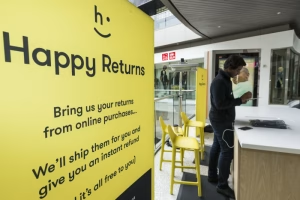
OM in the News: The Inventory Return Scam

Retailers nationwide have seen online returns skyrocket over the past four years after rolling out generous returns policies to attract customers amid a pandemic-driven surge in e-commerce. The returns policies have helped change shopping habits: Consumers have grown accustomed to ordering items online in several sizes and colors, then returning what they don’t want.

Shoppers last year returned 17.6% of items they purchased online, valued at more than $247 billion and more than double the percentage of goods returned in 2019. Returns have become such an entrenched part of online commerce that companies have sprung up to handle the growing business. UPS acquired one of those specialized operators, Happy Returns, for $465 million.

The ease of shipping goods back has also given criminals new tools to exploit in an online environment in which buyers don’t need to interact with store employees–and the scale and organization of the fraud is getting more ambitious, and organized.  More than $100 billion in merchandise was returned fraudulently in the U.S. last year, estimated to be 9-15% of the $850 million returned goods retailers received in 2024-2025, reports Supply Chain Brain (Feb. 2, 2026). 

Organized criminal groups “are taking advantage of the omnichannel retail environment,” said on industry expert. In some cases, fraudsters are returning knockoffs in place of designer goods and sending back boxes full of bricks or other filler rather than the original items. Others are manipulating shipping labels to receive a refund just from mailing back an empty envelope. Fraudsters marketing their services on Telegram and through other websites often sell their services in return for a cut of customers’ refunds.

Apparel retailer PacSun recently noticed a sharp increase in returns of online purchases, including one customer who had returned some 250 orders worth $24,000.  PacSun had issued the refunds, but the company never received the actual merchandise at its warehouse. Instead, workers found “used or different merchandise returned in the box, or even empty shoeboxes.”

Some retailers such as Amazon are taking legal action. It just sued the refunding-services group REKK that it claimed was “responsible for stealing millions of dollars of products from Amazon’s online stores through systematic refund abuse.”

Classroom discussion questions:

  1. How can the quality control inspections engaged during returns processing be defrauded?
  2. How has e-commerce made this fraud easier?

Guest Post: From No Frills to Trendy Food, Fashion and Home, Walmart’s New Product Assortment 

Professor Misty Blessley, at Temple U., cohosts many of our podcasts, as well as sharing her insights with our readers monthly.

 Value retailer, Walmart, known for focusing on price-sensitive shoppers, has moved into premium products and broader brand assortments, with the goal of winning over customers with more buying power. Appealing to higher-income customers (those earning over $100,000), requires the firm to shift from a no-frills mindset. 

The firm remains committed to everyday-low-pricing (EDLP), thus it must continue managing this highly effective strategy while integrating broader lines. This requires a supply chain flexible enough to support both high-turn grocery and slower fashion and lifestyle products, for example. 

On the inbound supply chain side, Walmart diversifies its supply base to procure new products. As is outlined in Chapter 11 of your Heizer/Render/Munson book, this requires identifying, vetting and selecting new suppliers as well as a host of supply-side tasks like vendor and contract management. 

Managing inventory requires additional adaptations. Walmart refreshed the look of its website and stores while avoiding alienating its historical customers. It did so by keeping flagship items in stores and premium lines at distribution centers. Chapter 12 outlines inventory concerns Walmart faces, from the importance of inventory record accuracy to strategies for managing inventory. 

On the outbound side, the firm’s e-commerce and fulfillment operations must be capable of satisfying wealthier customers, who often expect faster, higher-service delivery options, such as same-day delivery or premium curbside pickup. Meeting these expectations puts pressure on Walmart’s fulfillment network for more micro-fulfillment centers and localized inventory pools to reduce delivery times. Facility, inventory, and transportation cost trade-offs are also covered in Chapter 11.

Walmart is an exemplar in omnichannel retailing because it seamlessly integrates its physical stores, online platforms, supply chain, and last-mile services into a unified customer experience. Its customers purchase and receive products when, where and how desired. Walmart is offering frills next to its no-frills strategy.

Classroom Discussion Questions:

  1. How would you call upon Ch. 11 and 12 as a Walmart supply chain manager? 
  2. Some firms target different customer segments under different brand names. For example, Gap Inc. owns Gap, Old Navy, Banana Republic and Athleta. Walmart has chosen a different strategy. How is Walmart capable of serving its price-sensitive and wealthier customers under one brand?

OM in the News: Delivery Wars!

A decade ago, Walmart’s thousands of stores across the country made it look like a dinosaur in the online-shopping era, writes The Wall Street Journal (March 8-9, 2025). Now the retail giant is mounting one of the few serious challenges to Amazon’s dominance in e-commerce, and those very stores are central to its strategy.

Samantha Atkinson became a Spark driver last year to supplement her income. When Walmart workers load the car of a delivery driver, one order generally goes in the trunk, the second in the back seat and the third in the front passenger seat to prevent delivery errors.

Walmart delivered 5 billion items on the same day they were ordered last year, double the number delivered in 2023It can now deliver most of the 120,000 products in its supercenters, including meat, eggs and milk, to 93% of U.S. households the same day, sometimes in hours. “I am very, very grateful that we have 4,700 stores,” which now double as fast-delivery hubs, says Walmart’s CEO. To make most of those speedy deliveries, the retailer relies on thousands of freelance drivers using a system called Spark, created by Walmart, which uses an app to coordinate online orders. Tens of thousands of Spark drivers, who aren’t Walmart employees, make the majority of same-day deliveries.

About 41% of U.S. e-commerce sales go through Amazon, a much bigger share than Walmart’s 9%. But Walmart had $681 billion revenue in 2024 versus Amazon’s $638 billion. Over years of attempts, tests and failures, Walmart has carved out a niche that has Amazon working to catch up—fast delivery of online orders that often include inexpensive groceries, and increasingly other items it sells in its stores, such as clothing, batteries and prescription medicines.  Walmart gets more than 50% of its revenue from meat, eggs, lettuce and other groceries. It has used its scale to drive down prices for those items, which draw shoppers for regular trips.

Walmart’s same-day delivery coverage has stretched from 76% of U.S. households 2 years ago to 93% today.

Amazon also continues to expand rapidly. It has over 1,000 shipping facilities around the U.S., and more than 200 million people globally subscribe to its Prime membership. The similar Walmart+ offers free delivery for orders over $35.

But Amazon has struggled to dominate the fresh-food delivery business. It’s tried several models for delivery through Whole Foods and Amazon Fresh.

Classroom discussion questions:

  1. How does Walmart’s delivery service compare to Amazon’s?
  2. What is Walmart’s strategic advantage? Amazon’s?

OM in the News: Saks Pairs Robots with Workers

Staff and collaborative robots, or cobots, work together in this Saks warehouse

Seven months after launching its stand-alone e-commerce unit, Saks Fifth Avenue has started shipping online orders from a high-tech Pennsylvania warehouse, deploying dozens of autonomous robots programmed to help workers find Giambattista Valli gowns and Christian Louboutin pumps.

With its robots and new facility, both operated by GXO Logistics, Saks is aiming to keep up with skyrocketing online sales, reports The Wall Street Journal (Oct. 28, 2021). Like many other retailers, Saks has been flooded by stay-at-home shoppers since Covid.

“Advances in robotics, coupled with AI and machine learning capabilities, have created exciting possibilities in automated warehouse design,” said GXO’s CIO. Many of these advances enable fulfillment-center operators to boost efficiency and speed up deliveries, he said. “Technology is enabling greater precision in inventory management. Pairing workers with robots is a winning combination.”

Robots being used by Saks—known as cobots, because they collaborate with human workers—stand 4 feet tall and move about the warehouse on wheels. They are equipped with large computer screens, which are used to display images of items that workers need to gather for an order. The robots rapidly cross-reference incoming orders with a map of product locations in the warehouse and quickly guide workers to the items. From there, workers pick up the items and route them to the appropriate delivery bay.

The system helps move goods through the fulfillment process twice as fast as manual processes alone. That kind of speed will be crucial for online retailers, like Saks, as they gird for what is expected to be a busy holiday shopping season.

The move to the new high-tech facility is part of a broader plan to boost the retailer’s use of advanced digital technology to support an aggressive growth strategy. “We are focused on elevating the entire experience,” said Saks’ VP, “from how customers discover our offering, to how they engage with us, to how the product arrives at their home.”

Over the past 2 years the e-commerce unit’s sales increased 82%. Even as vaccines make it safer to return to physical stores, many customers are sticking to online shopping habits picked up during pandemic lockdowns.

Classroom discussion questions:

  1. How does this warehouse differ from that of an Amazon center? (Hint: see the Global Company Profile for Ch. 12 in your Heizer/Render/Munson text)
  2. Describe the technology used at this Saks facility.


OM in the News: Retail Haves and Have-Nots

Whole Foods gears up

The coronavirus pandemic has led many retailers to close stores temporarily and millions of Americans to do nearly all their shopping online, writes The Wall Street Journal (March 25, 2020). Particularly crippled have been retailers that haven’t embraced e-commerce or sell nonessential items such as fashion. Online sales for apparel and footwear retailers plunged this month.

By contrast, online sales at general-merchandise retailers have soared, jumping 50% in one day, March 13, compared with a year ago. Giant sellers such as Amazon and Walmart have struggled to keep up with the surge in demand, and those 2 companies are among a dozen large retailers looking to hire roughly 500,000 people in coming weeks.

The reliance on e-commerce is poised to grow as efforts to stem the virus have darkened stores and limited travel. Foot traffic to U.S. stores fell 58% in March. Roughly 1/3 of U.S. households now say they have used online grocery pickup or delivery. More than 40% tried it for the first time this month (including myself today with a grocery order to Whole Foods. It arrived in perfect shape in one hour!) Some retailers, though, that appear to have well-oiled e-commerce machines have been overwhelmed by rising demand. Grocery delivery time slots are hard to find at Walmart and Amazon in many markets.

“Impulse purchases will be lost,” said an industry exec. “Walmart and Target will do well as people stock up on supplies. But fashion retailers will be hurt.” One exception: lounge wear. As more people work from home, they are stocking up on comfy clothes including sweatpants and robes! (The number of sold-out tracksuits rose 36% this year). But for now, most shoppers are staying away from stores unless they are buying groceries or other essential items.

Classroom discussion questions:

  1. Which of the 8 techniques for improving service productivity in Table 7.3 in your Heizer/Render/Munson text are being implemented by the on-line shopping changes?
  2.  Table 1.2 summarizes the 10 OM decisions around which your text is based. How is each impacted by the current operations environment?

OM in the News: Walmart’s Secret Weapon Against Amazon–the Supercenter

A robot scans for product levels at a Walmart

“After years of internal debate about how to compete with Amazon, Walmart recently revealed the centerpiece of its plan to thrive in an e-commerce era: giant stores,” writes The Wall Street Journal (Dec. 21, 2019).

Walmart said it wasn’t going to win by building an unprofitable e-commerce operation or other stand-alone ventures. Instead, its supercenters will be the heart of a web of businesses all working together to attract shoppers and drive profits. The supercenters are sprawling stores of around 180,000 square feet offering 100,000 products, bathed under LED lights. Groceries, clothes, camping gear and TVs are for sale; customers can fill medical prescriptions, transfer money or get their hair done. They’re often open 24 hours and are community gathering spots, or a place for senior citizens to take a walk in cold weather–a re-emphasis on the giant outlets Walmart started building in the 1980s.

Walmart poured investment into e-commerce operations by lowering prices online, spending more on marketing and prioritizing faster shipping to better integrate its store and online activities for shoppers. The company took “Stores” out of its corporate name as “a symbol of how customers are shopping us today and how they’ll increasingly shop us in the future,” said its CEO. The company plans to add e-commerce warehouse capacity to have more of its products available for next day delivery. Like Amazon, Walmart also plans to invest in more capacity to offer fulfillment services and warehousing for third-party merchants—the outside companies that list their goods on Walmart.com.

The retailer has largely weathered the shift to online shopping and the rise of Amazon. Sales from U.S. stores and websites have risen for 20 straight quarters, as Walmart added online grocery pickup in store parking lots, cleaned up stores and lowered prices. As other traditional retailers lose customers and fail to compete, Walmart has increased its market share.

Classroom discussion questions:

  1. What is Walmart’s operations strategy, using the three competing approaches in Chapter 2 of your Heizer/Render/Munson text?
  2.  How does it differ from Amazon?

Happy New Years to all our readers–from Jay, Barry and Chuck!

OM in the News: Walmart Matches Amazon With One-Day Shipping

“Walmart wants to one-up Amazon in the fight for online shoppers”, writes Material Handling & Logistics (May 15, 2019). The world’s largest retailer is rolling out a next-day delivery service to counter Amazon’s recent move to speed shipment times for top customers to just 1 day from 2. Walmart customers in Phoenix and Las Vegas who buy at least $35 worth of goods now get free 1-day shipping. The offer will be applied to 220,000 items and will reach 3/4 of the U.S. by the end of 2019.

Unlike Amazon, which will spend $800 million this quarter to reduce delivery times, Walmart said its shift will actually cost the company less since the items will typically come in just one box from a single warehouse that’s closest to the customer. Keeping a tight lid on expenses is paramount for Walmart, whose domestic e-commerce business isn’t profitable. Walmart has plowed billions into e-commerce to carve out a piece of the market where Amazon rakes in almost 50 cents of every dollar spent online.

The next-day shipping applies to a broad range of merchandise — up to twice the number of items found in a typical Walmart supercenter — and include paper towels, dog food and diapers. Unlike Amazon’s 1-day delivery, which is available for its Prime customers who pay an annual fee of $119, Walmart’s service will be available without a fee.

Walmart will rely on its existing network of national and regional transportation companies to handle deliveries. For the past year, Amazon has offered to help entrepreneurs fund startup delivery businesses to expand its own logistics capacity. Walmart, meanwhile, has experimented with having its staffers make deliveries on their way home from their shifts.

Classroom discussion questions:

  1. What are Walmart’s strengths and weaknesses in this battle?
  2. How do the strategies of the two giants differ?

OM in the News: A New Twist on Reverse Logistics

Walgreens has struck about a dozen deals with companies in a bid to increase pharmacy revenue.

Some retailers believe that getting more directly involved in reverse logistics could them win new customers. Walgreens and Nordstrom will let online shoppers at other brands and retailers pick up or return orders at stores, the Wall Street Journal reports (April 17, 2019), a sign of how retailers are teaming up in new ways to draw customers as more shopping shifts online. Walgreens will offer package pickup and returns at more than 8,000 U.S. locations to companies including Levi Strauss and Urban Outfitters. For example, when shoppers want to return a product purchased on Levi.com, they can choose to ship it to Levi, drop it off at a Levi store, or take it to a Walgreens store.

Nordstrom will test the tactic at Los Angeles-area stores with a group of brands. The strategy highlights how e-commerce is pressing retailers to adjust to changing consumer habits and reset relationships between brands and stores. Department store Kohl’s has helped drive the trend by allowing Amazon returns at about 100 of its stores.

The rise of Amazon and new shopper habits have prompted many brick-and-mortar retailers to reevaluate how they allocate space. Last year, Saks Fifth Avenue moved its beauty department from its traditional spot on the high-traffic first floor in some stores, rebuilding on the 2nd floor to provide more room to offer services and compete with rivals.

Chains are also forming partnerships that would have been unthinkable years ago, including carving out real estate for their competitors in the name of getting people in the door. The industry is still grappling with how to navigate the logistic and competitive challenges these partnerships can bring.

Classroom discussion questions:

  1. Is it easy to set up such reverse logistics systems?
  2. What are the ramifications of Sak’s layout decision?

OM in the News: Warehousing Moving to Retail Locations in the New E-Commerce World

Empty stores and shopping centers are increasingly being converted into warehouse and e-commerce distribution centers. One recent study, reported in Material Handling & Logistics (Feb. 4, 2019),  found a surprisingly wide variety of retail-to-warehouse conversions. The projects include the total demolition of obsolete malls to be rebuilt as warehouses in Baltimore, Atlanta, Chicago, and Detroit. Other retail structures that were left standing after the retailers closed their doors also have been repurposed for industrial uses, including a former Toys ‘R’ Us in Milwaukee now occupied by a transmission manufacturer, and Sam’s Club’s conversions of 12 of its stores to distribution centers.

Freestanding big-box stores closer to population centers than they are to warehouse districts are the primary candidates for conversion. These retail structures also typically offer dock doors, ample parking and clear heights compatible with industrial usage. Major retailers who are choosing to expand their omni-channel platforms are transforming underperforming retail properties into e-commerce-driven logistics spaces.

Larger-scale vacant retail properties, such as malls and community centers, are more often purchased by industrial developers and then demolished to be replaced by new industrial construction that is designed to meet the physical requirements of prospective space users. Factors favoring the targeting of retail space for conversion include the prime locations of many retail centers, which often sit at busy intersections or highway interchanges. Another advantage is site access. Standalone big-box stores in particular offer backend docks and easy access for trucks. They also have the needed high ceilings.

“These types of conversions were once unthinkable, and now they’re not only happening, they’re gaining traction,” says one industry leader. “That industrial uses can overtake what are usually higher-rent uses illustrates the strength of demand for industrial real estate, especially last-mile distribution centers.”

Classroom discussion questions:

  1. What are the advantages and disadvantages of converting malls to warehouses?
  2. What is happening to other malls as they lose retail tenants?

OM in the News: UPS, Capacity, and a Busy Holiday Shipping Season

UPS is counting on a big boost in shipping capacity to avoid logjams in its network during the peak holiday shipping season, and the delivery giant is raising prices to help offset those investments. The company is planning to deliver 800 million packages in the U.S. between Thanksgiving and Christmas, up from 750 million last year, reports The Wall Street Journal (Oct. 25, 2018). Nearly every delivery day during that stretch will see volume of more than 30 million packages!

To handle the surge in packages driven by online shoppers, UPS is building more automated sortation hubs, including its 3rd-largest U.S. facility that just opened in Atlanta. UPS says it has added 7 times more processing and sorting capacity this year than it did in 2017. To offset those costs, it is pushing up prices on domestic deliveries and adding surcharges on oversize packages. In the U.S. business, revenue per piece rose 4.8% in the 3rd quarter, the fastest growth since 2011.

UPS also working closely with more of its largest shipping customers, like Amazon, on better forecasting demand during the period, including predicting volume based on where it’s shipped from and coordinating with shippers when they have promotions. The company hopes to avoid unexpected volume surges that caused delivery delays in the past. “The last couple (years) we’ve been constructively dissatisfied,” UPS’s COO said. “Our goal is to have this peak be the peak we all want it to be through the eyes of our customers.”

UPS is addressing its recent declining profit by trying to woo more higher-quality businesses—including small- and medium-size customers and health care companies—to offset predominantly lower-margin shipments tied to e-commerce.

Classroom discussion questions:

  1. What tactics for matching capacity to demand that we discuss in Supplement 7 is UPS employing?
  2. How might UPS’s moves impact profit and revenue?

OM in the News: Big Bets on the On-Line Home Delivery Grocery Business

Nine miles of conveyor belts within FreshDirect‘s new Bronx distribution center weave through the 400,000-square-foot warehouse

On a typical evening at online grocer FreshDirect LLC’s highly automated distribution center in NYC, workers fillet, wrap and label individual orders of swordfish and then push the packages on conveyor belts that run through the building. Trucked in that day from Nova Scotia, the fish might spend less than 24 hours there before hitting the streets bound for homes from Connecticut to Washington, D.C.

Designed to keep food fresh longer and move it faster, the operation is the online grocer’s multimillion-dollar bet on the fastest-growing sector in the grocery business. FreshDirect helped build the e-commerce home-delivery market, and now with Amazon and big grocery chains like Kroger piling on investments, companies are jockeying for position in the growing business, reports The Wall Street Journal (July 18, 2018). Amazon, Target and others have invested hundreds of millions of dollars to expand food delivery and build out their grocery e-commerce operations.  Peapod has expanded to 24 markets and is investing in technology to cut its handling and delivery costs. Walmart’s Jet.com will open a fulfillment center in NYC this fall to help roll out same day grocery deliveries there.

The grocers are trying to solve one of the toughest problems in home delivery: Getting food to doorsteps in the same condition consumers would expect if they went to the store themselves. Delivering perishables is tricky: Fruit bruises, meat spoils, eggs break. Botched deliveries can upend dinner plans, leaving customers angry, and hungry.

FreshDirect’s logistic hurdles start well before delivery. It must get products from its suppliers to the building, process the food, then pick, pack and ship orders before the quality degrades. So the new facility has 15 different temperature zones. Tomatoes do best at 55 degrees, but chicken and meat like it to be 32 degrees, which gives them more of shelf life.

Classroom discussion questions:

  1. List each of the 10 OM decisions that FreshDirect is facing now?
  2. Why is NYC a hub of on-line groceries?

OM in the News: Warehousing Adapts to the E-Commerce Boom

Prologis, the largest provider of logistics real estate in the U.S., is building the first multi-story warehouse in the U.S. in Seattle

The e-commerce boom is reshaping the entire supply chain, creating both demand for warehouse space and changing the way businesses store goods, reports Supply & Demand Chain Executive (March 13, 2018). In the past, warehouses have generally been on the outskirts of cities, isolated from high population density, partially so that goods could be moved without hindrance. But now warehouse space is at a premium, especially closer to population centers to facilitate next-, or even same-day shipments. “In the previous model you didn’t need to move things all that quickly,” said one industry expert. “In this compressed dynamic, you’ve got to push into cities and places where people live.”

Warehouse design also is changing. The average new warehouse built in the U.S. from 2012- 2017 is 143% larger and 3.7 feet higher than the last construction peak. Multi-story warehouses, popular in Asia and Europe, have joined the U.S. warehouse landscape to maximize space. Mega-warehouse markets have also just gotten bigger.

There has also been an increase in facilities called inland ports that are used to get freight closer to population-dense areas faster and cheaper. Inland ports are inland intermodal rail terminals that allow for less-expensive over-land rail transit from seaports before a container moves to a truck. Storage rates inland are also cheaper.

Some warehouses are physically changing as well. Fulfillment operations take up more space than traditional pallet and bulk storage and often require new equipment like conveyor belts and sorting or packaging machinery. It also requires additional labor resources working throughout the day to pick, pack and ship orders.

Classroom discussion questions:
1. Why is there interest in multi-story warehouses now?

2. Why have they been popular in Europe?

OM in the News: Apparel 2.0: Here Comes On-Demand Manufacturing

Amazon continues to cast a shadow over the apparel industry. Not only does the e-commerce giant create pricing headaches for major clothing manufacturers, but the company’s supply chain efficiencies and trove of consumer data are exceedingly hard to match.

The next shot from Seattle could be even more disruptive. Amazon has a patent for a process covering the on-demand manufacturing of clothing and other products in a computerized method, writes SeekingAlpha.com (April 29, 2017). (See the graphic below). The patent says the technology can be applied to a broad range of items, “including clothing or fabric products, accessories, footwear, bedding, curtains, towels, etc., in a wide variety of materials including, but not limited to paper, plastic, leather, rubber, and other materials.”

“By aggregating orders from various geographic locations and coordinating apparel assembly processes on a large-scale, the embodiments provide new ways to increase efficiency in apparel manufacturing,” reads the patent. The implication is that excess inventory would be no longer be a problem.

Amazon, which already has it own brands of shoes, dresses and suits, is also planning to develop a line of activewear. While it’s unclear in what direction Amazon’s apparel push will go, on-demand apparel manufacturing could create a broad reset in the textile industry.

The Amazon patent shows the process starts when customers submit their online orders. Patterns are printed onto rolls of fabric.

Classroom discussion questions:

  1. Why is Amazon moving in this direction?
  2. What is “on-demand manufacturing”?

OM in the News: Amazon Takes Flight

amazon-prime-airChristmas is always Amazon’s busiest period and in 2016 it is gearing up to deliver 220 million packages between Black Friday and Xmas eve in the US alone. This time though, reports The Financial Times (Dec. 20, 2016), the logistical challenge will be helped by Amazon’s new fleet of 767 cargo jets. Some 15 of those planes are already in operation, with 25 more set to be delivered next year. Perfecting its shipping network is key to Amazon’s e-commerce business, which has never generated much profit. Amazon spent a record $4.2 billion on shipping in the 4th quarter of last year, and that figure is expected to grow this year.

While Amazon flights are mostly moving goods from one Amazon warehouse to another — and the company still relies on UPS, FedEx and the USPS — the growth of its new cargo fleet underscores that Amazon is serious about becoming a big presence in air freight. Over the past few years, Amazon has expanded its logistics capabilities and taken more hands-on control, adding not only planes but also truck trailers and fleets of urban drivers. This is a costly strategy, and one that carries fresh risks if things go wrong.

This holiday period will be a test of new systems, new process, new relationships, and a test of the labor markets. In previous years delayed packages could be blamed on the carriers, but that will apply less as Amazon takes matters into its own hands.

The rise of e-commerce has led to a surge in mailed packages — something that all carriers will be struggling to deal with this season. And we are still at the front end of a dramatic shift (without much historical data) in the way consumers behave. Faced with that uncertainty, Amazon is betting that its own networks will eventually prove cheaper and more reliable than the alternatives.

Classroom discussion questions:

  1. Is Amazon moving away from its core competence?
  2. What are the advantages and disadvantages of the new fleet?