OM in the News: Netflix Streamlines its Old Business

The Netflix Fremont, CA. factory

It was just past sunrise at Netflix’s Fremont, CA., DVD operations hub, where metallic arms whirred in a giant glass box and rolling carts holding millions of DVDs lined the walls”, writes The New York Times (July 27, 2015). The company’s iconic red envelopes buzzed through an assembly line at the other end of the warehouse. The machine sucked a returned Netflix mailer into the system and then proceeded to slice open the envelope, identify and clean the disc inside, check that the DVD worked and reinsert it into the original sleeve. That disc was then returned to the storage carts or shipped out to another customer who had requested the title.

About 3,400 discs zip through the rental return machine each hour, 5 times as many as when teams of Netflix employees used to process the discs by hand. The machine symbolizes the way Netflix has managed to maintain a profitable physical DVD operation even as it transforms itself into a global streaming service. Netflix has 5.3 million DVD subscribers, a significant falloff from its peak of about 20 million in 2010; still, the division continues to churn out hundreds of millions of dollars in profit each year. And behind the scenes, OM analysts are trying to improve customer service and streamline the labor-intensive process of returning, sorting and shipping millions of DVDs each week.

Netflix has kept a core base of DVD customers, particularly in rural zones with lackluster Internet service and among people who want access to the breadth of its selection. To hold on to those profitable customers, Netflix continues to deploy state-of-the-art technologies that help trim costs as well as improve customer service. In Fremont, Netflix used to employ about 100 people to handle the returning, sorting and shipping of the DVDs. Today, about 25 employees work through the night, largely assisting the machines.  “Embrace change — that’s what I’ve learned here at Netflix,” says the general manager.

Classroom discussion questions:

1. Why does Netflix continue to invest in warehouse technology?

2. What OM tools discussed in Chapter 7 would be useful to Netflix?

OM in the News: A New Wave of Machines for Cutting and Carving

A Glowforge laser cutter at work on a wooden iPhone case. The computer-guided consumer device has a  $2,000 price
A Glowforge laser cutter at work on a wooden iPhone case. The computer-guided consumer device has a $2,000 price

The desk space next to PCs first welcomed paper printers and later made room for 3-D printers that could conjure any shape from spools of plastic. Now new devices, including laser cutters and computer-controlled milling machines, are coming out of industrial workshops and planting themselves on desktops, reports The New York Times (Feb. 16, 2015).

Laser cutters have been around for decades, used in industrial manufacturing applications to engrave or slice through almost any material you can think of, including steel, plastic and wood. The computer-controlled lasers in them make precision cuts that would be almost unimaginable by hand, except by highly skilled artisans. The machines have developed a strong following among jewelry makers, print makers and other artisans, many of whom have hung shingles out on craft sites like Etsy. Laser cutters are best suited to creating 2-D objects, though they can also be used to produce more intricate 3-D objects like lamps or sculpture by cutting flat pieces that are assembled later.

One start-up, the Other Machine Company in San Francisco, has created a device, the Othermill, that acts like a reverse 3-D printer. Rather than building up a 3-D object by creating layers of material, as a 3-D printer does, the Othermill uses spinning bits to cut away at blocks of, for example, wood, metal or plastic. The machine, which costs $2,199, weighs about 16 pounds, so it can be carted around in a car. Other Machine’s CEO said the company had sold the machine to chocolatiers who milled wax molds for their candies on the device. “There is no technological reason why everyday people don’t have access to manufacturing tools,” she said.

Classroom discussion questions:

1. Why is this tool important to the OM field?

2. How doe laser cutters differ from 3-D printers?

OM in the News: Amazon’s Robots Get Ready for the Holidays

These orange robots are the fruits of Amazon's 2012 purchase of Kiva Systems for $775 million
These orange robots are the fruits of Amazon’s 2012 purchase of Kiva Systems for $775 million

“Amazon‘s robot army is finally falling into place,” writes The Wall Street Journal (Nov. 20, 2014). The Seattle online retailer has outfitted several U.S. warehouses with squat, orange, wheeled Kiva robots that move stocked shelves to workers, instead of having employees seek items amid long aisles of merchandise. At a 1.2-million-square-foot warehouse in Tracy, Calif., Amazon just replaced 4 floors of fixed shelving with the robots. Now, “pickers” at the facility stand in one place and wait for robots to bring 4-foot-by-6-foot shelving units to them, sparing them what amounted to as much as 20 miles a day of walking through the warehouse. Employees at robot-equipped warehouses are expected to pick and scan at least 300 items an hour, compared with 100 under the old system.

In May, Amazon said it planned to deploy 10,000 Kiva robots by year-end, up from 1,400 at the time. At the heart of the robot rollout is Amazon’s relentless drive to compete with the immediacy of shopping at brick-and-mortar retailers by improving the efficiency of its logistics. If Amazon can shrink the time it takes to sort and pack goods at its 80 U.S. warehouses, it can guarantee same-day or overnight delivery for more products to more customers. The robots could also help Amazon save $400 million to $900 million a year in fulfillment costs by reducing the number of times a product is “touched.” The robots may pare 20% to 40% from the average $3.50-to-$3.75 cost of sorting, picking and boxing an order.

This is our 4th blog about the Kiva robots at Amazon over the past few years. To read earlier posts and view a short video, just type Kiva into the search engine box on the right.

Classroom discussion questions:

1. Why did Amazon buy Kiva Systems?

2. What are the advantages and disadvantages of using robots in the fulfillment process.

OM in the News: Robots That Kill

robot cage“The Return of the Killer Robots”—sounds like the title of a bad sci-fi movie!  But The New York Times (June 17, 2014) reports the dangers that robots pose to the humans who work alongside them, documenting at least 33 workplace deaths and injuries in the U.S., a number may well understate the perils ahead.

Robots have long toiled alongside workers in factories and warehouses, where they load boxes with items ordered online, drill and weld car parts, or move food from one conveyor belt to the next.

Unlike today’s robots, which generally work in cages, the next generation will have much more autonomy and freedom to move on their own. “In order for robots to work more productively, they must escape from their cages and be able to work alongside people,” said one industry expert. “To achieve this goal safely, robots must become more like people. They must have eyes and a sense of touch, as well as the intelligence to use those senses.”

Until now, robots have largely been used in manufacturing, particularly in the auto industry. They have mostly been “dumb robots,” designed for repetitive tasks that are dirty, dangerous or dull. But the robots whose generation is being born today collaborate with humans and travel freely in open environments where people live and work. They are products of the declining cost of sensors and improved artificial intelligence algorithms in areas such as machine vision. The Baxter robot, which does repetitive jobs in workplaces like packaging small items, is designed to sense humans and stop before coming in contact with them. It also has a display screen that cues those who are nearby about what the robot is focusing on and planning to do next.

Classroom discussion questions:

1. Describe some service applications of robots.

2. How are robots a part of Computer-Integrated Manufacturing (CIM), discussed in Chapter 7?

OM in the News: Jay Leno–The Advanced Manufacturer of the 21st Century

jay lenoAlmost everyone knows Jay Leno, the comedian, host of NBC’s “Tonight Show” and avid classic-car and motorcycle collector. Far fewer know Jay Leno, the advanced manufacturer, writes The Wall Street Journal (June 11, 2013).

Leno houses his more than 200 cars and motorcycles in solar-powered warehouselike buildings near LA that span 110,000 sq. ft. In one of the structures is an expansive shop equipped with an impressive array of 21st-century machines, including a Stratasys industrial-grade 3-D printer, a NextEngine scanner, a Fadal computer-controlled mill and a (very pricey) KMT Hammerhead water jet cutter that can slice through steel. Along with a battery of more-traditional metal machining equipment, the tools allow Leno and his small crew to fabricate just about any auto part that has been produced in the past 100 years.

“The days of going to a junkyard and trying to find an auto part that says Packard or Franklin on it are over,” Leno says. “We can make almost anything we need right here in the shop ourselves.” For his 1906 Stanley Steamer, “We took the worn piece and copied it with a scanner that can measure about 50,000 points per second. That created a digital file or image of the part, which we can modify in the computer if there are imperfections or defects in the part being scanned. Then you feed that data into the 3-D printer and, presto, you have a mold that will allow you to cast a brand new part.”

For a modest investment by virtually any industrial measure, Leno has been able to extricate himself in a meaningful way from the globe’s vast network of producers, distributors and sellers. As he puts it, “We’ve sort of gone off the grid.” He agrees that the new tools will increasingly empower other individuals and entrepreneurial ventures to make increasingly sophisticated things themselves. “Manufacturing started out with craftsmen making stuff in small cottage industries. In many ways, I think we’re going to go back to that cottage-industry model.”

Discussion questions:

1. What are the OM implications of this story?

2. Why does Leno cast his own parts?

OM in the News: Barbies, Auto Parts Hot Off the 3-D Press

Ford forges ahead with 3-D printing of this engine cover

Companies such as GE, Ford and Mattel are pushing 3-D printing further into the mainstream than most people realize, writes The Wall Street Journal (June 6, 2013). Unlike traditional techniques, where objects are cut or drilled from molds, resulting in some wasted materials, 3-D printing lets workers model an object on a computer and print it out with plastic, metal or composite materials.

Ford Motor The auto maker sees a future where customers will be able to print their own replacement parts. A customer could log onto the Web, scan a bar code or print up an order, take it to a local 3-D printer, and have the part in hours or minutes. Ford is currently using 3-D printing to prototype automobile parts for test vehicles. Ford engineers use industrial-grade machines that cost as much as $1 million to produce prototypes of cylinder heads, brake rotors, and rear axles in less time than traditional manufacturing methods. Using 3-D printing, Ford saves an average of one month of production time to create a casting for a prototype cylinder head for its EcoBoost engines. The traditional casting method, which requires designing both a sand mold as well as the tool to cut the mold, can take 5 months.

General Electric GE’s Aviation unit prints fuel injectors and other components within the combustion system of jet engines. Building engine airflow castings by melting metal powders layer by layer is more precise than making and cutting the parts from a ceramic mold.

Mattel The toy maker used to sculpt prototypes of toys from wax and clay before building the production models out of plastic. Today, Mattel engineers use any of 30 3-D printers to create parts of virtually every type of toy that it manufactures, including popular brands such as Barbie, Max Steel, Hot Wheels cars and Monster High dolls.

Discussion questions:

1. Can Mattel ever let its customers print their own toys from software files?

2. Why are 3-D printers such an important OM tool?

OM in the News: 3-D Printing Moves to Human Organs

“Need an artery for bypass surgery or custom cartilage for that worn-out knee?”, asks The Wall Street Journal (Sept.18, 2012). Then just hit “print” on your 3-D printer.

In laboratories across the U.S., biomedical engineers are working on ways to print living human tissue, with the goal of producing personalized body parts and implants on demand. These tissue-engineering experiments represent the next step in a process known as computerized adaptive manufacturing, in which industrial designers turn out custom prototypes and finished parts using inexpensive 3-D computer printers.

Instead of extruding plastic, metal or ceramics, these medical printers squirt an ink of living cells– called shorthand bioprinting. The machines can build up tissue structures, layer by layer, into all sorts of 3-D shapes, such as tubes suitable for blood vessels, contoured cartilage for joints, or patches of skin and muscle for living Band-Aids.

At Cornell, researchers are printing heart valves, knee cartilage and bone implants. At Wake Forest, bioengineers are printing kidney cells and are working on a portable unit to print healing tissue directly into burns or wounds. At the University of Missouri, researchers have printed viable blood vessels and sheets of beating heart muscle. Biomedical engineers hope to print out tailored tissues suitable for surgery and entire organs that could be used in transplants, to eliminate long delays for patients awaiting suitable donor organs and the risk their bodies may reject the tissue.

Leading the way is Organovo Inc., which introduced the first commercial 3-D bioprinters in 2010, and has so far made 10 of its “NovoGen” bioprinters. “It allows us to print a tissue structure that is a functional, living, human tissue,” says Organovo’s CEO.

Discussion questions:

1. Relate these 3-D printers to those currently being used in industry (see Chapter 5).

2. How is this advancement an OM issue?

OM in the News: How Analytics Will Change Day-to-Day Decisions

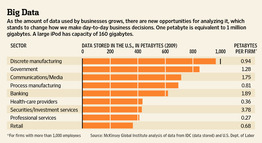
A few months ago, we reviewed an excellent new book called Thinking, Fast and Slow (Oct.22, 2011)  in which author Daniel Kahneman talks about how we make decisions. We see what we want , ignore probabilities, and, as Kahneman writes,  “we are often confident even when we are wrong”. But The Wall Street Journal’s  (Jan.4, 2012) article “What’s Your Algorithm”, says the important theme in business for 2012 will be “how analytics harvested from massive databases will begin to inform our day-to-day business decisions.  Call it Big Data, analytics, or decision science. This will change your world.”

The new algorithms can help us reduce the human decision-making biases that Kahneman fears. These software systems can chew through billions of bits of data, analyze them, and package the insights for immediate use. For example, crunching millions of data points about traffic flows, an analytics system might find that on Fridays a delivery fleet should stick to the highways–despite your devout belief in surface road shortcuts.

Until recently, we have been stymied by the cost of storage, slower processing speeds and the flood of data itself, often spread across different corporate databases. “A few years ago it might take a month to run a project involving 30 billion calculations. Today it can be done in 2 or 3 hours”, says Opera Solutions’  CEO.  HP just spent $11 billion to buy Autonomy Corp., which vacuums up “unstructured data” then applies analytic approaches to it.

Analytics (or as we called it, OR, MS, QA, or Decision Sciences when studying in grad school) is becoming mainstream WSJ reading.

Discussion questions:

1. How has IBM taken a leading role in business analytics?

2. How can massive number crunching help the operations manager?

OM in the News (with Video Tip): 3-D Printing of Body Organs and Concrete Buildings?

It was just July 7 when we blogged about a 3-D printer creating a crescent wrench as strong as the original. That blog was  accompanied by a short video showing the process from start to finish–one certain to entertain your class. But today’s Wall Street Journal (July 16-17,2011) has raised the 3-D printing bar potential way beyond plumbing tools. With the title,  “How Close Are We to Printing New Organs?”, the Journal describes how a whole dummy kidney made of biocompatible materials and cells, was “printed” on stage at a TED talk a few months ago. With about 90% of patients needing a transplanted organ seeking a kidney, being able to create a “self-derived” kidney would save many lives and spare people the expense and pain of dialysis.

Such “printed” kidneys that would be able to work in the body (they are structural, but lack blood vessels) are still years away, but the rate of advance means the 1st autologous transplant may still happen this decade.  Already, synthetic windpipes, grown with a patient’s own cells, are being transplanted. (The windpipe of the patient is scanned, molded from a porous medical plastic, and infused with cells from the patient in a bioreactor).

And the concrete in our blog  title?  Here is a 3-minute video of a concrete structure being built by a grander and rougher  3-D printer at a British university. The architect makes the design, after which the printer extrudes concrete from a nozzle to build up the object, layer by layer. Printed concrete products are proving to be stronger than the cast ones. They also have the advantage of a hollow interior through which a building’s wires and pipes can be run. And the ducts in the concrete parts look uncannily like blood vessels needed in the 3-D kidneys.  Pretty exciting advances in OM technology!

Discussion questions:

1. Why is 3-D printing, which has been around for a decade, now becoming such an important tool?

2. Ask students to research the costs of 3-D printers.

Video Tip: Bringing 3-D Printing to Life in the Classroom

Computer Aided Design (CAD) and 3-D Printing may not be the most exciting topics in the Design of Goods and Services chapter (Ch.5), but after you show this 4-minute video clip, there will be a definite uptick in class discussion. Our photo of a 3-D  printer just can’t do justice to the amazing work going on in this rapidly advancing area of OM. So when Prof. Bruce Elwell showed me the video we link to here, I knew it’s something important to share in the blog.

I recommend that you bring a crescent wrench with you to class to bring home the product and its design. Pass it around while the video plays so your students can get a better feel for the tool. And if you would like more background on 3-D printers, take a look at the blog we did on the subject a few months ago. It was based on a major article in The Economist in Feb., 2011.

OM in the News: The Rise of the American Service Robot

It was 50 years ago when a company called Unimation rolled out the world’s first industrial robot—for use in a GM plant in NJ. The American firm’s product weighed in at 4 tons and did a good job at welding. But by 1991, a U.S. Commerce Dept. national security assessment warned: “The U.S. is nearly out of the industrial robot business”. To this day, Swiss-based ABB and Fanuc (of Japan) dominate the $12 billion global market for manufacturing robots.

The U.S. is back, however, in a new, and even larger, service robot market, with 70 of the top 200 firms globally here–twice as many as in Japan or France, according to the latest Businessweek (March 7,2011).

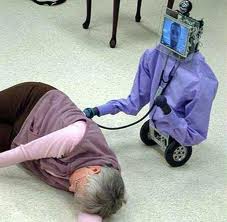
What is a service robot? It’s a robotic machine for defense, space, health care, logistics, consumer products, and e-tailing, among other markets. For example, iRobot makes Roomba floor cleaning machines and PackBot, a robot that searches caves for bomb disposal. Boston Dynamics makes Cheetah, a cat-like robot that runs 40 mph to scout out enemy positions. Aethon’s product is TUG, which automates the movement of medications, equipment, and meals in over 100 hospitals. Intuitive Surgical makes the daVinci robotic surgical system whose arms make (supposedly) more precise incisions than the MDs running them. And Kiva makes mobile robots to move goods and fulfill orders at e-tailers (see our blog on Kiva).

Why the comeback? Government funding, particularly from DOD, has helped. Big defense budgets financed the development of 1,000s of robots for deployment to Iraq and Afghanistan this past decade. But open-software systems have helped as well.  Free software from Microsoft and Willow Garage encourages researchers to develop new applications, while deep venture capital markets have provided the money.

Discussion questions:

1. What are the strengths and weaknesses facing this relatively new industry in the U.S.?

2. How does the use of service robots relate to the field of OM?