Good OM Reading: Model Thinking for Everyday Life

Every day operations managers face decisions, some simple and some complex. Our text focuses on these decisions with real world examples and hundreds of mathematical models to help guide decision making. But all too often students look for “the answer” on a search engine (or now on ChatGPT), learning nothing from the process. 

A new book, called Model Thinking for Everyday Life, by well-known MIT professor Richard Larson, asks readers to undertake a major mind shift in everyday thinking. The answer to many operations problems lies in the process that leads us there. Model Thinking helps develop critical thinking skills, using a framework of conceptual and mathematical concepts to help reach full comprehension and better decisions. 

Prof. Larson’s innovative approach to model thinking encourages:

  • Active learning with pencil and paper (no computer), which requires readers to immerse themselves in puzzles and life’s paradoxes.
  • No heavy math – complex technical issues are addressed in a simple, entertaining way.
  • Seeing the world  in terms of models, learning something new every day.

Here is an example: Suppose you need to be on today’s only ferry to Martha’s Vineyard, which leaves at 2 p.m. It takes about 30 minutes (on average) to drive from where you are to the terminal. What time should you leave?

In this example, a key concept at play is uncertainty. Accounting for uncertainty is a core challenge faced by operations managers. We need to see that:

  • an average of 30 minutes would cover a range of times, some shorter, some longer;
  • outliers can exist in the data, like the time construction traffic added an additional 30 minutes
  • “about 30 minutes” is a prediction based on past experience, not current information (road closures, accidents, etc.); and
  • the consequence for missing the ferry is not a delay of hours, but a full day — which might completely disrupt the trip or its purpose.

Without doing much math, we calculate variables, weigh the likelihood of different outcomes against the consequences of failure, and choose a departure time. Larson’s conclusion is one championed by model thinkers everywhere: Leave on the earlier side, just in case.

“Everybody uses models, whether they realize it or not,” Larson says. “When someone is shopping for groceries and thinking about how much of each product they need — they’re basically using an inventory management model of their pantry.”
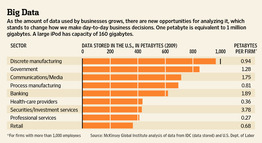
OM in the News: How Analytics Will Change Day-to-Day Decisions

A few months ago, we reviewed an excellent new book called Thinking, Fast and Slow (Oct.22, 2011)  in which author Daniel Kahneman talks about how we make decisions. We see what we want , ignore probabilities, and, as Kahneman writes,  “we are often confident even when we are wrong”. But The Wall Street Journal’s  (Jan.4, 2012) article “What’s Your Algorithm”, says the important theme in business for 2012 will be “how analytics harvested from massive databases will begin to inform our day-to-day business decisions.  Call it Big Data, analytics, or decision science. This will change your world.”

The new algorithms can help us reduce the human decision-making biases that Kahneman fears. These software systems can chew through billions of bits of data, analyze them, and package the insights for immediate use. For example, crunching millions of data points about traffic flows, an analytics system might find that on Fridays a delivery fleet should stick to the highways–despite your devout belief in surface road shortcuts.

Until recently, we have been stymied by the cost of storage, slower processing speeds and the flood of data itself, often spread across different corporate databases. “A few years ago it might take a month to run a project involving 30 billion calculations. Today it can be done in 2 or 3 hours”, says Opera Solutions’  CEO.  HP just spent $11 billion to buy Autonomy Corp., which vacuums up “unstructured data” then applies analytic approaches to it.

Analytics (or as we called it, OR, MS, QA, or Decision Sciences when studying in grad school) is becoming mainstream WSJ reading.

Discussion questions:

1. How has IBM taken a leading role in business analytics?

2. How can massive number crunching help the operations manager?

Good OM Reading: Thinking, Fast and Slow

My cousin Val, a prominent NY psychologist, just sent me a book which is slightly outside my traditional OM reading — and yet, provides wonderful insight into how managers  make decisions that affect all of  their operations. Titled Thinking, Fast and Slow (Farrar, Straus & Giraux, 2011), Princeton Nobel Laureate Daniel Kahneman  looks at the mental errors we all make, and asks if they can be overcome. The answer, unfortunately, is no.

When managers face uncertainty, instead of using data and statistics,  they lean towards “mental shortcuts”, skipping serious analysis — and indicating that we are not nearly as rational decision makers as we would like to think. Kahneman’s series of simple experiments show that our brains use a lot of bad habits that easily lead to unnecessary risks and bad choices.

Here is one such experiment. Try it out on your students. “A bat and ball together cost $1.10. The bat costs $1 more than the ball. How much does the ball cost?”  The majority of people (including Harvard, Princeton and MIT students) answer quickly, and with confidence, that the ball costs 10 cents. This obvious answer is wrong–it’s 5 cents.

The reason: Kahneman defines 2 types of mental systems. System 1 refers to quick, automatic thought (like 10 cents for the ball). System 2 is a higher energy thought process we rely on only when we need to or want to. Since we don’t want to think rigorously and since our System 1 hates doubt and ambiguity, he points out that our intuitions are generally wrong.

In business, fund managers charge high fees to manage portfolios, yet there is almost zero correlation to performance. Professional investors routinely think they know what others don’t. Entrepreneurs typically overstate their chance of success by 25%. CEOs who hold more company stock (a sign of self-confidence)  make more irresponsible decisions in acquisitions and mergers. And even homeowners have this System 1 bias. On kitchen remodels, they expect to spend about $18,500 , where the actual cost averages $39,000.

The economic implications are  of Thinking are gripping.