OM in the News: Mattel Builds a More Nimble Supply Chain

Supply-chain flexibility has been an overarching goal for companies in the wake of the pandemic, with manufacturers looking to build more resilience in their operations. Toy makers like Mattel face a broader challenge as kids’ attention moves toward videogames and smartphone apps, reports The Wall Street Journal (Oct. 14, 2024). 
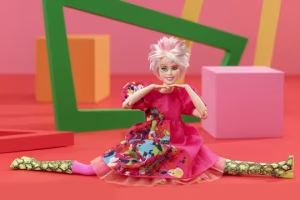
Mattel’s ‘Weird Barbie’ is meant to look like a doll that’s been ‘played with too much.’

When “Weird Barbie” became an unexpected breakout hit of the “Barbie” movie, Mattel kicked its new supply chain strategy into action. It accelerated the doll’s design and manufacturing process to tap in to the attention to the character, rapidly bringing the doll to store shelves. It was one example of how Mattel has revamped its supply chain, shuttering some factories, outsourcing production at others and fine-tuning work at some sites.

The idea has been to reset a supply chain long focused on relatively predictable seasonal patterns in the children’s toy market to make it more flexible to respond to rapid shifts in consumer demand.

To align its supply chain more closely with event-driven sales, Mattel has closed or sold five factories and invested in its sites in Mexico and Asia. It has cut the number of products it makes by 45% to get rid of less popular items.

Trimming the variety of toys it sells has helped better forecast shopper demand, reduce inventory and improve in-stock levels. Inventories fell to $777 million from $972 million a year earlier. Cutting items that don’t sell as quickly means “there’s less complexity overall in your supply chain, and you’re not having to try to manage so many different inventory items,” said an Auburn U. prof.

The company also moved to outsource more manufacturing. Although using contract manufacturers costs more than making the toys at its own factories, it can help keep Mattel from getting stuck with unused capacity when demand drops off.

Mattel has also adjusted its supply chain to react quickly to unexpected demand when toys go viral online, as it did with “Weird Barbie.” When the company needs to quickly get goods to shelves, it makes some items at its factory in Mexico, close to U.S. customers, and absorbs the higher manufacturing costs, or it airfreights products to the U.S. from Asia.

Classroom discussion questions:

  1. What is Mattel doing to revamp its supply chains?
  2. How has “Weird Barbie” impacted decisions at the firm?

OM in the News: 150 Shades of Red Drown Mattel’s Supply Chain

Mattel has gotten to the heart of one of its problems: Too many reds aren’t a good thing. The company’s designers until recently could choose from about 150 types of red when making Barbie dolls, Hot Wheels cars or other toys in its stable. Each variation added storage costs and downtime at factories for cleaning equipment to swap out shades.

“Complexity is really a killer,” said Mattel’s chief supply-chain officer. Mattel has chopped the choices of reds by more than 1/3 and is doing the same for other colors, part of a broad edict to simplify the company’s supply chain. The goal is to improve, modernize and ultimately tame a sprawling supply chain that operates 13 factories, employs  35,000 people and delivers toys to 375,000 retail locations world-wide, reports The Wall Street Journal (Jan. 2, 2020). “Supply chain had become one of our handicaps,” adds the CEO.

Mattel says it plans to keep factories that are “strategically important” or that can make certain products at a better quality and lower cost than a third party could, while consolidating plants that are underused. The company already changed how it sells and fulfills orders to retailers. In Europe, Mattel implemented an automated, online ordering system for wholesale orders, eliminating the need for its sales team to manually process orders. It also increased the minimum order size so that it wasn’t shipping orders valued at just a few hundred dollars into a fragmented retail market.

More broadly, Mattel is using new algorithms to tie its manufacturing output more closely to demand, helping the toy maker to gauge the right number of toys for the holidays. Mattel also will be making fewer products. The company is planning to cut the number of items it sells by 30%, targeting the 45% of the items it sells that only make up 6% of its revenue.

Classroom discussion questions:

  1.  Why does Mattel have so many plants? So many colors?
  2.  What inventory strategy is Mattel using to cut SKUs (see Ch. 12 of your Heizer/Render/Munson text)?

OM in the News: Barbies, Auto Parts Hot Off the 3-D Press

Ford forges ahead with 3-D printing of this engine cover

Companies such as GE, Ford and Mattel are pushing 3-D printing further into the mainstream than most people realize, writes The Wall Street Journal (June 6, 2013). Unlike traditional techniques, where objects are cut or drilled from molds, resulting in some wasted materials, 3-D printing lets workers model an object on a computer and print it out with plastic, metal or composite materials.

Ford Motor The auto maker sees a future where customers will be able to print their own replacement parts. A customer could log onto the Web, scan a bar code or print up an order, take it to a local 3-D printer, and have the part in hours or minutes. Ford is currently using 3-D printing to prototype automobile parts for test vehicles. Ford engineers use industrial-grade machines that cost as much as $1 million to produce prototypes of cylinder heads, brake rotors, and rear axles in less time than traditional manufacturing methods. Using 3-D printing, Ford saves an average of one month of production time to create a casting for a prototype cylinder head for its EcoBoost engines. The traditional casting method, which requires designing both a sand mold as well as the tool to cut the mold, can take 5 months.

General Electric GE’s Aviation unit prints fuel injectors and other components within the combustion system of jet engines. Building engine airflow castings by melting metal powders layer by layer is more precise than making and cutting the parts from a ceramic mold.

Mattel The toy maker used to sculpt prototypes of toys from wax and clay before building the production models out of plastic. Today, Mattel engineers use any of 30 3-D printers to create parts of virtually every type of toy that it manufactures, including popular brands such as Barbie, Max Steel, Hot Wheels cars and Monster High dolls.

Discussion questions:

1. Can Mattel ever let its customers print their own toys from software files?

2. Why are 3-D printers such an important OM tool?