OM in the News: German Apprenticeships in South Carolina

BMW’s plant in Spartanburg, S.C., is its biggest production facility in the world. It produces 1,400 cars a day and sends 70% of them overseas, making BMW the biggest car exporter in the U.S. By employing 9,000 people and training 100 apprentices at any one time, the BMW plant contributes to a skilled American workforce.

Overall, German companies employ about 700,000 people in the U.S. Often they implement the German-style training schemes for young people. In Germany, half the graduates of high schools and junior high schools choose a track that combines training on the job with further education at a public vocational institution. “This apprenticeship model,” writes the German ambassador to the U.S. in The Wall Street Journal (May 5, 2017), “is one reason why Germany has the lowest rate of youth unemployment in Europe and has been able to keep manufacturing jobs in the country.”

As high-wage countries, Germany and the U.S. face similar challenges in protecting existing production facilities and creating new manufacturing jobs. One of the most decisive factors for companies is whether they can find skilled and motivated workers, which is what apprenticeship programs provide. It’s also important to prepare for the industries of the future. In the era of New Manufacturing (what Europe has dubbed “Industry 4.0”), artificial intelligence and other digital technologies will transform factories and the workplace.

We all know that there is a tendency toward higher education in the U.S. Nevertheless, the success of the German apprenticeship model builds on the conviction that it is an equivalent alternative to college education. That approach in Germany has provided a solid return on companies’ investment, helped them to innovate, and contributed to warm relations between employers and employees.

Classroom discussion questions:

  1. Why is this model so rare in the U.S?
  2. What other German company has widely used apprentice training in the U.S? (see Chapter 1)

OM in the News: Making American Factory Workers More Tech-Savvy

apprenticeshipGerman robotics company Festo AG wants to make American factory workers more tech-savvy. As robotics take an ever more prominent role on factory floors, training workers and keeping their skills up-to-date has grown in importance, writes The Wall Street Journal (Sept. 10, 2014). Festo sees in the U.S. “a mismatch in the labor market between what businesses need and the kind of education young people are getting,” said its CEO. The firm is banking on growing demand for German-style vocational education in the U.S. In Germany, companies take on full-time apprentices as young as 16 and provide both theoretical and hands-on training in technical skills the companies need. Such programs usually last two years and results in a certification that is recognized across the industry.

About 2 million U.S. jobs go unfilled because of shortfalls in skills, training or education. Of those, roughly 600,000 are jobs that require more than a high-school diploma but less than a bachelor’s degree. One-third of U.S. job openings through 2020 will require such middle skills, with a vocational certificate, industry-based certification, some college credits or an associate degree—but not a classic four-year college degree. “American training in these areas has deteriorated since the early 1980s,” says one Georgetown U. professor.

German companies with operations in the U.S. have complained for years that factory workers lack specific skills they require to get the job done. Executives and American policy makers have said the U.S. could benefit from Germany’s approach to apprenticeships and on-the-job training. But the German approach is hard to transplant. “It’s a question of culture,” said an industry expert. “Parents and teachers tell kids that going to a four-year college is the only path.”

Classroom discussion questions:

1. Why has the German system seen slow acceptance in the U.S.?

2. Is there a relationship between productivity and apprenticeship programs?

OM in the News: Britain Promotes Apprenticeships to Help its Industrial Base

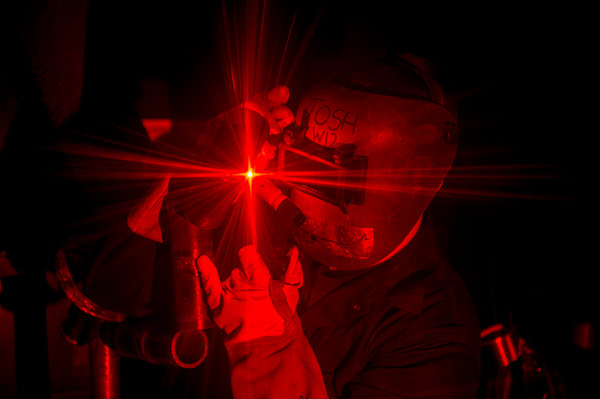
British apprentice learning high-integrity welding

Despite relatively high unemployment in Britain, especially among young people, there is a marked shortage of skilled manufacturing workers, writes The New York Times (Jan. 20, 2014). The problem is so acute that the government and industrial companies are behind an unprecedented push to get teenagers into apprenticeships to close that gap. The British government is trying to catch up with Germany and Switzerland, which have retained their competitive edge with the help of well-honed apprenticeship programs.

 A third of employers across Europe say that the lack of skills is causing major business problems in terms of higher costs, insufficient quality and lost time.  27% of the 2,600 companies surveyed by McKinsey note they have left an entry-level vacancy unfilled over the past year because there were no eligible applicants. Statistics like that, and the fact that about a quarter of people under 25 are jobless in Europe, prompted Britain to act, committing £1.57 billion to apprenticeship training last year. About 2.7 million new jobs in British manufacturing are expected by 2020, of which 1.9 million will require engineering skills. Companies will need to double both the current number of qualified recruits and of apprenticeships to fill those positions.
Britain is among the worst in the developed world at equipping its young people with numeracy and literacy skills. The career aspirations of high school students showed them to be heavily skewed toward jobs in acting, media and professional sports. Part of the challenge for Britain is turning around the bad reputation that apprenticeships can have, often being associated with dull, menial tasks that evoke images of Oliver Twist, the Dickens character who faced life as an apprentice to a chimney sweep. Britain has a record of apprenticeships back to medieval times, when boys were hired as young as 7 and often worked in brutal conditions.

Classroom discussion questions:

1. What are your student’s views towards apprenticeships?

2. Why is such training as important in the US as in Europe?

OM in the News and Video Tip: Factory Apprenticeship Is Latest Model From Germany

BMW's plant in S.C. employs 7,000
BMW’s plant in S.C. employs 7,000

For Joerg Klisch, hiring the first 60 workers to build heavy engines at his company’s new factory in South Carolina was easy, writes The New York Times (Dec. 1, 2013). Finding the next 60 was not so simple. “It seemed like we had sucked up everybody who knew about diesel engines,” said Klisch. So he did what he would have done back home in Germany: he set out to train them himself. Working with local high schools and a career center in Aiken County, S.C.—and a curriculum nearly identical to the one at the company’s German headquarters–Klisch now has 9 juniors and seniors enrolled in its apprenticeship program.

Inspired by a partnership between schools and industry that is seen as a key to Germany’s advanced industrial capability and relatively low unemployment rate, projects like this one are practically unheard of in the United States. But experts in government and academia, along with those inside companies like BMW, which has its only American factory in S.C., say apprenticeships are a desperately needed option for younger workers who want decent paying jobs, or increasingly, any job at all. And without more programs like Klisch’s, they maintain that the nascent recovery in American manufacturing will run out of steam for lack of qualified workers.

“As a nation, over the course of the last couple of decades, we have regrettably and mistakenly devalued apprenticeships and training,” said Thomas E. Perez, the secretary of labor. But S.C.’s emphasis on job training has also been a major calling card overseas. The state lured BMW here 2 decades ago and more recently persuaded France’s Michelin and Germany’s Continental Tire to expand in the state. Apprenticeship Carolina started in 2007 with 777 students at 90 companies. It now has 4,500 students at more than 600 companies and aims to add 1,400 more companies by 2020.

The New York Times article link contains an excellent 3 minute video clip, called “Creating Skilled Workers,” that you may wish to show in class.

Classroom discussion questions:

1. How do such programs affect productivity? (See pages 15-17 in Chapter 1).

2. Why are there so few apprenticeship programs in the US?

OM in the News: Why It’s Hard to Find Qualified Employees in France

Employers in the U.S. complain they can’t find qualified workers. But, as BusinessWeek (July 23, 2012) reports, the problem is not unique to American industry. While French  unemployment rose to 10% recently, about 43% of French companies were unable to recruit the workers they need. In some industries, 2/3 of the companies encountered difficulties hiring. It’s not just high-level engineers who are in short supply. The shortfall for home nursing and cleaning jobs was the highest, at 67%; it was 62% for engineers, 61% for cooks, and 58% for nurses.

The skills mismatch reflects France’s inability to adapt its educational and vocational training to business needs, as neighboring Germany has done. Every year, half a million German businesses take on teenage apprentices to teach them a trade: The apprentices supplement their on-the-job training with classes at vocational schools. In Germany, not only are vocational training firms obligated to provide details to the government on their job placements, but trainers’ pay is partly dependent on how many trainees find a job, which forces them to build classes around well-identified needs. The result: Youth unemployment  in Germany is 8.5%; France’s is 22%.

France’s educational system, somewhat like ours in the U.S., looks down on vocational training (a topic in Chapter 1), perpetuating the notion that intellectual jobs are more worthy than manual work.  “For years, there has been a deep hatred in the education system regarding manufacturing,” says an industry leader.  The lack of mobility among factory hands even inside France adds to the skills mismatch. French employees are rarely willing to move, compared with the U.S. and the U.K., because the French housing market lacks fluidity. While France spends a bigger piece of its national income on education than Germany—6% compared with 4.8%—it gets less bang for its buck.

Discussion questions:

1. Why don’t we have more apprentice programs in the U.S?

2. Where are there shortages of skilled workers in the U.S., and why?

OM in the News: Germany Exports Jobs Training to the US

Germany’s transplant-factories, like the sprawling VW complex in Chattanooga, aren’t just cranking out cars, machinery and chemicals. They are also bringing, writes The Wall Street Journal (June 14, 2012), a German training system that could help narrow America’s skilled labor gap. VW, which will graduate its first class of U.S. apprentices next year, is one of dozens of companies introducing training that combine German-style apprenticeships and vocational schooling.

These programs are winning adherents as manufacturers grapple with a paradox: Though unemployment remains stuck above 8%, companies can’t find enough machinists, robotics specialists and other highly skilled workers to maintain their factory floors. An estimated 600,000 skilled, middle-class manufacturing jobs remain unfilled nationwide, even as millions of Americans search for work.

“In the U.S. we’ve evolved to the point where we think the only thing people should strive for is a four-year college education, and factory work is seen as dirty, dangerous and repetitive,” says the director of the Aspen Institute’s Manufacturing and Society program. “In Germany, the work that is done on the factory floor and prepared by its vocational education system is highly valued.”

In Germany, 2/3 of the country’s workers are trained through partnerships among companies, technical schools and trade guilds. Last year, German companies took on and trained nearly 600,000 paid apprentices. In the U.S., such close cooperation doesn’t often exist. One stumbling block has been companies’ fear of spending on training, only to see apprentices go elsewhere. Siemens spends approximately $165,000 an apprentice in its new three-year mechatronics training program in Charlotte.  VW warns that without training its own skilled workers, it will struggle to expand: As it ramped up production this year, it needed a nationwide advertising campaign to fill 100 of the more specialized new jobs at the Chattanooga plant.

Discussion questions:

1. Why is VW willing to invest so much money in an apprentice?

2. Why are these programs more popular in Germany than in the US?