OM in the News: ‘War of the States’ and Lavish EV and Chip Maker Subsidies

States have long competed for big employers, writes The Business Journal (April 2, 2023). But now they are floating more billion-dollar offers and offering record-high subsidies, lavishing companies with grants and low-interest loans, municipal road improvements, and breaks on taxes, real estate, power and water.

“We’re in the second war of the states,” said one site selection consultant. “It is kind of a Wild West moment. It’s wild money and every state seems to be in on it,” added a U. of Texas professor. Georgia, Kansas, Michigan, New York, North Carolina, Ohio and Texas have made billion-dollar pledges for a microchip or EV plant, with more state-subsidized plant announcements by profitable automakers and semiconductor giants surely to come.

2022 set a record for the number of billion-dollar-plus incentive deals. At least eight were finalized, though that figure might be higher since such deals can be cloaked in secrecy and take time to come to light. More than $20 billion in public money was committed to subsidizing those known megadeals.

The subsidy offers are generally embraced by politicians from both major parties and the business elite, who point to promises of hundreds or thousands of jobs, massive investments in construction and equipment, and what they contend are immeasurable trickle-down benefits.

Still, academics who study such subsidies find them to be a waste of money and rarely decisive in a company’s choice of location. Studies conclude “they do little, if anything, to promote meaningful improvements in economic outcomes.”

The mounting cost of competing for the projects hasn’t dissuaded states from trying. On the contrary, they’re clambering to outdo each other. Michigan was stung by hometown Ford’s $11 billion commitment in 2021 to build EV and battery plants in Tennessee and Kentucky. It responded by pledging more than $2.5 billion for EV projects by Ford and GM and plants by makers of EV batteries and battery components. Pennsylvania has yet to lure a microchip or EV factory, and the state is sounding the alarm after watching neighboring Ohio land a $20 billion Intel plant. Texas promised to win passage of “economic development tools,” saying the state lost out on a massive Micron semiconductor plant because it couldn’t match the $5.5 billion in tax credits offered by New York.

Classroom discussion questions:

  1. Financial incentives are just one aspect of location decisions. What other factors (a topic in Chapter 8 in your text) do firms consider?
  2. What is driving the massive incentives states are offering?

OM in the News: Auto Makers and the Global Chip Shortage

Auto manufacturers have spent decades streamlining their supply chains, using their muscle over parts makers to reduce their own costs by carrying little inventory and relying on suppliers to deliver components “just in time.” But car makers are finding they can’t dictate terms in the same way to the chip industry with its far-broader customer base, particularly now that chip demand is booming globally among a swath of industries. Car makers blame the shortage on tier-one parts suppliers, which generally do most of the chip buying. The shortage will drive the global auto industry to produce nearly 700,000 fewer cars than planned for the first three months of 2021. Auto makers including VW, Ford and GM, have furloughed tens of thousands of workers.

Ford has slashed production of America’s top-selling vehicle, the F-150 pickup, because of chip shortages

The car-chip pain is partly a self-inflicted wound that traces to the pandemic’s early days, writes The Wall Street Journal (Feb. 13-14, 2021). When the global economy went into stasis, preparations for future car production halted. Auto-parts suppliers reduced orders for electronics, betting that large volumes wouldn’t be needed well into the future.

Chip makers chose not to stockpile parts and wait for car makers’ orders—a decision made easier by surging demand from sales of laptops, servers, smartphones, video game consoles, 5G networks, and other electronics. The harsh reality is that these other products have have a much, much higher rate of return than making chips for cars. Plus only one chipmaker, Taiwanese TSMC, produces about 70% of the units used in the world’s autos.

Still, the car industry largely operated as if electronics suppliers were at its mercy. Normally, when they are calling on their suppliers, everyone is excited about the large volumes. But it must be compared to the billions of smartphones and PCs that are being sold. Unlike with some other parts, said a chip maker exec, referring to the auto makers, “They don’t know how the sausage gets made at the bottom.”

Classroom discussion questions:
1. What is meant by the quote at the end of the blog?

2. Table 11.3 (page 450) in your Heizer/Render/Munson text lists 10 supply chain risks. Which, if any, apply in this case?

OM in the News: Coronavirus Makes Augmented Reality’s Potential a Reality

An engineer in the Netherlands using AR glasses developed by Microsoft to guide maintenance.

Intel’s semiconductor production hit a stumbling block in March. A chip plant in Arizona needed work done, but the engineer for the job was stuck in Germany because of coronavirus flight restrictions. If Intel couldn’t recalibrate existing machines and install new ones, America’s largest chip maker faced a production slowdown just when demand was surging as PCs and the cloud became critical to facilitate remote work.

Unable to fly in the German expert, Intel transported him virtually using augmented-reality goggles that had been developed mainly to show training videos. The stranded engineer, watching a video feed his counterparts at Intel relayed via their goggles, walked them through the repair, allowing the work to be completed on schedule. At Intel, this success launched remote maintenance from an experiment to part of the company’s permanent operational plans.

Across multiple industries, augmented reality, or AR, has transitioned during the pandemic from intriguing experiment to everyday tool, reports The Wall Street Journal (June 10, 2020). That makes AR, discussed in Chapter 5 (p.172) in your Heizer/Render/Munson OM text, more useful in a world where business travel and direct human interaction are restricted—and likely to stay that way for a while. Porsche’s usage of AR glasses in its U.S. dealerships more than tripled during the pandemic as technicians performing complicated repairs on the pricey sports cars called in virtual help from repair experts hundreds of miles away.

Globalfoundries, another major chip maker, faced a similar problem to Intel’s. When one of its multimillion-dollar machines needed work, an engineer at one of its plants donned a HoloLens headset and called up a video chat to consult an equipment expert in the Netherlands to guide him through repairs. That company is now using iPads, headsets, and AR or virtual reality tools to do jobs once done by traveling engineers.

Classroom discussion questions:

  1. What is the difference between AR and VR? (See Ch. 5)
  2.  How else might this tool be used in manufacturing or healthcare?

OM in the News: Chip Makers Push Spending for Faster Processors

South Korean manufacturer Samsung’s chip-fabricating facility under construction

“Chip makers are seeing the light. And it is costing them,” writes The Wall Street Journal (Nov. 6, 2019). Companies like Taiwan Semiconductor Manufacturing (TSMC), Intel, and Samsung are racing to produce smaller and faster processors. But the latest manufacturing processes, which require new types of production tools, are pushing the bounds of physics. These include systems that use extreme ultraviolet light, or EUV, to produce chip circuitry at a much thinner width than was possible with more commonly used light sources.  This requires special equipment for testing and process control– and means investments are reverberating through technology supply chains..

EUV tools are expensive—especially if one has to equip an entire semiconductor fabrication facility with them. ASML, the largest supplier of EUV lithography tools for chip makers, saw revenue of $827 million from the sale of just 7 EUV systems in the last 3 months. That works out to about $118 million per machine. Such systems also require other types of equipment for process control and testing. All told, the cost of building a new leading-edge chip-fabrication facility is now well into the billions. TSMC disclosed plans two years ago to spend $20 billion on just one new fab.

So it is little surprise that chip makers are cracking open their wallets. TSMC  plans to spend $14-$15 billion this year in capital expenditures—nearly 40% above its  stated target. Intel says its $16 billion capital expenditure (capex) target this year is a company record—and 36% above what it spent just two years ago. Samsung said it plans to spend about $20 billion this year on total semiconductor capex.

Classroom discussion questions:

  1. Why is chip making such a capital intensive business?
  2.  What is a “fab”?

OM in the News: Chip Makers Plot a Future in the U.S.

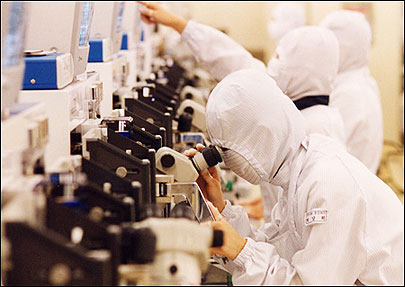
Degowning at the IM Flash plant

Nestled at the foot of Utah’s Wasatch Mountains, the IM Flash plant is a paragon of American high-tech manufacturing. Robots glide along the ceiling, moving silicon wafers the size of dinner plates between hulking machines that deposit and etch microscopic layers of material to build the most advanced memory chips in the world. For the 1,700 technicians and scientists who tend to the robots and troubleshoot problems in the delicate manufacturing process, the jobs offer generous pay and benefits.

For Intel and Micron Technology, the two American companies that jointly own and operate IM Flash, the venture allows both of them to sell cutting-edge, 3-D memory chips while sharing the multibillion-dollar costs of a modern semiconductor factory. In many ways, however, the IM Flash plant is an outlier. “While companies based in the U.S. still dominate chip sales worldwide, only about 13% of the world’s chip manufacturing capacity was in this country in 2015, down from 30% in 1990,” reports The New York Times (Feb. 27, 2017).

“It’s quite a bit more expensive to build a factory in the U.S.,” says Intel. The firm (which also has factories in Ireland, Israel and China) estimates that the extra cost for an American plant is more than $2 billion. Chip makers are hopeful that President Trump, who has promised large corporate tax cuts and a tougher approach to trade with China, will help them. The chip industry spends 1/5 of its revenue on R&D.

Looming in the background is China, which is currently a bit player in the industry but has committed to spend upward of $100 billion to create a world-class chip industry. “China is the largest market for us on the planet,” says an Intel OM exec. “It made sense to locate some production in China.”

Classroom discussion questions:

  1. Why has chip manufacturing declined in the U.S?

      2. Why is this a critical industry to retain?

OM in the News: Intel’s $7 Billion Arizona Chip Plant

intel“New chip plants are tremendously expensive,” writes The New York Times (Feb. 9, 2017), “requiring large tracts of land, reliable electricity and water, and a skilled work force that includes people with doctorates in chemistry and technicians who can repair a malfunctioning robot.” Sophisticated equipment is necessary to deposit and etch microscopic layers of material on silicon wafers, which are then cut and packaged into the microprocessors that run PCs, servers, smartphones and, increasingly, other electronic devices.

Countries compete to land such plants, especially modern factories that produce the most valuable chips and bring high-paying R&D jobs. Government subsidies are common, with China vowing to spend tens of billions of dollars to expand its domestic chip industry. While most technology manufacturing, such as computers and smartphones, has moved overseas, American factories still account for 1/7 of global chip production and produce many of the most valuable computer chips, including Intel’s flagship processors. Seventy-six chip plants are scattered across the U.S., from Maine to California.

Intel’s new $7 billion, 3,000 employee, chip plant in Arizona plant will build ultradense chips that Intel refers to as 7 nanometer, with transistors packed more closely together than in the chips the company now builds. The tighter spacing allows for faster, more energy-efficient chips. “This factory will produce the most powerful computer chips on the planet,” says Intel’s CEO, who adds: “the company had decided to proceed because of the tax and regulatory policies we see the (Trump) administration pushing forward.” Intel also has factories in China, Ireland and Israel.

Classroom discussion questions:

  1. Why are chip factories important to the U.S?
  2. Why is chip manufacturing a tough business to enter and succeed in?

OM in the News: Chip Makers Bet the Farm on Future Demand

The New York Times (May 3, 2011) has just reported some good news for US manufacturing, namely, the massive expansion of chip makers who are counting on continuing heavy demand for chips in smartphones, tablet computers, refrigerators, cameras, and GPSs. Samsung, the huge Korean chip maker, is betting $3.6 billion in expanding  its US factory to make logic chips for iPhones and iPads. The plant in Austin, scheduled to be completed next month, will be 2.3 million sq.ft., about the size of 40 football fields and one of the biggest factories in the country. Samsung chose Austin because of “the infrastructure and support system here–you can’t get that from anywhere else”.

Intel, the world’s largest chip maker, is spending $13 billion to build 2 new factories and upgrade 4 others in Oregon and Arizona, with the work to be complete in 2013. “When you make an investment in a factory, you’re essentially placing a bet on a manufacturing process that’s not yet done, for products that are not yet designed,  to sell in market that is not yet there”, says Intel.

Global Foundries, a contract maker (also called a foundry) of chips, is investing $4.6 billion in a new plant near Albany, NY,  that will build 28-nanometer chips for customers. (Small companies cannot afford the $ multibillion investment in making their own). Its 1.5 million sq. ft. plant will also open in 2013. “The appetite for tablet computers is a huge part of this move” to become the biggest contract chip producer in the world, says the  Milpitas, CA, company.

The chip industry “is a risky business that’s not for the faint at heart. Its like putting down $1 billion on the craps table”, adds an industry analyst.

Discussion questions:

1. The NYT article focuses on new chip plants in the US. But chip makers are also expanding this year in China, Germany, Japan, S. Korea, and Taiwan. Why the global move?

2. What happens to plants that are out-of-date?