OM in the News: Can Apple Change Its Supply Chain?

President Trump recently demanded Apple and other smartphone makers like Samsung make their phones in the U.S. or face a 25% tariff, reports CNN Business (May 23, 2025). But Apple’s CEO, Tim Cook, says its plan is to manufacture iPhones set to be sold here at newly built plants in India, stating “the majority of iPhones sold in the U.S. will have India as their country of origin.”

Unlike Apple, Samsung doesn’t rely on China for smartphone production. The South Korean giant closed its last phone factory in China in 2019. The vast majority of its smartphone manufacturing takes place in South Korea, Vietnam, India and Brazil.

Treasury Secretary Scott Bessent stated: “I think that one of our greatest vulnerabilities are external production, especially in semiconductors, and a large part of Apple’s components are in semiconductors. So we would like to have Apple help us make the semiconductor supply chain more secure.”

The world’s most valuable publicly traded company is flush with cash and rakes in tremendous profit — more than any company in history. But Apple has long contended that it cannot manufacture iPhones here. It has instead invested billions of dollars training millions of skilled engineers abroad, claiming China and India simply have more skilled engineers–and that they cost significantly less.

In 2010, Steve Jobs, Apple’s late CEO, called America’s education system an obstacle for Apple, which needed 30,000 industrial engineers to support its on-site factory workers. “If you could educate these engineers, we could move more manufacturing plants here,” he told then-President Obama.

So, can Apple reshore  iPhone production? The notion is a “fictional tale,” says tech exec Dan Ives at Wedbush Securities. “U.S.-made iPhones could cost more than 3 times their current price of $1,000, because it would be necessary to replicate the highly complex production ecosystem that currently exists in Asia. You build that supply chain in the U.S. with a fab in West Virgina and New Jersey, they’ll be $3,500 iPhones. And even then, it would cost Apple about $30 billion and three years to move just 10% of its supply chain to the US to begin with.”

While moving iPhone production to the U.S. may not be possible, Apple did announce a $500 billion investment to expand its U.S. facilities earlier this year, in an effort to appease the President.

Classroom discussion questions:

  1. Is it true that China and India have more engineering talent than the U.S.?
  2. Discuss the pros and cons of reshoring iPhone production from an OM perspective.

OM in the News: The Global Supply Chain Is a Mess

Supply chain woes mounted world-wide for makers of everything from cars and clothing to home siding and medical needle containers, reports The Wall Street Journal (March 18, 2021). The extreme Texas weather and port backlogs compounded problems for manufacturers already beset by pandemic disruptions.

Toyota and Honda were the latest multinationals to chime in about setbacks, with the two auto makers planning to halt production at plants in North America. Toyota cited a shortage of petrochemicals, manufacturing of which has been hobbled by last month’s Texas freeze. Honda pointed to a combination of port issues, the semiconductor shortage, pandemic-related problems and the crippling U.S. weather. Samsung, one of the world’s largest smartphone and chip makers, was just forced to idle two chip factories in Austin, Texas, representing 28% of Samsung’s total output.

ships in port of la

The disruptions underscore how several forces are coming together to squeeze the world’s supply chains, from the pandemic-driven rise in consumer demand for tech goods to a backlog of imports at clogged California ports to U.S. factory outages caused by weather woes. They are creating cost increases and delays for numerous industries. The disruptions, which come as the U.S. and other economies are beginning to lurch toward normalcy, show how messy the reopening of business is proving to be a year after pandemic’s onset, and how vulnerable supply chains remain.

Last month’s freeze in Texas was the latest plank on the pile. The state is home to the world’s largest petrochemical complex, which turns oil and gas and its byproducts into plastics. The February freeze triggered mass blackouts that shuttered plants, many of which remain offline.

Meanwhile, the California ports of Los Angeles and Long Beach (shown in the photo), which together handle more than a third of U.S. container imports, remain inundated from an inventory restocking drive that began late last year and has picked up steam in 2021. Lengthy backlogs that at one point left some 40 vessels anchored offshore waiting for dock space. 

Classroom discussion questions:

  1. What are the major issues confronting global supply chains?
  2. What options do companies have when dealing with multi-week backups at U.S. ports?

OM in the News: Samsung and Apple’s Love-Hate Supply Chain Relationship

When the iPhone X goes on sale next month, Apple rival, Samsung, has good reason to hope it is a roaring success,” writes The Wall Street Journal (Oct. 3, 2017). The South Korean company stands to make $110 from each $1,000 iPhone X that Apple sells. The fact reflects a love-hate dynamic between the phone makers that is one of the more unusual supply chain relationships in business. While each company vies to get consumers to buy its gadgets, Samsung stands to make billions of dollars supplying screens and memory chips for the new iPhone—parts that Apple relies on for its most important product. “These are two of the largest companies on the planet deeply tied at the hip and directly competitive,” says one Harvard prof.

Apple and Samsung are expected to be the world’s two most-profitable companies in 2017. And they will depend on each other to get there. Apple needs Samsung’s parts to make the iPhones that accounted for 2/3 of the company’s $216 billion 2016 revenue. Samsung needs Apple’s orders to fuel a component business that delivered 35% of the South Korean firm’s total revenue of $195 billion in 2016.

The relationship grew after Apple moved into selling smartphones. Apple’s immense demand for parts—it sells more than 200 million iPhones a year—limits the field of possible suppliers. Samsung is one of a handful of semiconductor makers that can make a small chip crammed with extra memory capacity. And it is the only significant manufacturer of the organic light-emitting diode displays Apple has adopted to create the iPhone X screen.The relationship took an acrimonious turn in 2011, when Apple sued Samsung over patent infringement, accusing the Galaxy S of ripping off the iPhone’s design. Samsung countersued Apple with its own patent-infringement. Six years on, the U.S. lawsuit is unresolved.

Classroom discussion questions:

  1. Describe similar relationships between competitors in other industries?
  2. Why does Apple depend on Samsung so heavily?

OM in the News: Samsung’s Battery Fix Gets a C Grade

To figure out what caused its Note 7 to catch on fire, Samsung put 200,000 phones through several different tests
To figure out what caused its Note 7 to catch on fire, Samsung put 200,000 phones through different tests

“After four months of testing over 200,000 phones,” writes The Wall Street Journal (Jan. 23, 2017), “what did Samsung determine caused its flagship Note 7 to catch fire?” The answer: Bad batteries. Two separate sets of bad batteries made by two different companies.

But what Samsung is still missing is its Tylenol moment. In 1982, Johnson & Johnson issued a massive recall after 7 people died from taking Tylenol products laced with cyanide. It led the company, and then the rest of the industry, to rethink pill packaging. Consumers saw the new seals as a mark of safety and protection. Samsung’s work on a seal that consumers can understand is still incomplete.

A quick recap: Note 7’s with 2 different versions of the battery–Samsung calls them A and B–were released last August. Soon after, some of the phones with Battery A started to burn up. Samsung recalled the phones, quickly replacing them with just Battery B models. Some of these phones started to burn up also, compelling Samsung to yank the phone altogether.

After erecting labs with 700 staff to test 30,000 batteries, Samsung has concluded that neither its hardware nor software was to blame. Instead, Samsung says the battery had issues.

Battery A had a design issue: There wasn’t enough room inside the battery for routine expansion of its component electrodes. Battery B had a welding issue caused by a manufacturing defect, which didn’t appear until production ramped up after Battery A was pulled from the market. (The resulting microscopic burrs poked through barriers inside the battery).

The core of the problem was that Samsung didn’t have the quality controls needed to identify the battery problems before they reached consumers.

Classroom discussion questions:

  1. What responsibility might Samsung share in setting the specifications and requirements for the Note 7 batteries?
  2. How can a phone maker prevent this kind of problem in the future?

OM in the News: How Samsung Survived the $5 Billion Galaxy Smartphone Recall

samsungSamsung’s recall of overheating Galaxy Note 7 phones attracted global scrutiny and hurt its brand image. But even with the $5 billion October disaster, Samsung’s 4th-quarter earnings were the highest in 3 years. “The reason,” writes The Wall Street Journal (Jan. 7-8, 2017): “competitors’ growing demand for Samsung components, a reminder of the company’s central role in the global technology supply chain.

While Samsung’s smartphone results took a hit, the company thrived on sales to Apple, Dell, HP, and Sony, whose smartphones, laptops and TVs rely on parts Samsung manufactures. As recently as 2014, Samsung’s phones were the cash cow. But with consumers no longer snapping up new phones every year, the company—which is the world’s biggest maker by shipments of both smartphones and memory chips—has shown there is plenty of profit to be made in the parts of devices not visible to most consumers.

Even when smartphones were selling strong, Samsung poured tens of billions of dollars into semiconductors and display panels to enable phones to run faster, hold more storage and offer crisper images. Recent advances have made its components more powerful than those of competitors—positioning Samsung as an essential parts supplier for many of its rivals. This friend-and-foe dynamic means Samsung can profit even when a consumer ditches a Galaxy phone for a competitor’s product.

As its reliance on smartphones has diminished, Samsung has looked to build on its dominance in electronic components by expanding its capacity as a chip and display-panel manufacturer. It is investing over $1 billion in its Austin, Texas, semiconductor factory to beef up production of processor chips for smartphones, and $10 billion to expand its production of organic light-emitting diode displays that are thinner than traditional liquid-crystal displays.

Classroom discussion questions:

1.What is Samsung’s core competence?

2.Compare this industry to supply chains for auto makers.


OM in the News: Samsung’s Fatal Flaw

The Galaxy Note 7 Smartphone after it caught fire

“Big product recalls are never easy,” writes The Wall Street Journal (Oct. 24, 2016). In 1982, Johnson & Johnson recalled 31 millions of bottles within days of 7 people dying from cyanide-laced Tylenol. (J&J spent more than $100 million on the recall and product relaunch and was widely praised for its response). In 2009, Toyota recalled more than 8 million cars worldwide because of a faulty accelerator pedal, costing over $3 billion.  And in 2015, 70 million Takata airbags were recalled in the U.S. alone. Consumers, however, are often willing to forgive mistakes if they believe the company is looking out for them and moving swiftly to address problems.

But, as the Journal‘s article “Samsung Recall’s Fatal Flaw” concludes, a rushed conclusion, based on incomplete evidence, forced the company to kill the Galaxy Note 7. A laboratory report last month said scans of some faulty devices showed a protrusion in Note 7 batteries supplied by Samsung SDI , a company affiliate, while phones with batteries from another supplier (Amperex) didn’t. It wasn’t a definitive answer, and there was no explanation for the bulges. But with consumers complaining and telecom operators demanding answers, the company felt it knew enough to recall 2.5 million phones. That decision in early September—to push a sweeping recall based on what turned out to be incomplete evidence—is now coming back to haunt the company.

Two weeks after Samsung began handing out millions of new phones, with batteries from the other supplier, the company was forced to acknowledge that its initial diagnosis was incorrect, following a spate of new incidents, some involving supposedly safe replacement devices. Worse, in China, where the company used only Amperex-supplied batteries in its Note 7s, the company dismissed reported smartphone fires as fabrications, arguing it was impossible for those batteries to have caused problems. Now, with U.S. regulators raising fresh questions, Samsung took the drastic step of killing the phone outright.

Classroom discussion questions:

  1. What could Samsung have done differently?
  2. Compare this recall with the 3 mentioned earlier.


OM in the News: Sharing the Same Production Process at Samsung and Globalfoundries

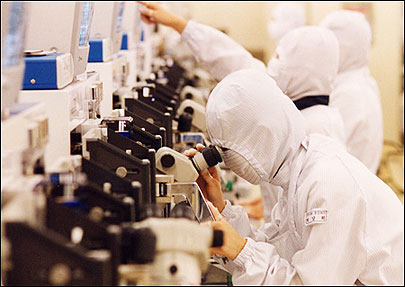
Two Globalfoundries workers in Albany, NY

Samsung and Globalfoundries just announced (see The Wall Street Journal-April 18, 2014) that they have agreed to adopt the same production process as they upgrade their chip-manufacturing services, an unusual alliance with implications for many designers of computer chips and other devices, notably Apple. With the agreement, chips produced by Samsung and Globalfoundries will be essentially identical; companies that design chips could have their products produced in factories operated by either company with no extra effort.  Companies generally prefer to reduce their reliance on a single supplier for components. In this case, the pact between Globalfoundries and Samsung provides a new selling point as the two companies try to woo customers away from Taiwan Semiconductor, the biggest chip maker.

The new pact could allow Apple in the future to shift chip orders between Samsung’s Austin plant and a Globalfoundries factory near Albany, N.Y.  “The idea of doing business with multiple suppliers is built right into Apple’s DNA,”  says one industry expert.

The pact also reflects the intense financial pressures associated with pursuing Moore’s Law, Silicon Valley’s shorthand for shrinking semiconductor circuitry to improve chips’ speed and data storage capability. With individual production tools priced at tens of millions of dollars—and complete chip factories costing $5 billion or more—fewer and fewer companies still develop new production processes. In response, companies are now working together to share costs of developing new production recipes.

But the deal goes much further. Globalfoundries agreed to abandon a technology it had been developing for creating chips with circuitry measured at 14 nanometers, or billionths of a meter. It will instead license Samsung’s 14 nanometer process, which has technical benefits, and uses common production tools and materials.

Classroom discussion questions:

1. What are the benefits of shared production?

2. Why is Apple encouraging this concept?


OM in the News: Apple vs. Samsung Is Really About Supply Chains

By now, everyone has heard the results of the law suit out of San Jose in which Apple was awarded $1.05 billion for damages incurred by Samsung’s infringement on  Apple patents (The Wall Street Journal , Aug.25-26, 2012). The  sweeping victory for Apple provides ammunition for more legal attacks on its  rivals in the $250 billion smartphone market–in which Samsung and Apple are #1 and #2. The jury found that Samsung infringed all but one of the seven patents at issue, and also decided Apple didn’t violate any of the five patents Samsung asserted in the case. “Today’s verdict should not be viewed as a win for Apple, but as a loss for the American consumer,” Samsung said. “It will lead to fewer choices, less innovation, and potentially higher prices.”

Apple, which prides itself on the style of its products, broke new ground by heavily relying on patents covering the physical design of its iPhones and iPads. (This is called “trade dress,”  the overall look and feel of a device.) Tech companies have more commonly relied on utility patents, which cover the way products work rather than how they look.

The bigger story from an OM perspective, though, may be in the fact that the rival companies have a $5 billion supply chain relationship. Apple is Samsung’s biggest customer for microprocessors. The current case in many ways resembles the 1996 lawsuit by GM against rival VW. GM’s VP for Supply Chains, Jose Lopez, was accused of  stealing GM’s plans for a new type of factory, dubbed “Plant X”, when he defected to VW. The settlement, in GM’s favor, recognized the role of each company as a supplier to the other. VW paid GM $100 million  and was required to buy $1 billion in parts from GM.

In today’s world, competition–as we say in Chapter 11–is often between supply chains, not between companies.

Discussion questions:

1. Ask students to research details of the GM-VW lawsuit and discuss them in class.

2. The Samsung-Apple lawsuit in Korea played out differently. Why?

OM in the News: Chip Makers Bet the Farm on Future Demand

The New York Times (May 3, 2011) has just reported some good news for US manufacturing, namely, the massive expansion of chip makers who are counting on continuing heavy demand for chips in smartphones, tablet computers, refrigerators, cameras, and GPSs. Samsung, the huge Korean chip maker, is betting $3.6 billion in expanding  its US factory to make logic chips for iPhones and iPads. The plant in Austin, scheduled to be completed next month, will be 2.3 million sq.ft., about the size of 40 football fields and one of the biggest factories in the country. Samsung chose Austin because of “the infrastructure and support system here–you can’t get that from anywhere else”.

Intel, the world’s largest chip maker, is spending $13 billion to build 2 new factories and upgrade 4 others in Oregon and Arizona, with the work to be complete in 2013. “When you make an investment in a factory, you’re essentially placing a bet on a manufacturing process that’s not yet done, for products that are not yet designed,  to sell in market that is not yet there”, says Intel.

Global Foundries, a contract maker (also called a foundry) of chips, is investing $4.6 billion in a new plant near Albany, NY,  that will build 28-nanometer chips for customers. (Small companies cannot afford the $ multibillion investment in making their own). Its 1.5 million sq. ft. plant will also open in 2013. “The appetite for tablet computers is a huge part of this move” to become the biggest contract chip producer in the world, says the  Milpitas, CA, company.

The chip industry “is a risky business that’s not for the faint at heart. Its like putting down $1 billion on the craps table”, adds an industry analyst.

Discussion questions:

1. The NYT article focuses on new chip plants in the US. But chip makers are also expanding this year in China, Germany, Japan, S. Korea, and Taiwan. Why the global move?

2. What happens to plants that are out-of-date?