Drones, in the headlines every day from Russia, Iran and Hezbollah, are also real manufacturing tools that can add valuable context and support. “They provide clear value in activities that are traditionally labor-intensive, disruptive or difficult to perform safely,” writes Industry Week (May 7, 2026).
Drones are making inroads in manufacturing in these two areas:
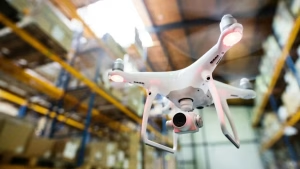
Inventory tracking: Indoor drones equipped with barcode scanners and computer vision systems can perform inventory scans with minimal disruption. In large warehouses or storage areas, they can significantly reduce cycle-count time and increase count frequency. The real-time data can be integrated into corporate software platforms, reducing excess stock and decreasing production delays due to stockouts.
Inspection: Conventional industrial inspections often require scaffolding, rope access, shutdowns or travel. They expose workers to heights, to confined spaces or to environmental hazards. Drones can transform this activity. High-resolution visual, thermal, ultrasonic and lidar payloads allow inspection of hard-to-reach areas, including storage tanks and silos, pipe racks, roof structures and overhead utilities. For remote manufacturing facilities, a drone mission can eliminate days of logistics and increase safety performance.
 The business impact is measurable: reduced downtime, lower mobilization costs, reduced safety risk and faster response to problem detection. In the energy and utilities sector, drone-based inspection has been estimated to reduce inspection costs by 70% and downtime by 90%.
Future innovation: The next stage in drone deployment is autonomous operation. Drones will increasingly operate from fixed docking stations, launching automatically to perform scheduled inspection missions. Data collected during these flights can be transmitted to AI-enabled analytics platforms and integrated into operational systems in near real-time. Coordinated drone swarms may be used to conduct large-scale inspections and surveys across a large infrastructure.
Challenges: Concerns about workforce displacement are common, and the increased adoption of drones is no exception. But drone programs typically augment skilled labor rather than replace it. Technicians can become certified drone pilots, remote inspection specialists, data analysts or AI-assisted defect reviewers.
Modern industrial drones are connected devices and must be treated as operational technology nodes within the broader cybersecurity architecture. A compromised drone platform presents a risk that goes beyond simple device failure. It may expose critical infrastructure data or provide a means to compromise enterprise networks.
Still, a fully scaled drone program that makes good use of its data is a significant strategic asset.
Classroom discussion questions:
- What other industries are already commonly using drones?
- Discuss their use in modern warfare.


 Food and beverage products led all stolen commodity categories, followed by agriculture, electronics, automotive parts, construction materials, and metals.
 Dr. Misty Blessley is a professor at Temple U. She shares her insights monthly.

