
For more than three decades, outsourcing followed a simple logic, moving work to lower-cost locations to reduce expenses and gain efficiency, writes Material Handling & Logistics (July 24, 2026). That model delivered real benefits, but the business environment has changed. Organizations now face pressure to innovate faster, strengthen resilience, protect worker safety, and meet increasingly complex regulations.
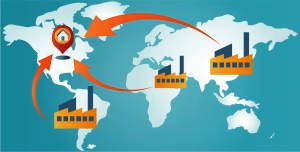 Instead of focusing solely on low-cost offshore outsourcing, organizations are adopting to a best-shore strategy, an approach that evaluates the nature of the work and places it in the location that delivers the greatest overall business value. The best-shore model recognizes that cost matters, but so do collaboration, speed, resilience, compliance, talent availability, and operational continuity.
Supply chain disruption, cybersecurity threats, geopolitical uncertainty, workforce shortages, regulatory change, and rising customer expectations have created new challenges that traditional outsourcing models were not designed to address. The lowest-cost location is now not always the lowest-cost solution.
A manufacturing plant cannot afford prolonged downtime because a critical engineering issue must wait until another region wakes up. A logistics operation cannot delay responding to a cybersecurity incident due to communication barriers.
Under the best-shore approach, organizations leverage a combination of offshore, nearshore, and onshore resources, assigning responsibilities based on business requirements rather than geography alone. Best-shore models incorporate three complementary delivery layers.
Offshore: Scale and Cost Efficiency Offshore delivery remains an essential component of global operations. Countries with large technical talent pools offer access to skilled professionals at competitive costs. Offshore teams often provide the scale necessary to support large transformation programs, application development initiatives, engineering projects, testing activities, data management, and managed services.
Nearshore: Speed and Collaboration Nearshore delivery helps bridge the gap between cost efficiency and operational responsiveness by locating teams in similar time zones and cultural environments. Teams can collaborate during the same business day, participate in real-time meetings, respond quickly to changing priorities, and engage more directly with business stakeholders.
Onshore: Governance and Business Alignment Certain activities benefit from being located close to the business itself. Executive engagement, regulatory compliance, stakeholder management, strategic planning, safety oversight, and customer relationships often require local presence and a deep understanding of business context.
Recent years have demonstrated how vulnerable organizations can become when they depend too heavily on a single geography, supplier, or operating model. A diversified best-shore model helps reduce concentration risk.
Classroom discussion questions:
- Summarize the differences between best-shoring and off-shoring.
- Provide an example of a firm that has best-shored.
 Dr. Misty Blessley is a professor at Temple U. She shares her insights monthly.