OM in the News: Drones Gain Manufacturing Altitude

Drones, in the headlines every day from Russia, Iran and Hezbollah, are also real manufacturing tools that can add valuable context and support. “They provide clear value in activities that are traditionally labor-intensive, disruptive or difficult to perform safely,” writes Industry Week (May 7, 2026).

Drones are making inroads in manufacturing in these two areas:

Inventory tracking:  Indoor drones equipped with barcode scanners and computer vision systems can perform inventory scans with minimal disruption. In large warehouses or storage areas, they can significantly reduce cycle-count time and increase count frequency. The real-time data can be integrated into corporate software platforms, reducing excess stock and decreasing production delays due to stockouts.

Inspection: Conventional industrial inspections often require scaffolding, rope access, shutdowns or travel. They expose workers to heights, to confined spaces or to environmental hazards. Drones can transform this activity. High-resolution visual, thermal, ultrasonic and lidar payloads allow inspection of hard-to-reach areas, including storage tanks and silos, pipe racks, roof structures and overhead utilities. For remote manufacturing facilities, a drone mission can eliminate days of logistics and increase safety performance.
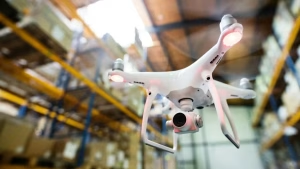
The business impact is measurable: reduced downtime, lower mobilization costs, reduced safety risk and faster response to problem detection. In the energy and utilities sector, drone-based inspection has been estimated to reduce inspection costs by 70% and downtime by 90%.

Future innovation: The next stage in drone deployment is autonomous operation. Drones will increasingly operate from fixed docking stations, launching automatically to perform scheduled inspection missions. Data collected during these flights can be transmitted to AI-enabled analytics platforms and integrated into operational systems in near real-time. Coordinated drone swarms may be used to conduct large-scale inspections and surveys across a large infrastructure.

Challenges: Concerns about workforce displacement are common, and the increased adoption of drones is no exception. But drone programs typically augment skilled labor rather than replace it. Technicians can become certified drone pilots, remote inspection specialists, data analysts or AI-assisted defect reviewers.

Modern industrial drones are connected devices and must be treated as operational technology nodes within the broader cybersecurity architecture. A compromised drone platform presents a risk that goes beyond simple device failure. It may expose critical infrastructure data or provide a means to compromise enterprise networks.

Still, a fully scaled drone program that makes good use of its data is a significant strategic asset.

Classroom discussion questions:

  1. What other industries are already commonly using drones?
  2. Discuss their use in modern warfare.

Guest Post: What a Chinese Drone Ban Means for U.S. Farming

Dr. Misty Blessley is a professor at Temple U. She shares her insights monthly.

DJI, a Chinese company and the world’s largest manufacturer of commercial and industrial drones, faces scrutiny in the U.S. over alleged cybersecurity risks. It is now close to being banned here.

One U. S. business that sells spray-drone kits reported that its challenges began last year when importing DJI drones became significantly more difficult. This uncertainty has caused concern across industries that rely on these tools, from public safety and construction to supply chain logistics. For American agriculture specifically, a ban could cut off access to vital equipment, leaving fields unmonitored, untreated, and risking harvest losses.

DJI drones are favored by farmers as they save weeks of labor by spraying seeds, fertilizer and fungicide from the sky.

Agriculture has adopted drones more rapidly than almost any other sector. Monitoring drones help detect disease and water stress early, while spray drones enable precise application of fertilizer and pesticides during narrow weather windows. They have become crucial for reducing input costs (China is accused of subsidizing their drone industry, which might explain some of the cost differences), protecting yields, and facilitating smooth food movement through supply chains. If imports are halted, many farmers could miss critical windows, leading to lower yields and creating issues along the supply chain, from processors to consumers.

Mitigation Strategies
To prepare, farming businesses should apply lessons learned from managing recent supply chain disruptions:
 Diversify suppliers – Start testing U. S. or non-Chinese alternatives, even if they are currently less cost-effective. Early adoption minimizes dependence.

Stock critical parts – As restrictions tighten, building an inventory now provides a safety buffer.

Use mixed fleets – Combine current drones with alternative technologies like ground sprayers to prevent single points of failure.

Plan operational slack – Stagger schedules or adjust operations to account for potential delays.

Collaborate and advocate – Engage with farm bureaus and trade associations to push for phased implementation, subsidies, or funding for domestic options.
 

Classroom discussion questions:
1• What are the challenges and drawbacks of each mitigation strategy?
2• Considering that the Chinese drone ban is likely, how should user decision-making be updated? (Refer to Module A Decision-Making Tools and consider these facts:◦ Drones can cut labor costs by up to 90% and reduce chemical use by 20–30%. ◦ A high-end U.S.-made drone can cost nearly $30,000, compared to a similar DJI unit costing $6,500).

OM in the News: Amazon Integrates Drones for Faster Delivery

Amazon’s plan for drones operating out of the same buildings as traditional delivery vans shows its ambition to have the technology become a regular part of its day-to-day fulfillment operations, writes Supply Chain Dive (Oct. 20, 2023). “The integration aims to help Amazon streamline the retail experience, create a safer and more sustainable delivery model, and deliver products more quickly,” the company said.

An Amazon drone takes flight. Prime Air drones will start deploying at same-day delivery sites rather than standalone facilities

Meanwhile, the plan for new drone delivery locations in the U.S. and abroad expand Amazon’s efforts to scale the emerging transportation method. Amazon has been using drones for nearly a year to deliver packages weighing up to five pounds in one hour or less. In College Station, Texas, Amazon drones have delivered hundreds of household items since 2022.

Amazon noted it eventually wants its drones to fly thousands of times and deliver millions of packages annually for customers. However, the rollout for its drone program has been slow, complicated by reported safety challenges and limited delivery activity in addition to industry-wide hurdles to mass adoption. “We are working closely with national regulators and international regulators, and communities in the EU, Italy, the UK, and the U.S., to develop this program,” Amazon said. “We have committed the necessary time and resources to build a safe and scalable service.”

Amazon has the opportunity to scale up its drone delivery coverage quickly by stationing them at same-day delivery sites. The company plans to double the number of these smaller facilities, which are stationed near metro areas and use a streamlined fulfillment process, in the coming years. “Think of products that fit the size and weight capabilities of the drone — like cold medicines and batteries — we place them close to customers at these sites, which enables us to deliver them at our fastest speeds, and now it makes sense to make deliveries even faster via drones,” Amazon said.

Amazon plans to lean on its MK30 drone to make the deliveries, replacing its existing drones by the end of 2024. The new design can fly twice as far as previous Prime Air drone models, expanding the company’s drone delivery range.

Classroom discussion questions:

  1. What are the advantages of drone deliveries?
  2. Limitations?

OM in the News: Delivery Drones are Arriving, at Last

“After nearly a decade of largely unfulfilled hype about flying robots dropping orders at your doorstep,” writes The Wall Street Journal (April 2-3, 2022), “several companies have started commercial operations in the U.S. involving dozens or hundreds of deliveries a day at each location.” The companies are vying to be Americans’ choice when they want a bottle of Advil, a takeout meal, or the next iPhone delivered in under 30 minutes—once federal regulators enable broader rollouts.

With a capacity of up to 6 pounds, Flytrex’s drones can ferry 33 chicken wings, plus sauce and fries

Zipline recently started working on deliveries with Walmart at an Arkansas location. Flytrex, an Israeli startup focused on food delivery in the U.S. suburbs, just announced a new delivery station in Texas after 2 years of testing. Wing, a unit of Google, has rapidly increased its deliveries in Virginia as a result of the pandemic. While still small-scale, the operations mean that in a handful of locations, regular people now can try these services for themselves.

Advocates for drone delivery say the technology could reduce emissions, the cost per trip, and traffic on roads, while also making sub-half-hour delivery—some companies are claiming in as little as 5 minutes—the new norm in the race toward e-commerce instant gratification.

Zipline has logged 20 million miles of flights across 275,000 commercial deliveries, mostly of blood, vaccines and medical products in Rwanda and Ghana. Last year, it built a launch platform attached to the back of a Walmart in Arkansas, near the firm’s HQ. That facility can serve any home in a 50-mile radius. Zipline operates 11-foot wide, fixed-wing drones that launch from a steel rail by an electric motor that accelerates the 44-pound aircraft to 60 miles an hour in one second. Flying autonomously, the drones drop orders at their assigned addresses in cardboard boxes suspended beneath paper parachutes. Upon return to the launch station, they maneuver so that a hook on their tails catches a suspended line. Zipline’s drones can hit a target as small as two parking spaces, with a package up to 4 pounds.

Flytrex has been making deliveries from a Walmart store in North Carolina, where it has delivered more than 18,000 items and can serve up to 10,000 homes. Its new delivery station near Fort Worth offers delivery for the Chili’s and Maggiano’s Little Italy restaurant chains.

Classroom discussion questions:

  1. Why has it taken so long for drones to be adopted?
  2. Why are drones an important tool for logistics managers?

OM in the News: Drones Seek a Role in Delivery of Covid-19 Vaccine

A handful of drone-delivery startups want to help transport Covid-19 vaccines from distribution facilities to health centers, vying for a logistical role in what is likely to be a sprawling and complex undertaking, reports The Wall Street Journal (Nov. 2, 2020). Several of these businesses have entered into medical delivery partnerships with drug companies and retailers—including Merck and Walmart — that could help position them to take part in the high-profile effort to distribute Covid-19 vaccines. Walmart said the pilot project with DroneUp will help the company learn about the role drone deliveries can play in pandemic response, health-care delivery and retail.

Meanwhile, some startups have discussed with governments around the world their ability to use unmanned aerial drones to transport vaccine doses, mainly in remote areas. The efforts are indicative of drone companies’ ambitions to reshape shipping and logistics. Delivering Covid-19 vaccines would enable drone startups to demonstrate on a world stage their ability to streamline operations and cut costs across distribution networks.

A Volansi drone

To be sure, using drones to transport Covid-19 vaccines likely would represent a sliver of the overall effort. They would primarily be for hard-to-access regions and fly along fixed routes to move doses in bulk.

Drone fleets can reduce reliance on drivers, increase delivery capacity and speed up the time it takes for supplies to reach patients. These advantages would be valuable in complex and urgent Covid-19 vaccine distribution.  Fleets of dozens of drones, for instance, could make half-hour trips delivering thousands of vials each day to health centers in remote areas.

Merck partnered with Volansi recently to fly medicines and vaccines from its manufacturing facility in North Carolina to a health clinic in unmanned drones. Vidant Health System is participating in the program, which is using a Volansi drone capable of carrying 5 pounds of medical cargo to locations up to 50 miles away.

Classroom discussion questions:

  1. What are the advantages of using drones for vaccine delivery?
  2. The disadvantages?

OM in the News: Amazon Gets U.S. Approval for Drone Fleet

Amazon’s latest drone is designed to carry packages weighing 5 pounds and fly a round-trip distance of 15 miles.

Amazon just received federal approval to establish a fleet of drones and will begin limited tests of package deliveries to customers in the U.S., reports The Wall Street Journal (Sept. 1, 2020).

The approval from the FAA is a milestone in Amazon’s push to use unmanned aircraft to deliver packages to global consumers. The company also has testing sites in Canada, Austria, and the U.K.

Routine drone deliveries to U.S. consumers are still years away, partly because the FAA needs to complete rules for remote identification of more than 480,000 drones currently registered for commercial operations, and issue separate rules permitting drones to fly regularly over populated areas. Amazon has now joined UPS and Wing (a unit of Google) in gaining approval to operate unmanned air fleets in the U.S. for tests involving customer deliveries. Amazon has sought regulatory approval for a broader range of drones and over a larger geographic area than its competitors.

Amazon CEO Jeff Bezos made the ambitious prediction in 2013 that drone-delivered packages would arrive at the doors of customers in 5 years. Although the company completed its first test flight in England in 2016, the process has taken longer than Amazon expected.

Wing last year began to deliver food and other supplies to customers in Virginia. The company has been conducting tests in partnership with Walgreens and FedEx. UPS, which received FAA approval to set up an airline fleet last year, has been using its drones to carry medical supplies at a hospital network in Raleigh, N.C. Other companies such as Uber Technologies have also conducted limited drone-delivery tests in the U.S.

Classroom discussion questions:

  1. What are the strengths and weaknesses of this delivery approach?
  2. Why does Amazon wish to enhance its shipping strategy?

OM in the News: Amazon Marries Drones and Intermodal

“Amazon wants its inventory everywhere”, writes Supply Chain Dive (Nov. 8, 2019). It is expanding its network of fulfillment locations with a focus on intermodal containers. Intermodal-based fulfillment, as Amazon’s patent application describes it, would allow the company to fulfill orders from rail, truck or ship. Here are the steps in the patent:
1. Load intermodal container with inventory.
2. A robotic system picks and loads items onto drone.
3. Launch and retrieval system puts the drone in appropriate position for take-off.
4. Drone departs container through opening in the roof.
5. Drone travels to a customer’s home, delivers package.

Amazon patent graphic for railroad sourcing

6. Drone meets back up with the container at a pre-calculated rendezvous point.

7. Variety of sensors track container’s location.

But wait, drones need new batteries, their propellers might break, and without a human in the loop how does this operation keep running smoothly? Amazon thought of this. One of the details included in the patent application is a maintenance container where drones can have a robotic technician replace propellers or batteries. Amazon says containers could be loaded with inventory before the launch of a book or video game in anticipation of demand spikes, placing inventory in locations where it expects orders.

To compete with brick-and-mortar locations, Amazon wants to cut down on delivery time making it just as convenient to hit order on the marketplace as it is to drive down the road. But this requires a complex network of inventory in fulfillment and sortation centers across the country. It has already promised one-day delivery for a variety of SKUs. Amazon claims drones will enable 30-minute delivery. Making this happen will not just require drones, but a vast web of SKUs across the country.

Classroom discussion questions:

  1. Why does “Amazon want its drones everywhere”?
  2.  What might be the weaknesses of this proposal?

OM in the News: Delivering With Drones and Shooting Down Drones–2 Views

Two very interesting articles just appeared regarding the future of drones.

The first, in The Wall Street Journal (Oct. 2, 2019), notes that UPS is now cleared to deliver with drones, with federal approval to start setting up a fleet of unmanned aircraft to deliver health supplies and eventually consumer packages potentially throughout the U.S. The company obtained an immediate green light to ship products in North Carolina hospitals. This broad approval for an entire fleet of future drones and pilots on the ground opens the door for many other types of longer-range applications spanning rural and suburban areas. The first phase includes 100 or more hospital complexes. As delivery options expand, UPS says future steps may include a single operator on the ground controlling multiple flights, or using drones to supplement traditional package delivery by trucks in rural areas. Its goal is to be the first drone operator to operate on a sizable scale.

The second article, in Businessweek (Oct. 7, 2019), is titled “Tech’s Most Controversial Startup Now Makes Drone-Killing Robots.”  Here we learn that the Pentagon has spent years searching for reliable ways to combat consumer drones that have been repurposed as reconnaissance craft or bombers. (The use of miniature quadcopters

Anduril’s Interceptor

for spying or terrorism has long concerned the U.S. The fear was underscored this year when military-grade drones were used in attacks in Saudi Arabia and the Strait of Hormuz, and last year during an assassination attempt in Venezuela using hobbyist drones).

Now, Anduril Industries, a 2-year-old Calif. startup, has begun shipping dozens of its drone-destroying Interceptors to military clients in the U.S. and the U.K.; and has hundreds more in production, with contracts to deploy Interceptors to overseas conflict zones. The Defense Department has pursued various remedies, including jamming drones’ signals and netting them like butterflies. But the idea of electronically disabling or ensnaring a drone without destroying it seemed ludicrous to Anduril. “Why not just shoot it down? All the soft kill systems are a waste of time,” says the firm’s CEO.

Classroom discussion questions:

  1. Make the case for and against commercial drones in The U.S.
  2.  Why is Anduril called a controversial company?


OM in the News: The Use of Drones Grows

A drone hovers over a home, capturing detailed images of the roof

“Building inspectors who used to rely on binoculars and ladders are turning to drones to check property exteriors for signs of damage or deterioration that could lead to injuries,” writes The Wall Street Journal (Feb. 21, 2018). But their lower cost and greater thoroughness is coming into conflict with another public safety concern: the danger drones pose to other aircraft or people on the ground. In New York City, which has thousands of old skyscrapers, drone use is prohibited for property inspection.  Yet buildings over 5 stories must be regularly inspected in NYC, forcing inspectors to go out with binoculars, field notes, a pen and paper.

Drones, which had early applications in warfare and surveillance, increasingly are being adopted by a wide range of businesses—from package delivery to underwater exploration. Business applications have grown significantly since 2016, when an FAA ruling made it easier to become a drone operator. Since that ruling, technological developments have made drones smaller, more reliable and easier to fly, causing a growing number of  building inspectors to embrace them.

Take the inspection of a cathedral in Long Island. Using a drone, inspectors could examine the chimney without having to erect scaffolds—the difference between a $1,000 inspection and a $10,000 scaffolding inspection. Using a drone also can shorten a weekslong inspection to a day. “It is realistic that a $10,000 drone inspection could cost over $100,000 of hanging scaffolding,” said one engineering consultant.

About 8% of the 21,000 certified home inspectors in the U.S. now use drones for inspections. Four years ago, there were virtually zero.

Classroom discussion questions:

  1. What are the advantages and disadvantages in drone usage for building inspection?
  2. How else might drones be used in OM?

Video Tip: Watching UPS’s Drones Deliver

A drone-equipped UPS van, seen from above
A drone-equipped UPS van

“Both the drone industry and federal regulators are years away from actual legal drone deliveries in the U.S.,” writes USA Today (Feb. 21, 2017). But that’s not stopping UPS from testing possibilities, both to get the visual of a drone with their logo out in front of the public and to see what works. The firm this week ran a test of a truck-launched drone delivery system for rural areas in Lithia, Fla. The drone-equipped vans would only be used on rural routes, says UPS.

Imagine a triangular delivery route where the stops are miles apart by road. The van-top drone would allow a UPS driver to make one delivery at the lower-left of the triangle, after launching a drone that would autonomously fly and deliver to the top of the triangle. While the drone is making its delivery, the driver would continue to the next stop, make another delivery by hand, and the drone would then rendezvous and recharge on top of the UPS truck.

UPS’  aim isn’t to replace drivers but to make them more efficient by allowing one driver to more quickly and efficiently deliver to several homes near one and other. The drone is fully autonomous. It doesn’t require a pilot. So the delivery driver is free to make other deliveries while the drone is away.

UPS estimates that reducing the distance its truck drive by just one mile per driver per day over one year could save the company up to $50 million. Rural delivery routes are the most expensive to serve, due to the time and vehicle expenses required to complete each delivery.

Here is a very short video your class will enjoy!

OM in the News: The Popcorn Arrives Via Amazon Drone

Drone used to make Amazon's first commercial delivery, in England
Drone used to make Amazon’s first commercial delivery, in England

This week, Amazon made its first commercial drone delivery, to an Amazon shopper in Cambridgeshire, England, a major step forward in its experiments with automated shipments. The flight — to deliver an Amazon Fire device and popcorn to a customer — took off from a nearby Amazon warehouse and lasted 13 minutes, covering 2 miles.

The company says it wants to expand the number of consumers who could participate in the trial to dozens in the coming months, eventually allowing hundreds to use the drone service. The start of customer trials for the drone delivery service, which Amazon calls Prime Air, is a milestone for a technology that could eventually automate an important part of Amazon’s business.

The advent of widespread drone deliveries, even if technically possible, would take years, and regulators from the U.S. and elsewhere could block the plans. “But even if drones end up handling only a small portion of Amazon’s overall deliveries, the implications could be far-reaching,” writes The New York Times (Dec. 15, 2016). The company, for instance, might not need as many truck drivers or other costly logistical operations. Drones could also have environmental benefits, by reducing reliance on pollution-belching vehicles. The biggest boon may be to customers, who could be able to receive their orders more quickly.

In England, Amazon has been allowed to fly drones without a human pilot at the controls, navigating to destinations solely by GPS. The company says it has developed “sense-and-avoid” technology to help the machines fly around towers, birds and other obstructions.

Classroom discussion questions:

  1. What are the limitations of drone use for deliveries?
  2. Why is Amazon pursuing the drone approach?

OM in the News: Amazon’s New Delivery Strategy

An Amazon Prime Air drone.

“Over the last few years, Amazon has left a trail of clues suggesting that it is radically altering how it delivers goods,” writes The New York Times (Aug.11, 2016). Among other moves, it has set up its own fleet of trucks; introduced an Uber-like crowd sourced delivery service; built many robot-powered warehouses; and continued to invest in a plan to use drones for delivery. It made another splash last week, when it showed off an Amazon-branded Boeing 767 airplane, one of more than 40 in its planned fleet.

These moves have fueled speculation that Amazon is trying to replace the 3rd-party shipping companies it now relies on — including UPS, FedEx and the U.S.P.S. — with its homegrown delivery service. Its logistics investments have also fed the theory that Amazon has become essentially unbeatable in American e-commerce.

The company, it appears, has a 2-tiered vision for the future of shipping. First, it’s not trying to replace 3rd-party shippers. Instead, Amazon wants to add as much capacity to its operations as possible, and rather than replace partners like UPS and FedEx, it is spending heavily on delivery services to add to its overall capacity and efficiency. Amazon’s longer-term goal is more potentially transformative. It wants to escape the vicissitudes of roads and humans, going fully autonomous in the sky. The company’s drone program could be combined with warehouses manned by robots and trucks that drive themselves to unlock a new autonomous future for Amazon.

If Amazon’s drone program succeeds (and Amazon says it is well on track), it could fundamentally alter the company’s cost structure. A decade from now, drones would reduce the unit cost of each Amazon delivery by about half.  According to Amazon, we will see drones in action within 5 years.

Classroom discussion questions:

1. Why does Amazon wish to enhance its shipping strategy?

2. What are the advantages and disadvantages of the drone program?

OM in the News: Using Drones to Take Inventory at Walmart

drone work in classic warehouse 3d image
Drone working in a Walmart warehouse

Soon, the labyrinthine aisles at Walmart’s distribution centers — stocked high with canned beans, toys and many other products — could also have a low humming sound. The country’s largest retailer, reports Supply & Demand Chain Executive (June 6, 2016), is testing the use of flying drones to handle inventory at its large warehouses, which supply the thousands of Walmart stores throughout the nation. In 6-9 months, the machines may be used in its distribution centers.

At a recent demonstration, a drone moved up and down an aisle packed nearly to the ceiling with boxes, taking 30 images per second. Walmart’s VP of Emerging Sciences and Technology explained that the machines could help catalog in as little as a day what now takes employees about a month. Walmart workers now manually scan pallets of goods with hand-held scanning devices. The drone’s methodical, vertical movements would essentially mimic the path of a person in a forklift who might be inspecting labels and inventory. While a Walmart employee may handle the drone, the technology could mean fewer workers would be needed to take stock or replace missing items.

Walmart is under intense pressure to grow amid an onslaught of low-cost competition, particularly from Amazon. It has committed to spending $2.7 billion on labor and technology to improve its on-line business. Walmart operates 190 distribution centers in the U.S., and each one services 100-150 stores. Millions of items can move through the centers each week and onto a fleet that includes 6,500 trucks and 8,000 drivers to move merchandise throughout the U.S.

Classroom discussion questions:

  1. Why are the drones a potentially important OM tool?
  2. What is Amazon doing to automate its warehouses?

OM in the News: Before the Drones, Amazon Lets Loose the Robots

kiva2Amazon  received a lot of news coverage for its sci-fi drone-delivery idea last week. But an immediate robotics effort under way in the Seattle retailer’s warehouses could save the company more than $900 million a year. Amazon’s rollout of robots from a company it bought last year, Kiva Systems Inc., could help pare 20% to 40% off the $3.50 to $3.75 cost of fulfilling a typical order, reports The Wall Street Journal (Dec. 9, 2013). The robots can shuttle shelves full of merchandise to warehouse workers, relieving of the workers of having to dash throughout the warehouse. “We believe this could be a significant opportunity to drive higher operating efficiency across Amazon’s massive fulfillment-center network,” says one industry expert.

Amazon has been working to reduce order costs and speed delivery, in part by constructing more warehouses closer to urban centers. While many of its latest efforts focus on deliveries themselves, Kiva robots could improve efficiency within warehouses, where humans—and human error—still rule the day. Amazon just disclosed that it has 1,400 Kiva robots in 3 of its warehouses. A broad rollout of Kiva robots could save Amazon $458 million to $916 million a year.

Perhaps more tantalizing is the potential for Amazon to sell the robots to other companies. Before Amazon bought Kiva, the robotics company was charging about $2 million for a kit of robots and as much as $20 million for large installations. Meanwhile, warehouse robots will remain a source of fascination. Indeed, Amazon’s announcement of its drone-delivery idea appeared to have prompted to disclose its effort to build robots.

Classroom discussion questions:

1. What are the advantages and disadvantages of introducing robots in the Amazon system?

2. Compare the use of drones vs. robots in improving OM efficiency.