OM in the News: Foxconn’s Big India Expansion

Apple has identified India as a prime destination as it seeks to diversify the sites where its products are assembled.

Apple’s main manufacturer, Foxconn Technology, is considering a major expansion in India, including assembling millions more iPhones and setting up new production sites as it seeks to further diversify beyond China, reports The Wall Street Journal (March 6, 2023). It aims to boost iPhone production to 20 million units annually by 2024 and triple the number of workers to as many as 100,000 at its existing plant near Chennai. The plant currently produces 6 million units.

Foxconn also plans to build:  a new production facility in Karnataka, where it would make products including iPhones; a new production site in Hyderabad; and a silicon carbide fabrication plant for its semiconductor business. The Indian government has offered billions of dollars of incentives in recent years to lure global manufacturers to India, as part of a major push to boost advanced manufacturing jobs and decrease reliance on electronics imports.

Meanwhile, Apple has been pushing suppliers to diversify beyond China after many of them faced production disruptions in China multiple times during Covid lockdowns. Geopolitical tensions have been growing between the U.S. and China, as well as between Beijing and Taiwan, where Foxconn is based.

China has been the biggest manufacturing hub in the electronics supply chain for years, with Apple a major driver after building much of its supply chain and assembly in the country over the past two decades.  Concerns over that reliance heightened after protests erupted at the world’s biggest iPhone production site in central China late last year over tight pandemic control policies and wages. Still, expanding into India won’t mean companies such as Apple and Foxconn leaving China. The supply-chain infrastructure that these companies have built over the past decades there can’t be easily replaced by other countries.

Despite strides in local automobile and smartphone production in recent years, India has long trailed regional rivals in advanced manufacturing due to concerns over the country’s challenging bureaucracy, protectionist rules and underdeveloped infrastructure. India, alongside Vietnam, has already been identified by Apple as a prime destination with the company seeking to diversify the sites where its products are assembled. Apple has told its suppliers to plan more actively for assembling its products beyond China.

Classroom discussion questions:

  1. Why India and Vietnam? Why not the U.S?
  2. Chapter 8 lays out key success factors that affect location decisions (see page 337). Which of these factors is Apple considering?

OM in the News: Why Apple Plans to Move Beyond China

Apple and China have spent decades tying themselves together in a relationship that, until now, has mostly been mutually beneficial, writes The Wall Street Journal (Dec. 3-4, 2022).  But in recent weeks, Apple has accelerated plans to shift some of its production outside the long the dominant country in its supply chain. It is telling suppliers to plan more actively for assembling Apple products elsewhere in Asia, particularly India and Vietnam, and looking to reduce dependence on assemblers led by Foxconn.

Protesting workers being beaten at Chinese iPhone factory in November

Turmoil at a place called iPhone City helped propel Apple’s shift. At the giant city-within-a-city in Zhengzhou, China, as many as 300,000 workers work at a factory run by Foxconn to make iPhones and other Apple products. At one point, it alone made about 85% of the Pro lineup of iPhones.

The Zhengzhou factory was convulsed by violent protests and running at only about 20% capacity last month. Coming after a year of events that weakened China’s status as a stable manufacturing center, the upheaval means Apple no longer feels comfortable having so much of its business and supply chain tied up in one place. In the past, China has excelled at building hundreds of millions of gadgets, heavily due to its concentration of production engineers and suppliers.

Two causes threaten China’s historic economic strength. Some Chinese youth are no longer eager to work for modest wages assembling electronics for the affluent. They also seethe because of Beijing’s heavy-handed Covid-19 approach, itself a concern for Apple and many other companies. And 5 years of U.S.-China military and economic tensions and U.S. tariffs have come into play.

The risk of too much concentration in China has long been known to Apple, yet for years it did little to lessen it. China supplied a diligent workforce, political stability and a huge local market. Apple’s goal is to now ship 40% to 45% of iPhones from India. Vietnam is expected to shoulder more of the manufacturing for other Apple products such as AirPods, smartwatches and laptops. American companies’ confidence in China has fallen to a record low, with about a quarter saying they have at least temporarily moved parts of their supply chain out of China over the past year.

Classroom discussion questions:

  1. What are the benefits and risks of Apple’s move?
  2. Figure 8.1 in your Heizer/Render/Munson text (see page 337) lists 20 factors that affect location decisions. Which concern Apple operations managers?

OM in the News: The Logistics Disarray in China

For decades, the world has depended on China as a massive factory floor and market. As the country’s economic growth crumbles, the pain is spreading globally. Lockdowns aimed at stamping out Covid-19 are throttling activity in the world’s second-largest economy. Overseas demand for China’s exports is fading as economies wrestle with surging prices and rising interest rates.

Workers lined up to get tested for Covid-19 at the Foxconn factory in Wuhan, China

The effects of China’s slowdown are showing up everywhere from German factories to Australian tourist spots. Car sales in China have collapsed, hitting auto makers including BMW, VW, and Tesla. Tesla sold just 1,512 cars made at its Shanghai plant in April, down 98% from the more than 65,000 it sold in March.

Foxconn, the world’s biggest iPhone assembler, faces logistics disruptions and other challenges in China stemming from the country’s stringent Covid measures, reports The Wall Street Journal (May 13, 2022). Most of Foxconn’s factories in China have been running under a bubble-like system. The manufacturer has relied on its supply-chain management expertise to keep production going even during Covid outbreaks.

Apple, Foxconn’s biggest customer, said that the Covid outbreaks in China threaten to hinder this quarter’s sales by as much as $8 billion.  Apple’s supply constraints mainly stemmed from Shanghai, much of which has been under a lockdown for more than a month, and the nearby regions, where logistics have been disrupted.

Foxconn has been following a closed-loop system to keep tens of thousands of workers in or around the factory, a system that has become the standard among manufacturers in China to continue manufacturing during Covid outbreaks.

In March, Foxconn had to suspend operations at its factories in Shenzhen, another site where it produces Apple products, after a virus outbreak there. Hit harder than Foxconn is rival Pegatron, the second-largest assembler of iPhones, which suspended production at its factories in Shanghai and nearby Jiangsu province last month.

Others in the electronics sector also face fallout from China’s anti-Covid policies. Sony faces delays in procuring parts from Shanghai and nearby areas. Panasonic warned that the impact from the lockdowns in China would start to manifest in its performance over the coming months.

Classroom discussion questions:

  1. What are the advantages and disadvantages of Foxconn’s “closed loop” system?
  2. What can Apple and other manufacturers do to mitigate the shutdown damages?

OM in the News: The Hidden Automation Agenda

The Milwaukee offices of the Taiwanese electronics maker Foxconn, which plans to replace 80% of the company’s workers with robots in 5-10 years

In public, many CEOs wring their hands over the negative consequences that A.I. and automation could have for workers. They talk about the need to provide a safety net for people who lose their jobs as a result of automation. But in reality, writes The New York Times (Jan. 26, 2019), many are racing to automate their own work forces to stay ahead of the competition, with little regard for the impact on workers.

All over the world, executives are spending billions of dollars to transform their businesses into lean, digitized, highly automated operations. They see A.I. as a golden ticket to savings, perhaps by letting them whittle departments with thousands of workers down to just a few dozen. A 2017 survey by Deloitte found that 53% of companies had already started to use machines to perform tasks previously done by humans. The figure is expected to climb to 72% next year. Investment bank UBS projects that the A.I. industry could be worth $180 billion by next year.

The author of “AI Superpowers” predicts that A.I. will eliminate 40% of the world’s jobs within 15 years. He said that CEOs were under enormous pressure from shareholders and boards to maximize short-term profits, and that the rapid shift toward automation was the inevitable result. But other experts have predicted that A.I. will create more new jobs than it destroys, and that job losses caused by automation will probably not be catastrophic.

The CEO of the Chinese e-commerce firm JD.com said last year that “I hope my company would be 100% automation someday.” The World Economic Forum estimates that of the 1.37 million workers who are projected to be fully displaced by automation in the next decade, only 1 in 4 can be profitably reskilled by private-sector programs. “The choice isn’t between automation and non-automation,” said the director of M.I.T.’s Initiative on the Digital Economy. “It’s between whether you use the technology in a way that creates shared prosperity, or more concentration of wealth.”

Classroom discussion questions:

  1. What can A.I. do to help OM functions?
  2. Will A.I. replace as many jobs as some predict?

OM in the News: When the Location Incentives are in the Billions

The incentives offered by Wisconsin and its municipalities to Taiwan’s Foxconn Technology Group since it announced a $10 billion megaplant in the state have gone up by nearly $1 billion, writes The Wall Street Journal (June 29, 2018).The company broke ground this week, almost a year after the deal was announced as a success in the president’s efforts to bring manufacturing jobs back to America. The Apple  supplier promised to open a 20 million-square-foot complex that would build liquid-crystal display panels and committed to creating 13,000 jobs in the state.

Foxconn Chairman Terry Gou with President  Trump at the signing

In return, Wisconsin offered $3 billion in financial incentives. In an effort to land the plant, municipalities added their own sweeteners. The town and the county where the facility will be built offered a $764 million incentive package. And Wisconsin added another $134 million to the tab to improve state highways and local roads in the area around the Foxconn site. The state is on the hook for 40% of the public bonds that finance the local expenses if the project flops. If all goes well, Wisconsin taxpayers would recoup the investment in the 2042.

Ballooning costs underscore how expensive and unpredictable such projects can become for states and cities eager to attract new investments and jobs. Currently 20 states and cities are vying to win Amazon’s second headquarters, which promises a $5 billion investment and 50,000 well-paying jobs. New Jersey and the city of Newark have offered as much as $7 billion in tax incentives, while Maryland has offered $5 billion. But unexpected costs can often creep up with large projects that receive money from multiple government entities.

A professor at the University of Texas said negotiating a state deal separately from a local deal is particularly “bad practice.” It can put pressure on a locality to offer a large incentive package and also pits local communities against each other after the state has already had its own bidding war with other states.

Classroom discussion questions:

  1. What would be a better way to provide incentives from the government point-of-view?
  2. Provide an example of how massive incentives have, indeed, paid off in the past.

OM in the News: Foxconn’s U.S. Factory Plans

Foxconn makes iPhones and other gadgets for Apple

Foxconn, which helped turn China into the center of electronics manufacturing, just announced it will build a $10 billion plant in Wisconsin to make display panels used in TVs and other products. This marks the first major U.S. investment for Foxconn, the world’s largest contract manufacturer of electronics and the maker of iPhones.

“Foxconn,” writes The Wall Street Journal (July 27, 2017), “is betting the U.S. can rebuild an electronics supply chain that largely shifted to China and other lower-cost Asian countries in recent decades.” The factory is expected to employ 3,000 people initially and as many as 13,000 people eventually. The state is providing Foxconn with a $3 billion, 15-year incentive package of tax credits.

In addition to the factory workers, it is estimated that the plant will create 22,000 indirect jobs and another 10,000 construction jobs– and draw as many as 150 supporting suppliers to Wisconsin and nearby states. The average salaries for the 13,000 jobs at the factory would be $53,000 annually, plus benefits.

The 20-million-sq.-ft. campus will primarily produce high-resolution liquid-crystal displays, known as 8K resolution LCD, used in smartphones and car dashboards, in addition to TVs. Many TVs currently sold in the U.S. are assembled in Mexico, so it is possible that the displays made in Wisconsin could be shipped across the border to be installed in TVs that are later shipped back to the U.S. for sale.

Classroom discussion questions:

  1. Why is Foxconn entering the U.S?
  2. What are the benefits and risks to Wisconsin?

OM in the News: The City That iPhone Built

Foxconn iPhone workers walk between Zhengzhou Foxconn factories

It was 2010 and the iPhone was coming to a new industrial town on the edge of Zhengzhou, China that would be known as iPhone City. One year later, Foxconn, the manufacturer, said the iPhone factory complex had 100,000 workers. Today, it employs 250,000 at the plant. The company makes 150 million iPhones each year, along with 20 million iPads.

“With Apple embracing outsourced manufacturing in Chinese cities, the iPhone’s success in the decade since it launched has fueled China’s rise at the center of the global electronics supply chain,” writes The Wall Street Journal (July 5, 2017). The explosion of higher-tech manufacturing was encouraged by Beijing as leaders sought to move factories up the value chain from making plastic toys and clothes. That shift transformed the lives of millions of Chinese, bringing jobs but also leading to complaints from workers of repetitive labor, restrictive work rules and poor living conditions.

The move to Zhengzhou followed a spate of suicides in 2010 at Foxconn’s other iPhone factory in Shenzhen, along the coast where wages were higher. “We hold our suppliers to the standard we hold ourselves: They must treat everyone with dignity and respect,” said Apple. Apple said wages and working conditions at its suppliers have improved significantly in the past 5 years.

Like American company towns a century ago—Pullman, Ill., Hershey, Pa., and Henry Ford’s Detroit—iPhone City revolves mainly around a single product, and it depends on that product for its wealth. During last fall’s rush to make the iPhone 7, when Foxconn was short-handed, state-owned coal companies lent workers to Foxconn. In past years, the province issued quotas to local authorities stating how many workers they needed to produce for Foxconn.

Classroom discussion questions:

  1. Why doesn’t Apple manufacture iPhones in the U.S.?
  2. What has China’s government done to assist manufacturers such as Foxconn?

OM in the News: How the iPhone Got Outsourced to China

A crushing work force begins arriving for the Apple early shift at 6:30 a.m., crossing paths with those leaving the late shift
A crushing Foxconn work force begins arriving for the Apple early shift at 6:30 a.m., crossing paths with those leaving the late shift in Zhengzhou.

Apple was late to China”, writes The New York Times (Dec. 29, 2016). In a bid to lower costs, some of the biggest American technology companies, including Compaq, Dell and H-P, began dismantling their domestic manufacturing in the 1980s and moving work overseas, largely to Asia. Not Apple.  Steven Jobs believed that software and hardware development had to be closely integrated.

Rather than close plants, Apple decided to build them — in Colorado, Texas and California. The plants were highly automated, with the walls painted white, just as Jobs liked them, and they were promoted as a symbol of American ingenuity. “This is a machine that is made in America,” Mr. Jobs trumpeted in 1984, after Apple opened a manufacturing facility in California to produce the Macintosh PC.

But by the mid-1990s, Apple began to embrace outsourcing under its new operations chief, Tim Cook (now CEO). Under Cook’s direction, Apple shifted business to Foxconn, then an up-and-coming Taiwanese contract manufacturer that had started to gain a following among big American PC brands. The partnership freed up Apple to focus on its strengths — design and marketing. Apple would come up with a new idea, and Foxconn would find ways to produce millions of units at a low cost.

“They have brilliant tooling engineers, and they were willing to invest a lot to keep pace with Apple’s growth,” said a former Apple executive. When Apple’s sales took off after the introduction of the iPod in 2001, Foxconn had the heft and expertise to meet the demand that accompanied each hit product. Foxconn’s factories could quickly produce prototypes, increase production and, during peak periods hire hundreds of thousands of workers. Now, some 350,000 workers assemble, test and package iPhones in the 2.2 square mile site— 350 a minute, 500,000 a day.

Classroom discussion questions:

  1. Everyone is talking about regaining manufacturing jobs. Can Apple reshore its manufacturing?

      2. What is Apple’s core competency? Foxconn’s?

OM in the News: China Begins to Lose Jobs

Some assembly line jobs are reshoring or moving to cheaper countries

Between 1999 and 2011, the U.S. lost 2 million jobs because of a surge in Chinese imports. With its large pool of workers who earned much lower wages than their U.S. counterparts, China attracted manufacturers seeking to reduce costs, bolster profitability and keep prices low. But “China’s labor market has changed sharply in recent years. China is moving up the value chain,” reports The New York Times (July 23, 2016).

Wages for Chinese factory workers now average $424/month, 29% more than just 3 years ago, and labor costs are now significantly higher than in many other emerging economies. Workers in Vietnam earn less than 1/2 the salary of a Chinese worker, while those in Bangladesh get paid 1/4 as much. The costs of manufacturing in China are now almost the same as in the U.S., after taking into account wages, worker productivity, energy costs and other factors.

Without the lure of large cost savings, more American companies are “reshoring,” with 24% saying they are actively shifting production home from China or are planning to do so over the next 2 years–up from only 10% in 2012. As a result, the number of manufacturing workers here is expected to increase over the next 5 years.

But it is not just the U.S. that is taking jobs away. Almost 1/2 are moving into other developing countries in Asia, while nearly 40% are shifting to the N. America. Foxconn, which makes Apple iPhones in Chinese factories, is planning to build 12 new assembly plants in India, creating 1 million new jobs there. Many Chinese companies are burdened by excess capacity, and downsizing may be unavoidable. China estimates that 1.8 million workers could lose their jobs in the steel and coal sectors alone.

Classroom discussion questions:

1. Will the U.S. recapture all the manufacturing jobs it lost? Why?

2. What is China doing to stay competitive?

OM in the News: Foxconn Replaces 60,000 Humans with Robots in China

foxconnApple supplier Foxconn Technology has replaced 60,000 human workers with robots in a single factory, reports the South China Morning Post (May 22, 2016). This is part of a massive reduction in headcount across China’s entire Kunshan region. Foxconn has been automating its manufacturing facilities throughout China, including Kunshan, for “many years,” which it says has freed up its employees to focus on higher value-added elements of the manufacturing process, such as R&D, process control and quality control. The job cuts do not augur well for Kunshan, which has a population of 2.5 million.

”Across all of our facilities today, we are applying robotics engineering to replace repetitive tasks previously done by employees,” Foxconn said. “As our manufacturing processes and the products we produce become more technologically advanced, automation is playing an increasingly important role in our operations and we have plans to automate more of our manufacturing operations over the coming years.”

Roughly 600 companies in the Kunshan region are looking to reduce headcount with robots, as part of an effort to accelerate growth and reduce costs. While developing robotics does present higher upfront costs, machines are more predictable, stable, and cheaper over the long term versus humans. With such high pressures placed on these manufacturers, which assemble much of the world’s consumer technology products and are often under strict deadlines, it also alleviates some of the ethical issues that arise when working people too hard for too long to meet demand. Foxconn has been criticized for years for inadequate working conditions, which led to a string of suicides at its manufacturing facilities a few years ago. Foxconn employees have complained of being overworked, sleeping in less-than-ideal dormitory conditions, and not being paid fairly.

There are, by the way, currently more than 260,000 robots working in U.S. factories.

Classroom discussion questions:

  1. How will Foxconn’s strategy impact U.S. manufacturers?
  2. How will this decision impact China?

OM in the News: Apple Decides That Two Suppliers Are Better Than One

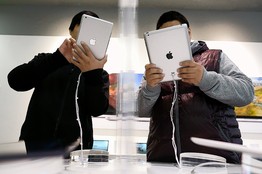
Pegatron began making iPad minis (left) recently, while Foxconn still assembles the larger iPads (right)

For years, nearly all of the world’s iPhones and iPads rolled off the assembly lines of a single company: Foxconn. It was a famous partnership between two outsize personalities— Steve Jobs, Apple’s intense and mercurial co-founder, and Terry Gou, the Taiwanese manufacturer’s equally demanding chairman. But under current CEO Tim Cook, reports The Wall Street Journal (May 30, 2013), Apple is dividing its weight more equally with a relatively unknown supplier, giving the technology giant a greater supply-chain balance. Pegatron will be the primary assembler of a low-cost iPhone expected to be offered later this year. Foxconn’s smaller rival across town became a minor producer of iPhones in 2011 and began making iPad Mini tablet computers last year.

Pegatron’s rise means an end to the monopoly that Foxconn, the world’s largest electronics contract manufacturer—has held over the production of Apple’s mobile products. There are strategic reasons for the shift: risk diversification after Foxconn’s manufacturing glitches last year with the iPhone 5 that resulted in scratches on the metal casings, and Apple’s decision to expand its product lines amid growing competition from Samsung and others. Pegatron also has been willing to accept thinner profits as it courts Apple’s business.

Ironically, Foxconn’s cost advantages from scale have waned as it works to improve factory conditions after a spate of high-profile worker suicides and accidents in recent years. Foxconn, in its growing heft as the world’s largest electronics contract company, was also getting more difficult for Apple to control, with incidents such as changing component sourcing without notifying Apple.

Pegatron, which has about 100,000 employees in Taiwan and China, expects to increase its China workforce in the second half of the year by around 40%. The staffing increase is largely due to expected production of low-cost iPhones.

Discussion questions:

1. Why is Apple diversifying suppliers?

2. What are the disadvantages of this move?

OM in the News: Radical Changes for Foxconn and China’s Electronics Industry

foxconnWhen Pu Xiaolen was hired at the Foxconn plant in Chengdu, China a little over a year ago, she received a short, green plastic stool that left her unsupported back so sore that she could barely sleep at night. Eventually, she was promoted to a wooden chair, but the backrest was much too small to lean against. The managers of this 164,000-employee factory, she surmised, believed that comfort encouraged sloth, writes The New York Times (Dec.27, 2012) in its lead story. Then one day, halfway through a shift inspecting iPad cases, she received a beige wooden chair with white stripes and a comfortable high, sturdy back. She wondered if someone had made a mistake.

But in Spring of 2012, unbeknown to Ms. Pu, a critical meeting had occurred between Foxconn’s top executives and a high-ranking Apple official. “This is a disgrace!” shouted Terry Gou, founder of Foxconn, the world’s largest electronics manufacturer and Apple’s most important industrial partner. Gou — seen by activists as a longtime obstacle to improving conditions inside his factories (which we have blogged about in the past) — was finally committing to a series of wide-ranging reforms. Foxconn’s pledges, if fully carried out next year as planned, could create a ripple effect that benefits tens of millions of workers across the electronics industry.

The firm announced that by July 2013, no employee would be allowed to work more than an average of 49 hours a week — the limit set by Chinese law. Previously, some Foxconn employees worked 100 hours a week. Foxconn also promised to increase wages, so employees’ total pay would not decline despite fewer hours — the equivalent of a 50% raise for many workers. With 1.4 million employees in China, Foxconn is setting a bar that all manufacturers will be judged against.

Change is hard, say officials in several Chinese companies. Reforming labor conditions in China will probably take decades, and labor abuses are an ever-evolving problem without just one right answer. “The days of easy globalization are done,” said an Apple executive.

Discussion questions:

1. What is/should be Apple’s role in this reform?

2. What events caused Chairman Gou to make this major move?

OM in the News:Thinking About Foxconn

In describing Foxconn, China’s massive contract manufacturer, Fortune (Oct.29, 2012) writes that the firm “has become synonymous with emblematic 21st-century workplace misery.” In September, worker brawls triggered riots at its assembly plant in central China. From January – June, 2010, 14 workers at Foxconn’s massive operation in Shenzhe — a facility  puts together iPads and iPhones — committed suicide at the company dorms, while 4 others tried and failed. Apple responded by hiring the Fair Labor Association, a global monitoring group, to report on conditions at Foxconn. The findings (high rates of worker accidents and forced overtime) prompted Apple CEO Tim Cook to pledge he’d work with Foxconn to improve conditions.

No one disputes that Foxconn needs to make significant changes. But often lost in the criticism of Apple and Foxconn is some local context. Although Foxconn may run its plants in a way that appalls Westerners, it turns away nearly 3 workers for every one it hires in China every year. Nor is Foxconn simply a sweatshop doing low-tech assembly of devices. Ranked 43rd on the Fortune Global 500, the firm is an innovator too. It is “the only company on the planet that could mass-produce such an array of products so quickly on the same production lines,” says one China expert.

And while the central government in Beijing has tried to pressure the company to clean up its act, local officials are constantly wooing Foxconn to set up new operations in their provinces. Officials in Henan, for example, helped the company recruit thousands of young workers to a new iPhone 5 factory in the city of Zhengzhou.

Recently, the nonprofit China Labor Watch issued a report on HEG Electronics (a major Samsung supplier) that documented the use of child labor in its factories. The report concluded: “Working conditions at HEG are well below those general conditions in Apple’s supplier factories.”

Discussion questions:

1. Why is Apple tied to Foxconn?

2. What human resource issues discussed in Chapter 10 are violated at Foxconn?

OM in the News: Skilled Work Without the Worker (with Video)

Robotics is just one  topic in our treatment of  technology in Chapter 7, but yesterday’s lead article in the New York Times (Aug. 19, 2012) called “Skilled Work Without the Worker” is worth sharing with your class. The point is that robots have become a lot more sophisticated in the past 2 decades and are now capable of doing very detailed work that only humans could do just a short time ago.

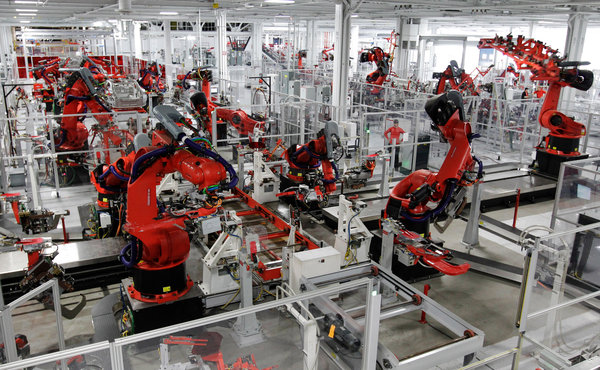
Tesla foctory robots perform not one, but 4 functions at the California auto plant

The piece begins by describing two Philips Electronics factories–one in China (where hundreds of workers hand assemble electric shavers)– and the other in Holland (where 128 robots  do the same work, guided by video cameras). The Dutch factory  has several dozen workers per shift, about a tenth as many as the plant in China. And the robots there work, of course, without a coffee break — three shifts a day, 365 days a year.

This is the future, says The Times. A new wave of robots is replacing workers around the world in both manufacturing and distribution. Factories like the one  in the Netherlands are a striking counterpoint to those used by Foxconn , which employ hundreds of thousands of low-skilled workers to make Apple products. Foxconn’s chairman, Terry Gou, has publicly endorsed a growing use of robots. Speaking of his more than one million employees worldwide, he recently said: “As human beings are also animals, to manage one million animals gives me a headache.”

With examples ranging from Boeing’s use of robots on the 787,  to C&S Wholesale Grocers fully automated warehouse, to a California organic farmer who uses them to pack lettuce, this exciting OM technology makes for a good discussion in many chapters of our text. The 4 minute video that accompanies the article is also well done.

Discussion questions:

1. Why have robots become a more powerful force in recent years?

2. What are the plusses and minuses of the new revolution?

OM in the News: Apple Audits its Suppliers in China

Apple effectively just wrapped its own knuckles publicly, with the publication of an audit of the working conditions at Foxconn, its biggest Chinese supplier. Apple CEO Tim Cook, showing serious leadership, completed the factory tours and committed his company to improvements and further monitoring of its Asian supply chain–particularly regarding

Tim Cook at Foxconn

overtime. Does this mean that the days are gone when Foxconnn would rouse 8,000 workers from their sleep in company dorms to put them on the iPhone assembly line at midnight?

The Wall Street Journal (March 30,2012) reports widespread breaches of work rules at Foxconn, including 60 hour work weeks and other health and safety violations. (The Journal piece includes a 4 minute video on Cook’s visit and an analysis of the impact of the audit on Apple’s reputation and sales.)  The audit of 35,000 workers building iPads, iPhones, and iPods at 3 Foxconn factories, found the majority of workers exceeding China’s legal maximum of 36 overtime hours a month–with the average working 80 hours.  The probe is one of the most detailed investigations of a Chinese manufacturer and the 1st major outside audit of Apple’s supply chain. Foxconn would have to hire tens of thousands of extra workers to comply.

The investigation, conducted  by the Fair Labor Association (FLA),  also found an array of  issues such as inadequate risk analysis and missing protective systems. More than 43% of the workers had experienced or witnessed an accident and “felt generally insecure,” said the FLA.

Foxconnn is already among the best of suppliers in China in terms of working conditions. Conditions at many of the others are incredibly grim. By putting pressure on the top end, Apple is likely doing all Chinese workers a favor.

Discussion questions:

1. Why did Tim Cook visit his Chinese suppliers?

2. How long will it take to implement major changes in working conditions in this supply chain?