Good OM Reading: Will 375 Million Jobs Be Automated by 2030?

A new McKinsey Global Initiative report cautions that as many as 375 million workers will need to switch occupational categories by 2030 due to automation. The work most at risk of automation includes physical jobs in predictable environments, such as operating machinery or preparing fast food. Data collection and processing is also in the crosshairs, with implications for mortgage origination, paralegals, accounts and back-office processing.

To remain viable, workers must embrace retraining in different fields. “The model where people go to school for the first 20 years of life and work for the next 40 or 50 years is broken,” states the report. “We’re going to have to think about learning and training throughout the course of your career.”

McKinsey believes we may see a massive transition on a scale not seen since the early 1900s, when workers shifted from farms to factories. A needed plan would include a big investment from the private and public sectors in new training programs and workforce transition programs.

Despite the looming challenges, the report revealed how workers can move forward. While the introduction of PCs in the 1980s eliminated some jobs, it created many more roles. Workers who are willing to develop new skills should be able to find new jobs. “The dire predictions that robots are taking our jobs are overblown. Yes, work will be automated, but there will be enough jobs for everyone in most areas,” McKinsey writes. The company adds that automation will not displace jobs involving managing people, social interactions or applying expertise. Gardeners, plumbers, child and elder-care workers are among those not facing risk.

Classroom discussion questions:

  1. What do your students think about the concept of career-long training and learning?
  2. How does this change impact the field of OM?

OM in the News: The Driverless Truck Vs. The Teamsters Union

It was the tale of a successful, long-distance beer run. A robotic truck coasted driverless 120 miles down Interstate 25 in Colorado on its way to deliver 51,744 cans of Budweiser. “Driverless vehicles threaten to dramatically reduce America’s 1.7-million trucking jobs,” writes the Los Angeles Times (Nov. 23, 2017). It is the front end of a wave of automation that technologists have been warning for years. Some predict it could rival the impact of the economic globalization and the resulting off-shoring of jobs.

At California start-up Embark, there already are indications of how trucking jobs are about to change. The company has made test-runs in which it is using self-driving trucks to ship refrigerators from a warehouse in Texas to a distribution center in Palm Springs. There is a driver in the cab, but for the bulk of the ride, when the truck is on the I-10 Freeway, that person is not driving. Eventually, there could be nobody in the cab for legs of the trip. Embark’s CEO says truck drivers still will have jobs and their quality of life will be much improved. Instead of making long hauls thousands of miles, he says they could stay in their communities and handle the more-complicated short hops at the beginning and end of the trips, along with loading and unloading.

Teamsters executives are skeptical, particularly as many pilot programs exhibit a diminished role for blue-collar workers. Volvo, for example, boasts how the autonomous garbage truck it developed doesn’t need a driver in the cab to navigate the route, freeing up that person to load the trash bins. Two jobs appear to become one. Many of the new positions created by such technology look nothing like the stable trucking jobs that are a staple of blue-collar America. They involve coding, data analysis and operation of complicated computer systems.

Classroom discussion questions:

  1. What are the plusses and minuses of driverless trucks?
  2. When do you think the autonomous vehicle revolution will actually impact society?

OM in the News: Retailers Check Out Automation

The Cash360 machine now in the back rooms of most of Wal-Mart’s 4,700 U.S. stores.

Shopping is moving online, hourly wages are rising and retail profits are shrinking—a formula that pressures retailers, ranging from Wal-Mart to Tiffany, to find technology that can do the rote labor of retail workers or replace them altogether. “Many U.S. retail jobs are ripe for automation, with 2/3 at high risk of disappearing by 2030,” reports The Wall Street Journal (July 20, 2017).

Self-checkout lanes can replace cashiers. Autonomous vehicles could handle package delivery or warehouse inventory. Even more complex tasks like suggesting what toy or shirt a shopper might want could be handled by a computer with access to a shopper’s buying history, similar to what already happens online today. “The primary predictor for automation is how routine a task is,” says a Citi researcher. “A big issue is that retail is a sizable percentage of the workforce.”

Nearly 16 million people, or 11% of nonfarm U.S. jobs, are in retail. Now, as stores close, these jobs are disappearing. Since January, the U.S. economy has lost about 71,000 retail jobs. Automation is filtering through many parts of retail. Tiffany is using machines to polish jewelry. Home Depot has self-checkouts in most stores and is testing scanner guns for shoppers buying bulky products like lumber.

Wal-Mart has long squeezed efficiency out of its business. Although it employs 1.5 million people in the U.S., it has around 15% fewer workers per sq. ft. of store than a decade ago. Its U.S. stores now have a Cash360 machine, making thousands of positions obsolete. Employees whose task was to count cash and track the accuracy of the store’s books have been replaced by the hulking gray machine that counts 8 bills per second and 3,000 coins a minute–then digitally deposits the money at the bank.

Classroom discussion questions:
1. What other jobs are likely to be replaced by automation in the coming decade?

2. Why is this an OM issue?

OM in the News: Who is Winning the Race for Jobs Between Robots and Humans?

Robot arms weld a vehicle at the GM plant in Lansing, Mich.

“Who is winning the race for jobs between robots and humans,” asks The New York Times (March 29, 2017). Two leading economists have just declared a winner: the robots. The industry most affected by automation is manufacturing. For every robot per thousand workers, 6.2 workers lost their jobs and wages fell by as much as 3/4 of a percent, according to the MIT and BU researchers. Theirs is the first study to quantify large, direct, negative effects of robots. The profs said they were surprised to see very little employment increase in other occupations to offset the job losses in manufacturing.

The study analyzed the effect of industrial robots in local labor markets in the U.S. Robots are to blame for up to 670,000 lost manufacturing jobs between 1990 and 2007, it concluded, and that number will rise because industrial robots are expected to quadruple. The findings fuel the debate about whether technology will help people do their jobs more efficiently and create new ones, as it has in the past, or eventually displace humans. The problem might be that the new jobs created by technology are not in the places that are losing jobs, like the Rust Belt.

In addition to cars, industrial robots are used most in the manufacturing of electronics, metal products, plastics and chemicals. They do not require humans to operate, and do various tasks like welding, painting and packaging. From 1993 to 2007, the U.S. added one new industrial robot for every thousand workers — mostly in the Midwest, South and East — and Western Europe added 1.6.

The next question is whether the coming wave of technologies — like machine learning, drones and driverless cars — will have similar effects, but on many more people.

Classroom discussion questions:

  1. Other research has predicted that humans will come out ahead in the job battle. Why do you think this is the case?

      2. Is the robot revolution a good OM trend?

OM in the News: The Automation of Oil Drilling

oil-rigs-2As the global oil industry begins to climb out of a collapse that took 440,000 jobs, anywhere from a 1/3 to 1/2 may never come back. “A combination of more efficient drilling rigs and increased automation is reducing the need for field hands,” writes Businessweek (Jan. 30-Feb. 5, 2017). 

Automation, of course, has revolutionized many industries, from auto manufacturing to food and clothing makers. Energy companies, which rely on large, complex equipment for drilling and maintaining oil wells, are particularly well-positioned to benefit. “It used to be you had a toolbox full of wrenches and tubing benders,” says one south Texas professor. “Now your main tool is a laptop.” During the boom, companies were too busy pumping oil and gas to worry about head count. The two-and-a-half-year downturn gave executives time to rethink the mix of human labor and automated machinery in the oil fields.

Nabors Industries, the world’s largest onshore driller, says it expects to cut the number of workers at each well site eventually to 5, from 20, by deploying more automated drilling rigs. Rigs have gotten so efficient that the U.S. oil industry needs only 1/2 as many workers as it did at the height of the shale boom in 2014 to suck the same amount of oil out of the ground.

The systems, that is all the processes involved in drilling and fracking a well, will be the key. That means an engineer can design an oil well at his desk. With the press of a button, an automated system would identify the equipment needed from a supplier, create a 3D model, send the details to the rig, and tell the rig to do the job.

Classroom discussion questions:

  1. Why the industry push for automation?
  2. What are the plusses and minuses for the U.S?

OM in the News: Robots Won’t Kill the Workforce

A robot collects dishes to be cleaned at Chilli Padi Nonya Cafe in Singapore

The U.N. forecasts that the global population will rise from 7.3 billion to nearly 10 billion by 2050. This has inspired a chorus of neo-Luddites, who fear that the “rise of the robots” is rapidly making human workers obsolete, a threat all the more alarming if the human population is exploding. But the Washington Post (Dec. 2, 2016) writes: “Before long we’re more likely to treasure robots than to revile them.”

In the U.S., productivity growth has fallen by almost half from its postwar average–and we face an aging population. Something will have to fill the void left by, say, retiring farmers; it is likely to be farmbots. And it may not be long before economists are worrying about a global shortage of robots.

Consider the turning point that China hit last year. For the first time since the 1950s, its working-age population growth was negative. As a result, China’s labor force is expected to lose 1 million workers each year for the foreseeable future, and it is also aging rapidly. Will robots pose a threat to jobs in China? “ In China, the robots are going to come just in time,” says Nobel economist Daniel Kahneman. No wonder Beijing now offers heavy subsidies to companies involved in industrial automation.

If automation was displacing human workers as fast as implied in recent books like Martin Ford’s “The Rise of the Robots,” then we should be seeing a negative impact on jobs already. We’re not. The job picture has been particularly strong in Germany, Japan and S. Korea — the industrial countries that employ the most robots. The nations with the highest density of industrial robots include S. Korea, with 531 per 10,000 employees, Japan with 305 and Germany with 301. The U.S. ranks 8th with 176. China is well behind with only 49, but it has the world’s fastest-growing robot population.

Classroom discussion questions:

  1. What is the impact of robots on the return of manufacturing jobs to the U.S?
  2. How is artificial intelligence playing a role on jobs, according to the article?

OM in the News: Jobs and the Clever Robot

robot graph“From steam engines to robotic welders and ATMs,” writes The Wall Street Journal (Feb. 25, 2015), “technology has long displaced humans—always creating new, often higher-skill jobs in its wake.” But recent advances—everything from driverless cars to computers that can read human facial expressions—have pushed experts to look anew at the changes automation will bring to the labor force. They wonder if automation technology is near a tipping point, when machines finally master traits that have kept human workers irreplaceable.

In the Australian Outback, for example, mining giant Rio Tinto uses self-driving trucks and drills that need no human operators at iron ore mines. Automated trains will soon carry the ore to a port 300 miles away. The Port of Los Angeles is installing equipment that could cut in half the number of longshoremen needed in a workplace already highly automated. Computers do legal research, write stock reports and news stories, as well as translate conversations; at car dealers, they generate online advertising; and, at banks, they churn out government-required documents to flag potential money laundering—all jobs done by human workers a short time ago.

Bill Gates said last year that automation threatens all manner of workers, from drivers to waiters to nurses. Gartner, the technology research firm, has predicted 1/3 of all jobs will be lost to automation within a decade. And in 2 decades, forecast Oxford University profs, nearly 1/2 of the current jobs will be performed with machine technology.

The first time automation spawned fears of a jobless future was in the 19th century, when English textile workers attacked the first mechanical knitting machines. They were right to fear the contraptions, which eventually replaced them. Some new machines are so efficient they push down prices and create more demand—which in many cases spawns more jobs, not fewer. The invention of the automobile threw blacksmiths out of work, but created far more jobs building and selling cars. Displaced workers with obsolete skills are always hurt. but the total number of jobs has never declined over time.

Classroom discussion questions:

1. What fields do you think will be most impacted by robots/automation in this decade?

2. Will jobs decline?

OM in the News: More Jobs For Machines–Less For People

Yesterday’s New York Times (Oct.24,2011) reports that a faltering economy explains much of the job shortage in America, but advancing technology has sharply magnified the effect . “Many workers are losing the race against the machine”, state two MIT researchers. Adds the current issue of the McKinsey Quarterly: “Technology is quickly taking over service jobs, following waves of automation of farm and factory work. This last repository of jobs is shrinking–fewer of us in the future may have white-collar business process jobs”.

Technology in production and  services is an important topic in Chapter 7, and this Times article can contribute to your class discussion of the issue. The MIT profs argue that the pace of automation has picked up in recent years because of robotics, NC-controlled machines, computerized inventory control, voice recognition, and e-commerce. Their new e-book, “Race Against the Machine”, states that automation is moving rapidly beyond factories to jobs in call centers, marketing, and sales, which are the parts of the service sector providing most jobs in the economy.

Since the recession started , corporate spending on equipment and software has increased 26%, while payrolls have been flat. Corporations are expected to report record profits of $927 billion this year, a 50 year high.

But technology has always displaced some work and jobs. As early as 1930, the economist John Maynard Keynes warned of a “new disease” that he called “technological unemployment”, the inability of the economy to create new jobs faster than jobs were lost to automation. Yet computers tend to be narrow and literal-minded, good at assigned tasks, but low at intuition and creativity. The key, writes the Times, “is not to compete against machines but to compete with machines”.

Discussion questions:

1. Is this a major change in business, or just a slow, continuing trend towards automation?

2. Do students believe that less and less service-oriented jobs will be available to them?

OM in the News: What is the Future of American Manufacturing?

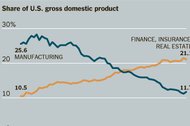
A lead article in today’s The New York Times (Sept.11,2011) questions whether the US can recover from its decline in manufacturing.   Was the tipping point reached in 2009 when China ousted America’s century long lead by generating $1.7 trillion of “value added” vs. the $1.6 trillion here? Or was it when manufacturing’s contribution to GDP declined to 11.7%  last year, down from 28% in the 1950s? (Countries over the 20% threshold are in Asia and Europe now, with China at 25%).

“We’re going to make sure the next generation of manufacturing takes root not in China or Europe, but right here, in the US”, President Obama told a joint session of Congress this week. An MIT prof counters: “The US today is alone among industrial powers in not having a strategy for thinking through what must be done in manufacturing”. “An advanced manufacturing policy is what this country must have”, adds Dow Chemical’s CEO Andrew Liveris. Liveris believes manufacturing needs government support to expand its dwindling share of the nation’s economy. He even advises the President to “pick winners” and “not let free markets rule”.

And although GE’s Jeff Immelt (co-chair of the President’s Council on Jobs, with Liveris) also expresses concern over the decline in jobs, multinationals like theirs have contributed mightily to the problem by shifting  jobs abroad. Half of Dow’s $58 billion in revenue comes from overseas operations and GE has just moved its Medical Imaging HQ from Wisconsin to China. The damage doesn’t end with factories overseas. With 40% of our engineers working in manufacturing, such jobs also decline. Innovation often originates in research centers near factories and “this trend”, writes The Times, “challenges the view that the US has the best scientists and research centers”.

Discussion questions:

1. Do Congress, the White House, and students see making an engine or scissors as important as  investment banking or retailing ?

2. Can the trend be reversed, and how?

OM in the News: The Startling Loss of US Manufacturing Capacity

The Sunday New York Times headline (Feb.13,2011) reads, “When Factories Vanish, So Can Innovators”. With the closing of the last spoon and fork (“metal flatware”) factory, in Sherrill, N.Y., the US  lost an industry that traces its roots to Paul Revere.  Just as  Sherrill Manufacturing succumbed to less expensive Chinese imports, so have the sardine cannery, stainless steel rebar, vending machine, incandescent light bulb, cellphone, and laptop computer industries.

Less noticeably, says The Times, the imported portion of components that go into American-made products has risen from 17% to 25% over the past 13 years. For example, the wings of many Boeing  jets are now made in Japan. With the inclusion of these imported components, manufacturing’s share of the GDP is actually 10.5%, not the government-reported 11.2%.  (This, of course, is down sharply from 14.2% a decade ago and 30% in 1950). Moody’s chief economist states: “I think there is a growing recognition that a diminished manufacturing sector will undermine our economy”.

 The US has long appreciated that low-wage workers abroad would cut consumer costs on a wide array of manufactured products. But the theory was that US producers would be the world’s best innovators, developing (and at least initially, producing) sophisticated new products here at home. Somehow, though, Apple’s spectacularly designed  iPad and iPhone are being made in Asia, not here. Likewise, Maglev (high-speed rail) was invented here, but the technology and production has  transferred to Japan.

Many experts  believe that the engineers and factory workers in Asia may become the next innovators. One economist is quoted as saying: “The big debate today is whether we can continue to be competitive in R&D when we are not making the stuff that we innovate. I think not”.

Discussion questions:

1. Do we need to worry that “young people stop thinking about making things” in the US?

2.If consumers have benefited from unrestricted lower-priced imports, what is the negative of the equation?

3. Is innovation falling in the US? Rising in Asia?