Teaching Tip: Why Quality Inspections Often Fail

We all know that students have trouble staying focused for a long lecture, even with the great job we all try to do. So try to find a short activity that will make a teaching point, break up the class for a few minutes, and get all the students enthused.  Here is something you may want to try in Chapter 6, Managing Quality. It takes about 10 minutes.

In this chapter, we have suggested that building quality into a process and its people is difficult. In the old days, inspection was the main form of quality control. But inspection may not catch all the errors, and it may be expensive. To indicate just how difficult inspections can be, ask your students to turn to the OM in Action box on page 234, called “Inspecting the Boeing 787”.

Ask them to each count the number of E’s (both cap and lower case), including those in the title. This should be a pretty easy inspection job, I think, and I offer a crisp $10 bill to the first student to give me the correct count. That usually gets their attention!

As they each finish, I ask them to shout out their count and I do a tally on the board. There is amazing variation and I only have to shell out the reward in maybe one out of five classes. The answer, by the way, is in the Instructor’s Solutions Manual, as discussion question #18.

If you can share a class exercise of your own, we would be very happy to publish it as a Guest Post.

Guest Post: The Missing Digit Puzzle

Prof. Andrew Stapleton at U. of Wisconsin-LaCrosse shares this teaching tip to enliven your class

This math puzzle looks a lot more intimidating than it really is. It is called the Missing Digit Puzzle. Pick a student to come to the front and write down a number on the white board or overhead projection. Hide or otherwise cover your eyes in some way so that you can’t see what your student is writing.

Ask your student to secretly write down ANY number (at least four digits long). e.g. 78341
Ask her to add up the digits… e.g. 7+8+3+4+1 = 23 … and then subtract the answer from the first number e.g. 78341 – 23 = 78318
Ask her to then cross out ONE digit from the answer. (It can be any digit except a zero) e.g. 7x318
She then reads out what digits are left e.g. 7-3-1-8. Even though you haven’t seen any numbers, you can say what the missing digit is! EIGHT

THE SECRET:
This great puzzle relies on the power of 9.
After your student has added up the digits and subtracted them, the answer will ALWAYS divide
by 9. If a number divides by 9, then when you add the digits up, they will also divide by 9. If
you check our example 7+8+3+1+8 = 27 which does divide by 9. When she crosses a digit
out, she then reads out the digits that are left. You add them up. In the example we had 7+3+1+8
= 19. All you do now is see what you have to add on to your answer to get the next number that
divides by 9! The next number to divide by 9 after 19 is 27. So, you need to add on EIGHT to
get to 27. This is the number that was crossed out!

Here’s another example:
Say the number written down is 873946284 (yikes!).
Your friend adds the digits 8+7+3+9+4+6+2+8+4 = 51
Your friend does the subtraction: 873946284 – 51 = 873946233
(So far you have NO IDEA what numbers are whizzing around!)
Your friend crosses a digit out 87394x233 and tells you what’s left.
You add 8+7+3+9+4+2+3+3 = 39.
The next number that divides by 9 after 39 is 45. As 45-39=6 this means that SIX is the missing
digit.
You can do this one quickly and even have other students come up and give it a try – and you
will always be able to tell what the missing digit is!

Guest Post: “Exploring Fibonacci– A Math Trick with Applications in OM

Prof. Andrew Stapleton, at U. Wisconsin-La Crosse,  provides another interesting exercise to liven up your OM class.

The Fibonacci sequence, introduced by mathematician Leonardo Fibonacci from Pisa, Italy in the 12th century, is a number sequence where each term is the sum of the preceding ones. A typical Fibonacci sequences looks like: 1, 1, 2, 3, 5, 8, 13, 21, 34, and so on. While this is the most well-known version, Fibonacci numbers can begin with any two numbers on the number line as long as they follow the same pattern of addition.

The sequence is closely related to the Golden Ratio, a concept that appears frequently in nature (e.g., in the spiral pattern of shells or of sunflowers) and art (e.g., proportions in Renaissance paintings).

Interestingly, the Fibonacci sequence also has practical applications in Operations and Supply Chain Management. It can be applied in areas such as supply chain network design, forecasting inventory fluctuations, resource allocation, and even in facility layout optimization.

Fun Math Trick using Fibonacci Sequence
Here is an engaging way to explore Fibonacci numbers with your students:
1. Have a student pick any two numbers, say 5 and 4.
2. Add the numbers together (5+4=9).
3. Now, take the second and third numbers (4+9=13)
4. Continue the process for ten steps and calculate the sum.
For example, start with 5 and 4. These yields: 5, 4, 9, 13, 22, 35, 57, 92, 149, 241.
Now calculate the sum of the sequence. The sum is 627.

How to Predict the Sum:
Before calculating, you can impress your students with a neat trick! Here’s how:
 Instead of adding all of the numbers manually, look at the fourth number from the bottom of the list. In this case, it is 57.
 Multiply the number by 11.
57 x 11 = 627 – this gives you the total sum without having to add them up.
This works because the Fibonacci sequences follow a predictable pattern:
This is what the list of numbers will be:

a
b
a + b
a + 2b
2a + 3b
3a + 5b
5a + 8b
8a + 13b
13a + 21b
21a + 34b
The sum is 55a + 88b, which is 11 times the seventh number. Since multiplying by 11 is a relatively simple calculation, this creates a fun and useful math trick to amaze your students and connect math concepts to OM.

Guest Post: Random Number Prediction–A Class Exercise

Prof. Andrew Stapleton at the U. of Wisconsin-Lacrosse shares a teaching tip when discussing random numbers.

Predict a “random number” by alternating four-digit contributions. Start by determining a 5- digit number and writing it down in dark ink on a large piece of paper and sticking it in your briefcase. I act like I am picking random numbers, but I know exactly how to get to the number I have pre-determined.

Here is an example: I tell my class, “Let’s pick some numbers, I’ll start”: 4729 Mine I already know that the final number – the one written on the large piece of paper in my briefcase is 24727.

I then ask for two students to give me each a two-digit random number. The greater the number of participants the greater the impact. Student one chooses “58” and Student 2 chooses “32.” So 5832 yours

4167 Mine I act like I am thinking about another random four-digit number, but what I am doing is making their digits and mine add to 9999. (i.e., 5832 + 4167 = 9999)

I again ask two different students to each give me a two-digit random number. One gives me “69” and the other “02”. So 6902 yours

3097 Mine Again I make theirs and mine add to 9999, but I don’t do it right away. In fact, I act like I am really just pulling my digits out of thin air.

Sum = 24727. I then add all of these together. I tell them I had a dream about what number we would collectively come to in this exercise and wrote it down on a piece of paper and I get it out and unfold it. Once they see it matches, they are baffled and are eager to learn how I did it.

Solution: I simply take my original 5-digit number and subtract 2 from the last digit and put it in front of the first. This is because whatever you choose – I will choose digits that add to 9. So, the second set adds to 9999 and the third set adds to 9999 – just shy of 20000, in fact 19998. So, I subtract those two from the end and stick the “2” in the front.

Guest Post: Developing Supply Chain Interest and Employability Skills Together–A 30 Minute Class Exercise

Nancy Southin
Brent Snider
Rosanna Cole

Our Guest Post today comes from Nancy Southin at Thompson Rivers University, Brent Snider at University of Calgary, and Rosanna Cole at Surrey Business School.

Employers are increasingly demanding that business schools provide not only content knowledge to our students, but also facilitate improved skill development in areas such a resiliency, critical thinking, communication, and tolerance for ambiguity. While this may seem daunting as we plan our upcoming curriculums, it could be as easy as PIE. Partial Information Exercise (PIE) is an approach we have developed where select information is intentionally withheld from a classroom exercise or case. Students must identify what information is missing, seek it from the instructor, then integrate that new information.

Our Patio Swings Intermodal Shipping Competition is a 30-minute classroom exercise that challenges student teams to identify the all the necessary supply chain activities required to effectively ship patio swings from a foreign supplier all the way to a national retail chain’s stores in time for a spring sale. Students must determine what date the order must be placed, how many intermodal containers will be needed, what date those containers need to arrive at the supplier for loading, and how many additional part-time staff are needed to process the shipment through the retailer’s distribution center. Students learn about global supply chain activities while also developing the desired workplace skills since only half the information required is initially provided. This exercise has proven to increase student interest in global supply chain management jobs, get them thinking more critically than traditional cases, and create a highly engaged classroom environment. To date, it has been successfully conducted in both undergraduate and graduate supply chain classes, and in multiple countries.

If you are looking for a global supply chain classroom activity that combines content knowledge and skill development for students in an engaging 30 minute exercise, just contact us at nsouthin@tru.ca or brent.snider@haskayne.ucalgary.ca and we will send you the complete lesson plan – it’s as easy as PIE!

Guest Post: An Experiential Learning Exercise for Teaching Line Balancing

Our Guest Post today comes from Brent Snider, senior instructor of Operations and Supply Chain Management at the University of Calgary’s Haskayne School of Business, and Nancy Southin, Assistant Professor at Thompson Rivers University.

Are you looking for an engaging way to teach assembly line balancing to your OM class but leery of the various games that consume significant class time and require the purchase of various materials such as Lego? We have developed a 30-minute experiential learning exercise that can help. It requires only a few minutes of photocopying, and can be done before any lecture content on line balancing is covered.

The exercise features a scenario in which a company is considering re-shoring their laptop production to improve their triple bottom line performance. Student groups are provided the required assembly tasks and then challenged to develop a task assignment that is physically feasible (i.e., satisfies precedence requirements), meets or exceeds expected daily demand, and minimizes the number of employees (stations) required. Groups must submit their solutions for review in front of the class.

Students are motivated to try their best by knowing that their design will be publicly peer reviewed, and also by a food prize for the group that develops the best design. Each submission is displayed on-screen and the class asked “how would this perform?” Through assessing the various submissions, students quickly discover potential pitfalls like exceeding cycle time, out of sequence tasks, and excessive employees. The instructor then facilitates a quick summary discussion, formalizing the “rules” for optimally balancing an assembly line.

Student surveys showed 96% of students recommended continued usage of the exercise and 92% believed the competition taught them how to determine a feasible solution for line balancing problems. Students who learned line balancing though this exercise were also found to have at least the equivalent learning as lecture based learners.

If you are looking for a low admin exercise that significantly improves student engagement when teaching line balancing, then this peer reviewed competition approach is for you. E-mail us at brent.snider@haskayne.ucalgary.ca and nsouthin@tru.ca and we will send you the full lesson plan!


Teaching Tip: Our New Inventory Management Simulation

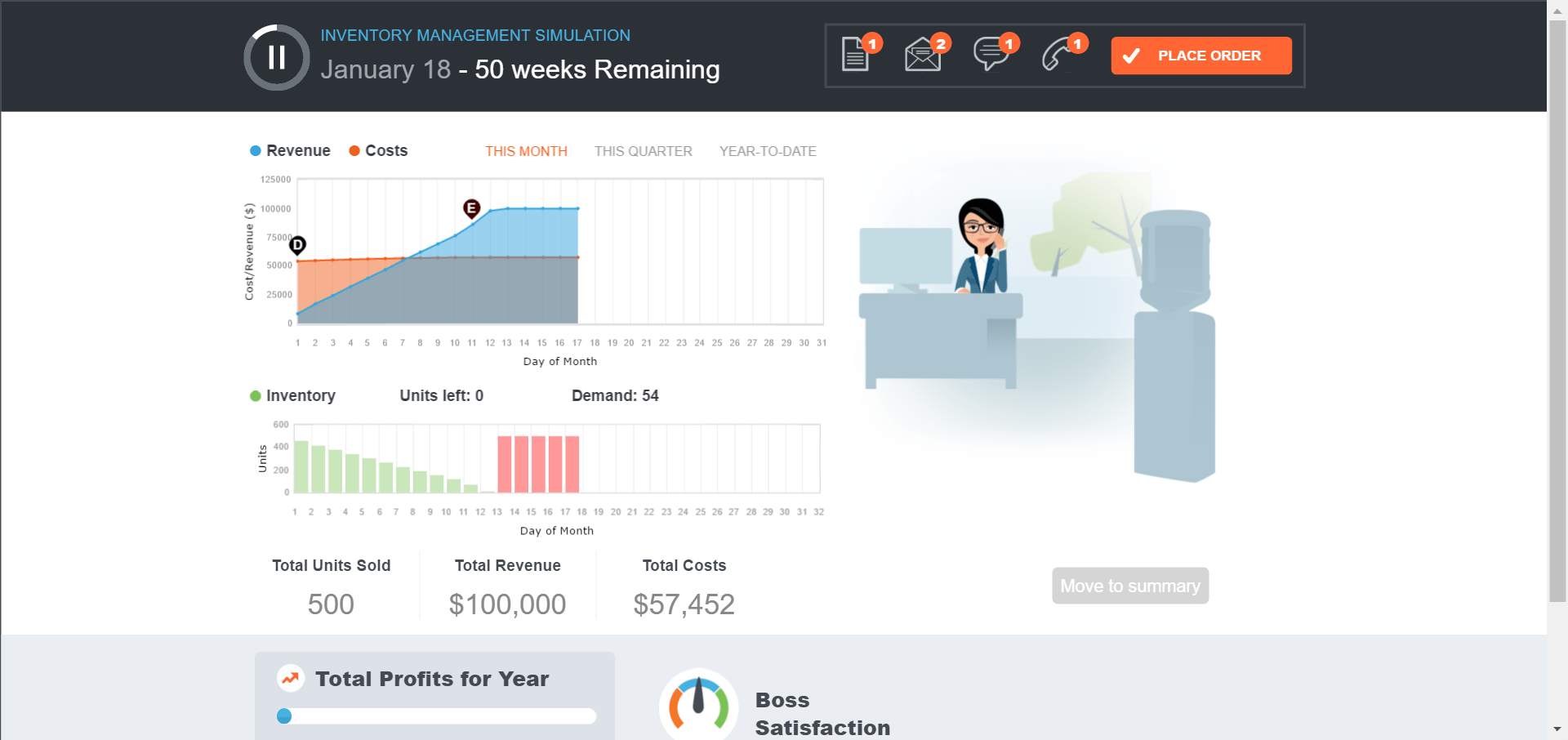
Inventory Simulation is the 4th of our four new classroom gaming exercises. It accompanies Chapter 12, Inventory Management and is free within our MyOMLab learning system.

Goal: Manage stock of electronics device to minimize costs and maximize profits.

You are the store manager at a local branch of DigiLife, a large electronics retail chain. A new version of a popular consumer electronics device called the Amulet is coming out this year. It is your job to sell as many Amulets as you can while minimizing your costs in order to maximize your store’s profits.

Learning Objectives

Primary Objectives:

  • Understanding how EOQ is calculated
  • Understanding the limits of EOQ

Ancillary Objectives:

  • Use EOQ formula = sqrt(2ds/h)
  • Where d = qty demanded, s = ordering/setup cost, h=holding cost
  • Understand what the answer means and what the inputs mean.
  • Knowing how EOQ can help guide you towards better decisions about order size and time between orders.
  • Understand that demand is variable (Sales/marketing give you their best forecast but no one can predict the future. Also, you may be given an average demand where actual demand will fluctuate from day to day.)
  • Understand that h has fixed and variable components (if you already have a fridge you might as well fill it. But if you’re paying for storage by the square foot, that’s going to vary).
  • Understand ordering costs aren’t always obvious (going to the gas station every day to top off your tank doesn’t mean you may more for your gas, but it’s a huge waste of time).
  • Understanding the economic impacts of defects and damage, stockouts and rush orders.
  • Understanding the limitations of using EOQ to guide your decisions–that EOQ doesn’t give you an exact answer, but it gets you close.
  • inventory simulation

Teaching Tip: Our New Quality Management Classroom Simulation

Quality Management Simulation is the 3rd of our four new classroom gaming exercises. It accompanies Chapter 6, Total Quality Management, and is free within our MyOMLab learning system.

Goal: Make quality investments with good ROI in terms of profits and customer ratings.

You are the manager of Cibare, one of the hottest Italian restaurants in town. You manage a full service staff and work closely with the Chef and the restaurant owner to ensure Cibare is providing a high-quality experience for customers. It is your job to make sure daily operations are running smoothly and that the investments you make to improve or maintain quality provides a return that exceeds the cost.

Learning Objectives

  • Understand that quality is an investment. There is a cost to investment and often a return. When managers allocate resources appropriately, the return on an investment should exceed the cost.
  • Understand that quality is a continuous pattern of activities and not a one-time event.
  • Develop a more complete understanding of total cost concepts.
  • Help the student realize that exact numbers and are not always available as on an exam and acknowledge that outcomes have uncertainty associated with them and that decisions must be made with imperfect information.

    Industry: Food service/ Hospitalityquality simulation

Teaching Tip: Our New Project Management Classroom Simulation

This Project Management Classroom Simulation is the 2nd of our new classroom gaming exercises. It accompanies Chapter 3, Project Management, and is free within our MyOMLab learning system.

Activity Brief

Select and manage subcontractors to achieve schedule and profitability goals of home-building project.

You are the general contractor for a high-end, private residence construction job. You manage teams of subcontractors who work on various aspects of the house, from plumbing and electrical to drywall and landscaping. The homeowners, Robert and Maggie Applebaum, want to be in their new house in 7 months and will check in with you regularly about its progress. It is your job to make sure daily operations at the site are running smoothly and that the house is completed on time and within budget, without negatively affecting your other building projects

 Industry: Constructionproject managemnt sim 2project management sim 1

Teaching Tip: Our New Forecasting Classroom Simulation

This Forecasting Classroom Simulation is the 1st of our new classroom gaming exercises. It accompanies Chapter 4, Forecasting, and is free within our MyOMLab learning system.

Activity Brief

As an operations consultant, you have just signed a 2 year contract to provide monthly forecasts of customer demand for a new gas station.  The gas station will sell 3 types of gas: Regular, MidGrade, and Premium. The gas station will have a total of 8 pumps offering all three types.

The gas station will also have a modest convenient store with a standard selection of snacks, beverages, and other miscellaneous items. However, the ownership group believes the station will attract business primarily due to its prime location near a major highway. Pricing for gas will be comparable to alternatives in the area and will predominantly be driven by market conditions relating to the price of crude oil per barrel.

The ability to forecast the next month forecast is critical for the station’s inventory management and other business planning. It will be necessary to gather various sources of information and ultimately analyze data in order to make the best forecast for each of the 24 months of the contract.

Your performance will be based on the collective mean absolute percentage error (MAPE) among the three types of gas. If you are able to forecast at less than or equal to 5% MAPE, you will receive a $10,000 bonus for your work. If your forecast are between 5% and 20% MAPE, you will not receive the bonus, but you will secure the position and receive a contract renewal. If the MAPE exceeds 20%, you will not receive a contract renewal.

Learning Objectives

  • Understand and break down patterns of customer demand
  • Generate forecasting models based on judgement, causal, time-series methods, or seasonal methods
  • Evaluate the quality of a forecast model using error metrics (specifically mean absolute percentage error).
  • Help students understand the distinction between the “signal” and the “noise” (Students are encouraged to also read The Signal and the Noise: Why So Many Predictions Fail, but Some Don’t. by Nate Silver). Many aspects of customer demand variation are explainable – the signal, but there needs to be an acceptance of unexplainable variation – the noise. In other words, students have to make a concession that their models will not predict customer demand with 100% accuracy.

Industry: Retailforecast sim 2forecast sim 1

Guest Post: Campus Club Cupcakes – Classroom Course Icebreaker Exercise

brent sniderOur Guest Post today comes from Brent Snider, who is an award winning senior instructor of Operations and Supply Chain Management at the University of Calgary’s Haskayne School of Business.

The first session of a required undergraduate OM course is often challenging for both faculty and students. Reviewing the course syllabus is mundane, and many students are unaware of what OM even is or why it is required.

Campus Club Cupcakes was developed specifically as a course icebreaker exercise to turn the first session into an in-class exercise that gets the entire class engaged and working together within minutes– while also conveying what OM is, its importance, and how it relates to other functional areas. Campus Club Cupcakes is a variation of the popular “Kristen’s Cookie Co.” case, incorporating supply chain management concerns. It consists of a 1-page mini-case and 5 related questions and is completely free. (E-mail me at brent.snider@haskayne.ucalgary.ca and I will send you the whole lesson plan).

The case scenario is based on a student club looking at alternatives to raise funds for their community development initiatives. The questions students are expected to work through are (1) how long would a student have to wait, (2) how many orders can be completed in a shift, (3) how many trays would be needed, (4) should a discount be offered, and (5) what are some of the risks. Cupcakes require a multi-stage process (baking, then toppings) which also enables discussion on supply chain management concepts of subcontracting and postponement.

Students work through the questions for 20–30 minutes followed by a debrief, all of which can be completed in either a 50-70 minute session.  We have used Campus Club Cupcakes to kick-off the OM course for the past 2 years and students have overwhelmingly embraced it, with over 92% commenting positively about the exercise.

I am confident you too can turn the dreaded “day 1” into “day won” with this exercise!


Teaching Tip: Lecturing in Your OM Class

lecture“Research has long cast doubt on the use of lecture in education,” writes Faculty Focus (July 15, 2015). The book What’s the Use of Lecture? claims the biggest benefit of lecture is that it is an efficient means of reaching a large number of students in a single setting. Lectures convey information but they do little to promote thought or problem-solving abilities, or to change behavior. Despite the evidence about lecture’s weaknesses, 2/3-3/4 of faculty members continue to rely on it. As Harvard’s Derek Bok argues, though facts, theories, and concepts delivered in lecture have little value unless students can apply them to new situations, ask pertinent questions, make reasoned judgments, and arrive at meaningful conclusions. Another prof puts it this way: “You may have a lecture that works to get students to take a multiple choice test really effectively. But when you have a conversation with that student after your semester, they may not actually remember anything.”

Transforming a class, especially a large lecture class, isn’t easy–and the adjustments in an active learning class can be difficult for students, as well. Millennials have a deep fear of failure–and do not deal well with ambiguity. They like clean, firm solutions to OM problems–not thinking beyond a single “right answer.”  Students have grown accustomed to sitting passively in lectures, reviewing your notes or slides posted online, attending study sessions, cramming for exams, and moving on. Many resent having to take an active role in class. Even so, a common complaint is not that professors are too demanding but that they don’t hold firmly to deadlines and expectations.

What can Jay and I do to help?  Our Instructors Resource Manual provides classroom exercises for every topic. The Teaching Tips button on this blog provides more ideas for involving students. The 35 videos we made can be shown and lead to discussions in class. The OM in the News blogs provide current topics to share with your class each day so they feel there is practicality to OM. Perhaps you have an exercise you would like to share with colleagues. Just write to me (brender@rollins.edu) and I will post it for everyone to read.


Guest Post: Beat the Instructor–A Great Classroom Forecasting Exercise

brent sniderOur Guest Post today comes from Brent Snider, who is an award winning instructor of Operations Management at the University of Calgary’s Haskayne School of Business.

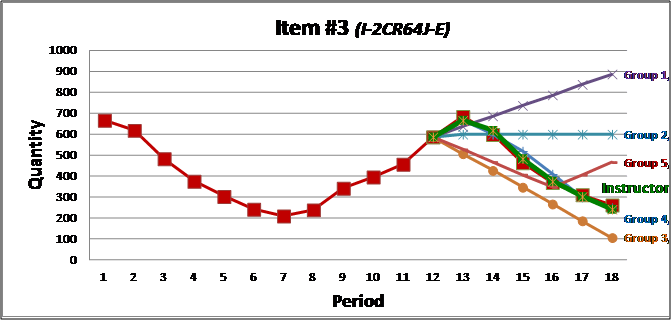
Forecasting is covered late in the term in our required undergrad course, which may contribute to student apathy towards the topic.  Beat the Instructor was developed after recognizing that there were no spreadsheet-based experiential introductory exercises that have been shown to build significant student interest in learning forecasting techniques.

Most forecasting exercises tend to be highly technical and or intended to be used after forecasting techniques have already been introduced in lectures.  Beat the Instructor is an in-class game that enables student groups to compete against their instructor in an introductory time-series forecasting exercise, even before any lecture content has been covered.  In addition to starting the forecasting topic positively via a 30 minute hands-on experiential learning exercise, the game has proven to build strong student interest in learning the forecasting techniques that are covered later in the lecture.

beat the instructor graphStudent groups are provided a spreadsheet with historical demand for 12 previous periods for 4 separate items.  Each of the 4 items represents one of the classical demand patterns of trend, cycles, seasonality, and random variations.  The students are then asked to predict demand for the next 6 periods for each item, and submit their forecast to the instructor.  In addition to competing amongst themselves, student groups are challenged to outperform the instructor’s forecast (who also predicts demand using the techniques that will be subsequently covered).  Each group’s forecast is graphed, in addition to the instructor’s, creating anticipation for the actual demand pattern.  After actual demand is randomly generated (and revealed on the graph), each group’s forecast error is calculated and ranked.  Typically the instructor outperforms most if not all groups, generating student interest in learning the techniques that can answer their often posed question: “How did you forecast so well?”

Guest Post: Making LP Relevant to Students

steve harrodDr. Steven Harrod is Assistant Professor of Operations Management at the University of Dayton. He shares a tip on teaching LP today.

It takes some creativity to make linear programming (see Module B in the Heizer/Render text) relevant to students. Here is an activity that offers a discussion of energy, transportation, and air pollution. The topic is coal-burning electric power plants, and it is an example of the blending problem.

Nearly half of all electricity in the U.S. is produced by burning coal, and nearly all of this coal moves by rail. Coal is an organic material that varies considerably in cost, power, and pollution content. Power plants frequently blend different coals to achieve their desired performance. Trains magazine published a detailed article on the movement of coal and its consumption by electric power plants in 2010. The readings and class materials may be downloaded here.

The documents package includes a quiz you may assign to motivate the reading assignment, a longer version of this Guest Post, and a sample spreadsheet model. Start the class discussion by drawing the class’s attention to the power plant at Monroe, Michigan. If you have an overhead projector with internet access, use Google maps to display a satellite photo of the plant. The lakeside plant has a prominent railroad loop and coal storage facility. You may also wish to explain how a power plant converts coal into electricity, and the environment concerns (sulfur causes acid rain and ash must be disposed of).

The challenge question for the students is: what coal should this plant purchase to satisfy energy and pollution limits at minimum cost? The formulated and solved LP leads to an optimal blend of three of the five coal sources. Ask the students, “is this intuitive?” Would you have been able to reach this conclusion without LP? Discuss at length and experiment with reducing or eliminating the pollution limits. This exercise may lead to a lengthy discussion of energy policy, environmental policy, and their joint effect on transportation demand.

Teaching Tip: First Day of Class Activities

professorThere’s no discounting the importance of the first day of class, writes teaching expert Dr. Maryellen Weimer in Faculty Focus (Jan.9, 2013).  What happens that day can set the tone for the rest of the course. Here are 2 activities for using that first day of class to emphasize the importance of learning and the responsibility students share for shaping the classroom environment.

Best and Worst Classes — In this activity, you write on the board: “The best class I’ve ever had” and underneath it “What the teacher did” and below that “What the students did.” On another section you write “The worst class I’ve ever had” and then the same two items beneath. Ask students to share their experiences, without naming the course or teacher, and begin filling in the grid based on what they call out. In 10 minutes or less, two very different class portraits emerge. Then move to the “best class” section of the board and tell students: “this is the class I want to teach, but I can’t do it alone. Together we have the power to make this one of those best class experiences.”

First Day Graffiti —  Flip charts with markers beneath are placed around the classroom. Each chart has a different sentence stem. Here are a few examples: “I learn best in classes where the teacher ___” “Students in courses help me learn when they___” “I am most likely to participate in classes when___” “Here’s something that makes it hard to learn in a course: _____” “Here’s something that makes it easy to learn in a course: ____” Students are invited to walk around the room and write responses, chatting with each other and the teacher as they do. After there are comments on every flip chart, the teacher walks to each one and talks a bit about one or two of the responses.