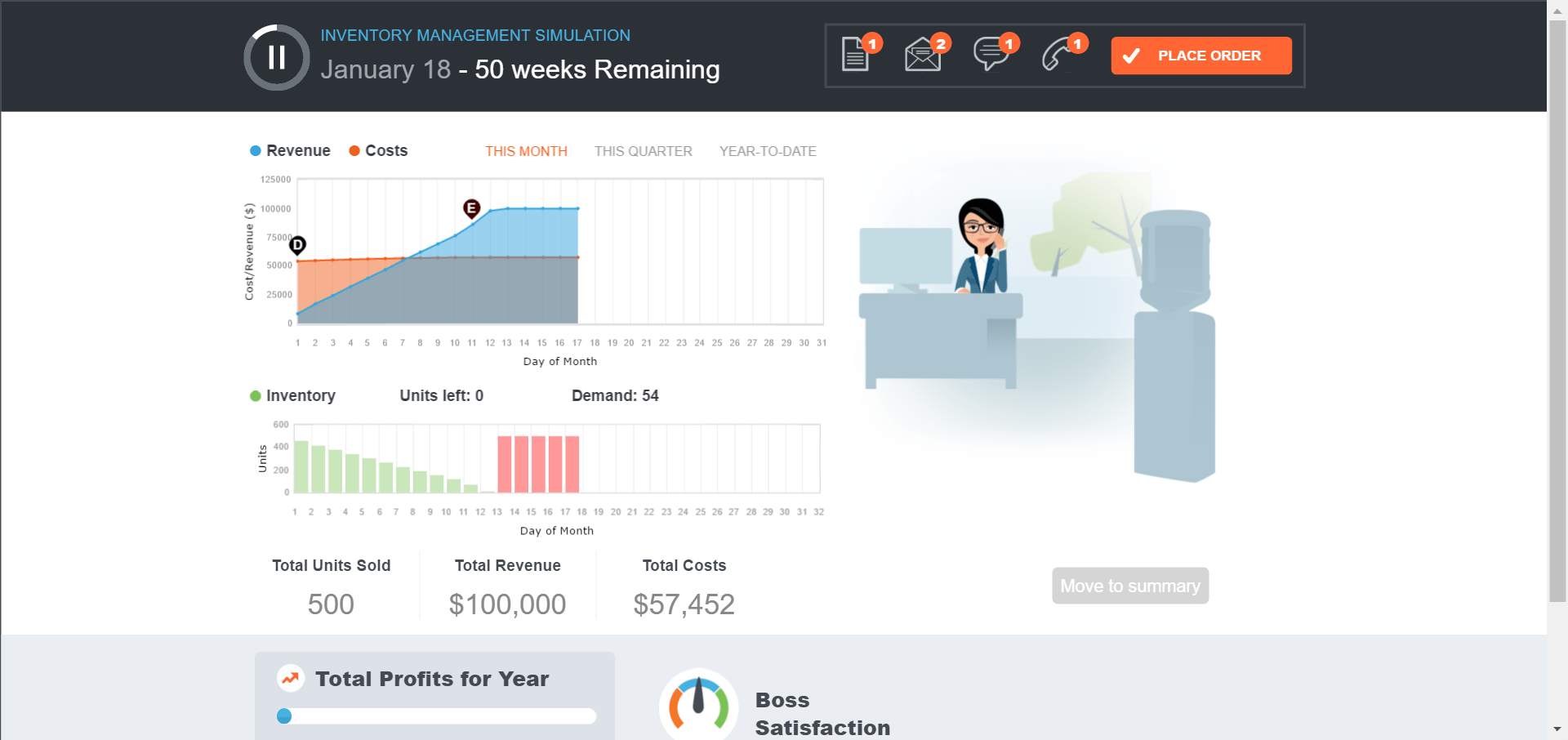
Teaching Tip: Our New Inventory Management Simulation

Inventory Simulation is the 4th of our four new classroom gaming exercises. It accompanies Chapter 12, Inventory Management and is free within our MyOMLab learning system.

Goal: Manage stock of electronics device to minimize costs and maximize profits.

You are the store manager at a local branch of DigiLife, a large electronics retail chain. A new version of a popular consumer electronics device called the Amulet is coming out this year. It is your job to sell as many Amulets as you can while minimizing your costs in order to maximize your store’s profits.

Learning Objectives

Primary Objectives:

  • Understanding how EOQ is calculated
  • Understanding the limits of EOQ

Ancillary Objectives:

  • Use EOQ formula = sqrt(2ds/h)
  • Where d = qty demanded, s = ordering/setup cost, h=holding cost
  • Understand what the answer means and what the inputs mean.
  • Knowing how EOQ can help guide you towards better decisions about order size and time between orders.
  • Understand that demand is variable (Sales/marketing give you their best forecast but no one can predict the future. Also, you may be given an average demand where actual demand will fluctuate from day to day.)
  • Understand that h has fixed and variable components (if you already have a fridge you might as well fill it. But if you’re paying for storage by the square foot, that’s going to vary).
  • Understand ordering costs aren’t always obvious (going to the gas station every day to top off your tank doesn’t mean you may more for your gas, but it’s a huge waste of time).
  • Understanding the economic impacts of defects and damage, stockouts and rush orders.
  • Understanding the limitations of using EOQ to guide your decisions–that EOQ doesn’t give you an exact answer, but it gets you close.
  • inventory simulation

Teaching Tip: Our New Project Management Classroom Simulation

This Project Management Classroom Simulation is the 2nd of our new classroom gaming exercises. It accompanies Chapter 3, Project Management, and is free within our MyOMLab learning system.

Activity Brief

Select and manage subcontractors to achieve schedule and profitability goals of home-building project.

You are the general contractor for a high-end, private residence construction job. You manage teams of subcontractors who work on various aspects of the house, from plumbing and electrical to drywall and landscaping. The homeowners, Robert and Maggie Applebaum, want to be in their new house in 7 months and will check in with you regularly about its progress. It is your job to make sure daily operations at the site are running smoothly and that the house is completed on time and within budget, without negatively affecting your other building projects

 Industry: Constructionproject managemnt sim 2project management sim 1

Teaching Tip: Our New Forecasting Classroom Simulation

This Forecasting Classroom Simulation is the 1st of our new classroom gaming exercises. It accompanies Chapter 4, Forecasting, and is free within our MyOMLab learning system.

Activity Brief

As an operations consultant, you have just signed a 2 year contract to provide monthly forecasts of customer demand for a new gas station.  The gas station will sell 3 types of gas: Regular, MidGrade, and Premium. The gas station will have a total of 8 pumps offering all three types.

The gas station will also have a modest convenient store with a standard selection of snacks, beverages, and other miscellaneous items. However, the ownership group believes the station will attract business primarily due to its prime location near a major highway. Pricing for gas will be comparable to alternatives in the area and will predominantly be driven by market conditions relating to the price of crude oil per barrel.

The ability to forecast the next month forecast is critical for the station’s inventory management and other business planning. It will be necessary to gather various sources of information and ultimately analyze data in order to make the best forecast for each of the 24 months of the contract.

Your performance will be based on the collective mean absolute percentage error (MAPE) among the three types of gas. If you are able to forecast at less than or equal to 5% MAPE, you will receive a $10,000 bonus for your work. If your forecast are between 5% and 20% MAPE, you will not receive the bonus, but you will secure the position and receive a contract renewal. If the MAPE exceeds 20%, you will not receive a contract renewal.

Learning Objectives

  • Understand and break down patterns of customer demand
  • Generate forecasting models based on judgement, causal, time-series methods, or seasonal methods
  • Evaluate the quality of a forecast model using error metrics (specifically mean absolute percentage error).
  • Help students understand the distinction between the “signal” and the “noise” (Students are encouraged to also read The Signal and the Noise: Why So Many Predictions Fail, but Some Don’t. by Nate Silver). Many aspects of customer demand variation are explainable – the signal, but there needs to be an acceptance of unexplainable variation – the noise. In other words, students have to make a concession that their models will not predict customer demand with 100% accuracy.

Industry: Retailforecast sim 2forecast sim 1

OM in the News: Marriott’s Simulation Game Lets Students Run the Hotel

Marriott International has just rolled out a new hotel-themed online game this week, which it hopes will attract students to positions in the hotel industry. The Wall Street Journal (June 6, 2011) describes “My Marriott Hotel”  as a realistic game that puts the player in charge of running the hotel kitchen (the company will roll out games depicting other aspects of the hotel business next year). The social media game, debuted on Facebook, puts the player in charge of buying ingredients, after being given an array of options in quality and price. The player also hires staff (based on experience and salary), and buys kitchen equipment. The players have to direct tickets to cooks and inspect orders before sending them to the customer.

Unlike  commercial simulations, like “Farmville” (by Zynga), Marriott is using computer gaming as a recruiting tool– to help fill  50,000 hotel positions this year. “Our game is so appealing”, says a Marriott exec. “Not only am I having fun but I am actually getting an understanding what it takes to run a kitchen”.

The model follows the  wildly popular “America’s Army”, introduced a decade ago by the US military. This effective recruiting tool cost little and led to a whole genre of industry simulation  games generally played on a mobile device. Siemens AG just bought “Plantville”, which simulates  being a manager for a bottling facility, a vitamin factory, or a plant that builds trains. Similarly, PlayFirst owns “Hotel Dash”, which simulates luggage delivery, room service orders, and hotel renovations. Marriott claims its game “will be more realistic”. But a Wharton prof says creating an effective game to help recruit “so far remains elusive”. It has to be both fun and realistic.

Discussion questions:

1. How can these games be effective OM learning tools?

2. Why did Marriott decide to provide this simulation at no charge?