OM in the News: AI, Lean Cultures and Toyota

“Artificial intelligence is going to replace literally half of all white-collar workers in the U.S.,” said Ford’s CEO Jim Farley, in the latest in a succession of executives warning of large-scale job cuts from AI.

Such claims can be pretty convincing—and unsettling.  Large-scale AI-related workforce reductions to date, however, are almost exclusively limited to AI-aligned companies like Meta and Google, writes Industry Week (Aug. 7, 2025).

That said, it’s undeniable that tools like ChatGPT are already having a profound influence on the future of OM work. And the bar keeps raising as AI platform providers release more powerful versions. (ChatGPT currently has around 700 million weekly users).

AI-first companies may be willing to shell out big money for AI “agents” that take the place of human workers. A popular target is workflows that are standard across many companies, such as handling employee queries to accounting or HR. Such work, however, is not as straightforward as it may seem.

Nobel Laureate Daron Acemoglu  predicts that over the next 10 years, only 5% of all tasks currently undertaken by humans will be profitably automated. He calls for a more human-centric approach. “That best possible way is a much more pro-human approach to AI that’s much more targeted at working with human decision-makers”.

Acemoglu’s findings are consistent with what lean leaders have been saying for decades. Uniquely human capabilities are essential to continuous improvement and central to lean’s most important pillar—respect for people.

Toyota’s approach to technology has been to articulate the need to improve the process and then, before evaluating automation solutions, investigate ways of meeting that need by simplifying the process (e.g., removing unnecessary steps). Taking this step avoids the common mistake of automating waste and leads to more effective and durable technology solutions.
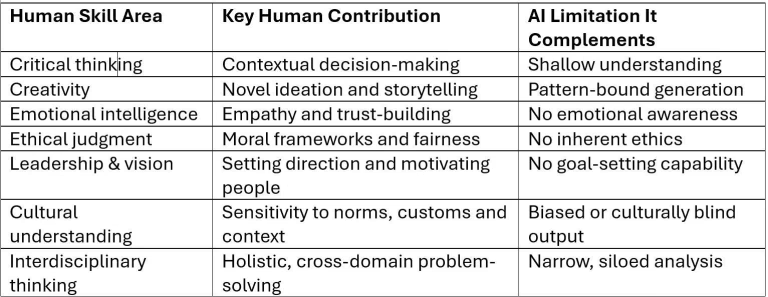
A key point here is that continuous improvement is a holistic undertaking that seeks to reduce costs and increase value. This is starkly opposed to the common preoccupation with cost cutting, and the use of AI as primarily a vehicle for reducing headcount. The human skill areas in the left column of the above table, however, are not widely recognized or developed in most organizations, and a culture that supports them takes years to build. Lean organizations, accordingly, place considerable emphasis on developing and nurturing skills such as listening, collaborating, problem solving, following a vision and mentoring.

Classroom discussion questions:

  1. How does Toyota’s approach tie with AI use?
  2. How can Chat GPT impact manufacturing work?

OM Podcast #9: Lessons From Toyota

Our latest podcast is an exciting change of pace.  Today, Jay Heizer hosts leadership coach, consultant, speaker, and author, Katie Anderson.  In this podcast they discuss her book Learning to Lead, Leading to Learn: Lessons from Toyota Leader Isao Yoshino on a Lifetime of Continuous Learning and the stories from her experience with Isao Yoshino and the Toyota Way that has made Toyota world-renown for the company’s style of management and culture of learning.

To learn more about Katie and her work, or to get the book, visit her website: https://kbjanderson.com/


Transcript

A transcript in Word of this podcast will download by clicking on the word Transcript above.

Instructors, assignable auto-graded exercises using this podcast are available in MyLab OM.  See our August 21st blog post with a recording of author and user Chuck Munson to learn how to find these, or contact your Pearson rep to learn more!  https://www.pearson.com/us/contact-us/find-your-rep.html

Guest Post: Using Data Analytics to Optimize Operations Management

Charlie Render is CEO of Render Analytics, a Florida-based data analytics consulting firm. He can be reached at https://www.renderanalytics.net/

Harnessing the power of data has emerged as a critical OM strategy for gaining competitive edge. Data-related technologies are being employed to elevate supply chain logistics, manufacturing efficiency, and overall operations.

Data analytics, the topic of Module G in your text, involves the systematic exploration of datasets to glean meaningful decision making insights. In the OM/SCM context, it encompasses the analysis of such diverse data points as order volumes, lead times, transportation costs, inventory levels, and customer behavior trends. This fusion is a natural convergence, given the voluminous data generated at each juncture of the supply chain. 

Here are four real-world examples:

 Amazon’s Demand Forecasting   By meticulously analyzing historical sales data, seasonal patterns, macroeconomic indicators, and even external factors like weather events and cultural trends, Amazon employs advanced predictive models. This enables the firm to anticipate product demand with remarkable accuracy. As a result, it can adjust inventory levels dynamically, minimize excess stock, and ensure the timely availability of popular products. The outcome is not just optimized inventory costs but also a seamless customer shopping experience.

UPS’s Route Optimization  UPS harnesses data analytics to refine its delivery routes. By integrating real-time traffic data, intricate delivery schedules, fuel costs, and even road closures, it constructs a comprehensive algorithmic approach. This approach identifies the shortest, most fuel-efficient routes for its fleets. The outcome is not just a reduction in fuel consumption and operational expenses, but also better on-time deliveries, positively impacting customer satisfaction.

Toyota’s Proactive Quality Assurance Toyota exemplifies how data analytics can revolutionize quality control within assembly lines. By tapping into data generated by sensors embedded within production equipment, Toyota has pioneered real-time quality assurance. This enables the detection of deviations from predefined quality benchmarks throughout the manufacturing process. Swift identification of potential defects lets Toyota rectify issues promptly. This means a reduction in defective units, lower warranty claims, and enhanced customer satisfaction.

Maersk Line – Transforming Container Shipping  Maersk  demonstrates the impactful combination of data analytics and sustainable supply chain practices. With the aim to minimize emissions and optimize routes, Maersk uses data analytics to study factors such as weather patterns, sea currents, and fuel efficiency. By leveraging these insights, it optimizes vessel routes, reducing fuel consumption, and subsequently decreasing greenhouse gas emissions. This data-driven approach not only aligns with a commitment to sustainable shipping, but also helps achieve substantial cost savings.

OM in the News: Toyota’s Production Halted Due to Insufficient Disk Space

Managers, as we note in Chapter 7,  appropriately spend a huge amount of time developing the proper process. But the perfect process is useless if not maintained (See Ch. 17 in your Heizer/Render/Munson text). Toyota was recently reminded, in a very expensive way, that lack of maintenance or improper maintenance can destroy even a well designed process.

It appears that Toyota’s 14 Japanese factories all shut down for about two days in late August due to a production order system malfunction caused by failure to maintain adequate computer disk space.

According to Toyota, its Japanese factories and their 28 assembly lines were halted due to “some multiple servers that process part orders” becoming unavailable and causing Toyota’s production order system to malfunction on August 28. The situation caused production output losses of roughly 13,000 cars daily, which threatened to impact exports to the global market.

The problem began during maintenance work on August 27. Toyota said: “During the maintenance procedure, data that had accumulated in the database was deleted and organized, and an error occurred due to insufficient disk space, causing the system to stop. Since these servers were running on the same system, a similar failure occurred in the backup function, and a switchover could not be made.”

A Reuters report claimed that the Toyota saw a third of its total production shut down until August 30. It said it restored its production order system on August 29 after transferring the data to a larger-capacity server. The malfunction happened while the parts ordering system was being updated. This shutdown directly impacted the company’s production ordering system so that no production tasks could be planned and executed.

The announcement is a blunder for the world’s top-selling automaker, which failed to ensure that mission-critical operations would be able to function, reports ArsTechnica (Sept. 6, 2023).

But Toyota affirmed that the outage was “not caused by a cyberattack.” The car vendor’s cybersecurity has faced scrutiny over recent years. Toyota shut down the same 14 Japanese factories in February 2022 due to a supplier getting hacked. But August’s outage may be more financially detrimental to Toyota than the 2022 event since domestic output was up 29 percent in the first half of this year, the first such increase in two years. Toyota was also hacked in 2021 through a US manufacturing parts subsidiary and at least three times more in 2019.

Classroom discussion questions:

  1. How were operations impacted by this shutdown?
  2. Was this a case of “preventive” or “breakdown” maintenance?


OM in the News: The “Nickel Pickle” and Other Electric Vehicle Tales

The Wall Street Journal (June 5, 2023) led with a front page article called the “Nickel Pickle” and then went on with two more stories about EV headwinds. Let’s summarize: To make batteries for EVs, companies need to mine and refine large amounts of nickel. The process of getting the mineral out of the ground and turning it into battery-ready substances is particularly environmentally unfriendly. Reaching the nickel means cutting down swaths of rainforest. Refining it is a carbon-intensive process that produces waste slurry that’s hard to dispose of.

Mining and refining nickel is a dirty business

The nickel issue reflects a larger contradiction within the EV industry: Though EVs are designed to be less damaging to the environment in the long term than conventional cars, the process of building them carries substantial environmental harm. One Indonesian miner, for example, said that rainforest clearing caused greenhouse gas emissions equivalent to 56,000 tons of carbon-dioxide. That’s equal to driving 12,000 conventional cars for a year.

Tesla adds that EVs cause more emissions during the manufacturing phase than conventional vehicles, due in part to the process of extracting and refining minerals.  Nickel is responsible for 1/3 of the carbon emissions generated from making a battery cell.

The second piece states that battery-powered EVs “are not the only way to achieve the world’s carbon neutrality goals.” Toyota is promoting its hybrids and plug-in hybrids as alternatives to battery-powered EVs. Plug-in hybrids contain an engine that can kick in when the battery runs low and are cheaper than EVs. That firm has pledged  to make all its vehicles carbon neutral by 2050.

Toyota’s CEO made news when he claimed that a “silent majority” in the auto industry “is wondering whether EVs are really OK to have as a single option.” He added that “the amount of raw materials in one long-range battery EV could instead be used to make 6 plug-in hybrid electric vehicles or 90 hybrid electric vehicles.” For that anti-EV comment, progressive investors and government pension funds have moved to oust him.

The 3rd article reports that VW “is searching the world, from Canada to Indonesia, for supplies to make the batteries in EVs it sells less dependent on Chinese components,” especially nickel. China dominates global production of refined battery materials used in EV batteries. “Today we are 100% dependent on China,” says a VW exec.

Classroom discussion questions:

  1. Why is nickel a supply chain problem?
  2. Why is the Toyota position controversial?

OM in the News: Chip Shortages are Still Hurting Auto Makers

Auto makers globally have been grappling with a shortage of semiconductors since late 2020, when a rebound in auto sales took companies by surprise after they had previously moved to reduce chip orders. Auto makers competed for limited supply against electronics companies like Apple and Dell that saw demand bolstered by stay-at-home consumers.

That demand has now eased, and smartphone sales are falling. The car market, meanwhile, has remained relatively strong and Toyota, the world’s biggest auto maker, says it still can’t get its hands on enough chips. Toyota is trimming this year’s production by 500,000 vehicles because of the shortage.

The situation reflects prolonged underinvestment in certain older types of chips that are particularly needed by car makers, writes The Wall Street Journal (Nov. 2, 2022). While slowing demand for smartphones and personal computers has eased shortages of memory and other chips and sparked fears of a glut, pockets of constrained supply remain. Analysts and chip executives say the supply-demand mismatch could drag on for years, that the auto industry isn’t yet near the end of its problems, and some might even worsen.

The problems particularly involve analog chips, which use older technology processing information with gradations, unlike digital chips that differentiate only between on and off signals. Other auto makers beside Toyota have also said they are grappling with a tight supply of legacy chips. Cars use hundreds of analog semiconductors for purposes such as moderating how much power is drawn from a battery, yet new investment has largely been funneled into developing more advanced chips.

Due to the nature of vehicles today, even if it’s just one type of semiconductor that’s in short supply, a car can’t be built. Toyota said it would temporarily give buyers of some models in Japan one smart key instead of two to help ration supplies.

Classroom discussion questions:

  1. What options do auto industry operations managers have when faced with a chip shortage?
  2. Why is there still a semiconductor shortage?

OM in the News: The Chip Crisis Finally Hits Toyota

Toyota’s Motomachi plant is one of the factories with suspended production.

The global semiconductor shortage has finally started to bite at Toyota, highlighting how a resurgence in Covid-19 infections from the Delta variant is now stifling chip manufacturing in Southeast Asia, worsening a parts crisis for car companies.

Japan’s largest car maker said Thursday it was cutting production in the country by 40% because of a shortage of semiconductors, highlighting how the scarcity is hitting even the best-prepared companies. In North America, Toyota is reducing factory output by between 40% and 60%. In total the cost will be 140,000-170,000 fewer vehicles manufactured. Toyota had recently touted its ability to insulate itself from the global shortages that burned its peers thanks to stockpiles of components and close relationships with suppliers.

Ford and GM also are scheduling more downtime at North American factories, in part because virus-related restrictions overseas are further adding to chip-supply constraints. Ford this year has lost output of more than 160,000 F-150 trucks, its top-selling vehicle and main profit driver. GM expects to make 100,000 fewer vehicles in North America in the second half of this year.

For much of this year, the chip-shortage challenges in the auto industry have largely stemmed from car companies miscalculating how quickly auto sales would bounce back and not ordering enough semiconductors, writes The Wall Street Journal (Aug. 20, 2021). Now, the auto industry is confronting a new wrinkle with a resurgence in Covid-19 infections in Southeast Asia, particularly in Malaysia, denting output at computer-chip factories that are already straining to fill orders. This region is where semiconductors are assembled into small components that control everything from engines to headlights.

The shortage has had a silver lining for Toyota and other car companies because the dearth of cars on dealer lots has pushed up prices.

Classroom discussion questions:

  1. What techniques shown in Supp. 7 of your Heizer/Render/Munson text are available for matching capacity to demand?
  2. What is the cause of the global chip shortage, and what is the solution?

Good OM Reading: “The Toyota Way,” by Jeff Liker

In the 1990s Toyota’s principles of production equipment became “simple, slim, and flexible,” which some people might interpret as “go slow and be cautious in adopting new technology.”  In today’s age of lightning speed in the digital world, Jeff Liker’s new book, The Toyota Way (Oct., 2020) says that would be a mistake. His message is: “adapt technology that supports your people and processes.” Where are real needs that technology can address to help achieve corporate goals? This is a question of pulling technology based on the opportunity, instead of pushing the technology because it is the latest fad. The key issue, writes Liker, is to avoid the temptation to buy and implement the latest gee-whiz digital tools, and instead to thoughtfully integrate technology with highly developed people and processes.

Toyota’s largest supplier, Denso, in Japan, has made remarkable progress in adapting real time data collection, the Internet of Things (IOT), and data analytics to support lean systems and amplify kaizen. At the center of Denso’s approach is people, and their ability to sense reality and think creatively.  Denso demonstrates that technology has the greatest potential when there is a culture of continuous improvement and the people are highly developed. Denso operates on the belief that IOT does not cut people out of the loop, but rather provides superior information to people about the process. The power of big data and AI is to give the operator information just-in-time that they previously could only guess at. But Denso expects the operator to use that information creatively to find the root cause and solve the problem through kaizen. Denso calls this “collaborative creation and growth of human, things, and equipment.”

Toyota’s system, says Liker, is about forcing people to think deeply to solve problems. Will computer systems make us lazy thinkers?  How can we marry the powerful information coming out of the computers with the creativity of people in developing and testing ideas for improvement? This is a book worth sharing with your students when you cover Chapter 16, Lean Operations.

OM in the News: Toyota Remakes Its Biggest Plant

Toyota’s largest plant in the world sits on 1,300 acres in rural Kentucky. With floor space equal to 170 football fields, the Georgetown factory houses more than 2,000 industrial robots, 6 cafeterias, and 2 paint shops. Its newest order of business has been to add the gas-electric hybrid version of the popular RAV-4 SUV to one of the plant’s three assembly lines, writes Businessweek (Oct. 7, 2019).

Georgetown is fighting to hold on to its status as Toyota’s biggest plant as demand for its sedans has plummeted and the 3-decade-old factory deals with high fixed costs, falling productivity, and the rise of a network of sibling plants in North America churning out more popular crossovers, SUVs, and trucks. When the factory opened, it was designed to assemble hundreds of thousands of mass-market vehicles, such as the midsize Camry. For 27 years that was Toyota’s bestselling car in America.

An AGV rolls down the Camry assembly line.

The Georgetown plant’s output peaked at 514,590 vehicles in 2007, just before the Great Recession. Americans’ appetite for sedans didn’t keep pace with a recovery in auto demand over the past decade. In 2018, Georgetown’s production totaled 430,224 cars, a sign of rapidly changing auto tastes. That meant investing $238 million more in Kentucky to add the RAV4 hybrid, bringing Toyota’s total investment in the plant to $7 billion.

Georgetown’s ebbing fortunes have increased pressure to cut costs and boost efficiency: it is now less expensive to build a Camry in Japan and ship it to Kentucky than to manufacture one locally. Kentucky is installing advanced flaw-detecting cameras, self-driving supply carts, and systems for sequencing component delivery so fewer parts need to be stored on the factory floor. That will require fewer workers doing manual tasks and will boost efficiency in line with newer factories. Toyota also is reconfiguring equipment to match its most flexible factories in Japan, which make a half-dozen different models on the same assembly line. So one of the big things that is changing is the plant layout.

Classroom discussion  questions:

  1. Why is plant capacity a vital issue here?
  2.  What changes have negatively impacted the plant’s success?

OM in the News: The Incentives Needed to Land an Auto Factory

Toyota and Mazda’s CEOs make the announcement

Toyota and Mazda’s recent announcement that they have joined together to develop a $1.6 billion factory in the U.S. set off cheers among auto-parts manufacturers and other businesses. But officials in the states and cities that are in hot pursuit of the 1,000 acre plant are holding off on celebrating until the venture makes the critical decision of where to locate the facility and 4,000 jobs. The shortlist includes: Alabama, Florida, Kentucky, Illinois, Indiana, Iowa, Michigan, Mississippi, N. Carolina, S. Carolina and Texas.

Foreign automobile manufacturers have been making cars in the U.S. for more than 30 years, writes The Wall Street Journal (Aug.9, 2017). The southeast has become the preferred location for many because of the business-friendly labor laws of many of the region’s states. Suppliers set up facilities near some of the region’s early plants, like the BMW factory in S. Carolina. “The assembly operations are saying we want suppliers close by,” said a site location expert. “When Toyota comes into a market, they’ll already be there.”

The Toyota-Mazda venture is likely to make its decision in part based on labor force and government incentives. Over the years, state and local governments have provided foreign auto makers a wide range of tax breaks, free land, infrastructure, training programs and other inducements that can be worth hundreds of millions of dollars. Toyota and Mazda are hoping to open the new plant, which will have an estimated production capacity of 300,000 units, in 2021.

Classroom discussion questions:
1. What incentives are usually offered auto manufacturers?

2. List the many factors that auto manufacturers consider in their location decisions.


OM in the News: Earthquakes in Japan Expose Supply Chain Fraility

Toyota is halting vehicle assembly across Japan due to earthquake disruptions at an auto-parts supplier, a move that recalls prior supply-chain interruptions
Toyota is halting vehicle assembly across Japan due to earthquake disruptions at an auto-parts supplier

“The vulnerabilities of the tight production supply chains at Japanese companies including Toyota, are back in the spotlight after earthquakes in Japan forced several to curtail output this week”, writes The Wall Street Journal (April 19, 2016). Toyota’s decision to shut 26 car assembly lines this week nationwide due to production halts by a supplier shows how the auto maker’s lean manufacturing system, often viewed as a model of efficiency, can be impacted by disasters. The latest shutdowns drew parallels to the aftermath of Japan’s 2011 earthquake and tsunami.

This is the second time in 3 months that Toyota has had to stop production in its Japanese plants after supplier troubles. The earthquake-affected supplier, Aisin Seiki, made door and engine components, and Toyota has yet to decide when it would resume operations. In February, Toyota lost production of 80,000-90,000 vehicles over a week-long halt after an explosion at a steel supplier. That shutdown weighed on Japan’s industrial output, which fell 6.2% that month.

Shutdowns occur largely because of Toyota’s JIT inventory system, a philosophy at the core of its efficient production method. By keeping as little inventory on site as possible, storage costs can be cut and component quality can be consistent. Toyota plants hold several hours worth of inventory for many parts, relying on a steady feed from suppliers. If suppliers suffer a disaster, Toyota can quickly run out of components.

After 2011, Toyota ensured that multiple suppliers are manufacturing each component. To assess risks, it built a database on suppliers, including on companies down the supplier chain. It also pushed suppliers to diversify production, and compiled scenarios on how parts production could be shifted to different locations in case of emergency.

Classroom discussion questions:

  1. What are the advantages and disadvantages of Toyota’s JIT system?
  2. Do U.S. firms face the same challenges? How?

OM in the News: Toyota’s New “Quiet” Plant in Kentucky

Lexus
Lexus’ “quiet” plant in Kentucky

Last month, a switch was flipped at a sprawling auto factory in Georgetown, Ky., and with it, Toyota started building Lexus cars in the U.S. for the first time.  Adding the 50,000 Lexus ES 350 models to be produced each year will transform the Kentucky plant into the largest Toyota factory in the world. That Toyota will have its largest factory in the American South is only the latest example of a building boom here by foreign automakers, writes The New York Times (Nov. 13, 2015).

Domestic automakers, by contrast, have resisted building new plants here. They have taken steps like adding shifts and hiring more workers at existing American plants, but building new ones is the purview of foreign automakers like Mercedes, Toyota, and VW, that are taking advantage of the lower shipping and trade costs, currency stability and largely nonunion work force that American factories provide.

Getting the new Lexus production line ready meant an expansion of machinery to create an almost completely separate operation from the rest of the Toyota factory. It also meant training workers in the Lexus quality control methods, which require tighter tolerances for fitting parts compared with regular Toyotas and more meticulous painting. The 750 new workers spent a total of 1.5 million hours training. Some even traveled to Japan to train with Lexus workers at plants there.
Then there is the noise at the plant — or lack of it. The quest has been to create what was unimaginable not too long ago: a largely noiseless, hushed atmosphere to house the new assembly line. “We want our team members to be able to hear a click,” says Lexus. “It is not just enough for a worker to see a potential problem; the worker should be able to hear it, too.”
Classroom discussion questions:
1. Why a quiet plant?
2. Why is Lexus manufacturing in the U.S.?


OM in the News: Toyota Shocks Its Keiretsu Network

Toyota's Akio Toyoda wants his firm's Japanese car-parts suppliers to be more globally competitive
Toyota’s Akio Toyoda wants his firm’s Japanese car-parts suppliers to be more globally competitive

Toyota launched a new Corolla in Japan this year that held a shock for its closely knit Japanese supplier network: a cutting-edge crash prevention system made by a German parts maker, reports The Wall Street Journal (Oct. 29. 2015). Until now, Toyota relied on Denso Corp., a major parts maker and key member of its traditional supplier network. The decision to go outside its traditional network highlights a growing concern within Japan’s auto industry: Parts suppliers, once considered the foundation of the country’s auto export prowess, are losing their edge, especially in next-generation software technologies for safety and autonomous driving.

The Japanese are lagging behind rivals in the innovation race in part due to their de facto control by the big auto makers, a system called keiretsu. This tight relationship enables close communications between car manufacturers and their suppliers, allowing them to fine-tune development of parts, but the insular nature of the groups may have stifled breakthroughs. “The globalization of Japan’s auto parts industry and competitive jockeying mean uncertainty and unpredictability” in a society that values stability,” says a U. of California prof.  Toyota is the last of Japan’s Big Three to fully maintain a keiretsu. Nissan dismantled its keiretsu about 15 years ago to slash costs.

“There is no Google, Apple or Uber in Japan to force a rethinking of mobility and the features in a car,” said an industry consultant. “So Mr. Toyoda really has no choice but to look outside of the keiretsu, which concentrates on traditional automotive parts.” Toyoda himself  adds: “If Toyota and its keiretsu members don’t get the best information and technologies and remain closed off to external influence, we won’t be able to survive.”

Classroom discussion questions:

  1. Describe the concept of keiretsu. Why is it widely used in Japan?
  2. Why is it not used in the U.S?

OM in the News: Toyota’s New Modular Design

toyotaToyota just announced a revamped manufacturing process—built on sharing components among vehicles—that the world’s best-selling auto maker says will produce half its vehicles by 2020 and slash costs. But its unveiling follows a path blazed in recent years by German rival VW—a reversal for the Japanese pioneer, whose production system was for decades seen as the gold standard, giving the world such manufacturing concepts as “just-in-time inventory” and “continuous improvement.”

As Toyota developed its new manufacturing process, it found itself chasing Volkswagen, which in 2012 launched vehicles built on its own new global manufacturing platform, reports The Wall Street Journal (March 27, 2015). VW’s effort to lower the huge development costs for 9 car brands produced a building-block system that allows it to develop platforms on which multiple brands can be built in the same factory and often on the same production line, a savings over designs that often required one factory per model. “It used to be: one plant, one line, one model,” said VW’s CEO. The system sets specifications for the basic underpinning of a vehicle and for attaching components from brakes and powertrains to engines.

The effort will save Toyota 30% of the upfront development costs of a new vehicle. Its so-called MQB platform allows multiple models, body styles and brands to be built in the same factory, reducing costs in several ways. The introduction of smaller manufacturing lines, for instance, is expected to reduce initial plant investment by approximately 40%. And the company’s new production process is built on much more expansive component sharing than its existing platform-sharing strategies. Toyota said it plans to increase the use of same or similar components, regardless of vehicle size and styles, allowing it to order parts in bulk and save costs through greater economies of scale.

Classroom discussion questions:

1. Why is the modular design so important?

2. What is the MQB platform?


OM in the News: Humans Steal Jobs From Robots at Toyota

Toyota worker manually welding a part previously done by robots

Inside Toyota Motor Corp.’s oldest plant, there’s a corner where humans have taken over from robots in pounding glowing lumps of metal into crankshafts, reports BusinessWeek (April 7, 2014). “We need to become more solid and get back to basics, to sharpen our manual skills and further develop them,” said a company exec. “When I was a novice, experienced masters used to be called gods, and they could make anything.” These “gods” are making a comeback at Toyota, the company that long set the pace for manufacturing prowess. Toyota’s next step forward is counter-intuitive in an age of automation: Humans are taking the place of machines in plants across Japan so workers can develop new skills and figure out ways to improve production lines and the car-building process.

“Toyota views their people who work in a plant like this as craftsmen who need to continue to refine their art and skill level,” said Jeff Liker, who has written 8 books on Toyota. Learning how to make car parts from scratch gives younger workers insights they otherwise wouldn’t get from picking parts from bins and conveyor belts, or pressing buttons on machines. At about 100 manual-intensive workspaces  across Toyota’s factories in Japan, these lessons can then be applied to reprogram machines to cut down on waste and improve processes. At the forging division of Toyota’s Honsha plant, workers twist, turn and hammer metal into crankshafts instead of using the typically automated process. Experiences there have led to innovations in reducing levels of scrap by 10% and shortening the production line length 96%.

Though Toyota doesn’t envision the day it will rid itself of robots — 760 of them take part in virtually all of the production process at its Motomachi plant — it has introduced multiple lines dedicated to manual labor in each of Toyota’s factories in Japan. Says one manager: “To be the master of the machine, you have to have the knowledge and the skills to teach the machine.”  Adds a University of Tokyo professor:   “Fully automated machines don’t evolve on their own. Sticking to a specific mechanization may lead to omission of kaizen and improvement.”

Classroom discussion questions:

1. Why is Toyota replacing robots with humans on some lines?
2. Why doesn’t every firm take this approach?