OM in the News: Walmart’s Secret Weapon Against Amazon–the Supercenter

A robot scans for product levels at a Walmart

“After years of internal debate about how to compete with Amazon, Walmart recently revealed the centerpiece of its plan to thrive in an e-commerce era: giant stores,” writes The Wall Street Journal (Dec. 21, 2019).

Walmart said it wasn’t going to win by building an unprofitable e-commerce operation or other stand-alone ventures. Instead, its supercenters will be the heart of a web of businesses all working together to attract shoppers and drive profits. The supercenters are sprawling stores of around 180,000 square feet offering 100,000 products, bathed under LED lights. Groceries, clothes, camping gear and TVs are for sale; customers can fill medical prescriptions, transfer money or get their hair done. They’re often open 24 hours and are community gathering spots, or a place for senior citizens to take a walk in cold weather–a re-emphasis on the giant outlets Walmart started building in the 1980s.

Walmart poured investment into e-commerce operations by lowering prices online, spending more on marketing and prioritizing faster shipping to better integrate its store and online activities for shoppers. The company took “Stores” out of its corporate name as “a symbol of how customers are shopping us today and how they’ll increasingly shop us in the future,” said its CEO. The company plans to add e-commerce warehouse capacity to have more of its products available for next day delivery. Like Amazon, Walmart also plans to invest in more capacity to offer fulfillment services and warehousing for third-party merchants—the outside companies that list their goods on Walmart.com.

The retailer has largely weathered the shift to online shopping and the rise of Amazon. Sales from U.S. stores and websites have risen for 20 straight quarters, as Walmart added online grocery pickup in store parking lots, cleaned up stores and lowered prices. As other traditional retailers lose customers and fail to compete, Walmart has increased its market share.

Classroom discussion questions:

  1. What is Walmart’s operations strategy, using the three competing approaches in Chapter 2 of your Heizer/Render/Munson text?
  2.  How does it differ from Amazon?

Happy New Years to all our readers–from Jay, Barry and Chuck!

OM in the News: Walmart Unveils Largest Blockchain for Supply Chain Management

Walmart Canada and DLT Labs are partnering together to launch a blockchain-based freight and payment network, reports Supply & Demand Chain Executive (Nov. 15, 2019). The solution (going live in Feb.) will be the world’s largest full production blockchain for any industrial application. “Just as the Roman’s concept, ‘dictum meum pactum’ (meaning ‘my word is my bond’) was fundamental to building trade, this product creates a secure digital handshake using blockchain to renew trust and efficiency in global trade,” states DLT’s CEO.

The new system uses distributed ledger technology to track deliveries, verify transactions and automate payments and reconciliation among Walmart Canada and its carriers which deliver inventory to over 400 retail stores across Canada. The blockchain-based freight and payment network manages, integrates and synchronizes all the supply chain and logistics data in real time, aggregating the data between Walmart Canada and its fleet of third-party trucks on a shared ledger. The solution also automates the many calculations enabling real-time invoicing, payments and settlement.

“Our carrier partners move over 500,000 loads of inventory nationally, which creates an extraordinary volume of transaction data. This new dynamic and interactive blockchain technology platform is creating complete transparency between Walmart Canada and all of our carrier partners,” adds Walmart’s VP for SCM. Walmart Canada operates 8.75 million square feet of distribution center and moves more than 853 million cases of merchandise annually. These goods are transported by a combination of 3rd party fleet as well as Walmart Canada’s own fleet of 180 tractors, 2,000 trailers and 350 drivers. Each third-party trailer tracks approximately 200 data points per shipment. Automating this data collection and management using blockchain results in a significant cost-saving.

While the application of blockchain technology in industry has long been discussed, this is the first practical implementation at scale, and it clearly demonstrates blockchain’s significant benefits.

Classroom discussion questions:

  1. As an Operations Manager what OM tools might you find helpful for successful implementation of blockchain?
  2.  What would you expect to be the major impediments to a successful implementation?

OM in the News: Walmart Turns to Virtual Reality

A Walmart employee goes through VR training

When some Walmart store workers want to apply for a higher-paying management role, the company fits them with a $250 virtual reality headset to see if they are the right candidate for the job. The country’s largest private employer is using a VR skills assessment as part of the selection process to find new middle managers, watching how workers respond in virtual reality to an angry shopper, a messy aisle or an underperforming worker.

VR training is becoming more common in a variety of industries to educate a large number of workers quickly or assess the technical ability of high-skilled workers like electricians or pilots. But Walmart’s use of the technology to gauge a worker’s strengths, weaknesses and potential is significant, writes The Wall Street Journal (July 1, 2019), because it pushes VR evaluation out to a massive hourly workforce and in some cases helps determine who gets raises and who gets demoted.

Walmart hopes the technology will limit bias inherent in many traditional hiring decisions, increase diversity and reduce turnover among its 1.5 million U.S. employees in a tight labor market. It started using VR training broadly last year, adding headsets in the backrooms of all 4,600 U.S. stores to train workers how to stock shelves or use new online pickup machines. The VR assessments have been given to over 10,000 workers so far as part of a new store management structure rolling out to some stores that reduces the number of managers. Use of VR reflects broader efforts by employers to quickly, but fairly gauge workers’ abilities as jobs change due to automation and other factors.

Classroom discussion questions

  1. What is the strength of this VR approach?
  2. What are the potential downsides of this technology in employee promotion?

OM in the News: Walmart Wants to Put Groceries Into Your Fridge

The new grocery-delivery service will initially be offered in Kansas City. Pittsburgh, and Vero Beach, Fla.

Walmart is opening a new front in home-delivery services: carting milk, eggs and other groceries and leaving them in the fridge. This fall, Walmart in 3 cities will start delivering online grocery orders directly to refrigerators in shoppers’ homes and garages. The workers will wear body cameras clipped to their chests, allowing customers to watch live streams of deliveries being made while they aren’t home. Workers will enter residences equipped with smartlocks, internet-connect devices that can be controlled remotely to unlock a door.

The service, Walmart InHome, marks the latest attempt by retailers to adjust to changing shopping habits and solve the last-mile delivery problem, especially for groceries, reports The Wall Street Journal (June 7, 2019). Walmart workers will need to be with the company for at least a year to make deliveries. Walmart also added short biographical profiles of its delivery workers to the pilot service’s consumer app, which helped humanize them. “Customers didn’t know who was coming into their homes, so we changed it,” the firm stated.

The retailer is working to grab market share in online grocery shopping to maintain its place as the country’s largest grocer. Walmart this year plans to offer online grocery pickup from over 3,000 store parking lots and 1,600 stores that offer grocery delivery, mostly by joining with crowdsourced delivery firms.

Amazon offers a similar in-home delivery service for Prime members in 50 cities, called Key by Amazon. But drivers don’t deliver fresh groceries, and they leave items just inside a door, garage or the trunk of a car, not a refrigerator.

Classroom discussion questions:

  1. Who is the target customer for this service?
  2. What operational difficulties might be encountered?

OM in the News: Walmart Matches Amazon With One-Day Shipping

“Walmart wants to one-up Amazon in the fight for online shoppers”, writes Material Handling & Logistics (May 15, 2019). The world’s largest retailer is rolling out a next-day delivery service to counter Amazon’s recent move to speed shipment times for top customers to just 1 day from 2. Walmart customers in Phoenix and Las Vegas who buy at least $35 worth of goods now get free 1-day shipping. The offer will be applied to 220,000 items and will reach 3/4 of the U.S. by the end of 2019.

Unlike Amazon, which will spend $800 million this quarter to reduce delivery times, Walmart said its shift will actually cost the company less since the items will typically come in just one box from a single warehouse that’s closest to the customer. Keeping a tight lid on expenses is paramount for Walmart, whose domestic e-commerce business isn’t profitable. Walmart has plowed billions into e-commerce to carve out a piece of the market where Amazon rakes in almost 50 cents of every dollar spent online.

The next-day shipping applies to a broad range of merchandise — up to twice the number of items found in a typical Walmart supercenter — and include paper towels, dog food and diapers. Unlike Amazon’s 1-day delivery, which is available for its Prime customers who pay an annual fee of $119, Walmart’s service will be available without a fee.

Walmart will rely on its existing network of national and regional transportation companies to handle deliveries. For the past year, Amazon has offered to help entrepreneurs fund startup delivery businesses to expand its own logistics capacity. Walmart, meanwhile, has experimented with having its staffers make deliveries on their way home from their shifts.

Classroom discussion questions:

  1. What are Walmart’s strengths and weaknesses in this battle?
  2. How do the strategies of the two giants differ?

OM in the News: Walmart’s Move to Automate Its Stores

An automated shelf scanner is among the robots that Walmart is introducing.

Walmart is expanding its use of robots in stores to help monitor inventory, clean floors and unload trucks, part of the retail giant’s efforts to control labor costs as it spends more to raise wages and offer new services like online grocery delivery, reports Supply & Demand Chain Executive (April 12, 2019). At least 300 stores this year will add machines that scan shelves for out-of-stock products. Autonomous floor scrubbers will be deployed in 1,500 stores to help speed up cleaning. And the number of conveyor belts that automatically scan and sort products as they come off trucks will double, to 1,200.

The company said the addition of a single machine can cut a few hours a day of work previously done by a human, or allow Walmart to allocate fewer people to complete a task, a large saving when spread around 4,600 U.S. stores. Executives are focused on giving workers more time to do other tasks, and on hiring in growing areas like e-commerce. Store workers spend 2-3 hours a day driving a floor scrubber through a store using the manual machines.

The automatic conveyor belts cut the number of workers needed to unload trucks by half, from 8 to 4 workers. An additional 900 stores will also get 16-foot-high towers that let shoppers pick up online orders without interacting with a human.

Retailers and other companies that hire large numbers of low-skilled hourly workers are increasingly looking to automation as they face higher labor costs and aim to improve retention amid the lowest unemployment in decades. Target added machines to count cash to backrooms of stores last year, following a similar move by Walmart.

Classroom discussion questions:

  1. In what other ways can automation be used at Walmart to increase OM efficiency?
  2. What is driving this expansion of automation?

OM in the News: Walmart’s Food-Delivery Challenges

There are many hurdles Walmart and other large grocers face as they race to expand fresh-food delivery and gain an edge in one of the fastest-growing e-commerce segments, reports The Wall Street Journal (March 15, 2019). Despite Walmart’s resources and more than 1.5 million U.S. workers, it mainly relies on a patchwork of independent companies to expand its delivery services as quickly, broadly and cheaply as possible.

A Walmart employee makes her way through a store, collecting items to fill a customer’s online order.

Walmart, the country’s biggest seller of groceries, is facing pressure to push forward in delivery because Amazon, a chief competitor, is making inroads in grocery sales. (Walmart generated $200 billion in U.S. grocery sales last year, more than double Kroger’s take and 5 times as much as Amazon’s in the sector). In recent years, Walmart added a service for placing online grocery orders for parking-lot pickup at 2,100 of its 4,650 U.S. stores. About 35,000 U.S. Walmart employees called “pickers” now weave through aisles compiling online grocery orders– a slower and more costly process than fulfillment from specialized distribution centers.

Walmart is offering delivery from 800 stores, with another 800 planned this year, mostly by joining with firms like DoorDash that crowdsource drivers. Walmart pays a fee to the driving companies and charges customers $8-$10 per order to offset that cost. But filling online orders with store workers in spaces organized for shoppers can be complex and expensive. And drivers for delivery firms need an incentive to lug bulky grocery orders from their cars to customers’ doorsteps. Walmart is testing using its own store workers to make deliveries. And last year, it began arming workers with devices that tell them the fastest route through stores and the optimal order to place items into bags. Future remodels could tweak stores to better accommodate online ordering.

Classroom discussion questions:

  1. What are Walmart’s core competencies (see Chapter 2) as they relate to food delivery?
  2. What are its key success factors (KSF’s)?

OM in the News: Walmart Bets on Consolidation Centers to Win at ‘Inventory Flow’

For big retailers with a lot of suppliers, it doesn’t make much sense to ship items directly from vendors to each individual store. It may not even make sense for vendors to ship to each regional distribution center. That’s where consolidation centers come in, writes Supply Chain Dive (Feb. 26, 2019). Walmart just announced it will open its 10th, a 340,000-square-foot high-tech consolidation center in California that will receive, sort and ship freight from suppliers before sending them to a distribution center.

Using consolidation centers, items from vendors whose purchase orders (POs) are smaller than what would fill an entire truck are consolidated with other similar shipments so that half-empty trucks aren’t showing up at stores. “We believe this investment is going to really set Walmart apart by being able to create a national purchase order for 4,600 stores where we can buy and flow inventory more efficiently than anybody else. The center will be the first to leverage best-in-class inventory management and automated inventory receiving and sortation,” said a Walmart exec.

The goal of the consolidation centers is to get items to Walmart store shelves as quickly as possible. Walmart also sees its consolidation centers as a better way to get the right inventory to the right stores. Walmart now has 10 of them, only not like this special one. They receive less-than-truckload freight shipments for all manner of products making their way to the retail stores and essentially collate freight into truckload shipments of products. From there, Walmart shipments go on to 42 regional distribution centers and the U.S. stores. What’s changing is that the new California consolidation center automates sorting, which allows it to process 3 times more freight volume than an equivalent manually-run facility. Further, order inaccuracies won’t be able to get as far downstream.

Classroom discussion centers:

  1. Explain the advantages of consolidation centers.
  2. What are the downsides?


OM in the News: From Reindeer to Robots, Automation Set to Deliver This Holiday

Warehouse robots created by GreyOrange resemble shelf-moving systems developed by Kiva Systems, now part of Amazon, but add AI to the technology

Never mind the reindeer and elves. This year, robots are helping deliver the holidays. Gap is using automated arms and AI to sort the retailer’s clothing orders. Walmart is testing robots that roam store aisles to check inventory and tell workers where to find goods. And logistics providers are sending mobile step-stools mounted with shelves through fulfillment centers to help pull online orders.

With the busy holiday peak looming, retailers and logistics companies are ramping up automation as surging demand for labor outstrips the number of available workers, reports The Wall Street Journal (Oct. 4, 2018). Much of the technology is being used in distribution operations, where workers are increasingly working alongside machines built to keep goods moving at a rapid pace. The use of robotics and other automation technology in industrial operations is growing, although the vast majority of warehouse work remains largely manual. About 16% of organizations across several industries including warehousing are now using commercial service robots, and 21% have them in pilot programs. Online fulfillment centers—where companies like Amazon pick, pack and ship consumer orders—require 2-3 times as many workers as traditional warehouses.

XPO said this week it is deploying 5,000 autonomous mobile units from GreyOrange at logistics sites across North America and Europe. The robots, which resemble Roomba autonomous vacuum cleaners, sync up with XPO’s warehouse-management software to help workers fulfill up to 48 orders at a time. The robots more than doubled the speed at which orders are processed and help the company keep better tabs on inventory. Logistics-industry interest in robotics is spreading as the technology gets cheaper and easier to adopt. Collaborative robots for example, can work safely alongside humans and be added quickly to existing sites without disrupting operations.

Classroom discussion questions:

  1. How are robots being used in retailers and warehouses?
  2. Why will robots not replace most warehouse workers?

OM in the News: The Blockchain Chicken

Did the chicken you just buy at the supermarket have a nice life, roam free, and eat healthy grains? asks Businessweek (April 16, 2018).  Every chicken at Carrefour, the big France-based grocery chain, comes complete with its very own life story, thanks to blockchain software. All you need to do is scan the label with your smartphone to get all the details. Carrefour wants to do whatever it can to ensure its products aren’t tainted, part of a broader industry trend that buys into the as-yet-unproven promise that blockchain can improve food safety.

Nestlé, Dole Food, Unilever, and Tyson Foods are also working with their biggest customer, Walmart, to implement a blockchain platform built by IBM. “There’s no question about it, blockchain will do for food traceability what the internet did for communication,” says Walmart’s VP. For every 1% reduction in food-borne diseases in the U.S., the economy is estimated to benefit by $700 million from increased productivity.

By making suppliers more accountable, adoption of the technology would help reduce some of the headline-grabbing food tampering of recent years: wood pulp blended with Parmesan cheese, horse meat passed off as minced beef, melamine added to water-diluted milk to raise protein (which caused 300,000 illnesses in China), and plastic mixed in frozen chicken nuggets. Such meddling, health dangers aside, costs the food industry as much as $49 billion a year.

Reducing waste is another goal. Recalls contribute to the 133 billion pounds of food  lost in the U.S. every year. Let’s say there’s a norovirus or listeria outbreak associated with spinach at your local grocery. It’s currently very difficult to identify the origin of contaminated food. With blockchain, grocers can quickly pinpoint the source, narrowed to even a single farm. And once in stores, blockchain data—combined with sensors and computer models—could help grocers better gauge the shelf life of produce.Classroom discussion questions:

  1. What are the strengths and weaknesses of blockchain?
  2. How does it work?

OM in the News: Walmart Tries Out Blockchain

Walmart found blockchain can improve the speed and accuracy of product recalls

Blockchain isn’t only about bitcoin. The technology best known as the record-keeping system behind cryptocurrencies seems poised to play a broader role in business, where it could change how supply chains work.
Walmart is using the blockchain technology to manage supply chain data for mangoes, berries and dozens other products. “The system, built with IBM, will help Walmart figure out where bad food came from during product recalls,” writes The Wall Street Journal (Feb. 7, 2018). 

Here is how it works: A blockchain ledger allows participants to add blocks of information after each party runs algorithms to evaluate a proposed transaction. If the parties agree that the transaction looks valid — identifying information matches the blockchain’s history and follows the rules created by the participants — then it will be approved, time-stamped and added to the chain.

For example, after a mango is picked from a tree, it makes many stops before getting to a store shelf. Farmers, packing-house workers, and others along the way use a mobile app from Walmart to send details such as harvest dates, locations and images of their fruit to the retailer’s blockchain. The process is simpler and more secure than the array of barcodes, scanners, paper forms and individual databases Walmart usually uses.

In a simulated recall under the blockchain system, Walmart traced the origin of a bag of sliced mangoes in 2.2 seconds. With Walmart’s other systems, the same exercise took 6 days, 18 hours and 26 minutes. This speed and accuracy could save sales that otherwise would be lost as stores pull all mangoes off shelves while waiting for trace-back results. It could also prevent illness and death. “We’re all after trust in the supply chain, especially in a crisis,” says Walmart’s head of food safety.

Classroom  discussion questions:

  1. Explain what a blockchain is.
  2. Why is the concept so potentially valuable as a supply chain tool?


OM in the News: The Psychology of Standing in Line on Black Friday

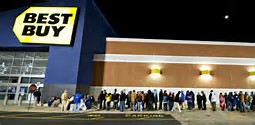
“Standing in line is a pain. At the post office. At the box office. At a restaurant. But on Black Friday, it’s an experience,” writes The New York Times (Nov. 24, 2017). The first spot outside some Best Buy stores is usually claimed weeks in advance, often by a person in a tent. Shoppers at Walmart will print out maps of the store, with circles around their primary targets. Someone, somewhere, will try to cut in line at a Target, arousing the wrath of the cold, cranky people who played it fair.

“These queues are quite different from the usual annoying ones we encounter day-to-day at the A.T.M. or in the subway,” said MIT prof Richard Larson. “People’s willingness to wait is, in some sense, proportional to the perceived value of whatever they’re waiting to acquire. Even if they don’t know what the line is for, they reason that whatever’s at the end of it must be fantastically valuable.”

Lines test patience, personal space and principles of fairness and rationality, especially on Black Friday, when the crowds can be overwhelming. Still, the promise of a once-a-year score lures hordes of shoppers to queues that start before sunrise.

Queuing theory examines why lining up by yourself induces more anxiety than being in a group, why choosing between multiple lines is more aggravating than standing single file and even how music and scent can improve the wait. Black Friday’s preordained opening hours mean that the time the line should start moving is predictable, which can sometimes cause customers to become more agitated as the end approaches. In 2008, a crowd of more than 2,000 shoppers waiting at Walmart store on Long Island began pounding on the glass doors a few minutes before the scheduled 5 a.m. opening time. The doors shattered and shoppers stampeded through, fatally trampling a worker.

Classroom discussion questions:

  1. How many of your students participated in the Black Friday queues?
  2. Is queueing theory more mathematical or psychological?

OM in the News: The “Last Mile” and USPS

As consumers demand ever-quicker and convenient package delivery, the US Postal Service wants to boost its business this holiday season by offering what few e-commerce retailers can provide: cheap next-day service with packages delivered Sundays to your home. Retail giant Walmart says it is considering the Sunday option, which could reshape weekend shopping trips to the mall.

The program, available in 20 major US cities, allows consumers to place online orders with participating retailers before a cutoff time Saturday. Postal carriers pick up merchandise from local stores for delivery the following day, similar to the Sunday package deliveries it now handles almost exclusively for Amazon in much of the US.

“The next-day weekend service is part of the Postal Service’s aggressive push into the parcel business at a time when its more lucrative first-class mail is declining in the digital age,” writes the Boston Globe (Nov. 4, 2017). With Amazon continuing to raise the bar of ‘‘free shipping’’ conveniences, from 1- or 2-day package arrivals to keyless in-home delivery via couriers, the financially beleaguered post office is billing itself as the trusted, low-cost carrier already serving every US household.

Bolstered by e-commerce growth and its Sunday operations, the Postal Service will reach new highs this year in holiday package delivery, with nearly 850 million parcels delivered from Thanksgiving to New Year’s. That 13% increase from 2016 would exceed the single-digit growth for UPS and FedEx, putting the post office on track to capture 45.6% market share in peak holiday deliveries. The post office’s growth is due in large part to its established network in the ‘‘last mile,’’ the final and usually most expensive stretch of a package’s journey to a customer’s door. UPS and FedEx already subcontract a chunk of their last-mile deliveries to the post office.

Classroom discussion questions:

  1. Why is the “last mile” an important OM issue?
  2. What are the strengths and weaknesses of the USPS model to Sunday deliveries?

OM in the News: Where to Locate the Next 1,000 Dollar General Stores

There are 14,000 one-story cinder block Dollar Generals in the U.S.—outnumbering by a few hundred even Starbuck’s domestic footprint. (Fold in the second-biggest dollar chain, Dollar Tree, and the number of stores, 27,465, exceeds the 22,375 outlets of CVS, Rite Aid, and Walgreens combined). And, writes Businessweek (Oct. 16, 2017),  1,000 Dollar Generals are opening this year as part of the $22 billion chain’s plan to expand rapidly in poor, rural communities where it has come to represent not decline but economic resurgence.

As retail stores were going under across the nation, the commercial real estate company, Cushman & Wakefield, was searching for bright spots in the industry. For 5 years running, Cushman realized, a dollar store had opened once every 4.5 hours, an average of more than 5 a day. “They see a need and are aggressively racing to meet that need for low-cost goods in places that are food deserts,” the firm says.

Dollar General’s sales per square foot have risen steadily in recent years, to $229– less than half of Walmart’s. Their gross profit margins were 31%, though, compared with 25% at Walmart. A Dollar General store also has lower startup costs; it spends about $250,000 for a new store, vs. the more than $15 million Walmart puts into a new Supercenter. The dollar chain thrives mostly on selling low-ticket items and basics, such as toilet paper, that help shoppers on tight budgets get through the week. (Dollar General hasn’t technically been a dollar store for decades, and only a quarter of its products sell for that amount today.)

In 2016, the firm detailed a site-selection strategy focused on small towns, dubbed “Anytown, USA.” It defined the core customer as: “Our Best Friends Forever”—an extremely cash-strapped demographic, with a household income less than $35,000, and reliant on government assistance, that shops at Dollar General to “stretch budgets.” These BFFs represented 43% of its sales. The company’s map shows 13,000 green dots as “remaining opportunities” for new stores—some in low-income urban neighborhoods, but most in small and very small towns.

Classroom discussion questions:
1. How does Dollar General’s location strategy differ from that of Walmart?

2. Are Walmart and Amazon threats to Dollar General?

OM in the News: Walmart’s New Approach to Increasing Productivity–Pay Employees More

A Walmart trainee perfecting a cereal display in Fayetteville, Ark.
A Walmart trainee perfecting a cereal display.

“WalMart is discovering that, sometimes it is in an employer’s best interest to pay more than necessary to get a worker into a job,” reports The New York Times (Oct.16, 2016). The 18th-century economist, Adam Smith, described the need to pay a goldsmith particularly well to dissuade him from stealing from you. More recently, economists have found evidence that people are more productive when they are paid above the market rate. An employee making more than the market rate, after all, is likely to work harder and show greater loyalty. Workers who see opportunities to get promoted have an incentive not to mess up.

There is evidence of this in practice. Higher pay at New Jersey police departments, for example, led to better rates of clearing cases. At the San Francisco airport, higher pay led to shorter lines for passengers. Among British home care providers, higher pay meant less oversight was needed.

Why a change of heart at Walmart? Because just a few years ago, shoppers were fed up. They complained of dirty bathrooms, empty shelves, endless checkout lines and impossible-to-find employees. Only 16% of stores were meeting the company’s customer service goals. Sales fell for 5 straight quarters, and shareholders were screaming.  As an efficient, multinational selling machine, the company had a reputation for treating employee pay as a cost to be minimized. So Walmart turned to the idea of “efficiency wages,” namely, pay workers more than the going rate will get more loyal, harder-working, more productive employees in return.

First Walmart planned 200 training centers to offer a clearer path for hourly employees who want to get on the higher-paying management track. Then it raised its hourly pay to a minimum of $10 for workers, and to $15 an hour (from $12) for department managers. Third, it offered more flexible and predictable schedules to workers. Average pay for a nonmanagerial employee is now $13.69 an hour, up 16% since 2014. The results: this year, the proportion of stores hitting their targeted customer-service ratings has rebounded to 75%. Sales are rising again.

Classroom discussion questions:

  1. Discuss the pros and cons of efficiency wages.
  2. What impact will Walmart’s changes have on the entire retail industry?