
The New York Times (May 3, 2011) has just reported some good news for US manufacturing, namely, the massive 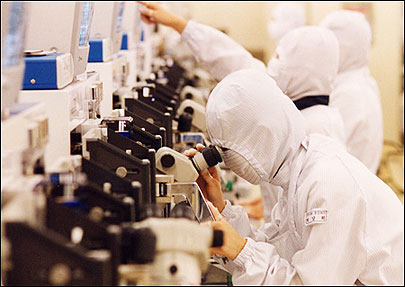 expansion of chip makers who are counting on continuing heavy demand for chips in smartphones, tablet computers, refrigerators, cameras, and GPSs. Samsung, the huge Korean chip maker, is betting $3.6 billion in expanding its US factory to make logic chips for iPhones and iPads. The plant in Austin, scheduled to be completed next month, will be 2.3 million sq.ft., about the size of 40 football fields and one of the biggest factories in the country. Samsung chose Austin because of “the infrastructure and support system here–you can’t get that from anywhere else”.
Intel, the world’s largest chip maker, is spending $13 billion to build 2 new factories and upgrade 4 others in Oregon and Arizona, with the work to be complete in 2013. “When you make an investment in a factory, you’re essentially placing a bet on a manufacturing process that’s not yet done, for products that are not yet designed, to sell in market that is not yet there”, says Intel.
Global Foundries, a contract maker (also called a foundry) of chips, is investing $4.6 billion in a new plant near Albany, NY, that will build 28-nanometer chips for customers. (Small companies cannot afford the $ multibillion investment in making their own). Its 1.5 million sq. ft. plant will also open in 2013. “The appetite for tablet computers is a huge part of this move” to become the biggest contract chip producer in the world, says the Milpitas, CA, company.
The chip industry “is a risky business that’s not for the faint at heart. Its like putting down $1 billion on the craps table”, adds an industry analyst.
Discussion questions:
1. The NYT article focuses on new chip plants in the US. But chip makers are also expanding this year in China, Germany, Japan, S. Korea, and Taiwan. Why the global move?
2. What happens to plants that are out-of-date?
One thought on “OM in the News: Chip Makers Bet the Farm on Future Demand”