MyOMLab: A Few Hints for Starting the Semester

myomlabHere are five tips that Jay and I would like to share as you start the fall semester with MyOMLab.

1)    Students need an Email address and a Course ID. So be sure students have both prior to registering and purchasing MyOMLab access codes.

2)    Creating (not copying) a new class–one since July 10, 2013–is necessary to ensure that all of the new features are available.

3)    The best deal for those buying a MyOMLab access card may be at the Pearson web site and via www.myomlab.com.

4)    We find that some extra time getting everyone ‘on board’ with MyOMLab the first few days of class is a good investment. A review of the new features that are accessed from the MyOMLab opening page may be time well spent. Additionally, students may find the Getting Started videos accessed from the Student FAQ under Student Features helpful. They are well done.

5)    Our newly redesigned 24/7 site for instructor/students for technical support is: http://247pearsoned.custhelp.com/. Or you can Phone 888-433-8435  for Instructors or 800-677-6337 for Students. Our Community site has been updated to include ALL of the MyOMLab training videos, new success stories, best practices and more.   http://www.myomlabcommunity.com/

OM in the News: Keeping Your Human Resources Happy

southwestIn Chapter 10, “Human Resources, Job Design, and Work Measurement,” we hold out Southwest Airlines as a model of workplace civility. The Wall Street Journal (Aug. 28, 2013), in this article on how hostile work environments cost companies in productivity and creativity, agrees. The Journal writes that the warm-and-fuzzy corporate culture of Southwest includes an entire department devoted to sending employees supportive notes when a family member is ill or congratulations when they have a baby. “We have people here who remember our birthdays when our family members don’t,” says one VP.

But this is rare. Some 96% of workers say they have experienced uncivil behavior and 98% have witnessed it, according to a Georgetown U. study.  A separate recent study showed that 50% of workers felt they were treated rudely at least once a week. Victims of incivility dial back their work effort and are more likely to lash out. Uncivil behavior can “spread like a virus across teams,” adds a professor at Antioch. And the costs can be steep: Cisco Systems estimates the cost of incivility in its organization at $8.3 million annually. That figure takes into account turnover, employees’ weakened commitment to the company and work time that was lost to worrying about future bad behavior.

At the National Security Agency, managers encourage workers to pay someone a compliment or show up early for a meeting. NSA employees who do good deeds are honored as “civility stars,” rewarded with plaques. Even Dish Network, which topped website 24/7 Wall St.’s list of “the worst companies to work for,”  is trying to take a kinder, gentler approach. That has meant summertime concerts and a softened stance toward the company’s attendance policy.  “I wanted it to be a more fun place to work,” says Dish’s CEO. “I think people have a responsibility to treat everybody else the way they want to be treated.”

Some organizations are even setting rules to foster friendliness. At Louisiana’s Ochsner Health System, employees are required to follow the “10/5 rule,” making eye contact with anyone within 10 feet and greeting anyone within 5 feet.

Discussion questions:

1. How can civility be increased in the classroom?

2. Is it the operations manager’s job to keep employees happy?

Good OM Reading: Superstorm Sandy and Supply Chains, One Year Later

flooded carsA month or 2 into dreaded hurricane season, and the US has so far dodged the bullet. Still, with 7 hurricanes expected to hit, what can be learned from Superstorm Sandy is a topic for discussion among supply chain managers. Though Sandy hit shore last year as “only” a tropical storm, it was one the most devastating weather events since Hurricane Katrina, in part because many supply chains were caught off guard.

In the aftermath of Sandy, the Securities and Exchange Commission led a just-released study of mid-Atlantic companies to understand how this event affected them and how they recovered. Here is a quick summary of the results:

  1. Consider all the possibilities of widespread disruption: Business continuity plans should take into account all possible sources for electricity, fuel, water and telecommunications in an effected area. Consideration should be given to multiple, redundant services and the proximity of vendors to the potential disaster area. Companies also should consider solutions that allow employees to work remotely.
  2. Consider alternative locations: Companies should consider diverse alternative locations with adequate resources to stay up and running and how they will get enough employees there.
  3. Examine critical vendor relationships: Companies should take a look at vendors that provide critical services or products, from fuel to banking and finance, and line up Plan B vendors (including pre-arranged contracts) if they should be knocked off-line.
  4. Telecommunications and technology: Contract with multiple carriers rather than relying on a single provider.
  5. Communications plans: In addition to staying in close touch with customers and trading partners, firms should consider establishing relationships with multiple broker-dealers to facilitate alternative market entry points.
  6. Take into account time-sensitive regulatory requirements: A crisis can happen at any time, potentially interrupting month-end data for regulatory computations and financial reporting. This is a good reason to dump paper solutions.
  7. Review and test the plan: Business continuity plans, including vendor and customer lists and other critical data, should be updated continually and tested at least annually.

The recommendations in this short SEC report may have been drafted with financial firms in mind, but the advice applies to all businesses and their supply chains.

OM in the News: Still Outsourcing to China?–A User’s Guide

PAL clothing factoryWe have blogged many times about the trends towards nearshoring and homeshoring– topics in Chapter 2. Yet thousands of US companies continue, of necessity, to outsource to China. The Wall Street Journal’s (Aug.19, 2013) interesting article, “Outsourcing to China?”, provides these class discussion points:

1. Start the process of finding the right manufacturer, using a site like Globalsources.com.

2. When you find factories that might meet your needs, ask for references and find out if the manufacturers have a history of respecting intellectual property and doing solid work. But don’t offer those factories complete specifications or samples of the product you want created, since your idea might get filched. Instead, send or show them a similar product for comparison.

3. Have your product made in several different places if possible. It also makes it less likely a manufacturer will impose a last-minute price increase, which is a common practice in China.

4. When you’re ready to commit to a supplier, bargaining is essential. “You need to haggle, or you’d be considered naive and taken for a ride,” says one consultant.

5. Watch out for “quality fade” over time. Sometimes the first few batches of a product are made according to specifications, but then manufacturers start to cut corners—say, by using cheaper material.

6. Structure payments according to performance. Make sure your contract allows you to reserve the right to pay less or impose a penalty if a batch doesn’t meet your expectations.

7. Don’t put much stock in patents. A U.S. patent can’t be enforced in China. You can apply for a domestic patent, but the enforcement of Chinese patents in China is far behind the rest of the modern world.

Discussion questions:

1. With all of these caveats, why do US firms still choose to manufacture in China?

2. What other steps can an operations manager take to insure a quality product at a fair price?

OM in the News: They Call it “The Chasing-Out Room” in Japan

Unwanted employees are made to feel forgotten

Shusaku Tani is employed at the Sony electronics plant in Tagajo, Japan, reports The New York Times (Aug. 17, 2013) front page story, but he doesn’t really work. For more than 2 years, he has come to a small room, taken a seat and then passed the time reading.  Sony consigned him to this room because it can’t get rid of him. His position at the Technology Center was eliminated, but Tani, 51, refused to take an early retirement offer in 2010 — his prerogative under Japanese labor law. So there he sits in what is called the “chasing-out room.” “I won’t leave. Companies aren’t supposed to act this way. It’s inhumane,” he states.

The standoff between Sony workers and management underscores an intensifying battle over hiring and firing practices in Japan, where lifetime employment has long been the norm and where large-scale layoffs remain a social taboo. Economists say bringing flexibility to the labor market in Japan would help struggling companies streamline bloated work forces to better compete in the global economy. Fewer restrictions on layoffs could make it easier for Sony to leave loss-ridden traditional businesses and concentrate resources on more innovative, promising ones.

Sony offered workers early retirement packages that are generous by US standards–severance payments equivalent to as much as 54 months of pay. But the real point of the rooms is to make employees feel so bored and shamed that they just quit. Labor practices in Japan contrast sharply with those in the US, where companies are quick to lay off workers when demand slows or a product becomes obsolete. It may be cruel to the worker, but it usually gives the overall economy agility.

Discussion questions:

1. Have the “chasing out rooms” been successful?

2. Why did Detroit automakers eliminate their version of the rooms (called “rubber rooms”)?

OM in the News: US Auto Makers Shift to Full Capacity

Chrysler plant in Detroit

Supplement 7 discusses a variety of tactics for matching capacity to demand. This Wall Street Journal (Aug. 17-18, 2013) article describing how more U.S. auto plants are cranking out cars around the clock provides a perfect example of these to use in class. After years of layoffs, plant closures and bankruptcies, U.S. auto makers are pushing factories to the limits. At GM, Ford, and Chrysler, more flexible union agreements now allow the companies to build cars for 120 hours a week or more while paying less in overtime pay.

Nearly 40% of car factories in North America now operate on work schedules that push production well past 80 hours a week, compared with 11% in 2008. “There has never been a time in the U.S. industry that we’ve had this high a level of capacity utilization,” says one industry expert. In 2005, the industry had 925,700 employees. In 2012, the workforce stood at 647,600.

Changes in union labor contracts have been critical to running auto factories harder. The Detroit Three now can schedule work at night and on weekends without paying as much in overtime as they would have in the past. Adding a third shift, as many plants have done, also reduces overtime. Overtime pay also starts after 40 hours a week, not after 8 hours a day as in the past. And a newly hired Detroit factory worker now earns about $15/hour versus $28/hour for veteran workers.

In Toledo, Chrysler is building all the hot-selling Jeep Wranglers it can. The plant has been running nearly round the clock, churning out about 800 Jeeps a day and using overtime to staff production lines 20 hours a day, 6 days a week for the past 2 years. Temporary workers fill in when regular employees aren’t available. Ford has gone a step further, adding a 4th crew of workers at some plants to keep those factories running 152 hours out of the 168 hours in a week.

Discussion questions:

1. How are automakers increasing capacity with fewer workers?

2. Why is capacity adjustment such an important OM issue?

OM in the News: Ergonomics for an Aging Workforce

aging factory workerIt’s no secret the exodus of retirement-age workers and their considerable knowledge is placing a strain on manufacturing companies around the globe. Less discussed, but just as real, reports Industry Week (Aug., 2013), are the challenges being presented by aging workers still employed on the manufacturing floor — and the design changes workplaces should be considering to keep these valuable employees productive and in the game.

“With this shift, we first must appreciate the difference between the younger and aging person, and then make sure we design accordingly so that these differences don’t become an obstacle,” says ergonomics expert Lance Perry.

Xerox, for example, has taken ergonomic measures to address its older population. In its 2012 environment, health and safety report, the company noted that musculoskeletal disorders continue to represent about half of its work-related injuries and illnesses, which, says Xerox, “is why we have strong processes to reduce ergonomic stresses in the workplace. Those strong processes include an ergonomic training program designed to provide simple ergonomic strategies, as well as awareness of the normal aging process, to reduce personal risk to employees.”

“Many people view the aging workforce as a liability, and to some extent it might be, but it is also an opportunity,” adds Perry. “This is where your experience lies, this is where your job knowledge lies, this is where, in some respects, loyalty lies.” Ultimately, Perry advises manufacturers to consider what design changes they can make to retain valuable, but aging, knowledge workers. “What can you do to keep them on the job longer and still be productive and safe in the process?”

Discussion questions:
1. Why is ergonomics an important issue for operations managers?

2. What kind of ergonomics designs can help older workers?

Teaching Tip: First Day of Class

The first day of class is critical,” writes Faculty Focus (Aug. 12, 2013). What happens sets the tone for the entire course. The impression you make will last the entire semester, and today’s students are not shy about sharing their opinions. That is why you must use the 1st day to inspire confidence in your abilities and create a classroom atmosphere where the rules are clear: expectations are high, and yet students feel welcome, comfortable, and engaged.

By starting the very first day of the term with clear routines and expectations, with easy procedures such as the “Today We Will” list, students learn that the class is well-organized and that they can achieve success through class attendance, preparation, and participation. You can maximize instructional time and minimize classroom management efforts.

The “Today We Will” list goes up on the board at the start of class and it stays there the entire time. The list lets students know what will be covered that day. They can glance at it to check progress or to see if they missed any big concepts. The list also keeps you on task. As you move around your classroom lecturing, the list is a visual reminder of what you need to accomplish in that period. It also reminds students that they are accountable for the day’s material whether they are present in class or not. For example, if  #1 on the list is “We will go over 3 questions that are on the midterm,” and a student missed the first 15 minutes of class, she will want to get that material from you or another student. So a thoughtful list will motivate students to attend class, arrive on time, and compensate for class time that they miss. If students have really grasped a concept more quickly than you expected, you can add items to the list.

However, the list is fairly standard on the first day of class. It contains the following 5 things: (1) Do what’s on the screen, (2) Introduce yourself, (3) Review syllabus completely, (4) Have lesson, (5) Conclude with preparation expectations for next class.

MyOMLab: Three New Features for Fall

myomlabJay and I have been working away for the past 6 months on three new features that you may want to incorporate into your use of MyOMLab this fall. We hope they add to the depth of choices you already have and you are able to make use of them.

1.  All new conceptual questions: Why is this important? Operations Management is both a quantitative and qualitative course. We have always had amazing resources for the quantitative aspects of the course in MyOMLab, and now we are beefing up our qualitative coverage. These questions are located right in the assignment manager, so instructors can assign them just like they would any other assignment, and they can integrate them into assignments with quantitative questions as well.

2.  New OM in the News section and assignments: This includes hand-picked articles from our blog that show how OM is used in the real world. A summary (300-400 words) of current articles from BusinessWeek, Forbes, Fortune, New York Times, and Wall Street Journal (along with hyperlinks) are provided for each chapter. There are 4 multiple choice questions that go along with the articles, and you can assign them from the assignment manager.

3.  All new video assignments: One of the hallmark features of our text has always been the videos we have created (35 of them, including the 5 brand new Orlando Magic series that just came out) to accompany the books. Now, you can assign the videos along with 4-5 multiple choice questions to test understanding right within MyOMLab.

In addition, we wanted to let you know that 92% of the End of Chapter material is now in MyOMLab: Our OM texts already had more problems and assignments than any other book on the market. Now, that choice is reflected in MyOMLab.

Good OM Reading: The Box That Built the Modern World

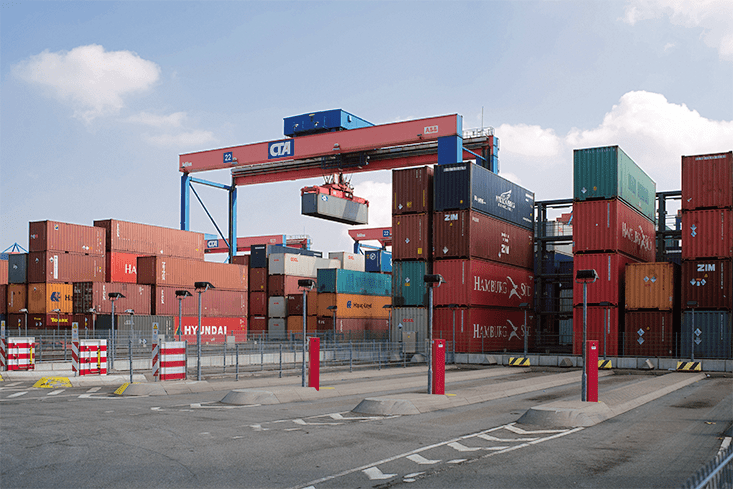
shipping containersFor a fascinating story called “The Box That Built the Modern World,” enjoy this article in In Transit (Issue 3, 2013). The piece follows the Hong Kong Express, docked at Hamburg’s Container Terminal for 33 hours. “Already, the ship was half empty. Cargo from Asia was stacked in neat rows of shipping containers on the dock. The ship is nearly a quarter of a mile long; from side to side it’s 157 feet. It can carry 13,167 20-foot-long containers, the standard box used in commerce around the world.” In less than 2 months the Hong Kong Express will call at 11 ports and travel more than 12,500 miles. Circling the world 4-5 times a year, it can move 1.4 million tons of cargo annually.

More than any other single innovation, the shipping container epitomizes the enormity, sophistication, and importance of our modern transportation system.  Fundamental to how practically everything in our consumer-driven lives works, it is the Internet of things. Just as email is disassembled into bundles of data you send, then re-assembled in your recipient’s inbox, the boxes are designed to be interchangeable, their contents irrelevant.

Once they enter the stream of global shipping, the boxes are shifted and routed by sophisticated computer systems that determine their arrangement on board and plot the most efficient route to get them from point to point. The exact placement of each box is critical: ships make many stops, and a box scheduled to be unloaded late in the journey can’t be placed above one slated for offloading early.

The In Transit article traces a T-shirt sewn at a factory near Beijing. Tagged, folded, and boxed, the T-shirt is stuffed into a container with 33,999 identical shirts at the factory. The merchandise passes through 36 steps before arriving at a discount clothing retailer’s distribution center near Munich. There’s the trucker who moves the box to a waiting ship in Xinjiang, the feeder ship that moves it to Singapore to be loaded onto a bigger Europe-bound freighter, the crane operator in Hamburg, customs officials, train engineers, and more. The total time in transit for a typical box from a Chinese factory to a customer in Europe might be as little as 35 days. Cost per shirt? “Less than one U.S. cent,” says a shipping exec. “It doesn’t matter anymore where you produce something now, because transport costs aren’t important.”

OM in the News: Li & Fung, The Most Important Company You Never Heard Of

Li & Fung workers protesting unpaid wages

Li & Fung — the most important company that most American shoppers have never heard of — has long been on the cutting edge of globalization, chasing cheap labor to garment factories first in China, then elsewhere in Asia, including Bangladesh. Now, with sweatshop disasters there drawing international scrutiny, the business is looking for the next best place where it can steer apparel buyers seeking workers to stitch clothing together for a few dollars a day.

As the world’s largest sourcing and logistics company,” writes The New York Times (Aug. 8, 2013), “Li & Fung plays matchmaker between poor countries’ factories and affluent countries’ vendors, finding the lowest-cost workers, haggling over prices and handling the logistics for 1/3 of the retailers found in the typical American shopping mall, including Sears, Macy’s, JCPenney and Kohl’s.”

The Hong Kong merchandiser owns no clothing factories, no sewing machines and no fabric mills. Its chief asset is the 15,000 suppliers in over 60 countries that make up a network so sprawling that an order for 500,000 bubble skirts that once took 6 months from drawing board to store shelf now takes 6 weeks at a sliver of the price.

“If globalization is a race to the bottom, where lowest wages win,” says an A.F.L.-C.I.O. spokeswoman, “Li & Fung is the sherpa showing companies the fastest route down that slope.” Li & Fung’s ability to exert pressure on factories can have unfortunate consequences, adds a labor advocacy group executive: “Every extra penny you squeeze from a factory is a step closer to that factory cutting the kind of corners that lead to deadly disasters.”

Meanwhile Li & Fung’s CEO says his company is considering South America and sub-Saharan Africa as possible places for growth. “I wouldn’t write Bangladesh off,” he said. “It still has some of the cheapest labor in the world. For factories to get safer, clothing prices would have to go up. So far, consumers have just not been willing to accept higher costs.”

Discussion questions:

1. What is the firm’s role in the apparel supply chain?

2. What risks do clothing companies take in depending on Li & Fung?

OM in the News: Things China Makes

Even though economists expected that the Chinese manufacturing sector would contract in July 2013, it did exactly the opposite. China’s economy is heavily dependent on manufacturing and exports; its citizens consume only a fraction of all the goods made in the country, and the rest are exported to the U.S., Europe and other markets. In fact, China makes so much stuff that if it suddenly decided to stop, most of the rest of the world would experience impossibly high demand for many “essentials” of modern life — things like air conditioners, cell phones and personal computers.

OM in the News: The Challenge of Fixing a Boeing 787

ethiopian airDesigning a new product such as the Boeing 787 is a huge undertaking, as discussed in Chapter 5, “The Design of Services and Goods.” The thin plastic skin on the 787 Dreamliner, writes The New York Times (July 30, 2013),  “is an engineering marvel, a mix of carbon fibers and epoxy molded into large barrel-shaped sections that are then baked at up to 350 degrees in giant ovens.” But while airlines love how this lightweight concoction saves fuel, the recent fire on a Ethiopian Air 787 in London provides the first test of how much more difficult and costly it will be to repair serious damage than on older aluminum planes.  Each day a jet remains grounded costs an airline tens of thousands of dollars.

The cause of the fire, a pinched wire on an emergency transmitter, was fairly mundane. But the high temperatures weakened the supports in a 10-foot stretch at the top of the rear fuselage and seared the paint on the top of the skin, causing the most extensive damage yet to one of the new 787s. Boeing will have to cut out the damaged areas and bolt a large patch, made of overlapping panels of composite materials, onto the plane. It will also need to install new composite supports and shore up the structural integrity of the plane. If the damage were more extreme, Boeing could remove the entire 23-foot-long barrel containing most of the jet’s rear fuselage and snap in another one.

The use of composite materials on planes has grown steadily over the last 4 decades. Only 1% of the weight of Boeing’s 747 jumbo jet came from composite parts when it was introduced in 1969. That increased to 11% by 1995 on the 777, which has an all-composite tail section. Composites now account for half of the 787’s weight, which, together with more efficient engines, cut fuel consumption by 20%.

Discussion questions:

1. What design issues did Boeing face in creating this plane? (Refer to the Global Company Profile that opens Chapter 2).

2. Why did Boeing make extensive use of composites?

OM in the News: When Detroit Was a Cluster

VW's plant in Chattanooga TN
VW’s plant in Chattanooga TN

Clustering is an interesting topic when you are covering location decisions in Chapter 8. Indeed, here in Orlando, over 70,000 people are employed in the theme park cluster that includes Disney, Universal, Legoland, Sea World, Gatorland, and more. This week, Universal Studios announced record profits after sinking a quarter billion dollars into the Harry Potter exhibit–and is adding yet another 1,800 room hotel to its site. The Wall Street Journal (July 31, 2013) adds to the discussion with an article titled “Detroit Was a Cluster”.

“Clusters,” writes The Journal, “offer powerful advantages such as labor market pooling. But these potent synergies can be lost when special technological competence becomes outmoded.” With lean manufacturing, clustering has become more important in the auto industry, with suppliers required to be between one hour and one day’s drive of factories. A new cluster has formed, known as the “auto corridor” between I-75 and I-65, which still includes the upper Midwest but has pulled the industry’s center of gravity steadily south.

The reason is well known: The Japanese, Germans and Koreans located their plants in the South to avoid the United Auto Workers. Honda was the bellwether when in 1980 it picked Marysville, Ohio for its first plant. Honda was expected to be required to employ the UAW, but picked a site in rural Ohio with little union presence. The firm soon concluded that its production system would be impossible with union workers, and that a UAW workforce could be avoided without undue political consequence.

Even a decade ago, more than half of all auto production jobs were still in Ohio, Indiana and Michigan. Now it’s below 44%. Kentucky alone today claims 440 auto manufacturing-related businesses! The transplants made little secret of their motivation in passing up the substantial benefits of the then-cluster around Detroit. Every Toyota factory in the U.S. is non-union and all but one is in the South. Ditto Nissan, Mercedes, Hyundai, BMW and Kia.

Discussion questions:

1. What is a “right-to-work” state?

2. Why are so many auto suppliers and plants clustering in Kentucky?

MyOMLab: Need Help With MyOMLab for Fall?

myomlabJay and I want to thank you for adopting MyOMLab for your course this Fall semester.  About half the students in the country using one of our OM texts have now adopted this assessment/learning system–and the percent is growing exponentially. Whether you are an experienced user or brand new to the program, our team has created many resources and tools to help you get the most out of MyOMLab.

Getting Started:

Adopting a new technology component is rewarding and exciting but takes time and training. Pearson has recently published a new MyLab/Mastering Training 2013 catalog which details the various training opportunities and offerings currently available. These include self-paced training courses complete with a certification option, Faculty-Advisor-led live online training sessions, Video Playlists, an Interactive Training Guide and more. Please visithttp://www.pageturnpro.com/Pearson-Education/52147-Professional-and-Career-Course-Catalog/index.html#1 and navigate to the MyOMLab section on page 22 to choose the training option that works best with your schedule and needs.

 Interactive User Guide:

Located on the MyOMLab home page under the Tours and Training tab, this searchable user guide offers step-by-step instructions and links to our tutorial videos throughout. (Click here).

 Virtual Classroom Training Sessions – If you prefer a personal touch, we offer virtual training sessions led by experienced users. Click here to view the schedule. (Be sure to click “Show all meetings.”)

First Day of Class:

Here you will find both a step-by-step student registration document as well as a Getting Started First Day of Class PowerPoint deck.  Students will also benefit from the Student MyOMLab playlist found here.

Technical Support:

We also have a newly redesigned 24/7 site for instructor/students for technical support: http://247pearsoned.custhelp.com/  or Phone 888-433-8435  for Instructors or 800-677-6337 for students.

The MyOMLab Community Site:

Our Community site has been updated to include ALL of the MyOMLab training videos, new success stories, best practices and more.   http://www.myomlabcommunity.com/