OM in the News: Starbucks Scheduling Software Makes the Headlines–Again

 Starbucks employees protesting work conditions at a Starbucks in Decatur, Ga

Starbucks employees protesting work conditions at a Starbucks in Decatur, Ga

Starbucks’ CEO Howard Schultz has long presented the brand as involving its customers and employees in something more meaningful than a basic economic transaction. But Starbucks has once again has drawn fire for its workplace practices, reports The New York Times (Sept. 24, 2015). Last year, the firm vowed to provide store employees with more consistent schedules from week to week, and to post their schedules at least 10 days in advance. The company said it would stop asking workers to endure the sleep-depriving ritual known as a “clopening,” which requires them to shut down a store at night only to return early the next morning to help open it.

But in the last 2 years, the combination of a tight labor market and legal changes has raised labor costs for employers of low-skill workers. And there has long been another central obstacle to change: the incentives of store managers, who are encouraged by company policies to err on the side of understaffing. It often turns peak hours into an exhausting frenzy that crimps morale and drives workers away. (Starbucks employees are often responsible for finding their own replacements when they are sick. “A lot of times when I’m really sick, it’s less work to work the shift than to call around everywhere,” said one barista.)

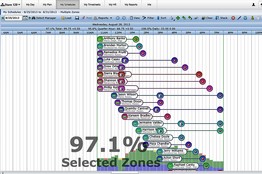
On the question of scheduling, Starbucks uses Kronos state-of-the-art software that forecasts store traffic and helps managers set staff levels accordingly. Using the software to schedule workers 3 weeks in advance typically is not much less accurate than using it to schedule workers one week in advance. “The single best predictor of tomorrow is store demand a year ago,” says Kronos’ VP.

Classroom discussion questions:

  1. Why is scheduling in the service sector complex?
  2. What benefits does Starbucks offer full-time and part-time employees that other food service operations do not?

OM in the News: Abercrombie–and Others–Agree to End “On-Call” Scheduling

a&fAbercrombie & Fitch will cease using on-call scheduling—which requires workers to make themselves available for shifts that may be canceled at the last minute—at its New York stores by the end of 2015, reports The Wall Street Journal (Aug. 7, 2015). The retailer, which also operates the Hollister chain, was among 13 companies that received notice from the N.Y. state attorney general, warning that they might be violating state law by requiring workers to show up or stay home with little notice. “Unpredictable work schedules take a toll on all employees, especially those in low-wage sectors,” said the attorney general.

Workers whose shifts are canceled don’t receive pay, even if they had blocked out that time and made child care or other arrangements. A&F workers say that they were expected to be on call at least twice a week and were often told to stay home just an hour before their shifts were to start. On-call scheduling allows retailers to staff up quickly during busy times and save on labor costs during slow days. Software now widely used by retailers forecasts staffing needs based on real-time sales and store traffic data. Workers, labor activists and legislators have criticized the practice, saying it makes employees’ lives and pay unpredictable.

A&F workers will now receive their schedules one week in advance and can opt in to receive alerts about additional shifts that need to be filled on short notice. Victoria’s Secret, which also received the letter, told employees it would stop using on-call shifts. The other companies targeted by the state are:  Burlington; Crocs ; Gap; J.C. Penney; J. Crew; Sears; Target ; TJX; Urban Outfitters; Ann Inc.; and Williams-Sonoma.

Classroom discussion questions:

  1. How common is on-call scheduling?
  2. What are the ethical issues involved?

OM in the News: At UPS, the Algorithm is the Truck Driver

ups trucks“Here’s a math problem for you,” writes The Wall Street Journal (Feb.17, 2015). Each United Parcel Service driver makes an average of 120 stops per day. There are 6,689 times 10 to the 195th power alternatives for ordering those stops! Which option is the most efficient, after considering variables such as special delivery times, road regulations, and the existence of roads that don’t appear on a map?

Even if an optimal answer exists, the human mind will never figure it out. And while experts at UPS have been giving the problem their best shot for more than a century, the company is shifting that work over to a computer platform, with 1,000 pages of coding, called Orion, which is 10 years in the making. Considered the largest operations research project in history, the $200-300 million algorithm was written by a team of 50 UPS engineers.

Orion consists of many components, including a “traveling salesman” algorithm, a tool that calculates the most efficient path between a variety of points, and geographic mapping. None of the solutions that Orion spews out are big or dramatic. It is all about saving $1-2 here and there. But in a network with 55,000 routes in the U.S. alone, that adds up. E-commerce has shifted more and more of UPS’s delivery stops to residences, and those packages are expected to make up 1/2 of all deliveries. It is a radical routing change from 15 years ago, when drivers would drop off several packages at a retailer.

Orion is expected to save the company $300-$400 million a year once it is fully implemented in 2017. (UPS saves $50 million a year by reducing by 1 mile the average daily travel of its drivers.) But reaction to Orion is mixed. For example, some drivers don’t understand why it makes sense to deliver a package in one neighborhood in the morning, and come back to the same area later in the day for another delivery. But Orion often can see a payoff, measured in small amounts of time and money that the average person might not see.

Classroom discussion questions:
1. Why is Orion so important to UPS?

2. Why is the software so complex?

OM in the News: Scheduling Zappos’ Call Center Employees

Zappos call center
Zappos call center

Last September, Zappos’ CEO Tony Hsieh was wandering the halls of the online retailer’s Las Vegas headquarters and noticed that the customer service center’s walls were covered—floor to ceiling—with sheets of printer paper. He had stumbled across the scheduling method for the center’s 540 employees, who respond to the 10,000 customer inquiries the online retailer receives every day. Employees choose their shifts in order of seniority, by writing their names on sheets of paper listing the shifts they want. “It was like how I signed up for college courses before I could do it on a computer,” says a senior manager at Zappos.

The old-school, paper-and-pencil process didn’t sit well with Hsieh,” writes Fortune (Jan. 28, 2015), “who is known for his devotion to customer service.” (The Amazon-owned company aims to answer 80% of customer inquiries within 20 seconds.) The wasteful manual sign-up process is now being replaced with Zappos’ Open Market, a newly created online scheduling platform that allows workers to set discretionary hours and compensates them based on an Uber-esque surge-pricing payment model: hourly shifts with greater caller demand pay higher wages. The goal of Open Market is to create a “free-market system,” and strike a balance between the rigidness of customer service center scheduling and what the company says is its dedication to giving employees time to pursue other opportunities at Zappos. Everyone receives at least 10% flexible time, so during a 40-hour week, employees would have 4 hours to play with. They could choose to not work during those hours or they could fulfill them whenever they liked by tacking them onto the start or end of a workday or by coming into the office on a scheduled day off.

Employees decide when to work with the help of Open Market’s real-time metrics algorithm that shows customer demand, as measured by the wait time of the longest-holding customer, and the accompanying compensation rates. The longer the hold time, the higher the customer demand, the more the employees working that shift would get paid.  The idea is to tie compensation for the employees—who earn an average of $14.50 per hour—into the Open Market model and pay them a range of hourly rates based on demand.

Classroom discussion questions:

1. What are the advantages of the new scheduling system?

2. How does Open Market differ from employee scheduling systems you are familiar with?


OM in the News: Airlines and the Winter Storms

Workers at Boston's Logan Airport faced a mountain of snow last week
Workers at Boston’s Logan Airport faced a mountain of snow last week

As we discuss in the Global Company Profile on Delta Airlines that opens Chapter 15, airlines have made rapid improvement in storm recovery. Using new tricks, techniques and conservative strategies to position airplanes and employees before storms hit, flights can resume quickly as soon as runways clear. The change is a reaction to stiffer regulations, including stronger rules on pilot rest, and customer outrage on tarmac delays.

New software in use at several big airlines reschedules crews in minutes, sparing dispatchers hours of manual puzzle-solving, reports The Wall Street Journal (Feb.5, 2015). Last week, United got planes back into its Newark, N.J., hub and other Northeast airports on Tuesday night and was back at full strength by Wednesday afternoon, using only 11 reserve pilots. In past storms, that number would have been in the hundreds. The airline keeps 15-18% of its 10,000 pilots on reserve duty to fill in when pilots get sick or delays throw off schedules. United, like other airlines, sometimes ran out of reserve pilots and flights would have to be canceled days later in sunny weather.

United has long used software to reschedule planes, then given dispatchers the task of manually finding available crews. But this time, a new computer program rescheduled pilots sidelined by snow. “That optimization is so beautiful,” says United’s VP. “Last year, we had multiple events where the recovery dragged on for days.”

Airlines say tarmac-delay rules, where the government imposes big penalties on carriers for leaving passengers marooned on grounded airplanes, have forced them to avoid the risk of flying close to the storm. Shutting down early turns out to be better for passengers and airlines. Fewer passengers get stranded at airports because they never start trips or know ahead of time they won’t get home so they avoid the airport. United actually ferried 7 planes empty into Newark Tuesday afternoon so they’d be ready for early-morning departures Wednesday. By 4 p.m. Wednesday Boston was back to normal.

Classroom discussion questions:

1. Why is the airline operations center so critical during weather disruptions?

2. What does optimization software do for the airlines?

OM in the News: Scheduling an Auto Service Center

auto serviceJeff Proctor, head of Metro Honda and Metro Acura in Montclair, Calif., endured a year of anger from service advisers after he gave their job of scheduling service work to a newly created call center. Suffering their wrath proved worthwhile, Proctor says in Automotive News (Jan. 23, 2015), because now his service bays are largely booked and his service revenue keeps rising. “We were able to regain control of scheduling appointments in the service drive, and that’s important because we’re only open a certain amount of hours, so we want to load our shop. The service advisers didn’t see it that way.”

By creating the call center, Proctor took service scheduling away from service advisers. They were often reluctant to book small jobs, such as oil changes and tire rotations, because they earn smaller commissions on those jobs compared with, say, a 3-hour brake repair. “It’s not in their best interest to take, say, an oil change that only pays them 2/10 of an hour,” Proctor says. “So they push them off for 3 weeks to make room to take a bigger paying job.” But often, those bigger jobs never surface, that time slot goes unfilled, and the dealership loses money and customers.

The call center’s 3 employees phone new-car owners to set up appointments for their initial maintenance service, and they take all inbound calls, setting service appointments. In the center’s first 12 months, total service appointments grew 10% and revenue increased 5%. When Proctor told his 8 service advisers about his plan for a call center, he initially experienced stiff resistance. “I had to sell them on the fact that this would benefit them long-term because they’ll be able to spend more time with the customer and upsell them with the services they need instead of having to deal with the interruptions of answering the phone.”

This is a good example of service scheduling options that you can use in Chapter 15.

Classroom discussion questions:

1. Which priority rule were the service advisors using prior to the call center?

2. How does scheduling for services differ from scheduling manufacturing systems?

OM in the News: American Airlines Returns to “Peak” Scheduling

Shorter connecting times mean runs of up to 1.1 miles in Miami's airport
Shorter connecting times mean runs of up to 1.1 miles in Miami’s airport

“American Airlines is making its Miami hub more hectic—on purpose,” writes The Wall Street Journal (Sept. 11, 2014). Instead of spacing flights evenly throughout the day, the airline just started bunching them together. The change restores an old format of “peak” scheduling, grouping flights into busy flying times followed by lulls when gates are nearly empty. American next year will “re-peak” schedules at its largest hubs in Chicago and Dallas-Fort Worth.

Airlines shunned peak schedules at hubs more than a decade ago because they meant higher costs such as more people and equipment, created too many delays and forced passengers to sprint through terminals to make connecting flights. Recently though, the industry has gravitated back to peaks and valleys as a way to fill seats and generate more revenue. “An additional person per flight will make a difference,” said American’s CEO. The company will gain $200 million more a year from re-peaking its schedules at hubs.

But travelers may have even less time to make flight connections or to eat. And airlines, airports and federal agencies are re-evaluating how they manage baggage, cleaning crews and security checkpoints with the new highs and lows in foot traffic. Peak scheduling packs planes better because it creates more possible itineraries, with shorter connection times. In Miami, 42 flights depart between 9 and 10 a.m. Then between 10 and 11 a.m., only a handful are scheduled to take off. The process repeats during the day with 10 “banks” of flights that fill about 45 gates at a time.

There are added costs to re-peaking. American hired 67 more gate agents and 150 baggage handlers and other ground workers. It had to purchase more belt-loaders, dollies and tugs that push planes out from gates. There are other pitfalls to airlines’ clumped schedules. If bad weather hits at the wrong time, diverted flights and missed connections can cause widespread delays.

Classroom discussion questions:

1. What are the advantages and disadvantages of this approach?

2. What other OM ideas could American use to increase efficiency?

OM in the News: Starbuck’s Controversial Scheduling Software

starbucks“Starbucks just announced revisions to the way the company schedules its 130,000 baristas, saying it wanted to improve ‘stability and consistency’ in work hours week to week,” reports The New York Times (Aug.15, 2014). The company intends to curb the much-loathed practice of “clopening,” or workers closing the store late at night and returning just a few hours later to reopen. All work hours must be posted at least one week in advance, a policy that has been only loosely followed in the past. Baristas with more than an hour’s commute will be given the option to transfer to more convenient locations, and scheduling software will be revised to allow more input from managers.

 
The revisions came in response to a Times article about a single mother struggling to keep up with erratic hours set by automated software. A growing push to curb scheduling practices, enabled by sophisticated software, has caused havoc in employees’ lives: giving only a few days’ notice of working hours; sending workers home early when sales are slow; and shifting hours significantly from week to week. Those practices have been common at Starbucks. And many other chains use even more severe methods, such as requiring workers to have “open availability,” or be able to work anytime they are needed, or to stay “on call,” meaning they only find out that morning if they are needed.

 
Starbucks prides itself on progressive labor practices, such as offering health benefits and stock. But baristas across the country say that their actual working conditions vary wildly, and that the company often fails to live up to its professed ideals, by refusing to offer any guaranteed hours to part-time workers and keeping many workers’ pay at minimum wage. Scheduling has been an issue for years. Said a former company executive: “Labor is the biggest controllable cost for front-line operators, who are under incredible pressure to hit financial targets.”

Classroom discussion questions:

1. What is the goal of the scheduling software many fast food restaurants use?

2. Why is scheduling a major operations issue at Starbucks?

OM in the News: Delta’s Unorthodox Scheduling System

Delta's Control Room
Delta’s Control Room

“The crew of Delta Air Lines  Flight 55 last Thursday couldn’t legally fly from Lagos, Nigeria, to Atlanta unless they waited a day due to new limits on how much pilots can fly in a rolling 28-day period,” writes The Wall Street Journal (April 3, 2014). The trip would have to be canceled. Instead, Delta headquarters told the captain to fly to San Juan, which they could reach within their duty limits. There, two new pilots would be waiting to take the Boeing 767 on to Atlanta. The plane arrived in San Juan at 2:44 a.m., quickly took on fuel and pilots, and landed in Atlanta only 40 minutes late.

The episode, unorthodox in the airline industry, illustrates the fanaticism Delta now has for avoiding cancellations. Last year, Delta canceled just 0.3% of its flights. That was twice as good as the next-best airlines, Southwest and Alaska, and five times better than the industry average of 1.7%.

As it cut cancellations with a more-reliable operation, overall on-time arrivals improved and Delta has fewer delays. Managers in Delta operations center (featured in our Global Company Profile  in Chapter 15) move planes, crews and parts around hourly trying to avoid canceling flights. How well an airline maintains its fleet and how smartly it stashes spare parts and planes at airports affect whether a flight goes or not. Delta’s new analytical software and instruments that can help monitor the health of airplanes and predict which parts will soon fail. Empty planes are ferried to replace crippled jets rather than waiting for overnight repairs. Typically the airline has about 20 spare airplanes of different sizes each day. About half are stationed in Atlanta and the rest spread around other domestic hubs and two in Tokyo.

Classroom discussion questions:

1. Why have Delta’s operations managers focused on cancelling fewer flights?

2. How does Delta’s fleet age (one of the oldest in the industry) impact this strategy?

OM in the News: Speeding Up the Airline Boarding Process

Barry and Jay at Alaska Airlines

Jay and I just returned from a visit to Alaska Airlines headquarters, where we studied the intricacies of operations management at the top-rated U.S. carrier.  One of the many issues we discussed was the speed of boarding passengers onto their flights.

In the past 3 decades, the airplane boarding process has become an increasingly important industry-wide issue for airlines and passengers. Prior to 1970, the average boarding speed of passengers nationwide was 20 passengers per minute. By 1998, this rate had decreased to 9 per minute. The increased costs of checking luggage will continue to play an important role in the time to board, as passengers are going to respond to increasing fees by carrying more bags onto the plane. As a result, the boarding speed may continue to decrease.

When using an average boarding strategy, the difference in boarding times when passengers have 2 carry-on bags compared to zero is almost 60%. Long boarding times impact costs. The total cost of airline delays in 2007 was estimated to be $29 billion in the U.S. alone, with the cost to airlines ($8 billion), the cost to passengers ($17 billion), and the cost from lost demand ($4 billion). This indicates the possibility for large savings for the airlines and passengers with more efficient boarding methods.

Seattle airportSo a recent article by Clarkson University researchers to develop a strategy for boarding flights caught our eyes. The new method, published in the Journal of Air Transport Management (Jan., 2014), assigns airline passengers to a specific seat based on the number of bags they carry, causing luggage to be evenly distributed through the plane. Each row of seats would tend to have a passenger with 2 bags, a passenger with 1 bag and a passenger with no bags. “The new method would save at least several seconds in boarding time and prevent any one area of the plane from becoming overloaded with bags,” says author Prof. John Milne. “Airlines could provide a smoother boarding experience for passengers by utilizing the research.”

Classroom discussion questions:

1. Why is boarding an OM issue and what control do managers have over the process?

2. What other boarding procedures are in place across the industry?

OM in the News: Employee Scheduling with Commercial Software

Dayforce software gives users an efficiency score for their scheduling

Say you own a thriving bakery that’s open 12 hours a day, seven days a week, and you have 9 full-time employees and 11 part-timers. The shop is busiest between 7 a.m. and 9 a.m. and then again from 11:30 a.m. to 3 p.m. How many people do you need on the noon to 6 p.m. shift?  This common problem is one we discuss in both Chapter 15 (Short-Term Scheduling) and Module B (Linear Programming). Behind the scenes are scores of software programs available to help businesses manage their scheduling conundrums, reports The Wall Street Journal (Sept. 16, 2013).

The biggest name in the “workforce management” software business, Kronos Inc., offers Workforce Ready, which allows small employers to start out with a single application, such as basic scheduling, and then add extra features, from calculating accrued time off to administering payroll. Kronos’s Workforce Central lets larger employers oversee a complex multistate or global employee base.

Because they can monitor workers’ hours better than traditional methods, the programs also allow employers to keep closer track of employees—reducing overtime, for instance, and syncing up with electronic time clocks to monitor tardiness and break times. And scheduling programs offer the ability to integrate with payroll software to tally workers’ paychecks, which helps reduce the simple mathematical errors that can plague manual scheduling and payroll processes.

There are benefits for workers as well. Ceridian’s Dayforce allows employees to view their schedules online, swap shifts with co-workers and record their availability. Guitar Center Inc., a music-instrument retailer with around 240 locations, began using Dayforce in 2010 after years of managing schedules with Excel spreadsheets. “Now we load customer traffic and transactions in 15-minute intervals into Dayforce, and it generates labor-demand curves that let each store know how many people they should staff for every 15 minutes,” says a Guitar Center exec.

Classroom discussion questions:

1. How can linear programming be used to solve scheduling problems?

2. Why is commercial software so useful?

OM in the News: New Looks at Loading and Boarding Planes

alaska air jetwayLoading an airplane quickly and efficiently isn’t an easy task. “It should be, and could be, but the humans involved can’t seem to get with the program,” writes Wired Magazine (Aug. 28, 2013). Better loading means more time in the air – which is where airlines make their money. The boarding process is far from standard – there are almost as many boarding procedures as there are airlines. This problem has long been pondered by operations managers, without a definitive answer. But there have been a few promising experiments.

The most unusual and deceptively simple idea is opening the door at the rear of the plane in addition to the door at the front. Alaska Airlines is trying this. The idea isn’t entirely new–many airlines open the front and rear doors at those airports where there is no jetway, only a staircase leading to the tarmac. Alaska has a new tool to help facilitate using both doors–a solar-powered ramp. Mounted on wheels, the ramp can be driven to the backdoor of the airplane, and passengers make two switch-back turns down the ramp to the ground, providing an alternative to stairs for easy suitcase rolling and wheelchair access. Using the aft door to unload passengers can reduce the turnaround time by 10 minutes.

One of the big reasons boarding has slowed to a crawl is people are carrying more bags aboard to avoid baggage fees. So American Airlines is experimenting with letting those who checked their bag board first. Ideally, these passengers will simply walk to their row and sit down. The airline says that overall it has shaved a few minutes off the boarding process.

Although airlines commonly board by sections, it’s generally a free-for-all with regard to where in that section you are. United uses the “outside-in” method of seating window passengers first, then middle, then aisle seats. The airline has been organizing passengers in better defined lines at the gate for each group, with the hope is there will be less of a bottleneck.

Discussion questions:

1. Why is boarding an important OM issue?

2. What else can airlines do to speed the process?

OM in the News: Speeding Up the Airline Boarding Process

airline arrival ratesThe forecast calls for heavy frustration with a 50% chance of innovation at U.S. airports this summer,” writes The Wall Street Journal (May 23,2013). Airport crowds are expected to be the largest in the U.S. since 2008. There’s already concern that budget cuts in TSA overtime will lead to longer security-screening lines. But travelers will find new boarding procedures at both United and American airlines that pack planes faster. The idea is to increase the percent of flights that arrive within 15 minutes of schedule, currently around 76%.

In an effort to get more flying out of planes and crews, a topic we discuss in Chapter 15, United is introducing new boarding lanes at gate areas this summer. Five different boarding groups will line up in different areas, akin to how Southwest lines up customers by groups, so that instead of a crush of people pushing toward the gate, each group will have a designated place to wait. After elite-level customers, the rest of the coach cabin will board window-seat passengers first, then middle seats, and aisle seats last. With the “Wilma” system, as United calls it, seats fill faster because people already seated don’t have to get up as much to let a row mate in. United says Wilma boarding is about 20% faster than boarding from the rear of the plane to the front.

American set its own new change in boarding this month. It joined Alaska Airlines in offering early boarding to customers who don’t have large carry-on bags. American offers Group 2 boarding, right after elite-level frequent fliers, to passengers without overhead-bin luggage. American tested the idea in seven cities earlier this year and found getting people without overhead bin luggage on early sped up boarding time and improved on-time arrival performance.

Discussion questions:

1. Why has Southwest’s management of scheduling been so successful?

2. What are the advantages and disadvantages of the “Wilma” system?

Guest Post: Tying Scheduling Back to Operations Strategy in Your Course

steve harrodDr. Steven Harrod is Assistant Professor of Operations Management at the University of Dayton and can be reached at steven.harrod@udayton.edu.

For those of you including Chapter 15, Short-Term Scheduling, in your syllabus, here is a great way to tie that topic back to the beginning of your course and to Chapter 2, Operations Strategy in a Global Environment. A significant topic in Chapter 15 is “Sequencing Jobs”, which is a logical extension to Module D– Waiting-Line Models.

In class, I work out three fundamental queue disciplines: first come first serve (FCFS), shortest processing time (SPT), and earliest due date (EDD). Following Example 5 from Chapter 15 of the Heizer/Render text, I walk my class through the solution of these three sequences using a custom worksheet that you may obtain online by clicking here.

I ask the students to recall the three competitive advantages of Chapter 2 (low-cost, differentiation, and response), and how sometimes it is unclear which competitive advantage applies. For example, does McDonald’s pursue a low-cost or differentiation strategy?

I then ask the students to label each sequencing rule by the competitive advantage it best aligns with. Clearly, EDD best supports response, because it most respects the timeliness of delivery. Then I impress upon the students how SPT leads to low-cost competitive advantage (WIP, flowtime). Finally, I assert that FCFS is a differentiation strategy, because it enforces social justice in the service pattern, and thus seeks to make each customer feel valued and unique. Viewed from the way in which they queue their customers, it then becomes obvious that McDonald’s pursues a low-cost strategy, Wendy’s pursues a differentiation strategy, and Domino’s pursues a response strategy.

I close this lecture by impressing on students how choices in Operations Management effectively dictate the strategic competitive advantage of the firm. Firms must align their stated strategy and their operating rules to each other, or else be perpetually in a mode of crisis and confusion.

OM in the News: Art and Science of Scheduling the N.F.L.

Howard Katz, NFL scheduling tzar

“We’re geniuses one day and absolute morons the next,” says Howard Katz, director of scheduling for the  National Football League. That’s because Katz must consider a confounding array of factors, from the N.F.L.’s expanded Thursday night package, which gives each team a game in a short week, to potential baseball playoff situations that could affect the availability of stadiums and parking lots in October.

The New York Times (April 20,2012) reports that for the networks that pay billions of dollars to carry N.F.L. games, Katz’s staff has been mostly geniuses. N.F.L. games were watched by an average of 17.5 million viewers last season. N.F.L. games accounted for 23 of the 25 most-watched television shows among all programming, and the 16 most-watched shows on cable last fall.

Designing a schedule that generates those ratings, while also guaranteeing competitive fairness, is more complicated than ever, even though software spits out 400,000 complete or partial schedules (once done entirely by hand) from a possible 824 trillion game combinations. Katz starts with thousands of seed schedules, empty slates in which a handful of critical games with attractive story lines are placed in select spots. Then the computers generate possibilities around those games.

The N.F.L. also feeds the computer with penalties for situations it prefers to avoid — three-game trips, for example, or teams starting with two road games. There are requests not to play at home on certain holidays — the Jets and the Giants typically ask not to play home games during the Jewish High Holy Days.  This year, the software generated 14,000 playable schedules, which were reduced to 150 with an eyeball test. Katz reviewed those 150 by hand, scoring them for each team and each network.

Linear programming may be at the heart of scheduling, but the process is definitely part art and part science.

Discussion questions:

1. Why is scheduling sports teams so complex?

2. Are all the teams happy with the final schedules?