Guest Post: Location– Facility Repurposing Failures

Prof. Howard Weiss is providing Guest Posts while I am travelling.

Figure 8.1 of your Heizer/Render/Munson textbook lists 6 factors affecting the decision about what site to select at a local level. Another factor at the site level is whether or not it is possible to take over an already existing site. In two previous blogs I have discussed successful repurposing of facilities in general and repurposing of closed Kmart buildings. Unfortunately, not all repurposing decisions turn out well. One case below shows the problems to the organization taking over the facility while the second demonstrates the problems to the township in which the facility is repurposed.

Philadelphia Parking Authority The Philadelphia Parking Authority (PPA) decided that it could repurpose a decaying 16-acre Exelon steam regeneration plant into an administration building and an impound lot. In 2019 PPA signed a lease for this property which had been vacant since it was closed in 1985. The owner agreed to improve both the 500,000 square foot administration building and the parking lots. In 2021 workers were moved into the building. There were sewage and bathroom problems and in a few weeks PPA pulled its workers out of the facility. The parking authority has ended its lease and is currently in the course of creating a new headquarters at another location in Philadelphia. The PPA will be reimbursed over $2,000,000 for the project but even with the reimbursement the estimated loss to PPA, not including wasted time, for this failed location is over $1,000,000. 

Lockheed Martin Site In 1995, Pennsylvania offered Lockheed Martin, a defense contractor, an incentive package of grants and loans worth $25 million to relocate employees to Newtown, Bucks County, PA. Your textbook notes, in the OM in Action box on “Iowa – Home of Corn and Facebook” in Chapter 8, that studies show that “incentives did not substantially contribute to economic performance”. Indeed, this was the case with Lockheed as it decided to close the facility by 2015. Closing cost the township roughly $560,000 in income tax from Lockheed’s 1,200 employees.

The drug company KVK Tech purchased the site for $12.5 million in 2015. Currently the site is barely used and the parking lots are nearly empty. In addition, local, state and federal officials have had difficulty with KVK using trailers instead of expanding, being in non-compliance on waste water and having flawed manufacturing processes.

 Classroom Discussion Questions: 

  1. Name a facility that generally is not repurposed. 
  2. What incentives does your city or county or state give to companies for locating in your area?

Guest Post: Lumber, Sawmills, and Location Decisions

Prof. Howard Weiss is providing blog posts while I am travelling.

The Location Chapter of your textbook (Ch. 8) notes that “goods for which there is a reduction in bulk during production (such as a sawmill cutting trees to lumber) typically need facilities near the raw material.” While sawmills need to locate near the trees for economic reasons, the lumber industry itself has made location decisions since colonial times for other reasons.

The lumber industry in the U.S. began with New England colonies providing much of the lumber. The lumber was used in the colonies but also exported to Great Britain. By 1830, more lumber was being shipped out of Maine than any place in the world. Lumber is still exported from Canada and the U.S., which account for 12% and 8% of world lumber exports, respectively. China is the number one exporter and accounts for 13% of world exports.

As lumber supplies, i.e. trees, dwindled in New England, logging moved to New York and Pennsylvania and then to the Great Lakes region. By the beginning of the twentieth century, Midwest supplies were not sufficient and logging moved to the Pacific Northwest.

Recently though, the warmer weather in the Pacific Northwest and Canada has led to insect infestations and wildfires forcing lumber producers to move elsewhere, namely, into the South. Since 2021, 4.54 million board feet of capacity have been added to Southern States whereas Eastern Canada, British Columbia and the US West have all lost capacity.

In addition, the replenishment time for forests in the south is 20-30 years, which is less than for other areas. Major lumber companies have also moved south to Alabama, Georgia, Florida, Texas and the Carolinas because wood there is plentiful and inexpensive.

The figure below displays the number of lumber mills closed in the Northwest and the number of lumber mills in the South.

The move from the Northwest to the South means that different trees will be providing lumber. The Northwest forests were mainly Douglas firs whereas the Southern forests are Southern Pine trees. Southern Pine is not as straight as Douglas fir and is more prone to warping. This affects the choices of wood and design by the major users of lumber – the construction industry.

Classroom discussion questions:
1. What are the by-products from a sawmill?
2. Draw a figure of the supply chain for lumber, similar to the supply chain figure for soft drinks given in Figure 1.2 of your Heizer/Render/Munson text.

OM in the News: Why Apple Plans to Move Beyond China

Apple and China have spent decades tying themselves together in a relationship that, until now, has mostly been mutually beneficial, writes The Wall Street Journal (Dec. 3-4, 2022).  But in recent weeks, Apple has accelerated plans to shift some of its production outside the long the dominant country in its supply chain. It is telling suppliers to plan more actively for assembling Apple products elsewhere in Asia, particularly India and Vietnam, and looking to reduce dependence on assemblers led by Foxconn.

Protesting workers being beaten at Chinese iPhone factory in November

Turmoil at a place called iPhone City helped propel Apple’s shift. At the giant city-within-a-city in Zhengzhou, China, as many as 300,000 workers work at a factory run by Foxconn to make iPhones and other Apple products. At one point, it alone made about 85% of the Pro lineup of iPhones.

The Zhengzhou factory was convulsed by violent protests and running at only about 20% capacity last month. Coming after a year of events that weakened China’s status as a stable manufacturing center, the upheaval means Apple no longer feels comfortable having so much of its business and supply chain tied up in one place. In the past, China has excelled at building hundreds of millions of gadgets, heavily due to its concentration of production engineers and suppliers.

Two causes threaten China’s historic economic strength. Some Chinese youth are no longer eager to work for modest wages assembling electronics for the affluent. They also seethe because of Beijing’s heavy-handed Covid-19 approach, itself a concern for Apple and many other companies. And 5 years of U.S.-China military and economic tensions and U.S. tariffs have come into play.

The risk of too much concentration in China has long been known to Apple, yet for years it did little to lessen it. China supplied a diligent workforce, political stability and a huge local market. Apple’s goal is to now ship 40% to 45% of iPhones from India. Vietnam is expected to shoulder more of the manufacturing for other Apple products such as AirPods, smartwatches and laptops. American companies’ confidence in China has fallen to a record low, with about a quarter saying they have at least temporarily moved parts of their supply chain out of China over the past year.

Classroom discussion questions:

  1. What are the benefits and risks of Apple’s move?
  2. Figure 8.1 in your Heizer/Render/Munson text (see page 337) lists 20 factors that affect location decisions. Which concern Apple operations managers?

OM in the News: New York Goes After Cryptocurrency Miners

Bitcoin mines need cheap and plentiful electricity

Bitcoin mining the process by which powerful computers solve complex mathematical equations to validate transactions is a crucial part of the cryptocurrency economy. And while amateurs could once mine coins at home, the complexity of equations, and the energy needed to solve them, has soared with the growing popularity and value of BitcoinWe have twice posted blogs regarding cryptocurrency mining and its need for massive computers. (See “Going Crazy with Bitcoin Mining” on Nov. 15, 2021 and “Cryptocurrency’s Damage to the Environment” on April 19, 2021.)

But climate advocates have long said that the value of cryptomining operations were not worth the environmental costs. The process requires an immense amount of electricity so much so that China banned the practice last year in an effort to meet its climate goals

New York became the first state to enact a temporary ban on new cryptocurrency mining permits at fossil fuel plants, a move aimed at addressing the environmental concerns over the energyintensive activity, reports the New York Times (Nov. 22, 2022). The move in NY comes months after some other states (Montana and Georgia) and Quebec, Canada had adopted more friendly policies toward the industry, offering tax incentives in hopes of luring crypto-mining operations after China cracked down. This bill will create the pause we need in the current trend of purchasing old power plants in New York for corporate profits and allow us to properly evaluate the impact of this industry on our climate goals before it is too late,” says a NY State legislator.

But it also comes at a moment of intense turbulence, and a potential crossroads, for the cryptocurrency sectorEarlier this month, the crypto exchange known as FTX suffered a swift and public collapse that led to its declaration of bankruptcy. The fall of what had been a trusted player in the new market has led to broader questions about the future of cryptocurrency.

The Chamber of Digital Commerce, a crypto advocacy group, denounced the NY bill as unfairly targeting the cryptocurrency industry, saying: To date, no other industry in the state has been sidelined like this for its energy usage. This is a dangerous precedent to set in determining who may or may not use power.” 

Classroom discussion questions:

1. Chapter 8 in your Heizer/Render/Munson text discusses location decisions based on government incentives. Relate that political issue to crypto mining.

2. What is your position on NY’s ban?


OM in the News: The New Electric Vehicle Hubs

More automakers are bringing EV battery production in-house to secure a stable supply of batteries as demand for vehicles outpaces the manufacturing of them, reports Supply Chain Dive (Oct.18, 2022)

LG Energy Solution created a joint venture with Stellantis to construct a large-scale battery plant in Ontario, Canada — the country’s largest automotive cluster. The companies said they expect the plant will spur a “strong battery supply chain in the region.”

Honda will invest billions of dollars to manufacturer EV batteries in Ohio and retool the Marysville plant for EV production.

Now, Honda is following a similar script in Ohio. In addition to the joint venture with LG Energy Solution, the automaker announced it will invest $700 million to retool three Ohio plants.

“These Honda facilities, along with the new EV battery plant, will serve as a new EV hub in Ohio,” the company said. “Honda’s EV hub will leverage the company’s longstanding production, product development and purchasing operations located in Central Ohio.”

The actions come as the automaker aims to begin EV production and sales in North America by 2026, and make battery-electric and fuel cell EVs represent 100% of its vehicle sales in North America by 2040. EV batteries manufactured at the joint venture plant will be combined with battery cases produced at Honda’s Anna Engine Plant and installed in EVs built at two other Ohio plants, after they are revamped for EV production.

Ford has begun construction on an EV “mega campus,” bringing suppliers, a battery plant and assembly line to one location to exert greater control over its supply chain. General Motors has taken a similar approach, with two of its joint venture battery plants located in Ohio and Michigan near neighboring facilities. Automakers’ U.S. investments come on the heels of federal incentives encouraging domestic production of electric vehicles.

Classroom discussion questions:

  1. What are clusters and hubs and why are they important? Provide examples from other industries.
  2. What drives the battery production?

Video Tip: Where New Warehouses are Booming–Loop 303

The growing logistics activity comes as many retailers and manufacturers are looking to reconfigure their supply chains, both to get closer to the big U.S. consumer markets and to get around the bottlenecks at traditional freight hubs.

The drive along the 36-mile length of the Loop 303 freeway around Phoenix takes under an hour. The trip goes fast, but not quite as fast as the land along the 303 is being gobbled up by developers and filled with massive manufacturing and logistics facilities. “Developers from all parts of the country have been planting flags in that area. For the most part, that corridor is spoken for,” says one developer.

The rush of activity along the 303 was triggered by a number of factors, chief among them being the rising costs of development in California. Slowly, companies were starting to realize they could build a distribution center or manufacturing plant in the Phoenix area for much less than a facility would cost in the major cities in California. And, the ports of Long Beach and the border with Mexico were within a few hours’ drive by truck.

“The Southwest Valley of Phoenix has always been the industrial and manufacturing corridor,” said an industry VP. “You can get to the ports in six hours, drop your shipment and get back home, all within allowable times.”

This 5-minute Wall Street Journal video (Oct. 12, 2022) takes a close look at one 17-mile stretch of Arizona’s Loop 303 highway where dozens of warehouses are springing up. Importers say regions like this one in Arizona are a good alternative to expensive and heavily-congested hubs like California’s Inland Empire, where space is scarce and comes at premium prices. Click here to watch it.

Classroom discussion questions:

  1. What are the advantages and disadvantages of opening warehouses on Loop 303?
  2. Of the 7 factors that impact location decisions discussed on pages 338-340 (see Chapter 8) in your Heizer/Render/Munson text, which applies here?

Guest Post: Shoe Capital of the World

Our Guest Post comes from Prof. Howard Weiss, who created the ExcelOM and POM software that we provide free to our readers.

Lynn Massachusetts In colonial days shoemakers had a capacity of roughly 5 shoes–not pairs–per day. The industrial revolution moved shoe manufacturing to factories, increasing capacity to 50 pairs per day. In 1883, Jan Matzeliger of Lynn, Massachusetts patented a machine that would use a wooden mold to form the leather top of the shoe and then attach it to the bottom. The new machine replaced this step (called lasting) which was performed by hand by skilled shoemakers. And it increased the capacity to 750 pairs per day while reducing the price of shoes by 50%.

 Figure 8.1 of your Heizer/Render/Munson textbook mentions several factors for a successful location which we examine now with respect to shoe manufacturing.

Labor talent Due to the continuous flow of skilled shoemakers into the state, 234 shoe manufacturers chose Lynn as their location and manufactured over 1,000,000 pairs per day. This made Lynn the Shoe Manufacturing Capital of the World. The state of Massachusetts produced more shoes than anywhere else in the U.S. through World War I. 

Matzeliger’s lasting machine

Leon, Mexico Today, however, over 90% of shoes bought in the U.S. are not manufactured here. One of the major manufacturing locations is Leon, in the state of Guanajuato, Mexico which currently has over 3,000 shoe manufacturers including Nike, Converse, Crocs, Skechers and New Balance. This makes Leon the current Shoe Manufacturing Capital of the World. There are several reasons for this:

Location of markets Leon is located roughly 250 miles northwest of Mexico City and has easy highway access to other cities in Mexico and to the U.S. through the 45 U.S.-Mexico border crossings. Mexico’s infrastructure is in excellent shape as are its highways. Shipments by truck to the U.S. take no more than 3 days, and to Latin America no more than 7 days. Guanajuato has an international airport with flights to cities in Mexico and L.A., Houston, Chicago and Dallas. Shipments to Europe take less than 2 weeks.

Labor talent again Mexico has had large influx of skilled leatherworkers from Europe.

Proximity to raw materials/supply chain One of the key materials needed to manufacture shoes is leather and there are nearly 700 leather tanneries in Guanajuato providing this raw material.

Classroom discussion questions: 

  1. What major manufacturer or service organization is located near your home or school and what were the factors for selecting that location?
  2. What is the effect of NAFTA in selling shoes manufactured in Mexico in the United States?

OM in the News: Manufacturers Head South

Caterpillar’s planned relocation of its global headquarters to Texas from Illinois comes as the equipment maker and other companies expand their manufacturing bases south. Manufacturing employment has been on the rise in many Southern and Southwestern U.S. states in recent years, as companies target the regions for new factories, plant expansions and corporate bases, seeking what some executives have said is a growing available workforce and cheaper real estate.

Florida, Texas and Arizona increased their manufacturing employment the most in the five years through 2021, while New York, Washington and Illinois lost the most manufacturing workers over that same period.

Ford announced its new investments in Kentucky and Tennessee outside the Kentucky State Capitol

Ford Motor said it would spend $11.4 billion along with a South Korean partner to build four factories in Tennessee and Kentucky that would support electric batteries and vehicles. Toyota said that it would invest $1.24 billion in a North Carolina battery and car plant. Leprino Foods is investing $870 million in a new mozzarella plant in Texas, and Novelis intends to build an aluminum rolling plant near Mobile, Ala.

“Companies investing in southern parts of the country have cited benefits including growing workforces, more affordable housing, availability of physical infrastructure and quality educational systems,” writes The Wall Street Journal (June 16, 2022). Southern and Southwestern state lawmakers have worked to make their states friendly to new or established manufacturers, letting companies deduct energy spending from sales-tax bills, for example, or providing exemptions from local property taxes and tax credits that can be resold to other businesses. States in the South and Southwest have typically lower unionization rates than states in historic union strongholds such as Illinois and New York. In 2021, 15% of Illinois workers were represented by a union, compared with 4.7% in Texas.

Such factors, as we discuss in Chapter 8, Location Strategies, can be meaningful in the manufacturing industry, where profit margins often are thin. “A big reason you see this migration is it has a lower cost of business to operate in this area,” said the head of the Texas Business Association.

Classroom discussion questions:

  1. List all the factors that manufacturers consider in making location decisions.
  2. What is meant by a “right-to-work” state?

OM in the News: The High Cost of Operating in California

In Chapter 8, Location Strategies, we talk about the Key Success Factors (KSFs) that firms need to achieve competitive advantage in selecting a location for their plants. It turns out that these KSFs are also the reason why some manufacturers are leaving California.

Hog production at Smithfield Foods

The Wall Street Journal (June 13, 2022) article, “Smithfield Foods, Citing High Costs of Operating in California, to Close Pork Plant,” explains why the largest pork processor in the U.S., is closing an 1,800-person plant in California and shrinking the size of its hog herd in the region. Smithfield says “the cost of doing business in the state wasn’t worth it,” citing higher taxes, utility costs and labor costs in the state compared with other areas where it operates.

The decision to close the plant comes as food suppliers are dealing with increased costs on items like livestock feed, transportation and packaging. Russia’s invasion of Ukraine, one of the world’s top grain-producing regions, has recently sent the price of livestock feed higher.

In California, the cost of utilities is 3.5 times higher per head to produce pork compared with the 45 other U.S. plants Smithfield operates. “It’s increasingly challenging to operate efficiently there,” said the company. “We’re striving to keep costs down and keep food affordable.”

Smithfield also said part of the reason it closed the facility was the regulatory environment in the state. Specifically, a state law passed by voters in 2018 and backed by the Humane Society, called Proposition 12. It requires breeding pigs to be able to lie down and turn around in spaces in which they are housed, essentially outlawing pork produced using small gestation stalls in most circumstances.

Pork producers and suppliers have resisted, saying such moves would raise meat prices by causing farmers to spend millions of dollars changing their operations, create supply-chain chaos and risk their pigs’ health.

The supply of hogs in the U.S. also isn’t expected to grow soon as higher feed, labor and material costs have weighed on pig farmers, making it too expensive for them to expand. For processors, if the supply of hogs isn’t increasing, it makes sense to cut high-cost plants that might not even be running at capacity.

Classroom discussion questions:

  1. On the issue of hog comfort and safety (see the Ethical Dilemma in Chapter 7), what position do your students take?
  2. What KSFs in Chapter 8 (see Figure 8.1) are driving Smithfield to leave California?


Guest Post: Location, Capacity, Life Cycle and Lego

Professor Howard Weiss presents his monthly Guest Post. Howard recently retired from a distinguished career at Temple University.

As illustrated in Figure 8.1 in your Heizer/Render/Munson location chapter, one of the important factors in selecting a country is the location of markets. Toymaker Lego just said it plans to build a new factory in Vietnam to keep up with rapidly growing demand for its colored plastic bricks among children across Asia. Lego will build the plant outside of Vietnam’s business hub of Ho Chi Minh City and the plant is expected to open in 2024, create 4,000 jobs over the next 15 years, and cost more than $1 billion. It will be a carbon-neutral plant and use solar energy from its roof and a solar project nearby for all of its energy. 

Lego, which is the largest toy company in the world, began manufacturing in 1949 and currently has five factories worldwide: in Denmark where Lego is headquartered, and in Hungary, Mexico, the Czech Republic and China that produce 100 billion bricks per year. While there currently is a plant in China, demand in Asia is projected to be greater than the capacity at the Chinese factory. One of Lego’s strategies has always been to locate factories near its markets. Vietnam is important because essentially the life cycle of Legos in Asia is in the growth phase whereas the life cycle for Legos in Europe and the Americas is in the mature stage as described in Chapter 5 (see Figure 5.2) of your textbook.

The growth in demand in Asia is due to an increase in the middle class, higher birth rates and increased spending power in Asia than in Europe and North America. Locating near its Asian markets should reduce shipping costs and delivery times and make Lego less susceptible to supply chain disruptions.  Lego has noted that the decision to build in Vietnam was not due to recent supply chain disruptions. In fact, Lego claims to have encountered no production or distribution problems due to COVID. In terms of quality, roughly .002% of manufactured bricks do not meet the required standards.

Lego is not the only major company to recently plan to increase its production capacity in Asia. Recently Ford announced that it would upgrade its facilities in Thailand at a cost of $900 million.

Classroom discussion questions:

  1. Why is it easier now than previously to locate offices, factories, retail stores and banks outside of a company’s home country?
  2. What are other important factors in choosing a country? 

OM in the News: Why Tennessee Hits the Electric Vehicle Sweet Spot

Tennessee is emerging as a leader in a national scramble to develop electric-vehicle and battery production, as states compete to woo multibillion-dollar investments from auto companies pivoting away from the combustion engine. Ford and South Korean battery maker SK Innovation recently said they plan to develop a large complex to make EVs and batteries there. That follows similar investments made by GM and VW to add EV production at their Tennessee assembly plants.

Ford’s real-estate scouts began their search early this year by looking at 85 potential locations across more than a dozen states. Ford’s checklist included a large empty property, so Ford could move quickly without having to clean up or retrofit an existing facility; cheap and reliable energy derived from renewable sources; access to rail and interstates; and reasonably close proximity to Ford’s other assembly plants– all factors we discuss in Chapter 8 of your text.

Tennessee has stepped out in front in large part because of yearslong efforts by the state and the Tennessee Valley Authority, which provides power to the region, writes The Wall Street Journal (Oct. 16-17, 2021). The state promoted its extensive workforce-training programs, a right-to-work law, and proposed $500 million in incentives. The TVA offered inexpensive,  reliable energy and at least $100 million in power upgrades and other incentives.

Energy costs are a big consideration for the battery factories because of the immense amount of electricity they use: 5 times more than in a typical auto assembly plant. TVA charges some of the lowest industrial energy rates in the country.

Tennessee made its mark on the auto world in 1983, when Nissan opened its first U.S. plant in Smyrna, Tenn. This was followed by large manufacturing operations for GM and VW. Hundreds of suppliers followed. Today, many thousands of Tennesseans are employed in vehicle manufacturing.

Auto makers are spending more than $300 billion globally by mid-decade to transition their lineups, including on massive battery factories and on new and revamped assembly plants. VW is nearing completion of an $800 million expansion of its decade-old assembly plant in Chattanooga, where next spring it is scheduled to start production of its new ID.4 electric SUV.  GM in the past year decided to double down on Tennessee as a base of EV production, spending $2 billion to overhaul its assembly plant in Spring Hill, for electrics, starting with a plug-in Cadillac SUV.

Classroom discussion questions:

  1. What is a “right-to-work state” and why was it a factor here?
  2. Discuss the incentives offered to auto makers. Are they reasonable?

Guest Post: Kmart, Location Factors, and Repurposing Buildings

Howard Weiss is Professor of Operations Management Emeritus at Temple UniversityHe is also the developer of our POM and ExcelOM software, provided free to adopters.

Since 2005, Kmart has closed all but 17 of its 2,085 stores. In Figure 8.1 in the Location chapter of your Heizer/Render/Munson textbook, location of markets is listed as a factor in deciding on a country in which to locate. For retailers, location of markets is also a major factor in site decisions. In fact, in 2012, Professor Yingru Li published a study stating that the selection of store locations partially explains why Wal-Mart, which currently has more than 5,300 stores in the U.S., has been more successful than Kmart.

Unfortunately, when Kmart was locating new stores it did not factor into its decisions that customers were moving further outside of cities and that it should locate stores beyond a city’s beltway.

In a previous blog here I discussed the repurposing of facilities. U-Haul self-storage seems to be the biggest beneficiary of the closings as it has opened storage facilities in over 20 former Kmarts. Some other uses and their locations are:

Churches, Charlotte, NC; Plainview, TX; Holland, MI

Drug Company, Desert Hot Springs, CA

COVID-19 vaccine clinic, Cudahy, WI

Storage Facility (Not U-Haul), Fremont, OH; Roanoke, Va, Danville, NC; Reno, NV;

Cannibis Location, Antioch, CA

Factory, Auburn Hills, MI

Retail Store – Big Box/Department, Clive, IA; Exeter Township, PA

School, Brevard County, FL; Waukegan, IL

Library, Lebanon, MO

Farmers Market, Herndon, WA

Classroom discussion questions:

  1. What other venues might relocate to a closed Kmart?
  2. Why have so many of the Kmart stores been converted to storage facilities?

Guest Post: Location Factors Revisited–Trucking

Prof. Howard Weiss provides today’s guest post. Howard is the creator of the Excel OM and POM software that comes free with our text.

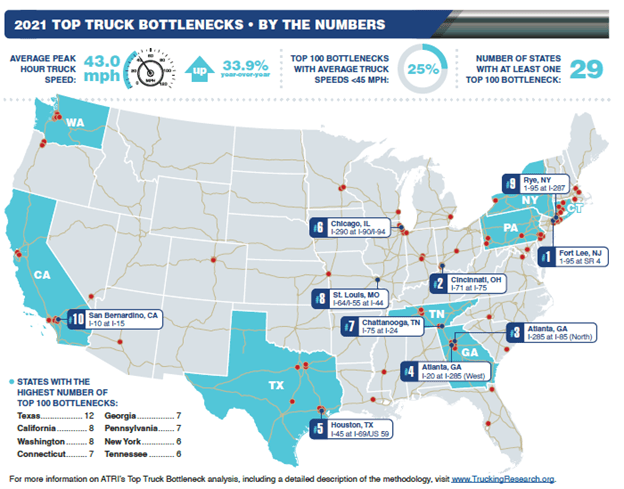
Bottlenecks cost the U.S. economy more than $42 billion in 2019, according to Federal Highway Administration data, and freight shipments suffered almost 660 million hours of delay on the nation’s roadways. Trucks experienced over 27 million days of delays with 1/3 occurring on interstates.

The American Transportation Research Institute (ATRI) has recently issued a report detailing the top 100 traffic bottlenecks in the U.S. based on GPS data from more than one million trucks at 300 specific locations. Figure 8.1 of your Heizer/Render/Munson textbook points out that one of the important site location factors is “air, rail, highway, and waterway systems” and Chapter 11 notes that “the vast majority of manufactured goods moves by truck” –which is 73% of the value of the freight. This makes the information in the ATRI report one of the critical factors when selecting a location and/or trying to reduce costs in the supply chain. The figure below shows the top 10 congestion sites in the report.

Of course, COVID has had a major effect on congestion. One study indicated that in February 2020 congestion increased due to panic-buying consumer demand. Another study showed that in March 2020 congestion decreased due to less volume of traffic on the road. On the other hand, congestion increased in 2020 because more road construction projects were able to begin and move at a faster pace due to the reduction in travel. Overall, truck speed was up 34% in 2020 compared to 2019.

Classroom Discussion Questions

  1. Amazon has chosen to locate its HQ2 on the East Coast where there is a great deal of congestion. What reasons aside from transportation would lead Amazon to make this regional decision?
  2. Does proximity to markets explain some of the reasons for the bottlenecks?


Guest Post: Size and Natural Hazard Risk

Prof. Howard Weiss shares his insights with us monthly. Dr. Weiss recently retired from Temple U.

Scrub Daddy Inc., the maker of smiley-faced scouring pads featured on ABC’s Shark Tank reality show, is moving into a recently acquired South Jersey office-and warehouse building from its current home in Delaware County.

As mentioned in Figure 8.1 of your Heizer/Render/Munson textbook, one location factor is the size of the site. Size has become more important than it previously was because employees need to maintain a safe distance from each other due to COVID-19. In the case of Scrub Daddy, the size of their new facility is large enough to accommodate the 65 employees who currently are located in three facilities in a different suburb of Philadelphia.

Another factor that may, in general, be important is risk assessment based on natural hazards as opposed to the political risks listed in the figure.  The Federal Emergency Management Agency (FEMA) has prepared the National Risk Index (NRI) which identifies risks by county based on the following 18 natural hazards: Avalanche, Coastal Flooding, Cold Wave, Drought, Earthquake, Hail, Heat Wave, Hurricane, Ice Storm, Landslide, Lightning, Riverine Flooding, Strong Wind, Tornado, Tsunami, Volcanic Activity, Wildfire, and Winter Weather

FEMA (https://www.fema.gov/flood-maps/products-tools/national-risk-index) essentially performed a Factor Rating on these 18 factors for each county in the U.S. For each factor, the county scores were scaled from 0 to 100. FEMA assigned equal weights to each of the 18 factors and simply computed the sum of the 18 hazard scores for each county.

Classroom Discussion Questions

  1. What are the advantages and disadvantages of consolidating all of your employees in one location?
  2. Does using equal weights on the 18 factors make sense for individual organizations?

OM in the News: McDonald’s Un-Location Decision

Fewer people want to eat their meals at Walmart, writes The Wall Street Journal (April 10-11, 2021).  For years Walmart and large restaurant chains like McDonald’s enjoyed a mutually beneficial relationship. The retailer delivered a steady stream of diners, and the eateries provided rental profits and a reason for shoppers to stick around stores. Walmart and McDonald’s first started working together around 1994. At one time, Walmart allowed McDonald’s to be the exclusive restaurant when it was present in a store. 

But those bonds have frayed as more shopping goes online and fast-food restaurants depend more on drive-through windows for sales, a feature Walmart locations don’t have. The pandemic has made indoor dining unappealing—or prohibited—for many shoppers, accelerating the split.

mcdonald's

So McDonald’s is closing hundreds of restaurants located in the huge retailer’s stores, the last vestiges of a 30-year-old experiment between the companies. (At its peak, there were 1,000 McDonald’s restaurants inside Walmarts). The closures could pose a challenge for Walmart, which has long counted on revenue from restaurants leasing space inside its stores. That is different from some competitors such as Costco, which runs its own restaurant space selling inexpensive pizza and hotdogs. Retailers hope food service inside store walls draws shoppers to linger longer or give workers a place to eat while taking a break.

McDonald’s locations inside Walmart stores are generally less profitable than stand-alone restaurants, in part because they lack a drive-through, the main source of McDonald’s sales. And customers at times loaded up on refills and condiments, diluting margins. Even before the pandemic, Walmart shoppers increasingly preferred to shop and leave or buy online. Around a third of restaurant sales inside stores come from Walmart employees.

To compensate, Walmart plans to open more Domino’s, Taco Bell, Ben’s Soft Pretzels, and Ghost Kitchens Brands locations to fill the space.

Classroom discussion questions:

  1. Why is McDonald’s un-locating?
  2. Are there any downsides to replacing McDonald’s with chains like Domino’s or Pizza Hut?