OM in the News: Modular Construction in New York City

Factory workers installing walls in Pennsylvania

A vacant lot in Manhattan is littered with rubble and concrete pilings. But this month, writes The New York Times (March 10, 2013), this 50-foot-wide sand pit will be transformed into a 7-story apartment building, with finished bathrooms, maple cabinetry and 10 terraces. This example of fixed position layout (see Chapter 9) is the result of modular, or prefabricated, construction. The technique means a building is manufactured piecemeal on a factory assembly line, trucked to the construction site and erected much the way Legos are. The trend toward modular does pose issues, particularly for NYC’s powerful construction unions as it means exporting some construction jobs to factories outside NY.

The modules, which have steel and concrete frames, are being trucked four to five at a time to the building site from their Pennsylvania factory. On each of the following mornings for about four weeks, an enormous crane will stack the modules. Workers will then “zip” them up, connecting one to the next, and to the building’s plumbing and electrical systems.

Completed 7-story apartment house

The project is expected to take 9 months from start to finish, compared with 16 to 18 months if construction had been done on-site. “Because it takes half the time,” says the builder, “we can rent out the units and generate income much quicker, and the carrying costs are lower.” Because modular units are built on an assembly line — which is a quarter-mile in length at the factory — there are constraints, including having to choose the paint colors, finishes, appliances and every other detail upfront. But with indoor construction, there are no delays or damages to the material from inclement weather. Modular construction provides sustainability benefits, too. “We can recycle everything, all of the packaging materials, the gypsum, every piece of steel,”  says a modular builder, “because none of our products are affected by the elements.”

Discussion questions:

1. What are the advantages of fixed position layout in building construction?

2. What are the disadvantages?

OM in the News: Hotels Layout a New Lobby Look

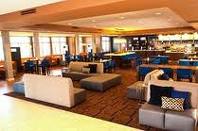
As Jay and I were sitting in the lobby of the Marriott hotel on Michigan Ave. (in downtown Chicago), a few days ago at the POMS meeting, we were amazed at the crowd that seemed to be in the massive space all hours of the day. People were in mini meetings, they were watching six huge TV screens, they were drinking coffee, eating, or simply typing away at their laptops. It seems the new layout of hotel lobbies is intended to make them a place for both guests and locals to lounge and feel like they are in a living room or on the deck of an ocean liner.

Hoteliers, according to The Wall Street Journal (April 19, 2012), want a lobby that is abuzz with locals  and out-of-town guests doing business or kicking back.  Consumers, it turns out,  are willing to pay a premium to stay at such a property. Beyond the buzz, mobile workers find there’s more leg room in hotel lobbies than in coffee shops. In some lobbies, it’s possible to order food and drink from the roaming wait staff. Freelancers have taken to hotel lobbies, instead of Starbucks, and hotels are courting them with long tables and lots of outlets. When Ted Copeland, for example,  comes in for his coffee at Chicago’s Public Hotel (shown in the photo), the barista has his order  ready. Then he sets up his laptop and lingers for a few hours over the caffeine and free Wi-Fi.

A crowded hotel lobby creates an upbeat, buzz-worthy atmosphere, which over time is thought to lead to higher occupancy. “If you have an active lobby, from a customer standpoint, it does reinforce the idea that the hotel is successful and a good hotel,” says an industry consultant. Many hotels say even overnight guests, especially those under 40, are more comfortable working in a public lobby than upstairs in their rooms.

Discussion questions:

1. Why is layout so important in this industry?

2. How has Starbucks taken advantage of the lobby trend?

OM in the News: Office Layout as an OM Strategy

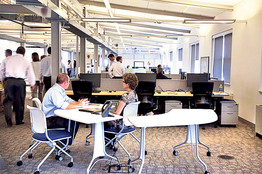
The Wall Street Journal (Feb.29, 2012) writes that “companies looking for cost savings are increasingly packing more employees into less space.” This Chapter 9 topic of office layout reflects a trend causing high commercial vacancy rates in a slowly recovering economy. Panasonic, for example, is moving from a 575,000 square foot campus in New Jersey to a 280,000 sq. ft. one nearby. This comes without reducing headcount, but rather reconfiguring its offices. The General Services Administration (GSA) is building a new 800,000 sq.ft. DC headquarters that will hold 6,000 employees. Its current building houses just 2,400 employees in 700,000 sq. ft.

It turns out that with workstations shrinking and private offices disappearing (replaced by more cubicles with low walls), and with more employees working remotely, employers have been gradually taking up less space for decades. Firms today take about 200 sq.ft. on average per employee, down 20% from a decade ago. And “the amount of space is continuing to shrink,” according to an industry expert.

Landlords of top space are particularly concerned about law firms, which for decades devoted large swaths of their offices to filing cabinets and libraries, as well as desks for support staff. But lawyers need fewer assistants, and technology is shrinking, or making obsolete, the need for paper storage. San Diego law firm Robbins Geller Rudman & Dowd just contracted its space by 20%, to 114,000 sq.ft.,while adding more lawyers.

Discussion questions:

1. Is there a similar trend to reduce operations space in manufacturing?

2. What other benefits accrue from shrinking office space per employee?

Video Tip: Delivering Fast Food and Groceries in Asia

 I was about to blog about a video of how the Home Plus  Korean supermarket chain has extended its “storefronts” into that country’s subway system. It’s a great 2.5-minute clip that your students will enjoy and which will lead to class discussion about layout, location, and logistics. As  the #2 food chain in Korea,  Home Plus wanted to catch up in sales with E-Mart, but without adding more stores. The virtual  stores  on the subway platform allow customers waiting for trains to scan items with their smart phones. The products are delivered to their homes shortly after the customers  arrive themselves.

But then yesterday’s Wall Street Journal (Dec.13, 2011) followed with a story along a similar vein.  Titled “Asia Delivers For McDonald’s”, the Journal reports that in cities from Beijing to Seoul, McDonald’s and KFC have set up armies of motorbike delivery drivers carrying specially designed boxes delivering Big Macs and buckets of chicken wings. More than 1/2 of KFC’s 3,500 restaurants in China offer delivery, sometimes in just 15 minutes (with a goal of under 30 min.) for orders placed either on-line or by phone.  And more than 2,000 new KFCs will be added in China in the next decade with the service. “We will probably stop building call centers as more people buy online”, says KFC’s CFO.

“If you can’t come to us, we’ll come to you”  is  McDonald’s slogan in Asia, says the firm’s regional president. Equipping its kitchens to handle  delivery involves laying out an area for assembly. Orders are packed in battery-powered induction heating boxes and insulated coolers that both fit on the back of the yellow and red scooters. The flat delivery fee is about $1.

Discussion questions:

1. Why did the online supermarket delivery system (eg., Webvan) did not succeed in the US?

2. Why do we have more drive-throughs  in the US?

OM in the News: Toyota’s Assembly Line Advances

Today’s Wall Street Journal (Nov.29,2011) features the pressures facing Toyota–overcapacity, weak demand, an exchange rate for the yen that makes Japanese-made cars expensive, quality problems that forced the recall of 10 million vehicles, and the supply chain issues caused by the March earthquake and tsunami. Competitors like Honda and Nissan are moving more manufacturing overseas, to plants closer to customers. But Toyota, long a proponent of corporate social responsibility to protect Japanese jobs, has also pledged to build at least 3 million cars annually in Japan, with 1/2 for export. So the company, which wrote the book in the 1960’s on lean manufacturing and JIT, is looking for new ways to wring out efficiencies from its production systems.

Toyota sees its first new plant in Japan in 18 years as the answer. Here is why: The Miyagi factory is designed for advanced low-volume, hyperefficient production, with 1/2 the workers and 1/2 the square footage of Toyota’s 16 other plants. Inside, half-built Corollas and Yaris sit side-by-side, rather than bumper-to-bumper, shrinking the assembly line by 35% and requiring fewer steps by workers. Instead of car chassis dangling from overhead conveyor belts, they are perched on raised platforms. This is 50% cheaper, and also reduces cooling costs by 40% because of lower ceilings. Finally, the assembly line uses quiet friction rollers to move the cars along. The rollers use fewer moving parts than typical chain-pulled conveyor belts.

This is a timely article to share with your class when you discuss assembly line layout in Chapter 9. And if you show the Wheeled Coach layout video for this chapter, the 2 assembly lines make for a good comparison.

Discussion questions:

1. How can Toyota’s new layout help improve the challenges facing the company?

2. Why are other Japanese auto manufacturers moving production to the US?

OM in the News: That’s One Gigantic Shoe Warehouse

One of the largest warehouses in the US is about to open its doors in a new 1.82-million-sq. ft. building near the Port of Los Angeles. Skechers USA, Inc., the nation’s no.2 footware company chose the area because,  in the world of international trade, Southern California remains the hub of choice. The Los Angeles Times (July 1, 2011) points out that the LA/Long Beach  Port  is the highest rated cargo movement region in the US in terms of container counts, rail connections, and infrastructure. Skechers needs the space to handle all the containers of shoes made in China by its contract manufacturers (the firm keeps 300 staff there just to stay on top of the contractors).

How big is the new $1/4 billion distribution center? First, it takes 1/2 minute to drive from one end to another at 60 mph. It’s 2,900 feet long and 700 feet wide, enough to hold 40 football fields. It’s the size of 17 Wal-Marts. There are 270 truck bays. But more importantly, it will replace 6 smaller warehouses. In the old system, workers had to handle shoes 3 times as they moved from building to building, adding costs, including the wages of truck drivers. “Now”, says the COO, “no one will have to touch it to do the same amount of work”.  Instead of  “7,000 pairs of shoes an hour, with the new warehouse, we’re expecting to be able to move 18,000-20,000 pairs of shoes every hour”. In effect, the move allows Skechers to get out of the trucking business.

At the LEEDS-certified warehouse, conveyor belts  which are programmed and pressure sensitive will move the shoes and prevent product pile up, which happens with traditional belts. Storage racks are operated by robots that pick up the boxes and bring them to the desired locations.

Discussion questions:

1. What are the advantages and disadvantages of such a massive distribution center?

2. Why is proximity to West Coast ports become important to logistics?

OM in the News: The New Hotel Layout

We open Chapter 9, Layout Strategies, with the Global Profile on how McDonald’s around the globe are starting to look more like coffee shops than burger joints. According to The Wall Street Journal (June 10, 2011), hotel lobbies are being redesigned en mass to look like Starbucks outlets as well.  Hilton’s Garden Inn chain remodeling plan, for example, includes what employees call a “Starbuckian area” with communal seating  for the laptop set.

Likewise, Intercontinental’s Holiday Inn  chain is opening a new lobby concept called the “social hub”, with built-in TVs, high tables for laptop plug-in, and an area for food and coffee. Marriott is refitting 100’s of lobbies with touch screens so customers can check weather and flight information. More than 300 Courtyard’s have lobby bistros, with a full breakfast and other food options. And Hyatt lobbies now have a central counter where guest can order drinks, coffee, or food. The same employees who check guests in can even serve the lattes or burgers.

Research shows that younger guests would rather spend time in lobbies than in their rooms. “They want to be alone, but not lonely”, according to a Hilton VP. The new layouts represent a way for hotels, hard hit during the recession, to boost  revenues without taking the risk of raising room rates.

Discussion questions:

1. Why are hotels renovating lobbies instead of rooms?

2. What are the strategic issues of hotel layout?

Good OM Reading: Taco Bell and the Golden Age of Drive-Thru

If there was one article you could ask your students to read at the beginning of the OM semester, it would be this lead piece in Businessweek (May 9,2011). The theme is that OM innovations at fast food restaurants like Taco Bell rival those at any factory in the world. Written from the view of the drive-thru window (which generates about 70% of fast food sales), the article lets you overview your course with issues of productivity (Ch.1), technology and process design in services (Ch.7), layout (Ch.9), and time & motion studies (Ch.10). The story also comes with a 1-1/2 minute video which the students will enjoy as well.

Here is a quote from the 5-page reading: “Go into the kitchen of a Taco Bell today, and you’ll find a strong counter argument to any notion that the US has lost its manufacturing edge. Every Taco Bell, McDonald’s, Wendy’s, and Burger King is a little factory, with a manager who overseas 3 dozen workers, devices schedules and shifts, keeps track of inventory and the supply chain, supervises an assembly line churning out a quality-controlled, high-volume product, and takes in revenue of $1 million to $3 million a year, all with customers who show up at the front end of the factory at all hours of the day to buy the product”.

 The firm’s  CEO concludes, “At Taco Bell today I’ve got 6,000 factories, many of them running 24 hours a day”.
Adds a former Wendy’s VP for OM, “The most advanced operational thinking in the world is going on in the back” of a fast food restaurant. Wendy’s is rated as the fastest brand (an amazing 134 seconds per drive-thru vehicle), but Taco Bell comes out 1st ranked overall with an average time of 164 seconds and a 93.1% accuracy rate.

This article describes the restaurant layout (the topic of our Global Company Profile in Ch.9), new technologies in the industry, bottlenecks, staffing issues, and much more.  It is a perfect lead-in to the exciting topic we teach.

Video Tip: Layout of the New Arnold Palmer Hospital

Jay and I  have created two videos to accompany Ch.9 (Layout Strategies) : the first an assembly line analysis at Wheeled Coach (the ambulance manufacturer) and the second the design of a radical new building  for the Arnold Palmer Hospital.  The hospital layout was really exciting because we became involved in the project and filmed it from start to finish.

Instead of the traditional “racetrack” design (long hallways with a central nursing station on each floor), when the hospital  added the  new building  a circular “pod” system was designed. The whole idea was to cut down the walking time of the hospital’s most precious scarce resource: nurses. The average nurse (about 45 years old) was hiking 2.7 miles a day up and down the hallways to the central station.

The layout design process lasted over a year. Over  1,000 meetings of doctors, nurses, and patients turned into drawings and then into “test” layouts. The hospital rented a warehouse a mile away and created full-sized mockups of every type of room. When we toured, we were encouraged to comment on every aspect of the layout, from placement of electrical outlets, to pictures on the walls, to Murphy beds for guests, to bathrooms.

The result was  a roundish building with  central nursing pods for each cluster of 34 rooms (this is shown in Figure 9.22 in the book). What a change in walking time for nurses: a 20% drop with the new layout!

Nothing is perfect, though. Despite all the thoughtful planning, analysis, and mockups, the last time I visited the new building I found nurses still unhappy about the “local station” pods. They  had to go back and forth to the “central station” too frequently because everything needed was not at the local pods near the patient rooms. Layout is indeed part art, part science.

OM in the News: Layout and the Shrinking Office

Office layout may not be the most exciting topic we teach in Chapter 9, but  an article in The  New York Times (Jan.19,2011) will definitely catch your students’ attention. Titled “Office Work Space is Shrinking”, students will discover that their future office may be a lot smaller than they anticipated, but that’s not all bad.  As employees become more mobile and less tied to their desks, the work space per employee nationwide (across all industries) has dropped from 400 sq. ft. in 1985 to 250 sq. ft. today. And it’s heading towards 150 sq. ft. within 10 years.

“A lot of thinking about the office has changed”, says the president of Steelcase, which is the leading office furniture maker. “The work setting was a reflection of your status.  A job focuses more on collaboration  than on the individual now”.

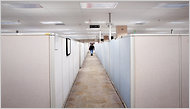
Intel, featured in the Times article, was known for decades for its endless rows of gray cubicles, low ceilings, and flourescent lighting. Intel was never one of those tech companies to offer beanbag chairs, designer desks, or pinball machines. But in the last 2 years, the company has completed a major relayout of over one million sq. ft. of office space. Gray walls are now yellow, purple, and white,  cubicle walls are low enough to see  other employees, and lounges have been equipped with flat-screen TVs, comfy chairs, and sleek kitchens. The whole idea was to get people to work more in groups, rather than be isolated at their desks.

This also saves money. With less space needed per person, one newly layed-out floor at Intel holds 1,000 employees, up from 600. In some departments where employees are on the road a lot, two people may be assigned to one desk. Even tradition-bound firms in accounting and banking are embracing the open-floor layouts. The thinking is that downsizing makes people interact more and become more productive.

Discussion questions:

1. What are the plusses and minuses of the new office layout concept.?

2. Which system do students prefer–private offices(or cubicles) vs. open floor plans?

OM in the News: Product and Layout Changes Drive McDonald’s

We open Chapter 9 (Layout Strategies) with the story of  the 7 strategic changes at McDonald’s since 1950. All  but one have been major layout redesigns (eg., indoor seating, drive thru, play areas, self-service kiosks, etc.). Adding breakfast foods to the menu (in the 80’s) was the one product change–until now. The front page article in The Wall Street Journal (Dec.27,2010) details two brand new strategies–the 1st a product decision and the 2nd yet another layout change.

Under pressure from market-share competitors of all types–from 7-Eleven and Starbucks to smoothie outlets and gas stations– the 14,000 US McDonald’s have broadened their fare. As of now, there are  fruit smoothies, oatmeal, carmel-mocha drinks, flatbread sandwiches, and “garden” snack wraps. This new product development strategy (Ch.5) has created so many choices that the company has been running ads reminding us it still sells Big Macs.

Using manufacturing technology, McDonald’s has made many new items from existing items’ ingredients. Chicken wraps use Chicken Selects’ meat and breakfast burrito tortillas. This simplifies preparation and lowers costs.

But new layout costs have  blunted franchisee enthusiasm. The food assembly line (see Figure 9.12 in the text) had to be changed to make wraps. And an even bigger modification was the addition of the $100,000 McCafe drink stations– one of the most expensive changes in years. (The corporation picks up $30,000 of that cost). Stores had to be redesigned to make room for space next to the pick-up window to accommodate the 4 pieces of drink equipment. Some franchisees balked at the price tag and low drink sales volumes, claiming “we are not even paying for the electricity to run the machines”.

Discussion questions:

1. Why did McDonald’s make these two strategic changes?

2. Ask your students to rank the importance of the  9 changes, referring to the Global Profile in Ch.9.

3. How has the average McDonald’s  changed in the past decades? Are all of the layout strategies still in place?

OM in the News: Layout and Hiring Tales at Uni-Solar

 We are aware of the dramatic impact China’s new solar production push has had on this fledgling US industry. (See my blog on Oct,19,2010) . Selling prices have dropped 30-40% in the past 2 years due the Chinese competition.

The Wall Street Journal (Dec. 1, 2010) tells the story of Greenville, Michigan’s loss of 4,000 jobs overnight in 2006 when Electrolux shut its refrigerator factory. When Uni-Solar broke ground on the 1st two of 6 giant new solar factories, the town of 8,000 saw the sun about to shine again. But quickly shrivelling in sales and unprofitable, Uni-Solar capped at only 400 employees and is already looking to move production abroad to India. 

Now as to why I share this story as a layout (Ch.9) topic:  the twin solar plants (each more than 288,000 sq.ft.–the size of 5 football fields) sit side-by-side, part of building plenty of capacity for growth. But shortly after the plants were built, managers realized they could have instead doubled capacityby simply attaching  a small wing on the side of a plant and  reconfiguring  the floor plans to maximize the use of long rows of automated machines”. A very interesting quote!

The 2nd half of the tale you may want to share with students is the changing skill set needed (Ch.10) from the time the old Electrolux plant opened 28 years ago. Donna Cooper, 51, tells of her start in the old factory: “I had never had a job interview”. The screening process consisted of reading an eye chart and showing she could touch her toes. For Uni-Solar she had to go back to school at a community college, then through a terrifying series of  job interviews, some 3-on-1. At $15/hour, she makes less than her old job paid. “High wages for unskilled workers is a thing of the past”, adds Cooper. This points to a structural change in our economy.

Discussion questions:

1. How common is the Greenville story?

2. What caused the sudden changes in the solar panel industry when everyone seeks “green” energy?

3. Discuss the new skill sets needed in manufacturing.

OM in the News: The Rise of the (Orange) Warehouse Robot

If you remember back a decade ago, the e-grocery firm Webvan outfitted warehouses with 4.5 mile long mazes of conveyor belts and carousels meant to sort, box, and deliver groceries. The idea and company was a bust, going belly up in 2001. But its founder, Mick Mountz, decided  that what was missing was robots. So in 2003, he founded Kiva Systems to provide warehouses so automated that any e-commerce firm could compete with Amazon. “Now you can get  Amazon in a bottle”, says Mountz. “Everyone can have what Amazon has”.

According to this week’s Businessweek (Nov.10,2010),Kiva’s technology provides the backbone of Diapers.com, Zappos.com, and a dozen other retailers. Its squat orange robots scurry around warehouses and bring shelves of clothes, car parts, electronics, or whatever the product, to packing stations. There, humans pack and ship. The cheapest system ($1 million), comes with 30 robots and 2 packing stations. Most systems cost $4-6 million.

 Kiva  integrates with existing inventory management software and is smart enough to continuously reorganize inventory based on order flow. If there is an uptick for one SKU, the robots place that item closer to workers.

Here is an entertaining 4 minute video of the robots at work.

Discussion questions:

1. Why did Webvan fail?

2. What did Kiva do to change warehouse management?

3. What other kinds of firms could benefit from this approach?

Video Tip: Assembly Lines at Wheeled Coach Ambulance

Wheeled Coach , the world’s largest manufacturer of ambulances, is the kind of firm you would want to take your students to tour to see how factories work. The firm uses 5 parallel assembly lines, fed by work cells, in which 5 ambulances move forward to the next work station each day. The work cells feed the main assembly lines on a JIT basis and perform all the pre-assembly work, such as painting, carpentry, upholstery, electrical wiring , etc.

When I show the video (7 min.) in class,  I simultaneously draw the 5 parallel lines, and label in each day’s work station as it is described.  You can discuss how the work cells are more efficient than having the tasks they perform done as part of the line.

 Some interesting aspects are not shown. First, these are real factory jobs, often dirty, non-union,  low paying, and all hot! (There is no A/C –or heat– in most factories here in Florida). So staffing is usually difficult (this recession being an exception, of course).

When we filmed, workers did 5 standard 8-hours shifts, starting  6:30am. When hiring was really tough, Wheeled Coach switched to four 10-hour days to make the job more attractive.  That made line balancing even more difficult, since each vehicle still needed to move forward once a day.  It took  a few years before the firm realized this only made matters worse, as quality fell dramatically in the last 2-3 hours of the shift. It returned to the 5 day week recently.

How else could efficiency improve? Last time I visited, the smaller “van conversion” models were moved to a different building on their own line, with 3 or 4 flowing off every day, since they are much simpler designs.

OM in the News: The (Gentler) Chicken-Killing Assembly Line

I was 7 years old when my Dad proudly took me to the Dubuque (Iowa) Packing Co. to show me what he did as a supervisor in the cow butchering department.  I won’t go into graphic detail as to how the animals were queued up to have their throats slit.  They were stunned first to make the process as pain free as possible.

Maybe you can see why yesterday’s New York Times (Oct.22,2010) front page headline, “New Way to Help Chickens Cross to the Other Side”, caught  my attention. It turns out that chicken producers, egged on by animal rights groups, are also switching to a system of killing their birds more humanely. The new process uses gas to render the chickens unconscious before they are hung by their feet to have their throats slit.

“When you grab a chicken, turn it upside down and put it on the line, its stress, stress, stress”, says one chicken producer.  The new system is not only meant to be kinder to the animals, but to plant workers as well. Dealing with struggling, flapping chickens–like dealing with bellowing cows who sense impending doom– makes meat processing plant jobs among the worst in the country.

This topic can fit in your OM course in 3 ways: (1) students have strong opinions about the issue of  how we slaughter animals (see the Ethical Dilemma box on pig production in Ch.7, Process Strategy); (2) when you discuss job satisfaction/motivation in Ch.10, it makes the point that not all jobs are easy to staff/manage; and (3) this is a classic case of an assembly  line, in Ch.9’s photo, at the end of the chapter.

Discussion questions:

1. Does killing chickens this way make you more comfortable with the  production process?

2. How are most chickens raised in preparation for slaughter?

3. Will it be easier to market a chicken as “killed stress-free”?