Teaching Tip: Explaining a Crossover Chart

The Wall Street Journal (March 23, 2021) tackles a question in many minds, namely, are EVs better for the environment than their gas-fueled counterparts? The researchers find that Teslas generate 65% more carbon dioxide emissions than the Toyotas (because of the metals needed for lithium-ion batteries) before they roll off the assembly lines. Then the tide starts to turn and we hit crossover at 20,600 miles driven. The RAV4 burns gas, refined from crude oil. The Tesla refills with electricity, which still burns coal but is getting cleaner each year with more renewables and natural gas. By 200,000 miles, the lifespan of a typical car, the emissions comparison is no longer close.

wsj article

How quickly the U.S. fleet of 280 million cars and pickups switches to EVs will have a huge impact on the country’s overall emissions. They currently contribute 17% of the U.S. total.

We think this graph may pique your students’ attention when you cover crossover charts in Chapter 7, Process Strategies, or when you discuss life cycle ownership in Example S2 in Supplement 5, Sustainabilty.

Classroom discussion questions:

  1. What assumptions are made in this analysis?
  2. When do you think EVs will take over for gas-powered vehicles in the U.S.?

OM in the News: Using Blockchain to Trace Your Clothes

Labor exploitation, like environmental degradation, is baked into fashion supply chains around the world, writes The Financial Times (March 13, 2021). One contributory factor underlying these issues is a lack of traceability: most brands work with so many layers of middlemen that they don’t actually know who is sewing their garments, much less who’s dyeing the fabric or picking the cotton. Researchers at the Transparency Index (which ranks clothing brands based on how much they know and disclose about their own supply chains), say companies have a “total lack of knowledge about where the components of their products are being made, and at what cost to people and the environment”.

Hence a more technological approach to trace apparel supply chains: block-chain. U.K.-based Fibretrace is offering something unprecedented: a way to store supply chain information within the very fibres of a garment.

Here’s how it works: a bioluminescent ceramic pigment as fine as dust is added to the fibres at the beginning of the supply chain (for cotton, it’s added in the ginning stage, when the cotton fibres are separated from their seeds; for synthetics, it’s added at the fibre production stage). Each batch of pigment is created according to a unique “recipe”, which acts almost like a serial code.

Then, at each stop in the supply chain — dyeing, weaving or sewing — the fibre is scanned and that facility then adds new information about what they did to the fibre to a secure blockchain. The pigment is so safe for humans that it’s classified as an “edible product.” The cost: roughly 3 cents for a T-shirt.

Although being able to track a supply chain doesn’t necessarily ensure it will be free of forced labor or manufacturing practices that are bad for the planet, traceability is a very useful first step.

Classroom discussion questions:

  1. Describe how blockchain works in general, and in this industry in particular. (Hint: see page 453 in your Heizer/Render/Munson text)
  2. What other tools do brand name garment firms have to control supply chain sourcing ethics?

.

OM in the News: The EV Revolution’s Missing Link

While EVs can be powered up at home, a fast-charging infrastructure is essential to getting beyond their current limited adoption, writes The Wall Street Journal (Feb. 27-28, 2021). But there are problems: too few charging stations, too much demand at the stations that are available, broken chargers, confusing payment systems, exorbitant electricity rates, and uncertainty over how long cars need to charge.

So far, only Tesla has offered a reassuring pitch about conveniently and reliably recharging on the go. Tesla built a nationwide fast-charging infrastructure for its vehicles even before its cars were widely adopted. But this technology doesn’t work on non-Tesla cars. While Tesla offered “open source” charging technology, using it meant signing off on terms the world’s biggest automakers were unwilling to accept. They instead collectively adopted a competing standard in the U.S., making their vehicles incompatible with Tesla’s. 

Drivers of EVs who wish to take them on road trips need to plan ahead carefully

Building the requisite charging infrastructure for the rest of the EV universe will be expensive. The U.S. government has proposed building a network of 500,000 chargers in 5 years, which would cost billions–and probably won’t be profitable. There are currently about 128,000 gas stations in the U.S., but only about 5,000 fast-charging stations. The result is a patchwork of stations is improving but still needs work.

Many stakeholders—from automakers and charging companies to utilities and government agencies—have an interest in a reliable national network of fast chargers. But if the sole source of income for these charging stations is from dispensing electricity, it doesn’t appear they’re a viable business. The average fast-charging station, charging market price for electricity, would take 20-25 years to pay off. Part of the problem is that when in use, a single fast-charging stall can draw the equivalent of a whole neighborhood’s electricity needs. So it can be very expensive to connect a station with up to a dozen individual chargers to the local electrical grid, and secure enough energy supply.

Classroom discussion questions:

  1. How does this problem relate to the Triple Bottom Line discussed in Supp. 5 of your Heizer/Render/Munson text? (see p. 195)
  2. What do you see as the future for EVs in the U.S.? Will it be different in Europe? Why?


OM in the News: Coke Goes 100% Recycled

Coca-Cola will soon begin selling sodas in completely recycled plastic in the U.S. for the first time, reports Industry Week (Feb. 9, 2021) . The initial items will be introduced this month in a group of states that includes California and Florida, for drinks such as Sprite, Coke, and Diet Coke in 13.2-ounce bottles made from 100% recycled plastic.

The company — which has been named a top plastic polluter by a leading non government organization (NGO) — will soon distribute additional soda and bottled water items from completely recycled packages. The U.S. is the 19th market worldwide where Coca-Cola now sells item entirely made of recycled packaging. The new measures amount to a 20% reduction in the company’s use of new plastic across North America compared to 2018. They will collectively reduce 10,000 metric tons of greenhouse gas emissions annually in the U.S. – the equivalent of taking 2,120 cars off the road for one year 

Concerns about plastic waste “continue to be top of mind for our consumers,” said Coke’s VP for sustainability, adding that the new steps are “a major milestone in a large and complex market. Introducing 100% recycled PET bottles is a big proof point of how recycling can help create a circular economy.” Coca-Cola has set a target of using at least 50% recycled content  in packaging by 2030.

In 2020, the group Break Free From Plastic placed Coca-Cola, along with PepsiCo and Nestle, as the world’s “top plastic polluters” for the third year in a row and called on the groups to end single-use plastic packaging worldwide.

Classroom discussion questions:

  1. How does this move relate to the Triple Bottom Line discussed in Supp. 5 of your text?
  2. Why is plastic waste a major issue?

OM in the News: The Case for the Electric Delivery Van

When you think of electric vehicles, you might think first of a Tesla. But a more financially rewarding use of the technology could be the vans that deliver your online shopping, reports The Wall Street Journal (Jan. 23, 2021).

Until recently, such unassuming vehicles occupied an easily ignored niche within the multitrillion-dollar automotive industry. That is changing fast. Rivian just raised $2.65 billion to fund its rollout of EVs, including a delivery vehicle for Amazon.com, which holds a stake in the startup. And GM just created a new company, BrightDrop, to focus on selling EVs to the delivery market. It expects to ship 500 units to its launch partner, FedEx, this year.

Electric delivery vans operated by DHL in Germany

Electric vans are at the confluence of two big trends. One is the rise of e-commerce at the expense of bricks-and-mortar retail, to which the pandemic has given a boost. The other trend is vehicle electrification. The likes of UPS, DHL and FedEx have all committed to reducing their carbon emissions and need electric delivery trucks to do it. So has Amazon, which ordered 100,000 electric vans from Rivian, the first of them due later this year.

Logistics operators and small contractors are focused on careful cost calculations, including over the lifetime of their vehicles, as we illustrate in Example S2 of Supplement 5 (Sustainability in the Supply Chain). That increases the attractions of EVs, which tend to have low running and maintenance expenses. One reason such calculations are possible is that vans don’t typically need the long driving ranges required of passenger cars. Vans are often driven around cities for predictable distances and can be recharged overnight at depots.

Another advantage of EVs, as Tesla has shown, is the facility with which software can be integrated into their overwhelmingly electronic systems. Unlike Tesla fans, van owners stand to benefit financially from this advantage. Logistics is a data business. The more tools for cost-efficient routing, driving, loading and the like that manufacturers can offer fleet owners, the more business they will attract. 

Classroom discussion questions:

  1. What are the advantages and disadvantages of electric vans?
  2. Why are retailers like Amazon investing in these vans?

OM in the News: Manufacturing’s Circular Economy

With a raging pandemic, disrupted supply chains, and a growing scarcity of raw materials, 2021 will present serious challenges to the global manufacturing industry. American Machinist (Jan. 6, 2021)  sees a renewed resolve among manufacturers to focus on sustainability and join the circular economy the strategic effort to eliminate waste and the maintain a continual use of resources. Manufacturers are approaching the circular economy model by rethinking how they design and produce their products with as little waste as possible, how they ship them, and how they approach the growing after-market repair and recycling market.

The circular economy is putting pressure on companies to reexamine their business processes; not only to improve quality and profitability, but because an efficient supply chain consumes less energy, uses fewer resources, and produces less waste. In short, gearing production toward sustainability is good business.

One example is DyeCoo, a textile company that has partnerships with Nike and IKEA, has developed a water-free process for dyeing. Using highly pressurized, recyclable carbon dioxide instead of water, the company can produce its product in half the time, using a fraction of the energy of traditional methods. Another example is Cambrian Innovation. This U.S. company treats wastewater contaminated by industrial processes, not only turning it into clean water, but even producing biogas that can be used to generate clean energy.

Manufacturers also will need to reengineer, and in some cases reimagine, their products. This means building for longevity in a sustainable business plan. If you are a lighting fixture manufacturer selling light as a service to an airport, you will want to produce lightbulbs to last long as possible, to maximize ‘uptime’ and revenue.

 Manufacturers are also taking serviceability into account in the design phase. Consider Dell and its Latitude laptop computers, which have been designed with recycling in mind. Using removable batteries, standardized fasteners, and by eliminating mercury and adhesives, Dell is able to produce laptops that are 97% recyclable.

Classroom discussion questions:

  1. How does Supp. 5 in your Heizer/Render/Munson OM text define “circular economy?”
  2. Provide examples of how product design teams can use alternative materials to improve sustainability.

OM in the News: The Fight for the Eco-Friendly Space

From recycled plastic credit cards to insect-based pet food and biodegradable shoes, sustainable and eco-friendly products have swept across consumer markets in recent years, writes Financial Times (Nov. 28, 2020). In the four years to 2019, only 16% of consumer goods products in the US were marketed for their sustainability, yet they accounted for more than half of the sector’s growth.

This proliferation of a huge range of green and eco-friendly goods has worried regulators and prompted questions about whether sustainability claims are always truthful or clear. “There is a lot of activity but some of it is very superficial and some of the product or packaging claims are actively misleading,” says a Unilever exec. The rise in sustainable goods was prompted both by consumers who want brands that have a strong purpose and by investors.

Worms are turned into a nutrition product for household pets at a facility in France as part of a growing trend for sustainable foodstuffs

At the same time, a generational shift has taken place. An NYU research study found that “the younger the household, the more likely they were to buy sustainability-marketed products.”

As sustainable products have moved into the mainstream, labels and credentials have proliferated. Canada’s Eco Label Index has counted more than 450 certification schemes. The EU said it was “concerned that this surge in demand for green products and services could incentivize some businesses to make misleading, vague or false claims.”

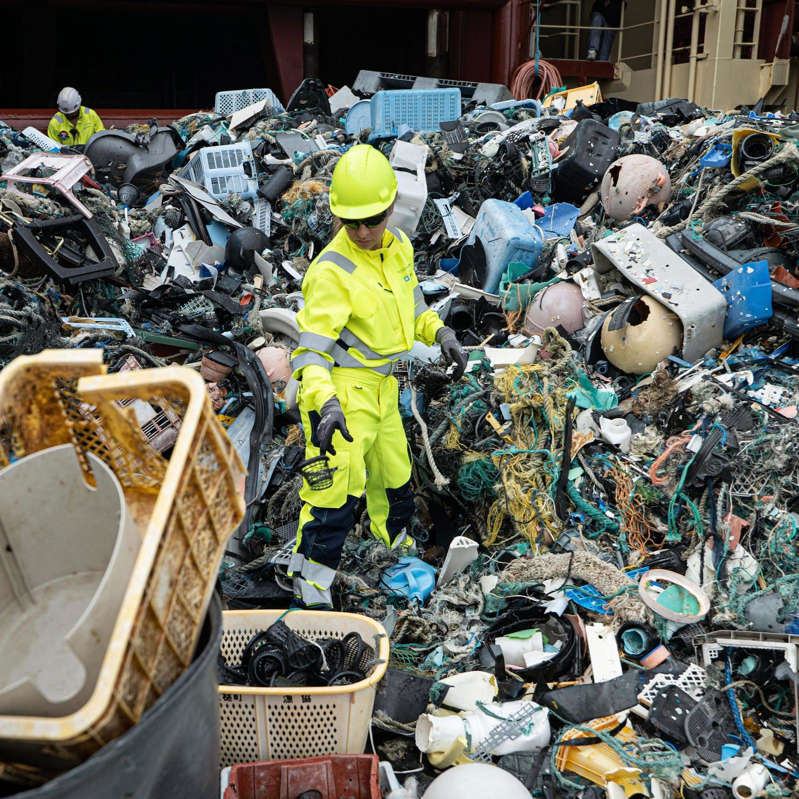
Some popular terms, such as “biodegradable,” lack widely accepted definitions, while others can be misleading. One example is packaging that is “recyclable” but requires specific local facilities that are not always available. A growing number of products claim to be made from recycled “ocean plastic,” even though no system exists to remove plastic waste from the sea at scale.

Classroom discussion questions:

  1. What OM functions are involved in meeting sustainability goals?
  2. What does the term “corporate social responsibility” mean in relation to this article? (Hint: see p. 194 in your Heizer/Render/Munson text)

OM in the News: J and J’s Circular Supply Chain for Packaging

Converting bottles to recycled plastic. Redesigning baby lotion bottles to ditch the pump. Swapping out the black Listerine cap for a clear resin one. Reducing the dimensions of cartons holding Carefree pads to use less paper. Johnson & Johnson’s goal is to use 100% recyclable, reusable or compostable plastic packaging, and recycled paper and pulp-based packaging by 2025, reports Supply Chain Dive (Oct. 13, 2020) .

The company will spend $800 million to make these packaging changes in an effort to convert its consumer health products packaging to sustainable options. To make a package fully recyclable, every part must be recyclable, including the label. (Some bottles use a label which can cause recycling issues). The packaging should also be compatible with the recycling process, likely a reason J&J is looking to remove the pump from some products. The pump needs to be discarded before recycling the bottles, and not all consumers do this.

J&J is planning to change Listerine’s black cap for a clear resin one, because clear plastic can be reprocessed into more forms than black plastic.

But sustainability isn’t the only consideration in packaging. The packaging has to be functional. There’s a greater issue if the packaging causes product damage in an effort to use more sustainable packaging materials. Plastic color can also change to generate higher recovery values.

Instantly reducing supply chain waste starts with using less material. Package optimization testing can help determine the least amount of material needed to effectively ship products. Looking at the carbon footprint is also part of the sustainability process. Usually, the less material used, the lower the carbon footprint.

These efforts all support the circular economy that we describe in Supp.5, “Sustainability in the Supply Chain” on pages 197-200.

Classroom discussion questions:

  1. Select three products and evaluate their packaging. How could it be more sustainable?
  2. How have hotels become more sustainable conscience?

OM in the News: The Secret to Affordable Electric Cars?

Melting down batteries for recycling is difficult and sometimes hazardous work.

The cost of batteries has long been the biggest obstacle to making electric cars affordable for the masses, reports The Wall Street Journal (Aug. 29-30, 2020). As a result, electric vehicles still carry a hefty $12,000 average price premium compared with gas engine cars.

Since 50% to 75% of the cost of a battery for the industry now lies with its raw material, Redwood Materials, in Carson City, Nevada, sees potential for recycling to lower costs. Almost every day old iPhones and other used personal electronics arrive by the truckload at Redwood, where workers crack them open, pull out their batteries and strip them for raw materials. The firm believes refuse holds the key to driving the electric car revolution forward—and making the vehicles affordable enough for everyone to own one. (Another source is the supply of used EV batteries, which is exploding. Half-a-million EVs are expected to be scrapped in 2025).

For most battery manufacturers, where to find all the nickel, cobalt and lithium needed to make the batteries that power Tesla’s cars and their growing list of rivals is the number one problem. Extracting those materials from nature, through mining and other processes, is costly and difficult, and production is lagging far behind expected demand.

Redwood Materials’ tack is to quietly build the biggest car battery-recycling operation in the U.S., betting that it can perfect a fast and efficient way of collecting and repurposing those materials to disrupt the centuries-old mining industry. “Forever, the entire market has been dictated by the commodity price of these metals,” said Redwood’s CEO. “It is work that is essential if the industry is going to continue to increase production of electric cars at the pace companies are planning.”

Classroom discussion questions:

  1. When federal subsidies end, will demand for EVs remain high?
  2. What are the advantages and disadvantages of recycling vs. mining for raw materials?

OM in the News: Sustainability Goes Mainstream

Expired yogurt. Cardboard cartons. Pallets and plastic jugs. Wilted lettuce. Steel drums. Is it ecologically sound policy to send multiple trucks to transport waste products for separate recycling and diversion, when one dump truck could haul it all away? This is just one question companies face when trying to improve sustainability and in some cases reach carbon neutrality, the topic of Supplement 5.

Companies are increasingly cognizant that consumers and investors are watching their actions to reduce emissions– and realize their pledges have other positive impacts, including financial ones. Instead of sending tons of material to landfill, companies are identifying their waste streams with economic value and sending those materials to recycling facilities, writes Supply Chain Dive (July 21, 2020). Firms can calculate the carbon footprint involved with waste and landfill and see if diversion would yield additional savings.

Consumer sentiment now makes waste reduction a priority. “It’s becoming more prevalent; 30-40 years ago, nobody cared,” said one industry exec. (We recommend showing our video case study: “Green Manufacturing and Sustainability at Frito-Lay” to make this point).

In the U.S., over 30 million tons of food goes to the landfill– about 75% of total food waste, comprising 22% of municipal solid waste (MSW) landfill. Almost 7.5 million tons of food waste is converted to energy through combustion of MSW, and 2.57 million tons is composted. Materials like cardboard and plastics have resale value, and businesses are relatively disciplined about recycling these, due to the economic incentives and sustainability goals. Metal has the highest impact in recycling, given its value. It takes 75% less energy to make a steel product with recycled steel versus with virgin steel, and 95% less energy to make aluminum cans with recycled aluminum.

Companies can calculate emissions using the EPA’s Waste Reduction Model, a reporting tool for baseline and ongoing greenhouse gas emissions.

Classroom discussion questions:

  1. What does the Triple Bottom Line mean?
  2. What forces during the pandemic are working against increased sustainability efforts?

OM in the News: Strained Supply Chains and Circularity


In a fast-moving, understaffed crisis, medical facilities produce lots of items that may not be easily recyclable.  Remanufacturing and circular economy experts are anticipating an increased need for recycling, writes Supply Chain Dive (June 10, 2020). Some are targeting the healthcare sector specifically while others think the coronavirus crisis highlights how essential recycling and reuse can be for other industries struggling to cope with ruined supply chains. All this upheaval could reveal how circularity may serve everyone better than pre-pandemic protocol did.

Stunted (or overwhelmed) supply chains partially explain why “reuse” has become integral to coping with this pandemic. “Anytime there’s a resource-constrained situation, it’s important to extend the lifespan of products,” says the U.S. Chamber of Commerce, an organization that works with businesses to help them pursue circular economy practices. For example, mask shortages prompted interest in sanitizing N95 masks with vaporized hydrogen peroxide.

There will be plenty of remanufacturing needs once the pandemic is over. Many ventilators made for desperate hospitals will get put in storage, for example, and someone will have to figure out how to keep them in good condition in case the machines need to get rolled out again.

Pressure comes as recycling access in the U.S. has deteriorated in certain ways, and the balance between reuse and disposal could shift in a post-pandemic world. Single-use items, like the stretchy plastic gloves that gum up recycling facilities, could boom when people are hyper-concerned about sanitation.

Reuse might be a future need in some industries — but others have to adopt its companion, recycling, even more quickly. Paper mills that produce packaging for General Mills, Pillsbury and other food suppliers still need raw materials to meet customer demand and higher grocery store sales. Residents are also moving forward with at-home construction projects, and regional suppliers of plastic or wood-composite lumber still need those supplies. Recycling fills those supply chain needs, and importantly, keeps paper mills and other manufacturing facilities open.

Classroom discussion questions:

  1. What is the “circular economy”? (Hint: See Supp. 5 of your Heizer/Render/Munson OM text)
  2. Why has recycling “deteriorated in certain ways”?


OM in the News: The Plastic Bag Controversy

The NY ban on plastic bags has forced customers to use bags of paper, cotton, or more durable plastics.

Reusable shopping bags are “petri dishes for bacteria and carriers of harmful pathogens,” read one warning from a plastics industry group. They are “virus-laden.” The group’s target?  Countless Americans increasingly using natural fiber bags instead of disposable plastic bags.

The plastic bag industry, battered by a wave of bans nationwide, is using the coronavirus crisis to try to block laws prohibiting single-use plastic, reports The New York Times (March 26, 2020). “We simply don’t want millions of Americans bringing germ-filled reusable bags into retail establishments putting the public and workers at risk,” said an industry campaign ad. The Plastics Industry Association went so far as to request the US government to declare that banning single-use plastics during a pandemic is a health threat.

The science around reusable bags and their potential to spread disease is contentious. One study found that reusable plastic bags can contain bacteria, and that users don’t wash reusable bags very often. A government study found that coronavirus can remain on plastics for up to 3 days.

What is clear, however, is that single-use plastic bans have become a growing threat for the plastics industry. Packaging  makes up 1/3 of end-use demand for plastic resins as a whole. Before the coronavirus outbreak, the nationwide move to ban plastic bags had reached California, Hawaii, New York, as well as cities like Boston, Boulder, Chicago, and Seattle. But now disposability, once a dirty word, has become a selling point as hygiene takes priority over sustainability. Because plastic is made from fossil fuels, plastic prices track oil prices — which have slumped. That has made recycling plastic less economical.

Ironically, the bag ban in California in 2016, which led to elimination of 40 million pounds of single-use plastic bags, led to a 12 million pound increase in larger trash-bag purchases.

Classroom discussion questions:

  1.  Make the case in support of single-use plastic bags.
  2.  Make the case against them.

OM in the News: The Fraught Future of Recycling

The American recycling industry is in crisis — and cities are on the front lines.

The economics undergirding the U.S. recycling system have fallen apart, writes Energy and the Environment (Feb. 15, 2020). Unable to absorb the extra cost, some cities are opting to kill recycling programs altogether — just as public concerns about climate change are ratcheting up. Why?  (1) China, the biggest buyer of U.S. recycled materials, has closed its doors. Before the ban, the U.S. was exporting around 70% of its waste to China. (2) Changing consumer behaviors have made the trash-sorting process more complex and expensive.

 A major Maryland recycling center area used to turn a healthy profit from processing recycled materials from a 50-mile radius. Now it’s having to pay vendors to truck material away. The Prince William County facility operates up to 22 hours a day to process about 550 tons of thrown out paper, plastic, aluminum and glass delivered there daily.

  • Despite the heavy machinery and increased automation involved, the process is still extremely dependent on humans.
  • On each shift, 28 “sorters” sift through the material as it rolls down a series of fast-moving conveyer belts. The workers spot and pull out non-recyclable trash from the stream so fast that they look like card dealers in a game of blackjack.
  • Contamination is a huge problem. People throw surprising things — Christmas trees, old carpet, shoes, diapers and even cinder blocks — into their recycling bins.


 About 60 other cities are struggling to make recycling work or have cancelled their programs. Others have stopped accepting glass, paper or plastics. (Baltimore County just admitted that it hasn’t recycled the glass its collected for the past 7 years). Some have seen massive increases in their costs. Omaha, Nebraska, received a single bid for recycling services for $4 million, twice the city’s budget. Milton, Massachusetts, experienced a 36% increase in recycling costs.

Classroom discussion questions:

  1. How is this a Triple Bottom Line issue? (See Supp. 5 of your Heizer/Render/Munson OM text).
  2. What can companies, government, and society do?

OM in the News: Your Foam Coffee Cup Is Fighting for Its Life

Dart’s single-use containers.

The Dart Container Corporation, which makes foam products, is a manufacturing behemoth and produced a fortune for the family behind it. Dart makes, by the millions, white foam cups, clamshells, coffee cup lids, and disposable forks and knives — the single-use containers that enable Americans to eat and drink on the go. It employs 15,000 people across 14 states. But now many of its products are being labeled as environmental blights contributing to the world’s plastic pollution problem, writes The New York Times (Feb. 11, 2020).

Cities and states are increasingly banning one of Dart’s signature products, foam food and beverage containers, which can harm fish and other marine life. Maine and Maryland banned polystyrene foam containers last year, and nearly 60 nations have enacted or are in the process of passing similar prohibitions. Environmental groups say polystyrene containers are difficult to recycle in any meaningful way. They believe the harm that plastic pollution can inflict on marine life is immediate. “There is overwhelming evidence that this material is seriously damaging the earth,” said a Maryland lawmaker.

But Dart is not backing down. After Maryland voted to ban foam, Dart shut down its warehouses in the state, displacing 90 workers and sending a signal to other locales. San Diego recently decided to suspend enforcement of its polystyrene ban in the face of a lawsuit by Dart. Even as the market for polystyrene shrinks, many environmental groups want to abolish foam entirely because if it ends up as litter, it can break down easily into small pieces, harming fish and animals that ingest it. For humans, plastic fibers have been found in everything from drinking water to table salt.

The same properties that can make foam an environmental problem also make it profitable to manufacture. The costs are low because foam is 95% air and can be made using relatively little raw plastic.

Classroom discussion questions:

  1. Relate this issue to the Triple Bottom Line, as discussed in Supplement 5 in your Heizer/Render/Munson text.
  2.  What is Dart’s position in terms of sustainability?

OM in the News: Hotel Chains Ditch Travel-Sized Toiletries

Accor Hotels is the latest global hotel chain to eliminate travel-sized toiletries from its rooms. The company, which owns 40 brands including Ibis, Novotel, the Fairmont and Mondrian, is removing individual tubes of shampoo, conditioner and bath gel from its 340,000 guest rooms. It’s part of Accor’s broader environmental campaign that includes getting rid of all single-use plastic items at its 5,000 properties.

Accor is replacing the plastic toiletries with either wall dispensers or glass, bulk-sized toiletries by the end of 2020. The chain is also replacing a number of common hotel items usually made from plastic, including keycards, laundry bags and cups, with materials made from “relevant alternatives.” More than 200 million single-use plastic items are used annually at Accor’s hotels. The changes are part of its effort that focuses on “reducing environmental impacts and strengthening efforts to combat plastic pollution of the world’s oceans and other natural environments.” Accor is joining a growing list of hotel chains have been making changes to benefit the environment.
Businesses are facing disruption from climate change and customers are increasingly demanding that products and services are environmentally friendly, reports CNN Business (Jan. 22, 2020). Last year Marriott said it was ditching personal toiletries from its more than 1 million guest rooms starting in 2020. The chain, which also owns Ritz-Carlton and W Hotels, said it expects to reduce its plastic disposal by 30% annually. IHG, which owns Kimpton Hotels and Crowne Plaza, is also in the process of replacing individual plastic toiletries with bulk-sized ones across its 843,000 rooms. So is Hilton, which has more than 950,000 rooms globally. That hotel chain also has a number of other environmental initiatives in place, including participating in the Clean the World soap program and improving energy efficiency.
Classroom discussion questions:
1.  What are other examples of product design improvements discussed in Supp. 5 of your Heizer/Render/Munson text?
2.  How will this movement help sustainability?