OM in the News: GE’s Engines and Additive Manufacturing

The GE90 is a family of turbofan engines built for the Boeing 777 long range wide-body aircraft

I don’t often share articles from American Machinist, but this one on General Electric’s development of a new generation of jet engines (April 15, 2015) struck close to home. My 2nd job out of college was at this very plant near Cincinnati, where I worked as a designer for the massive CF-6 engine, back in the early 1970s. (My 1st job was actually as an engineer at McDonnell Douglas, in St. Louis, on the design team for the DC-10–which used the CF-6).

Now, 45 years later, GE reports that its GE90 will be the first of its commercial jet engines to be manufactured with a housing component produced by additive manufacturing. The GE90, the world’s largest turbofan engine, was the first jet engine to incorporate composite fiber polymeric material on its front fan blades when it was introduced 20 years ago. Additive manufacturing is quickly gaining acceptance in jet engine production, for its design flexibility, material selection, and production cost advantages.

The term refers to various production methods, including stereolithography for polymer materials. GE is using laser-powered 3-D printers, 3-D “inking” and “painting” machines, and other advanced manufacturing tools, to make parts and products that were thought impossible to produce and which sometimes verge on art. It has also been in the forefront of companies adopting additive manufacturing for high-volume production. “Additive manufacturing has allowed GE engineers to quickly change the geometry through rapid prototyping and producing production parts, saving months of traditional cycle time without impacting capabilities,” says the GE program manager.

GE’s production rates for jet engines and components are setting new records for volumes: Its total backlog for jet engines exceeds 15,000 units, representing more than $135 billion for equipment and services.

Classroom discussion questions:

1. What is additive manufacturing and why is it important to GE?

2. What is stereolithography?

OM in the News: A New Wave of Machines for Cutting and Carving

A Glowforge laser cutter at work on a wooden iPhone case. The computer-guided consumer device has a  $2,000 price
A Glowforge laser cutter at work on a wooden iPhone case. The computer-guided consumer device has a $2,000 price

The desk space next to PCs first welcomed paper printers and later made room for 3-D printers that could conjure any shape from spools of plastic. Now new devices, including laser cutters and computer-controlled milling machines, are coming out of industrial workshops and planting themselves on desktops, reports The New York Times (Feb. 16, 2015).

Laser cutters have been around for decades, used in industrial manufacturing applications to engrave or slice through almost any material you can think of, including steel, plastic and wood. The computer-controlled lasers in them make precision cuts that would be almost unimaginable by hand, except by highly skilled artisans. The machines have developed a strong following among jewelry makers, print makers and other artisans, many of whom have hung shingles out on craft sites like Etsy. Laser cutters are best suited to creating 2-D objects, though they can also be used to produce more intricate 3-D objects like lamps or sculpture by cutting flat pieces that are assembled later.

One start-up, the Other Machine Company in San Francisco, has created a device, the Othermill, that acts like a reverse 3-D printer. Rather than building up a 3-D object by creating layers of material, as a 3-D printer does, the Othermill uses spinning bits to cut away at blocks of, for example, wood, metal or plastic. The machine, which costs $2,199, weighs about 16 pounds, so it can be carted around in a car. Other Machine’s CEO said the company had sold the machine to chocolatiers who milled wax molds for their candies on the device. “There is no technological reason why everyday people don’t have access to manufacturing tools,” she said.

Classroom discussion questions:

1. Why is this tool important to the OM field?

2. How doe laser cutters differ from 3-D printers?

OM in the News: Alcoa Embraces Additive Manufacturing

Alcoa today can 3-D print the dies used to manufacture turbine parts

There’s a great deal of testing that goes into airplane parts to be sure they can handle the temperatures and stresses of aviation. Alcoa would know. The 125 year old metals producer makes parts for gas turbine engines used by Boeing and Airbus. The problem? All that testing takes time. Between tooling, development, and casting, it used to take Alcoa a year to manufacture one of the nickel-alloy parts that go into an engine, where it must withstand temperatures of up to 2,000˚F. Then, writes Fortune (Dec. 1, 2014), the company discovered additive manufacturing—better known as 3-D printing.

In past few years, the company has been using additive manufacturing to create the dies that shape engine parts. With additive manufacturing Alcoa cut the time by 50% and the cost by 25% required to develop the process and manufacture the part. “We’re really at the beginning of what I would call a second Industrial Revolution,” says Alcoa’s CEO. “You go from idea to product in no time. It’s almost like production at your fingertips.”

In the past, Alcoa built a die using a process called subtractive machining. It’s similar to sculpture: Start with a material—in this case, steel—then whittle it down into the shape you need. Ten to 30 weeks later, the company ended up with a custom die that it would then use to cast the needed engine part. Today, Alcoa pairs CAD with 3-D printing to construct the die from a computer file, layer by layer. A process that once took half a year is completed in 2-8 weeks, allowing the company to dramatically increase its output. Alcoa can now handle more parts orders—for commercial aircraft, business jets, regional jets, even helicopters—and ramp up to meet them faster.

Classroom discussion questions:

1. Why is 3-D printing so important to Alcoa?

2. What is the difference between additive and subtractive manufacturing?

OM in the News: 3-D Printing’s Promise–and Limits

3-D printing churns out 100 Square Helpers ( a plastic part that holds credit card reader in place on an iPhone) a day.

Manufacturers are finding that a revolutionary technology has its limits, writes The Wall Street Journal (June 2, 2014). According to enthusiasts, 3-D printing was supposed to rewrite the rules of how things get built. Forget building new factories, or outsourcing production to China. The compact devices would launch a manufacturing renaissance centered in people’s living rooms and garages. Some makers of 3-D printers don’t argue with the critiques. Devices like MakerBot’s are meant to help designers and engineers test ideas and speed the development of products, not necessarily replace large-scale manufacturing.

The crossover point at which point traditional manufacturing is more effective usually comes at 5,000 pieces. So if a company is making a mass-appeal product with a huge production run, such as a Barbie doll, it would probably stick with injection molding. With injection molding, companies must create a different mold for every different part they want to produce. And if the specifications for a part change, they must come up with a new mold for it. But with 3-D printing, there’s no mold—just a computer model of the part that can be updated at any time. What’s more, 3-D printing can easily handle complex designs and print an item with multiple parts all at once. With injection molding, parts often need to be manufactured separately and then assembled.

3-D printing is also becoming invaluable for military applications. Military hardware can have a working life of 30 years, so it’s far less expensive to 3-D print parts as needed than to keep the necessary tooling around for the entire life cycle of the item. For instance, workers assembling the $116 million Lockheed F-35 jet fighter use hundreds of 3-D printed tools to assemble the plane, with numerous 3-D parts in development.

Classroom discussion questions:

1. Will 3-D printers replace traditional manufacturing?

2. Explain how 3-D printing works.

OM in the News: 3-D Printing–or Additive Manufacturing?


A new way to turbocharge  turbine-making
A new way to turbocharge turbine-making

Engineering companies now prefer to talk about “additive manufacturing” rather than “3D printing,” writes The Economist (May 3, 2014). One reason is that printing is not quite the right word for some of the technologies given this label. Whereas hobbyist-scale 3D printers typically build a product by squirting out drops of plastic, a newer manufacturing technique called selective laser melting zaps successive layers of powder with a laser or ion beam, hardening only certain bits. Larger firms want to stress the “manufacturing” aspect: that technology has moved beyond the development labs and is now being used on the factory floor to make complex metal parts. In Siemen’s gas turbines, for example, elaborately shaped blade components are hard to design and costly to make. But Siemens is using additive manufacturing machines to cut the cost and the time needed to replace the blades on customers’ turbines when they break– eventually from 44 weeks down to 4.

For simpler mechanical parts, the approach allows designers to imagine shapes that would be impossible to create through older techniques, besides greatly speeding up prototyping—for turbine blades and similar parts, from 16-20 weeks to just 48 hours, Siemens says. Additive manufacturing cuts the cost of tooling and materials: a piece can have all of its holes incorporated into it, with great precision, as it is built up from powder, instead of needing to have them expensively drilled afterwards. Siemens hopes to cut the cost of some parts by perhaps 30%.  As it gets easier to make low-volume, specialized parts in-house, Siemens gains bargaining-power when it comes to outsourcing such parts to other firms.

Aircraft engines, subject to even higher standards of reliability than turbines, are another area in which the engineering giants have implemented additive manufacturing. GE is using it to make fuel nozzles for its next-generation Leap engines. GE says the nozzles will be 25% lighter and five times more durable than their predecessors—and since there are 20 or so in each engine, the weight savings are significant.

Classroom discussion questions:

1. Is there a difference between 3-D printing and additive manufacturing?

2. How will 3-D printers change the world of manufacturing?

OM in the News: Jay Leno–The Advanced Manufacturer of the 21st Century

jay lenoAlmost everyone knows Jay Leno, the comedian, host of NBC’s “Tonight Show” and avid classic-car and motorcycle collector. Far fewer know Jay Leno, the advanced manufacturer, writes The Wall Street Journal (June 11, 2013).

Leno houses his more than 200 cars and motorcycles in solar-powered warehouselike buildings near LA that span 110,000 sq. ft. In one of the structures is an expansive shop equipped with an impressive array of 21st-century machines, including a Stratasys industrial-grade 3-D printer, a NextEngine scanner, a Fadal computer-controlled mill and a (very pricey) KMT Hammerhead water jet cutter that can slice through steel. Along with a battery of more-traditional metal machining equipment, the tools allow Leno and his small crew to fabricate just about any auto part that has been produced in the past 100 years.

“The days of going to a junkyard and trying to find an auto part that says Packard or Franklin on it are over,” Leno says. “We can make almost anything we need right here in the shop ourselves.” For his 1906 Stanley Steamer, “We took the worn piece and copied it with a scanner that can measure about 50,000 points per second. That created a digital file or image of the part, which we can modify in the computer if there are imperfections or defects in the part being scanned. Then you feed that data into the 3-D printer and, presto, you have a mold that will allow you to cast a brand new part.”

For a modest investment by virtually any industrial measure, Leno has been able to extricate himself in a meaningful way from the globe’s vast network of producers, distributors and sellers. As he puts it, “We’ve sort of gone off the grid.” He agrees that the new tools will increasingly empower other individuals and entrepreneurial ventures to make increasingly sophisticated things themselves. “Manufacturing started out with craftsmen making stuff in small cottage industries. In many ways, I think we’re going to go back to that cottage-industry model.”

Discussion questions:

1. What are the OM implications of this story?

2. Why does Leno cast his own parts?

OM in the News (with Video Tip): 3-D Printing of Body Organs and Concrete Buildings?

It was just July 7 when we blogged about a 3-D printer creating a crescent wrench as strong as the original. That blog was  accompanied by a short video showing the process from start to finish–one certain to entertain your class. But today’s Wall Street Journal (July 16-17,2011) has raised the 3-D printing bar potential way beyond plumbing tools. With the title,  “How Close Are We to Printing New Organs?”, the Journal describes how a whole dummy kidney made of biocompatible materials and cells, was “printed” on stage at a TED talk a few months ago. With about 90% of patients needing a transplanted organ seeking a kidney, being able to create a “self-derived” kidney would save many lives and spare people the expense and pain of dialysis.

Such “printed” kidneys that would be able to work in the body (they are structural, but lack blood vessels) are still years away, but the rate of advance means the 1st autologous transplant may still happen this decade.  Already, synthetic windpipes, grown with a patient’s own cells, are being transplanted. (The windpipe of the patient is scanned, molded from a porous medical plastic, and infused with cells from the patient in a bioreactor).

And the concrete in our blog  title?  Here is a 3-minute video of a concrete structure being built by a grander and rougher  3-D printer at a British university. The architect makes the design, after which the printer extrudes concrete from a nozzle to build up the object, layer by layer. Printed concrete products are proving to be stronger than the cast ones. They also have the advantage of a hollow interior through which a building’s wires and pipes can be run. And the ducts in the concrete parts look uncannily like blood vessels needed in the 3-D kidneys.  Pretty exciting advances in OM technology!

Discussion questions:

1. Why is 3-D printing, which has been around for a decade, now becoming such an important tool?

2. Ask students to research the costs of 3-D printers.

Video Tip: Bringing 3-D Printing to Life in the Classroom

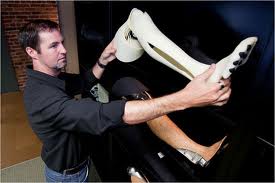
Computer Aided Design (CAD) and 3-D Printing may not be the most exciting topics in the Design of Goods and Services chapter (Ch.5), but after you show this 4-minute video clip, there will be a definite uptick in class discussion. Our photo of a 3-D  printer just can’t do justice to the amazing work going on in this rapidly advancing area of OM. So when Prof. Bruce Elwell showed me the video we link to here, I knew it’s something important to share in the blog.

I recommend that you bring a crescent wrench with you to class to bring home the product and its design. Pass it around while the video plays so your students can get a better feel for the tool. And if you would like more background on 3-D printers, take a look at the blog we did on the subject a few months ago. It was based on a major article in The Economist in Feb., 2011.

OM in the News: Exciting Developments in 3-D Printing

When we were writing the current edition of our OM text,  Jay spent  weeks just looking for any decent  photo of 3-D printers and 3-D object modeling (which we cover in Ch.5). Now The Economist (Feb.10,2011) has just published a lead article on how 3-D printing will transform manufacturing. This is a topic we think your students will find interesting.

Engineers and designers have been using 3-D printers for a decade, but mostly to make quick and cheap prototypes before tooling up in a factory to manufacture the real thing. Now 3-D printers are being used more than 20% of the time to actually manufacture the products. Its called “additive manufacturing” and is already being used to make medical implants, jewelry, dental crowns, custom boots, racing-car parts, solid-state batteries, and much more.

At AEDS (the Airbus people),  machines “print” a complex titanium landing gear bracket, the size of a shoe, which would normally be laboriously hewn from a solid block of metal. Their plan is much bigger though: as the 3-D printers grow, AEDS wants to print the whole wing of a jet.

Printing in 3-D may seem bizarre, but it is similar to clicking the print button on your inkjet printer to produce a letter. The difference is the “ink” in a 3-D printer is a material deposited in successive, thin layers until a solid object emerges. EADS, for example, starts with titanium powder. The printers spread a layer about .02 mm thick onto a tray where it is fused by lasers. Compared to a machined part, the printed one is 60% lighter, but just as strong! And a reduction of 1 kg in an airplane saves $3,000 in fuel per year.

The most exciting part of additive manufacturing is that it lowers the cost of entry into the business of making things. Some think the impact will be to manufacturing what the inkjet printer was to document printing.

Discussion questions:

1. Have each student find a different application of 3-D printing.

2. Why is this a potentially revolutionary technology?