OM in the News: Amazon Moves to Uber-Like Service for Deliveries

Amazon is moving to Uber-like delivery services

Aspiring delivery drivers take note: Amazon wants you,” writes the Chicago Tribune (Oct. 11, 2015). The e-commerce company has launched Amazon Flex, which will pay $18 to $25 an hour in exchange for delivering packages for Amazon with your car and smartphone. “Be your own boss: deliver when you want, as much as you want,” says its website. The service, available in Seattle, is coming soon to Chicago, NYC, Baltimore, Miami, Dallas, Austin, Indianapolis, Atlanta and Portland. Amazon Flex is the latest player in the “gig economy,” which also includes ride-booker Uber and on-demand delivery service Postmates.

Amazon Prime Now’s 2-hour delivery is free, and 1-hour delivery is $7.99. Shoppers can track the courier using the Amazon Prime Now smartphone app. “Amazon Flex will allow us to ramp quickly to meet customer demand, which is super helpful in a business like Prime Now where we see interesting peaks in volume,” says the firm’s spokesperson. “It could also be helpful during the holiday season, or during sales like Prime Day, where we experience sharp peaks in delivery volumes.” Amazon now uses carriers like UPS and the U.S. Postal Service.

Drivers can choose any available 2-, 4- or 8-hour blocks to work the same day. In the future, Amazon Flex said it might offer opportunities to deliver on bike or on foot. Deliveries can be picked up at a nearby location. “You’ll receive items to deliver in a local radius, based on length of the delivery block you signed up for,” says Amazon. Besides providing hourly pay, Amazon Flex is offering insurance to participants during the time they are delivering. The insurance includes $1 million in commercial automobile liability coverage, and $1 million in uninsured motorist coverage.

Classroom discussion questions:

  1. Why is Amazon revamping its logistics supply chain?
  2. Will students be attracted to such jobs?

Guest Post: Amazon vs. The New York Times

Our Guest Post today comes from Lawrence M. Miller, at http://www.ManagementMeditations.com

Last week the New York Times published an important article on Amazon and its very competitive, demanding culture. (Jay and Barry’s OM Blog summarized the issue on August 18th). I think the Times piece and the response to it from Jeff Bezos are important reading. Here is my take:

Amazon has grown in the highly competitive Internet and technology environment and is daily competing to bring new products and services to market. They have succeeded so far because of the intensity of their culture. They have been in the conquering “barbarian” stage of expansion and they are deliberately trying to hold on to that culture beyond the point at which it normally drifts into a more stable and comfortable state. Culturally, it is still a start up! And start-ups, fighting for their lives and to grab a piece of market territory that they can call their own, live at a level of intensity that makes many extremely uncomfortable. They are at war!

My guess is that Amazon is straddling the Barbarian and Builder/Explorer stage of my life cycle model. This is a good place to be in an external environment that is filled with rapidly emerging competitors and changing technologies. If you aren’t conquering you are probably about to be conquered!

Managing the culture of a company is like tuning a stringed instrument: over tighten and it makes a squealing sound; under tighten and it sounds dead. What is too much pressure for one person is not for another. If a company wants to grow, it needs to maintain that “creative dissatisfaction” that drives employees to innovate and perform at a high level. On the other hand, it wants a culture that does not drive away the most creative and capable. Amazon could not have succeeded as it has if its culture was driving away its most talented. It can’t be that bad!

NYT


OM in the News: Want an 80-Hour Workweek? Try Amazon!

A company picnic. Some fathers said they considered quitting because of pressure from bosses to spend less time with their families. “Nearly every person I worked with, I saw cry at their desk.” states a former marketing exec.

On Monday mornings in Seattle, recruits line up for an orientation intended to catapult them into Amazon’s singular way of working. They are told to forget the “poor habits” they learned at previous jobs. When they “hit the wall” from the unrelenting pace, there is only one solution: “Climb the wall.” To be the best Amazonians they can be, they should be guided by the leadership principles, 14 rules inscribed on laminated cards. At Amazon, workers are encouraged to tear apart one another’s ideas in meetings, toil long and late, and held to standards that the company boasts are “unreasonably high.” The internal phone directory instructs colleagues on how to send secret feedback to one another’s bosses.

Most of the newcomers filing in on Mondays will not be there in a few years.  Losers leave or are fired in annual cullings of the staff — “purposeful Darwinism,” says former HR director. Some workers who suffered from cancer, miscarriages and other personal crises said they had been evaluated unfairly rather than given time to recover. “When you’re not able to give your absolute all, 80 hours a week, they see it as a major weakness,” stated one former employee. “Amazon is in the vanguard of where technology wants to take the modern office: more nimble and more productive, but harsher and less forgiving,” writes The New York Times (Aug. 16, 2015).

 “You can work long, hard or smart, but at Amazon.com you can’t choose two out of three,” says Jeff Bezos. If Amazon becomes the country club like Microsoft, “We would die,” he adds. The firm retains new HQ workers in part by requiring them to repay a part of their signing bonus if they leave within a year, and a portion of their hefty relocation fees if they leave within 2 years. The median employee tenure is 1 year, among the briefest in the Fortune 500. Only 15% of employees have been at the company more than 5 years.

Classroom discussion questions:

  1. Would the Amazon model work in the typical firm?
  2. Why do employees seek out Amazon jobs?

OM in the News: Amazon’s Robots Get Ready for the Holidays

These orange robots are the fruits of Amazon's 2012 purchase of Kiva Systems for $775 million
These orange robots are the fruits of Amazon’s 2012 purchase of Kiva Systems for $775 million

“Amazon‘s robot army is finally falling into place,” writes The Wall Street Journal (Nov. 20, 2014). The Seattle online retailer has outfitted several U.S. warehouses with squat, orange, wheeled Kiva robots that move stocked shelves to workers, instead of having employees seek items amid long aisles of merchandise. At a 1.2-million-square-foot warehouse in Tracy, Calif., Amazon just replaced 4 floors of fixed shelving with the robots. Now, “pickers” at the facility stand in one place and wait for robots to bring 4-foot-by-6-foot shelving units to them, sparing them what amounted to as much as 20 miles a day of walking through the warehouse. Employees at robot-equipped warehouses are expected to pick and scan at least 300 items an hour, compared with 100 under the old system.

In May, Amazon said it planned to deploy 10,000 Kiva robots by year-end, up from 1,400 at the time. At the heart of the robot rollout is Amazon’s relentless drive to compete with the immediacy of shopping at brick-and-mortar retailers by improving the efficiency of its logistics. If Amazon can shrink the time it takes to sort and pack goods at its 80 U.S. warehouses, it can guarantee same-day or overnight delivery for more products to more customers. The robots could also help Amazon save $400 million to $900 million a year in fulfillment costs by reducing the number of times a product is “touched.” The robots may pare 20% to 40% from the average $3.50-to-$3.75 cost of sorting, picking and boxing an order.

This is our 4th blog about the Kiva robots at Amazon over the past few years. To read earlier posts and view a short video, just type Kiva into the search engine box on the right.

Classroom discussion questions:

1. Why did Amazon buy Kiva Systems?

2. What are the advantages and disadvantages of using robots in the fulfillment process.

OM in the News and Video Tip: Rise of the Robots


robots industrialThe exponential growth in the power of silicon chips, digital sensors and high-bandwidth communications improves robots just as it improves all sorts of other products,” writes The Economist’s special report (March 29-April 4, 2014).  Three other factors are also at play.

One is that robotics R&D is getting easier. New shared standards make good ideas easily portable from one robot platform to another. A robot like Rethink Robotics’s Baxter, with two arms and easy, intuitive programming interface, would have been barely conceivable 10 years ago. Now you can buy one for $25,000. A second factor is investment. (The biggest robot news of 2013 was that Google bought eight promising robot startups.) The third factor is imagination. In the past few years, clever companies have seen ways to make robots work as grips on film sets and panel installers at solar-power plants. Aerial robots—drones– let farmers tend their crops in new ways, give viewers and broadcasters new perspectives on events, monitor traffic and fires, look for infrastructure in need of repair, and more.

While society may benefit greatly, robots’ growing competence may make some human labor redundant. Aetheon’s Tugs, for instance, which take hospital carts where they are needed, are ready to take over much of the work that porters do today. Kiva’s warehouse robots make it possible for Amazon to send out more parcels with fewer workers. Click here to watch a great 3 minute video on Amazon’s robots. Driverless cars could displace millions of people employed behind the wheel today.

The advent of robots that are cheap and safe enough to be used outside big factories is one reason for a resurgence of interest in robotics over the past few years.  Foxconn, a Taiwanese company that manufactures and assembles electronics, is aiming to robotize much of its operation with hundreds of thousands of its own relatively cheap Foxbots.  Car companies use the lion’s share of industrial robots; they account for over 50% of robot installations in the U.S.

Classroom discussion questions:
1. Why are robots proliferating?

2. Why did Amazon buy Kiva Systems?

OM in the News: Amazon Skates To Where The Puck Is Going To Be

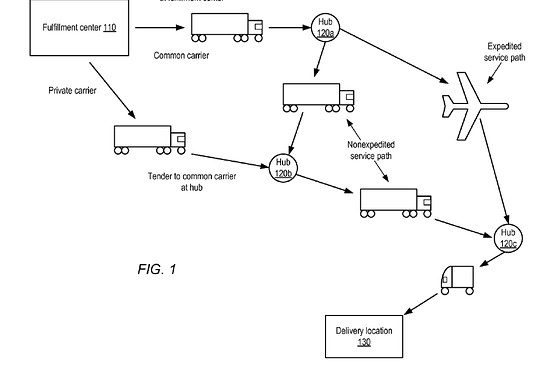
Evidently,  Amazon.com has read hockey great Wayne Gretzsky’s famous quote: “I skate to where the puck is going to be, not where it has been.” Amazon thinks it knows you so well it wants to ship your next package before you order it. The Wall Street Journal (Jan. 17, 2014) writes: “The Seattle retailer gained a patent for what it calls anticipatory shipping, a method to start delivering packages even before customers click buy.”

The technique could cut delivery time and discourage consumers from visiting physical stores. Amazon says it may box and ship products it expects customers in a specific area will want – based on previous orders and other factors — but haven’t yet ordered. The packages could wait at the shippers’ hubs or on trucks until an order arrives. In deciding what to ship, Amazon said it may consider previous orders, product searches, wish lists, shopping-cart contents, returns and even how long an Internet user’s cursor hovers over an item.

Today, Amazon receives an order, then labels packages with addresses at its warehouses and loads them onto waiting UPS, USPS or other trucks, which may take them directly to customers’ homes or load them onto other trucks for final delivery. It has been working to cut delivery times, expanding its warehouse network to begin overnight and same-day deliveries. The patent demonstrates one way Amazon hopes to leverage its vast trove of customer data to edge out rivals.

A possible Amazon logistics trail

Discussion questions:

1. What are the dangers in this concept?

2. Is this more realistic than using drones to ship packages?


OM in the News: Before the Drones, Amazon Lets Loose the Robots

kiva2Amazon  received a lot of news coverage for its sci-fi drone-delivery idea last week. But an immediate robotics effort under way in the Seattle retailer’s warehouses could save the company more than $900 million a year. Amazon’s rollout of robots from a company it bought last year, Kiva Systems Inc., could help pare 20% to 40% off the $3.50 to $3.75 cost of fulfilling a typical order, reports The Wall Street Journal (Dec. 9, 2013). The robots can shuttle shelves full of merchandise to warehouse workers, relieving of the workers of having to dash throughout the warehouse. “We believe this could be a significant opportunity to drive higher operating efficiency across Amazon’s massive fulfillment-center network,” says one industry expert.

Amazon has been working to reduce order costs and speed delivery, in part by constructing more warehouses closer to urban centers. While many of its latest efforts focus on deliveries themselves, Kiva robots could improve efficiency within warehouses, where humans—and human error—still rule the day. Amazon just disclosed that it has 1,400 Kiva robots in 3 of its warehouses. A broad rollout of Kiva robots could save Amazon $458 million to $916 million a year.

Perhaps more tantalizing is the potential for Amazon to sell the robots to other companies. Before Amazon bought Kiva, the robotics company was charging about $2 million for a kit of robots and as much as $20 million for large installations. Meanwhile, warehouse robots will remain a source of fascination. Indeed, Amazon’s announcement of its drone-delivery idea appeared to have prompted to disclose its effort to build robots.

Classroom discussion questions:

1. What are the advantages and disadvantages of introducing robots in the Amazon system?

2. Compare the use of drones vs. robots in improving OM efficiency.

OM in the News (and Video): Quality of Life at Amazon

Amazon's warehouse in Wales.
Amazon’s warehouse in Wales.

On its home territory, Amazon.com is routinely hailed as a jobs machine,” writes The New York Times (Dec.2, 2013).  Thanks to its warehouse building spree, it is hiring tens of thousands of workers, plus many more for the holidays. President Obama has called Amazon “a great example of what’s possible… the kind of approach that we need from America’s businesses.”

The recession might have cut deeper in Europe, making the question of new jobs even more crucial, but the attitude there is much cooler toward Amazon and its high-tech ways. In Germany, there is continuing labor strife. France is erecting barriers against the company’s aggressive discounting. And in Britain, the warehouses have been compared, in a story in The Financial Times, with a “slave camp.”

That shocking charge resurfaced in the latest investigation when a BBC reporter, Adam Littler, briefly went to work undercover at Amazon’s Wales warehouse. His report, broadcast last week on the show “Panorama,” (click here for the 1/2 hour video) showed him hustling to keep up with the demands of his hand-held scanner, which gave him only a few moments to find each product. In his 10-hour night shift, Littler said: “I managed to walk or hobble nearly 11 miles. We are machines, we are robots, we plug our scanner in, we’re holding it, but we might as well be plugging it into ourselves.”

Michael Marmot, a labor expert identified by the BBC as “one of Britain’s leading experts on stress at work,” told the TV show that with “the characteristics of this type of job, the evidence shows increased risk of mental illness and physical illness.” Amazon’s own expert disagrees, of course, and we have to question the shock value displayed in the video. The real question for your students is how are labor standards set–and whether they are fair to both the company and employees. For another view altogether of Amazon’s sophisticated warehouses in the US, watch this 3 minute video.

Classroom discussion questions:

1. How can labor standards for this job be set (see Chapter 10)?

2. What are the ergonomic issues addressed in the video?

OM in the News: From Navy Oil Tankers to Amazon’s Diapers

8 ships returning to Caroline Islands anchorage, 1944

Amazon’s online diaper sales and the U.S. Navy’s refueling protocol for World War II appear unrelated and worlds apart. Nevertheless, they are both answers to an identical logistics problem: how can an organization shorten the time between a customer’s order and a supplier’s response?

Amazon is seeking a way to decrease its response time to online buyers. In the case of diapers, this means encouraging a supplier such as P&G to relocate its operations adjacent to Amazon’s warehouses. With co-location, both firms presumably can reduce their shipping costs, better manage their inventories, and speed up deliveries.

The Navy experienced a similar logistics problem during World War II, writes The Wall Street Journal (Nov.25, 2013). In the early months of the war, the Pacific fleet engaged in hit-and-run tactics; it had to return to Pearl Harbor, where its oil supply tanks were located. When the Navy launched a 1943 offensive in the central Pacific, the geographical distance between consumer (fleet) and supplier (Hawaii) widened. Refueling consumed a precious commodity—time.

One  logistic solution: seize an enemy-held island, convert the island into an advanced base and construct oil storage facilities for the fleet. That worked, but as the Navy accelerated its offensive, it outran the advanced base network. By 1944, the Navy introduced floating bases at Pacific anchorages. Commercial tankers delivered fuel oil to the anchorage, storing oil in barges. A gap, though, between oil demand and supply still persisted.

Then the Navy turned logistics on its head, dispatching 36 oilers to meet carrier task force units at prearranged locations in the forward area. Oilers now refueled fleet units on the move in “underway replenishment.” The results were dramatic. A carrier task force could remain free from a fixed base for 3 months. Fleet Admiral Nimitz termed the Pacific just-in-time supply chain as his “secret weapon.” Naval historians would describe Nimitz’s logistic plan as a “fleet within a fleet.” Amazon’s co-location has been called a “plant within a plant.”

Classroom discussion questions:

1. How is co-location used in the auto industry?

2. What are the supply chain problems for the US military in the Afganistan war?

OM in the News: The Critical Last Mile at eBay

eaby nowThere’s a hot new job in tech: delivery guy. As the holiday shopping season gets underway, same-day delivery has become a new battleground for e-commerce, reports The New York Times (Nov.24, 2013). For all the sophisticated algorithms and proprietary logistics software involved, many services come down to “valets,” who race to a store, scan the aisles for the requested items, buy them and rush them to the customer. The app for eBay Now, the company’s local shopping service, promises that valets will complete a shop-and-drop-off not just in the same day but “in about an hour,” a timetable crucial to the company’s intensifying efforts to one-up Amazon in the delivery game.

It wasn’t so long ago that overnight delivery seemed amazing enough. Then Amazon started building huge “fulfillment centers” near major U.S. cities to be as close to customers as possible. With 40 such centers encompassing more than 80 million square feet and employing 20,000 full-time workers, Amazon offers same-day delivery in 11 cities.

EBay, which last month announced plans to expand eBay Now to 25 cities, has a different model: use existing stores or “retail partners” as distribution centers and beat Amazon in the race against the clock. The personal, labor-intensive valet approach doesn’t translate easily into profit. “You just can’t get any hourly worker to do this — you need someone with a work ethic and a willingness to go out of the standard operating procedure to delight the customer,” said a Forrester Research analyst. “It is an H.R. issue, not a tech issue. Many of these companies are coming at it from a tech standpoint. One thing Amazon has done very successfully, is they’ve owned the entire value chain. They’ve owned the last mile, the moment when the package arrives. Once you can own the moment that matters, you build a loyal customer base.”

There is a 2 minute video attached to the article which illustrates the eBay Now system.

Classroom discussion questions:

1. What has happened to earlier quick delivery companies?

2. What are the OM issues involved in eBay Now?

OM in the News: Amazon Moves In With P&G

amazonAt the end of a road in Tunkhannock, PA., called P&G Warehouse Way, sits a warehouse stocked with Pampers diapers, Bounty paper towels and other items made by  P&G. Inside the distribution center, reports The Wall Street Journal (Oct.15, 2013), is another company: Amazon.com. Each day, P&G loads products onto pallets and passes them over to Amazon inside a small, fenced-off area. Amazon employees then package, label and ship the items directly to the people who ordered them.

The e-commerce giant is quietly setting up shop inside the warehouses of a number of important suppliers as it works to open up the next big frontier for Internet sales: everyday products like toilet paper, diapers and shampoo. The under-the-tent arrangement is one Amazon’s competitors don’t currently enjoy, and it offers a rare glimpse at how the company is trying to stay ahead of rivals.

Logistics have long been crucial to success in retail. Years ago, Wal-Mart set up a system that lets suppliers monitor what needs to be replenished. Amazon instead is going out to its suppliers by piggybacking on their warehouses and distribution networks. Amazon is able to reduce its own costs of moving and storing goods, better compete on price with Wal-Mart and club stores like Costco, and cut the time it takes to get items to doorsteps. P&G began sharing warehouse space with Amazon 3 years ago and has expanded the practice. Amazon is now inside at least 7 P&G distribution centers world-wide.

The economics of the arrangement benefit both sides. For Amazon, “co-location” reduces the cost of storing bulky items like diapers and toilet paper and frees up space for the Web retailer to stock higher-margin goods in its own distribution centers. P&G, meanwhile, saves on the transportation costs that it would have incurred trucking products to Amazon’s regional distribution centers. Plus, it gets Amazon’s help in boosting online sales, a priority for many in the industry.

Classroom discussion questions:

1. What is the advantage of “co-location” to P&G?

2. The advantage to Amazon?

OM in the News: Wal-Mart vs. Amazon Logistics

This Wal-Mart hub sends supplies out to physical stores

Few have done better than Wal-Mart when it comes to retail logistics—the art of ordering, transporting, stocking and tracking merchandise, writes The Wall Street Journal (June 19, 2013). Wal-Mart pioneered a sophisticated hub-and-spoke distribution network which uses warehouses to service stores less than a day’s truck drive away so it could remove middlemen, quickly replenish shelves and reduce costs. At its distribution centers, scanning technology tracks merchandise as it flows at 6 miles per hour on 12 miles of conveyor belts onto trucks. Some items spend less than 45 minutes in warehouses.

Supply trucks crisscross the country and arrive daily at Wal-Mart’s more than 4,000 U.S. stores. Shipments are based on real-time data of shopper purchases, transmitted by the second as employees scan items at store checkouts. But with its e-commerce operations, which began in the late 1990s, Wal-Mart has been less exacting, instead relying on makeshift spaces carved out of store-serving warehouses and third-party operators to handle the load. Electronics ordered from Walmart.com are often delivered by companies like Ingram Micro which transport Apple tablets or Samsung phones to shoppers without ever going through Wal-Mart’s warehouses.

By contrast, Amazon has spent 15 years building its e-commerce network, with more than 40 U.S. warehouses within 35 miles of major cities. “As Amazon’s bets on infrastructure pay off, it can sell products at lower costs and puts even more pressure on other retailers,” says one industry expert. Wal-Mart now plans to spend roughly $430 million this year on e-commerce investments, including a logistics system tailored for Web orders. It is building distribution centers, but also will use stores as mini distribution centers. While logistics costs account for 3% of the price of an average “shopping basket” in stores, they make up 15% of the price of online orders.

Discussion questions:

1. What is Amazon’s logistics advantage?

2. How did Wal-Mart stumble in the move to electronic shopping?

OM in the News: Amazon Warehouse Jobs Push Workers To The Limit

The physical demands at the Amazon warehouse in Campbellsville, Ky. take a toll on employees, reports the Seattle Times (April 4, 2012). “Just as Amazon tracks and analyzes the habits of online shoppers, the company has created a hyper-efficient warehouse culture where worker performance is continually monitored and measured in pursuit of slashing costs and shipping times.” Three former workers at Amazon’s warehouse in Campbellsville told the Times there was pressure to manage injuries so they would not have to be reported to OSHA, such as attributing workplace injuries to pre-existing conditions or treating wounds in a way that did not trigger federal reports.

A former Amazon safety official in Campbellsville wanted to discuss reducing the work pace when temperatures pushed over 100 degrees, but says he never dared broach the subject with management. “I knew that was off the table — not an option,” he said.  Instead, he outfitted roving managers with backpacks full of Gatorade, which they served to workers so the workers wouldn’t have to leave their posts.”  Managers said the company created a work environment where employees who complained about such conditions risked retaliation and firing.

More than 15,000 full-time employees, earning stock and health benefits, work at Amazon’s fulfillment centers (warehouses) in the US. The firm is expanding at breakneck speed to staff its global network of 70 centers–17 opened just last year. And as we noted a few days ago in this blog, Amazon just bought Kiva Systems, a warehouse robot company which Amazon believes will increase employee productivity dramatically.

At Campbellsville, Amazon was viewed as an economic savior when it opened in 1999 with 700 jobs. The town’s biggest employer, Fruit of the Loom, had just shut its factory and unemployment topped 22%. Jobs at $14/hour are high in the region.

Discussion questions:

1. How do these conditions compare to companies in Asia?

2. What is Amazon’s position regarding unions?

OM in the News: Amazon Adds That Robotic Touch

“In the battle between man and machine, the robots  just scored a victory in the world of e-commerce,” writes The Wall Street Journal (March 20, 2012). Why? Because Amazon this week bought Kiva Systems, which makes squat orange robots used in shipping centers,  for $775 million. Although Amazon has used some automation in its fulfillment centers in the past, it depended heavily on people, hiring thousands during the peak holiday seasons to cruise through gigantic warehouses to pick items from shelves.

With Kiva, Amazon is looking for a more automated approach. The robots, which we have blogged about earlier, are already used at Zappos.com and Diapers.com, two websites that Amazon acquired. Rather than a worker walking to the shelves, Kiva’s robots bring the product shelves to a stationary warehouse worker. The robots  locate the items in a customer’s order, move the products around the warehouse, and help get packed boxes to the shipping dock. This improves productivity by bringing the products directly to employees to pick, pack, and stow.

Kiva claims that a packer working with its robots can fulfill 3-4 times as many orders per hour, but Amazon, with over 56,000 employees, says it won’t eliminate jobs. The firm now has a total of 69 fulfillment centers (with 19 new ones added last year alone).

The Journal article is accompanied by a short video of the robots in action.

Discussion questions:

1.Compare the old and new Amazon picking  systems. What are the advantages and disadvantages of each?

2.Why did Amazon buy Kiva?

OM in the News: The Making of Amazon’s Kindle Fire

The Wall Street Journal (Nov.18, 2011) has an interesting  article on the manufacture  of Amazon’s new Kindle Fire, and asks: “Is the company making any money on the $199 device”?  Two research firms that follow Apple’s production closely come up with different answers. UBM TechInsights says Amazon pays $143 for the components in the Fire.  ISuppli estimates the cost to be $203. The main difference is in the price of the 7 inch display and touch-screen assembly, which UBM puts at $50, but which ISuppli estimates to be $87.

Both firms agree that Amazon used a lot of techniques to save costs. The box the Fire comes in is the same one used to package the Fire for other retailers like Best Buy. The only accessory inside is a wall charger and cord. “Amazon’s approach was to take out everything they didn’t need”, says iSuppli.

I like this product for class discussion because its one the students care about, yet likely have very little knowledge about its inner workings.

Discussion questions:

1. Why do firms, such as iSuppli and UBM, analyze  products like the Kindle so closely?

2. Why does Amazon view the manufacturing process and component costs as a trade secret?