
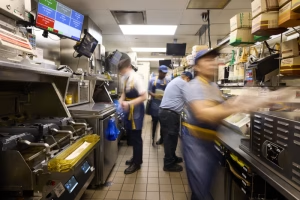
The goal? To drive better experiences for its customers and workers who today contend with issues ranging from broken machines to wrong orders. To accomplish that, McDonald’s tapped Google Cloud to bring more computing power to each of its restaurants—giving them the ability to process and analyze data on-site. The setup, known as edge computing, can be a faster, cheaper option than sending data to the cloud, especially in more far-flung locations with less reliable cloud connections.
McDonald’s is also exploring the use of computer vision (see Chapter 7), the form of AI behind facial recognition, in store-mounted cameras to determine whether orders are accurate before they’re handed to customers.
Additionally, the ability to tap edge computing will power voice AI at the drive-through. Edge computing will also help its restaurant managers oversee their in-store operations by creating a “generative AI virtual manager,” which handles administrative tasks such as shift scheduling on managers’ behalf.
AI will be able to help McDonald’s tailor its promotions and offers by using customer data such as prior purchasing history, and even linking it with weather data. “A customer who we know loves our sweet treats could get an offer through the app for a McFlurry on a hot summer day,” said the firm’s CIO.
Despite its first-mover advantage, McDonald’s will still face challenges including cost and the difficulty of rolling out the same technology across franchises and corporate-owned locations. But, compared with some of its quick-service restaurant peers, McDonald’s has been relatively aggressive at investing in new digital technologies. That, combined with the vast amount of data it has collected on its customers, gives the fast-food giant a leg up on figuring out how to improve customer loyalty.
Classroom discussion questions:
- What is “edge computing” and why is it a powerful tool for OM?
- Summarize the technology makeover being undertaken. Why is the firm going down this expensive path?


