
The great unknown for international travel: How long will I have to wait at immigration when I arrive? At Bangkok’s airport, it can be 2 hours. At New York’s JFK, its 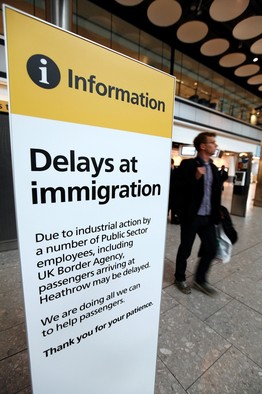 23 minutes at 3 am, but 37 minutes at 5 am. And at London’s Heathrow, 25% of non-EEU passengers wait more than 45 minutes. (Heathrow’s target that 95% of passengers clear with 45 minutes was breached at least 107 times during the 1st 2 weeks in April).
The Wall Street Journal (May 5-6, 2012) reports that the biggest cause of long delays is that arriving flights aren’t spaced out evenly, and that there aren’t always enough border agents to process long lines when arrivals are clumped together. “It’s simply a matter of a saturated queue, and you solve that with either more servers or shorter processing time,” says Carnegie Mellon’s Prof. Alfred Blumstein.
Since shorter processing times could mean less attention paid to security checks to keep illegal migrants or terrorists from crossing borders, airports need to add more agents to minimize wait times. Part of the challenge with staffing, of course, is that demand for passport checks varies widely throughout the day. “We know at times queues have been too long,” says a Heathrow spokesman. He said the agency is adding 80 agents at peak times, and 480 during this summer’s Olympics.
With budgets tight, however, expanding the workforce can be difficult. Prof. Blumstein, for example, who waited for over an hour at Heathrow two weeks ago, suggested moving people sooner from the main queue into shorter lines before each desk to “shorten the dead time.” As we teach in Module D, however, if the person already at the desk takes longer than average to clear, this can increase the overall average time in queue. That can lead to frustration if others who were further behind in the queue get served first.
Discussion questions:
1. Identify which queuing model Heathrow uses now.
2. How can you improve on Blumstein’s suggestion?
