Guest Post: Quality Management in Services

Prof. Howard Weiss, retired from Temple U., shares his thoughts monthly.

A recent issue of The Philadelphia Inquirer presented two compelling examples of quality management—or, more accurately, lapses in quality management—within the service sector. These cases illustrate the difficulty of applying quality principles to both healthcare and transportation.

Virtua Hospital. Two newborn infants were mistakenly brought to the wrong mothers. Each mother breastfed the wrong child before the error was discovered. The nurse who identified and reported the mistake to her supervisors was subsequently terminated. Hospital administrators justified the dismissal by claiming the nurse had failed to check infant ID bands at the beginning of her shift. The nurse stated she had never been informed of such a policy.

Your Heizer/Render/Munson text notes in Chapter 6 there should be “Employee empowerment: When employees see a problem, they are trained to take care of it.” This nurse did take care of the problem. Reporting it should have led to continuous improvement in the ward rather than her being fired. The result of firing an employee who reports a problem will mean that fewer employees will report problems. This, of course, undermines quality improvement.

Philadelphia International Airport (PHL).  PHL ranked last in customer satisfaction among the 27 Large airports that serve 10-33 million passengers per year–the 5th consecutive year it was at the bottom of the rankings.


Chapter 6 notes that “The personal component of services is more difficult to measure than the quality of the tangible component.” Nevertheless, J.D. Power evaluates airports on a range of specific, measurable factors including facilities, services, and customer experiences.

Management of PHL is fully aware of the airport’s shortcomings and has taken steps to improve by adding new bathrooms, new restaurants and a customer service training program. Plans are also underway to improve the rail platforms, seating, carpeting and roadway signage. However, these improvements will not fix the major problem. The airport is too small and too old and there is no room to expand it. One other factor to consider is that unlike with products, the passengers at PHL may not have other choices for which airport to use.

Classroom discussion questions
1. Does your employer encourage the reporting of problems/ mistakes?
2. Why might passengers at PHL not have other options? (Hint-check out American Airlines).

OM in the News: TSA, Thanksgiving, and OM Come Together

TSA’s airport operations center in Arlington, Va., opened this summer and coordinates checkpoint operations at the 30 largest airports. Here, screens show projected and actual passenger volume by hour, plus projected wait times, staffing levels and number of lanes open for terminals at Chicago’s O’Hare and New York’s LaGuardia airports
TSA’s airport operations center coordinates checkpoint operations at the 30 largest airports.

With the busiest travel day of the year approaching the Sunday after Thanksgiving (2.8 million people will pass through U.S. airports that day), the Transportation Security Administration says it’s better prepared to handle record numbers of travelers and should make it through Christmas without gridlock.

“This marks the first winter test of a new command center in Virginia, built to react more quickly to trouble spots at airports,” reports The Wall Street Journal (Nov. 18, 2016). The command center has screens on 3 walls displaying data from the 30 largest airports. They monitor wait times, equipment failures, number of lanes open, and projected and actual passenger volume hour-by-hour at security checkpoints. Airports with waits of under 30 minutes for standard screening and 10 minutes for trusted-traveler PreCheck lines are green, but turn yellow if waits jump higher in either category. A morning conference call with airports and airlines takes place 7 days a week. From there, TSA has shifted screeners and canine teams and used overtime to nip major delays.

On a recent day, a checkpoint here in Orlando, showed a 38-minute wait around noon, grabbing TSA’s attention. Extra officers were added, and by 2 p.m. the wait dropped to 5 minutes. TSA staffing is also up, with 44,800 uniformed officers. TSA says it will have enough officers and overtime dollars to keep all lanes open at peak holiday periods.

And automated lanes, commonly used in Europe and  Canada, have just opened at Chicago’s O’Hare Airport and are in the works at other big hubs. They have multiple places for travelers to load trays for X-ray screening, so one slow passenger doesn’t delay everyone. If a suspicious item is detected, bins are automatically diverted to secondary screening instead of stopping the X-ray belt and waiting for an officer. The approach shows a 20-30% boost in throughput.

Classroom discussion questions:

1. What OM approaches is TSA employing?

2. What other ideas do students have to streamline the screening process?

OM in the News: Queuing Up for Airport Security

tsa2Queuing up at the Orlando airport last week, en route to giving a lecture at Tulane University, I encountered a 40+ minute wait for TSA security checks. Returning from New Orleans a few days later, the TSA walk through took less than 2 minutes. Reading the Wall Street Journal’s article “Airport Security Lines Grow” that day (March 3, 2016), leads me to believe this is a good topic for class when you cover Waiting Line Models in Module D. Here is what the Journal writes: “Longer lines are the result of a collision of three changes: reduced staffing from federal budget cuts, a surge in travelers at some airports, and efforts to fix significant screening lapses.”

Current staffing is about 41,000 screeners, below the congressional cap of 42,500, and 5,600 fewer screeners than in 2011. At the same time, TSA has been intentionally slowing down security screening to tighten it up. This comes after some failures to identify weapons and other mistakes during covert government testing.

It  is not just Orlando International. Chicago O’Hare has had lines this week snaking through concourses, delaying hundreds of flights. Atlanta has seen peak-time security screening waits of an hour recently because checkpoints are “woefully understaffed.” TSA and airlines have started advising travelers to arrive up to 2 hours before a domestic departure and 3 hours for international flights.

American Airlines says it has had to delay hundreds of flights in January. At Delta’s New York Kennedy terminal, the PreCheck expedited screening line stretched almost out the building door on a recent Friday morning. Airports in Minneapolis, Las Vegas, Denver, Seattle and Miami all say they have seen longer lines at checkpoints over the past two months.

Classroom discussion questions:

  1. What tools in the text could be used to analyze this queuing problem?
  2. Why the vast disparity between Orlando and New Orleans TSA?

OM in the News: How the McLaren Racing Team Sped Up Heathrow Airport

mclarenThe McLaren Formula 1 Racing Team has long had a reputation as a data-obsessed racing operation, writes BusinessWeek (Oct. 6-12, 2014). So the company decided 5 years ago that the highly specialized expertise it’s developed in data analysis, simulation, and decision support is something that businesses would profit from and pay for. Among its projects, McLaren’s Applied Technology Group has designed health monitoring systems for sick children, helped data center operators to better manage spikes in demand, and created a scheduling system for Heathrow Airport that reduces flight delays.

Air travel, like racing, is a realm where things often don’t quite go right. The limited supply of Heathrow airport gate slots and runway space and the inevitability of poor weather combine to create a tightly coupled network where delays and bottlenecks can quickly ripple across continents. The managers at airports who coordinate arrivals and departures have to deal with planes that took off the day before—some already late or rerouted—and to figure out how best to bring them in. Heathrow presents a particularly intricate puzzle. It moves more people than all but a couple of airports in the world, yet it has only 2 runways—Chicago’s O’Hare, by comparison, has 8. And local environmental and noise regulations restrict flights to between 6 a.m. and 11 p.m.

Prior to McLaren, scheduling had relied on a computer program that looked at a few “study days” from the past season, usually idealized days in which little went wrong. McLaren created a software tool that models bad days as well as good ones and simulates the effects on global air traffic of events such as a blizzard in Frankfurt or fog in Singapore. That’s enabled the airport to better plan for delays and, as a result, to increase its capacity.  For example, if it becomes clear by midafternoon that Heathrow simply won’t be able to handle all of its remaining scheduled arrivals before the 11 p.m. cutoff, the software will recommend how to proceed based on Heathrow’s priorities. Cancel the fewest flights? Preserve the most connections? Favor long-haul flights over shorter ones?

Classroom discussion questions:

1. To what other elements of airport operations can simulation be applied?

2. Why is simulation important to McLaren?

OM in the News: Can You Help TSA Shorten Security Queues?

TSA checkpoint in Atlanta

In anticipation that more fliers will be eager to pay for expedited checkpoint screening, the Transportation Security Administration has promised to award $15,000 in cash prizes to whomever can design a faster waiting line system, reports Nextgov (July 18, 2014). The competition is on InnoCentive, a website for crowdsourcing solutions to problems, which enables individuals and teams to submit proposals. “There is a guaranteed award,” the contest overview states. “The total payout will be $15,000, with at least one award being no smaller than $5,000.”

The challenge aims to solve expected problems with TSA PreCheck, a program where passengers who undergo a background check and pay $85 get access to fast lanes that don’t require removing shoes, coats, liquids and laptops. “Current queue layouts at TSA Pre✓ airports will need to adapt to support the increasing population of TSA Pre✓ passengers,” the competition states. “TSA is looking for the Next Generation Checkpoint Queue Design Model to apply a scientific and simulation modeling approach to meet queue design and configuration needs of the dynamic security screening environment with TSA Pre✓.” TSA also is asking for approaches that would help speed standard, “free” waiting lines.

Competitors must supply a proposal that considers physical logistics, peak hours and staffing schedules, among other constraints. The “line” extends from the point where a passenger joins the end of the queue to the metal detector or body scan machine. Wait times cannot be more than 5 minutes for PreCheck and 10 minutes for standard lines. Also, the model should enable TSA to apply a “Computer Aided Design drawing to define the physical space available for queuing.”

Competitors are required to provide an animation of a computer screen that shows passengers flowing through lines. It must display real-time reporting during the animation, and allow a user to pause a simulation run when necessary for analysis or evaluation. What a great example of a complex, real-world queuing problem to ask your students to discuss!

Classroom discussion questions:

1. Why is TSA turning to crowdsourcing?

2. What ideas do you have for speeding the lines?


OM in the News: Queuing Up For TSA’s Fast Security Line

The TSA wants to speed up this line. Really.

Fliers gripe that getting through airport security lines can be too slow. Now, it may be fliers who are slow to sign up for a program to speed them through the lines. The Transportation Security Administration is aggressively trying to encourage more people to sign up for TSA Precheck, reports The Wall Street Journal (April 17, 2014). 

Precheck, launched in 2011, is much-loved among travelers because they don’t have to take off their shoes and jackets, don’t have to pull liquids and laptops out of baggage, and can walk through metal detectors without a full-body scan. By doing background checks on Precheck enrollees and scanning law-enforcement databases, TSA offers what is essentially pre-9/11 screening to “trusted travelers.”

TSA wants lots more people enrolled in Precheck to make better use of its designated security lanes, which currently number 590 at 118 U.S. airports. “It’s one of the last great bargains the U.S. government is offering,” TSA Administrator John Pistole has joked. To entice travelers into Precheck and test TSA’s ability to handle more people, the agency has been selecting regular passengers to go through Precheck security lanes and get it printed on their boarding passes. Selection is based on criteria like passengers’ travel history and the route being flown. TSA officers trained in behavior detection also can move passengers they deem low risk from regular queues into Precheck lanes.

Pistole said he has heard the complaints about Precheck lanes getting clogged, and TSA has already decided to stop moving travelers 75 years of age and older into Precheck service, unless they are enrolled, because they sometimes can take 10 minutes to move through. “It used to be great, but recently the Precheck lines have been the slowest of all the lines,” said Northeastern University OM Professor Fred Van Bennekom, who has timed TSA lines. “Sometimes there’s almost no one in regular lines and we’re all backed up at Precheck.”

Classroom discussion questions:
1. Why is the TSA using the Precheck program?

2. What else can operations managers do to speed up the security screening process?

OM in the News: Queuing Up at Heathrow

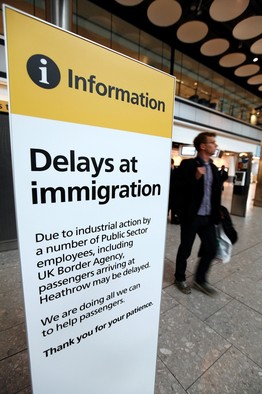
The great unknown for international travel: How long will I have to wait at immigration when I arrive? At Bangkok’s airport, it can be 2 hours. At New York’s JFK,  its 23 minutes at 3 am, but 37 minutes at 5 am.  And at London’s Heathrow,  25% of non-EEU passengers wait more than 45 minutes. (Heathrow’s target that 95% of passengers  clear with 45 minutes was breached at least 107 times during the 1st 2 weeks in April).

The Wall Street Journal (May 5-6, 2012) reports that the biggest cause of long delays is that arriving flights aren’t spaced out evenly, and that there aren’t always enough border agents to process long lines when arrivals are clumped together. “It’s simply a matter of a saturated queue, and you solve that with either more servers or shorter processing time,” says Carnegie Mellon’s Prof. Alfred Blumstein.

Since shorter processing times could mean less attention paid to security checks to keep illegal migrants or terrorists from crossing borders, airports need to add more agents to minimize wait times. Part of the challenge with staffing, of course, is that demand for passport checks varies widely throughout the day.  “We know at times queues have been too long,” says a Heathrow spokesman. He said the agency is adding 80 agents at peak times, and 480 during this summer’s Olympics.

With budgets tight, however, expanding the workforce can be difficult. Prof. Blumstein, for example, who waited for over an hour at Heathrow two weeks ago, suggested moving people sooner from the main queue into shorter lines before each desk to “shorten the dead time.” As we teach in Module D, however, if the person already at the desk takes longer than average to clear, this can increase the overall average time in queue. That can lead to frustration if others who were further behind in the queue get served first.

Discussion questions:

1. Identify which queuing model Heathrow uses now.

2. How can you improve on Blumstein’s suggestion?