OM in the News: Machines are Making Your Sushi, and That’s Good

In the belly of a machine about the size of an office printer, a plastic roller presses sticky rice onto a bed of seaweed. The oxygen-to-grain ratio has been precisely calibrated with the aid of X-ray tests. A razor slices the sheet into a flawless rectangle, which plunks down onto a steel tray ready to be stuffed with ruby-red tuna or smoked eel.

The $14,000 robot can help a food prep worker churn out 200 sushi rolls an hour—up from the 50 or so a chef could make by hand, according to its maker, Autec USA. Autec says orders have quadrupled over 5 years amid rising sushi consumption and a growing chef shortage. Among its customers is Whole Foods.

Service industries have lagged other sectors in spending on labor-saving equipment during this economic expansion, because as long as workers were plentiful and wages stagnant, it made more sense to hire than to invest in automation. Services make up a growing share of the U.S. economy—64% of gross output last year, up from 40% in the 1950s—but their share of capital expenditures has been relatively flat over time.

“Now, many businesses are going beyond replacing old equipment,” writes Businessweek (Dec.25, 2017). They’re also pouring money into new technology, along with buildings and production equipment. For the first time since 2000, service sector investment in intellectual-property products (think software and R&D) has surpassed 4% of GDP.

Autec expects demand for its robots to stay strong. Its most popular machines are an example of the kind of automation that can make life easier for workers—rolling out rice over sheets of nori is one of the most difficult, and tedious, parts of sushi making—rather than make them obsolete. Customization—inserting different kinds of filling—still requires humans.

Classroom discussion questions:
1. Why did service sector investment lag behind the industrial sector?

2. Why is efficiency improvement important in the service sector?

Video Tip: Inside Amazon’s New NYC Warehouse

The shelf arrangement makes sense for many small orders that “look” random.

Inside Amazon’s New York warehouse for Prime Now, nothing is organized. Or actually it is, but its driven by a random stocking algorithm. The one-floor warehouse on 34th Street is full of everything marked as currently available on Prime Now, Amazon’s service that has couriers deliver orders within 2 hours.

The 25,000 products aren’t grouped by type. Instead, they’re stashed in cubbies and tracked in a kind of organized chaos. A copy of Hamilton by Ron Chernow, for example, sits next to a box of candy canes or a jar of mayonnaise. Yet it seems to make sense to randomly stock items of similar popularity.

Once an order is placed, warehouse staff remove the products from inventory and bag them. The paper-bagged orders are grouped by their destination — in New York, anywhere in Manhattan or Brooklyn.

Prime Now is available only to Prime members, and so far it’s in about 30 cities. Amazon chooses where to launch Prime Now based in part on which cities have a high proportion of Prime members. The service first launched in 2014 in New York.

OM in the News: The Disney MyMagic+ Revolution


The cost of each band has dropped from $35 to under $5

It was February 2011, and Disney’s CEO, Bob Iger, gathered his board of directors. Iger set his sites on his boldest gamble yet: to reinvent Disney’s iconic parks. He planned to pump $1 billion into MyMagic+, a sweeping plan to overhaul the digital infrastructure of Disney’s theme parks, which would upend how they operated and connected with consumers. At the core was the MagicBand, an electronic wristband that could digitally carry everything a guest might need—park tickets, photos, coupons, even money. It would give guests entry to Disney World, pay for goods at retail shops, and unlock their hotel room doors. “It would be a virtual key to the Magic Kingdom,” writes Fast Company (May, 2015).

Iger’s effort would prove to be monumental. Disney World isn’t an amusement park: It’s a metropolis. Sprawled across 25,000 acres of Orlando, it contains 4 theme parks, nearly 140 attractions, 300 dining locations, and 36 resort hotels. Its 15 mile monorail system has a daily ridership of 150,000. The parks have their own power plant and security force, plus some of the world’s largest laundry facilities.

More than 28,000 hotel doors needed their locks replaced in order to connect wirelessly with the MagicBand, even as the rooms were occupied. Two dozen workers spent 8 months upgrading 120 doors per day. The company rolled out 6,000 mobile devices to support MyMagic+ in the parks. More than 70,000 cast members got MyMagic+ awareness training. Disney World’s physical infrastructure, which was first built in the late 1960s, also needed major capital improvements. Park-entry touch points (283 of them) needed to be upgraded. As much of Disney World lacked a Wi-Fi connection, the company had to install more than 30 million square feet of coverage. It was a huge effort to wire a communications infrastructure the size of San Francisco.

Not surprisingly, the project did not go smoothly. The rollout did not hit until mid-2014.  But now that it is place, MagicBand has cut turnstile transaction time by 30%. Park capacity has also increased, and over 5,000 more people fit into the park each day. And guests say MagicBand is a lifesaver; they couldn’t imagine going back to the old system, with all the paper tickets and FastPasses.

Classroom discussion questions:

1. Are there any operations downsides to this new technology?

2. Can this technology be easily expanded to all theme parks?

OM in the News: Your Smartphone Will See You Now

New smartphone tools, like blood pressure monitors, aim to give more power to patients

Over the past decade, smartphones have radically changed many aspects of our everyday lives, from banking to shopping to entertainment. Medicine is next, writes Dr. Eric Topol in The Wall Street Journal (Jan.10-11, 2015). With the smartphone revolution, an increasingly powerful new set of tools—from attachments that can diagnose an ear infection or track heart rhythms to an app that can monitor mental health—can reduce our use of doctors, cut costs, speed up the pace of care and give more power to patients.

Let’s say you have a rash that you need examined. Today, you can snap a picture of it and download an app to process the image. Within minutes, a computer algorithm can text you your diagnosis. That message could include next steps, such as recommending a topical ointment or a visit to a dermatologist for further assessment. Smartphones already can be used to take blood-pressure readings or even do an EKG.

Now, at any time of day or night, you can get a secure video consultation with a doctor via smartphone at the same cost (about $30-$40) as the typical copay charge. Deloitte has forecast that virtual physician visits (replacing physical office visits) will soon become the norm– that as many as 1 in 6 doctor visits were already virtual in 2014. Even bigger changes are in the works. Using wearable wireless sensors, you can use your smartphone to generate your own medical data, including measuring your blood-oxygen and glucose levels, blood pressure and heart rhythm. And if you’re worried that your child may have an ear infection, a smartphone attachment will let you perform an easy eardrum exam that can rapidly diagnose the problem without a trip to the pediatrician.

“We’re often told that the U.S. faces a big looming shortage of physicians,” writes Dr. Topol. “The expansion of DIY medical capabilities certainly challenges that notion: We may end up not having a physician shortage at all.”

Classroom discussion questions:
1. How can the smartphone be used in other service industries?
2. Why is this an important operations tool?

OM in the News: The Rise of the Robot Work Force Stokes Human Fears

Robotic bellhop delivers fresh towels to a Silicon Valley hotel

A machine that administers sedatives recently began treating patients at a Seattle hospital. At a Silicon Valley hotel, a bellhop robot delivers items to people’s rooms. Last spring, a software algorithm wrote a breaking news article about an earthquake that the Los Angeles Times published. “Although fears that technology will displace jobs are at least as old as the Luddites, there are signs,” writes The New York Times (Dec.16, 2014), “that this time may really be different.” The technological breakthroughs of recent years — allowing machines to mimic the human mind — are enabling machines to do knowledge jobs and service jobs, in addition to factory and clerical work.

Economists long argued that just as buggy-makers gave way to car factories, technology would create as many jobs as it destroyed. Now many are not so sure. Artificial intelligence has become vastly more sophisticated in a short time. Self-driving vehicles are an example of the crosscurrents. They could put truck and taxi drivers out of work — or they could enable drivers to be more productive during the time they used to spend driving, which could earn them more money.

The challenge is evident for white-collar jobs, too. Ad sales agents and pilots are two jobs that the Bureau of Labor Statistics projects will decline in number over the next decade. Flying a plane is largely automated today and will become more so. (Boeing, by the way, announced last week that it is preparing for 1-pilot commercial jets). And at Google, the biggest seller of online ads, software does much of the selling and placing of search ads, meaning there is much less need for salespeople. Telemarketers are among those most at risk, adds The NY Times.

Classroom discussion questions:

1. Is artificial intelligence having as great an impact as the article suggests?

2. What other service applications can robots help perform?

OM in the News: The Disappearing Supermarket Self Check-Out

Self checkout machines at supermarkets require a lot of human intervention

Computers seem to be replacing humans across many industries, and successfully so in the service sectors such as bank and hotel lobby ATMs and airport kiosks, reports The Wall Street Journal (Oct. 6, 2013). But these tasks—along with more routine computerized skills like robotic assembly lines—share a common feature: they’re very narrow, specific, repeatable problems, ones that require little physical labor and not much cognitive flexibility. In supermarkets, self-checkout machines’ deficiencies illustrate the limits of computers’ abilities to mimic human skills.

The human supermarket checker is superior to the self-checkout machine in almost every way. The human is faster. The human has a more pleasing interface. The human doesn’t expect us to remember or look up codes for produce, she bags the groceries.

Self check-out works well enough when you want just a handful of items, when you don’t have much produce, when you aren’t loaded down with coupons. What’s so cognitively demanding about supermarket checkout? Checkout people all point to the same skill: identifying fruits and vegetables. Some supermarket produce is tagged with small stickers carrying product-lookup codes, but a lot isn’t. It’s the human checker’s job to tell the difference between green leaf lettuce and green bell peppers, and then to remember the proper code. “It took me about three or four weeks to get to the point where I wouldn’t have to look up most items that came by”, said one clerk.

National supermarket chain Jewel-Osco is getting rid of self-checkout lanes from some of its stores. The firm said it’s an effort to reconnect personally with all of its customers despite the higher costs the shift entails. Theft is also a concern driving some grocers away the unmanned check-outs, as are hassles such as liquor and other purchases that require an employee to step in. Self check-outs generally have one staff member assisting customers at 4-6 stations at once.

Classroom discussion questions:

1. Why are some stores eliminating self check-out?

2. Why is this an OM issue?

OM in the News: Eliminating the Waiting Line at Hotel Check-In

Concierge registering guest at Andaz West Hollywood

Hotels are changing the way guests check in to their rooms, writes The New York Times ( March 19, 2013), eliminating the traditional stop at the front desk to speed up, simplify and personalize the process. When guests arrive at citizenM, a boutique European hotel chain, they check in at a kiosk and go straight up to their rooms. The kiosk was designed to be easy to use because most travelers are encountering it for the first time.

“The hospitality industry is moving toward more automated check-in systems,” says NCR’s VP for kiosk systems. “Customers are used to A.T.M.’s at the bank instead of tellers, checking in for airplane flights online, and they are now looking for that same efficiency when they arrive at a hotel. No one wants to wait in line for the front desk anymore”.

Automated hotel check-in is expected to expand rapidly. In a typical system, guests check in by computer or phone before they arrive and enter their expected arrival time, which helps the housekeeping staff with the room cleaning schedule. A bar code is sent to the traveler to print out or display on his or her phone. At the hotel, the guest scans the bar code at a kiosk. The machine assigns a room and spits out the number of plastic key cards requested, and the guest can head upstairs.

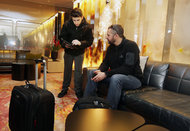
Hotels are also using new technologies to eliminate the front desk check-in line — with personal greeters who shepherd guests through the check-in process in a more comfortable setting. Andaz West Hollywood has combined its front desk staff, bellmen and concierge functions into “hosts,” who greet guests as they enter the lobby and sit with them on comfortable couches to check in using an iPad with a credit card reader.

This article is a nice complement to the Winter Park Hotel case study in Module D.

Discussion questions:

1. What is the benefit to hotels in implementing kiosk check-in?

2. Will these systems be widespread in a few years?

OM in the News: R2D2 Enters the Hospital Hallways

Thousands of “service robots” are entering US hospitals. “Picture R2D2 from ‘Star Wars’ carrying a tray of medications or a load of laundry down hospital corridors'” writes The Wall Street Journal  (March 15, 2012).  As America’s elderly population grows, the country’s health care system is facing cost pressures and a shortage of medical personnel. Administrators are planning to foist some of the less glamorous work onto robots. “We are just not going to have enough human hands to do all the work,” says an industry expert.

The new breed of service robots are self-aware, intelligent (using advanced sensors and motion detectors tied to powerful microprocessors and voice activation), and able to navigate changing environments, even in chaotic hospitals.  InTouch Health, in Santa Barbara, has machines that allow doctors to connect to far-flung patients with videoconferencing. The robots enable a doctor to make rounds virtually and check on patients from miles away. More than 400 hospitals are using the InTouch machines.

 Aethon, in Pittsburgh, has sold robots to over 100 hospitals. These machines haul food trays, linens, medical trash, drugs, and medical records around the hospital, all while staying out of the way of rushing doctors and nurses. While the robots are popular with hospital staff, a union spokesperson at El Camino Hospital (which has 20 robots deployed) says: “We will always advocate for good jobs in which community members could be doing the work.”

(There is a short video on the robots embedded in the WSJ article as well.)

Discussion questions:

1. Ask the class to name some other service applications of robots.

2. What are the advantages and limitations of using robots in hospitals?