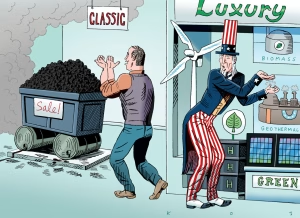
OM in the News: The Green Energy Transition Isn’t Easy

“Despite extravagant hype, the green-energy transition from fossil fuels isn’t happening. Achieving a meaningful shift with current policies is too costly,” writes The Wall Street Journal (June 25, 2024).

Globally, we spent almost $2 trillion in 2023 to try to force an energy transition. Over the past decade, solar and wind energy use has soared to record levels. But that hasn’t reduced fossil-fuel use, which increased even more over the same period.

Research shows that when countries add more renewable energy, it does little to replace coal, gas or oil. It simply adds to energy consumption. For every 6 units of green energy, less than one unit displaces fossil-fuel energy. While renewable energy sources worldwide will dramatically increase up to 2050, that won’t be enough even to begin replacing fossil fuels—oil, gas and coal will all keep increasing, too.

During the 19th-century transition to coal from wood, overall wood use increased even as coal assumed a greater percentage of energy needs. The same thing happened during the shift to oil from coal: By 1970, oil, coal, gas and wood all delivered more energy than ever before.

With a thirst for affordable energy, oil and coal energy use has doubled, hydro power has tripled and gas has quadrupled in the last 50 years. The use of nuclear, solar and wind power has surged.  During past additions of a new energy source, researchers found it has been “entirely unprecedented for these additions to cause a sustained decline in the use of established energy sources.”

Solar and wind aren’t better, because unlike fossil fuels, which can produce electricity whenever we need it, they can produce energy only according to the vagaries of daylight and weather. They are cheaper only when the sun is shining or the wind is blowing at just the right speed.

When we factor in the cost of 4 hours of storage, wind and solar energy solutions become uncompetitive with fossil fuels. Further, solar and wind are almost entirely deployed in the electricity sector, which makes up only 1/5 of all global energy use. As we struggle to find green solutions for most transportation, we have yet to address the energy needs of heating, manufacturing or agriculture. And we are ignoring the hardest sectors like steel, cement, plastics and fertilizers.

Classroom discussion questions:

  1. What can managers do to help the need for sustainable operations given these statistics?
  2. Will solar, wind, and nuclear take over the bulk of energy production? Why or why not?

OM in the News: Learning Curves and Solar Power

Recent history shows that climate policies such as taxes, subsidies and mandates matter most by catalyzing a virtuous cycle of higher demand that leads to more innovation, learning-by-doing and economies of scale that lower costs and further boost demand. In solar power, the results have been spectacular. Between 1980 and 2012, the cost of a photovoltaic module made from crystalline silicon fell 96%. Roughly 30 percentage points of this is attributed to public and private research and development, which among other things, led to more efficient modules and larger, thinner silicon wafers. Another 60 points came from “learning-by-doing”—improvements to the manufacturing process, such as less waste, that came with experience—and economies of scale, reports The Wall Street Journal (Aug. 25, 2022). The average plant capacity grew roughly 200-fold.

Similar, though less dramatic, dynamics have been at work in wind power and battery storage. They all hewed to “Wright’s Law,” named for the 1930s aeronautical engineer Theodore Wright. In Module E, Learning Curves, we explain that each doubling of production is accompanied by a roughly constant percentage decline in cost, known as the learning rate. “Over the long term these learning rates appear to be the best way to predict the future cost of technology that we know of,” said one industry expert.

One implication is that as a technology matures, production takes longer to double and so costs fall more slowly. In solar power, for instance, PV module factories are now so large and the manufacturing process so efficient that incremental improvements are much harder to come by. Sure enough, the cost of solar-generated power has fallen an average of 6% annually from 2018 through 2021, compared with 21% in the previous nine years.

Greater potential lies in replicating the experience of solar in other technologies that are currently too costly for widespread adoption. Emission reductions in the coming decade are the low hanging fruit, achievable with technologies that are already competitive or nearly so with fossil fuels such as wind, solar and batteries. Getting the rest of the way to net zero depends on hard-to-decarbonize sectors such as aviation, industrial processes and agriculture for which commercially viable technology to eliminate emissions doesn’t yet exist.

Classroom discussion questions:

  1. Where were learning curves first applied? (See Table E.1 in your Heizer/Render/Munson text)
  2. Why do costs fall more slowly as a product matures?

OM in the News: China’s Solar Overcapacity

In our last blog about China and its solar industry, we noted that vast economies of scale and government subsidies were sending solar panel prices down sharply. China was also grabbing market share not only in the US, but controlled the bulk of the European market. With global demand up, Chinese firms like Yingli Green Energy, Suntech, and LDK Solar were ramping up production capacity–doubling it and running factories 24/7, 365 days  a year in some cases. According to today’s Businessweek (Feb. 9, 2011), “all of the major Chinese producers are engaged in massive, very aggressive capacity-expansion programs.”

But their timing may be off. As the Chinese ramp up, austerity-minded European governments are scaling down their solar subsidies. Germany, France, Spain, the Czech Republic, and others, are reducing support for solar power producers dramatically as they face record-high deficits. This leaves China with capacity way ahead of what the market can take.

It’s not just subsidy cuts, though. The French Environmental Minister says most new solar panels “were made in China with a highly questionable carbon footprint”. She adds:  the policy must “create jobs in France, not subsidize Chinese industry”. Since Yingli made 60% of its income off of Germany last year, and Suntech’s European sales were 74% of total revenue in 2009, the Chinese are learning a painful lesson in capacity management. Their internal market is one alternative, but total Chinese demand is only one-twentieth of what Germany spends on solar in one year. This article ties in well with the discussion of capacity planning in Supp.7.

Discussion questions:

1. Do politics play a role in the solar industries in China? In the US? In Europe?

2. How can overcapacity be avoided?

OM in the News: Solar–Will the U.S. Lose Out to China?

A few days ago, our blog gave the good news that BMW and Mercedes were expanding their manufacturing in the US. For our nation’s standard of living to rise, we indeed need to make things. And such jobs pay well and provide a path for middle class success.

But the New York Times headline (Oct.13,2010), “In the Future, Already Behind” brought me back to reality with a thud. The story is about Silicon Valley and its commitment to transforming the economics of solar panel production. Firms like Solyndra, Nanasolar, and MiaSole bet the farm that their “thin film” technology would make them the Intels and Apples of the exploding global solar industry.

But just as Solyndra flipped the switch on its new $733 million California  factory last month, everything changed. The Chinese, using vast economies of scale and government subsidies, sent the price of panels plunging 40%  and grabbed 40% of the vast California market. They also took the bulk of the European market. What looked like a chance for US manufacturing to dominate a critical growing market has crumbled to the realities of globalization.

“How do you fight against enormous subsidies, low-interest loans, cheap labor and scale, and a government strategy to make you no.1 in solar?”, asks an American CEO.

New technologies (see Ch.7), meant to be cheaper, must get there faster is one lesson we learn here.

Discussion questions:

1. What are the dangers of ceding this industry to the Chinese?

2. How can the US firms counter this threat (see Ch.2 for a strategy discussion)?

3. Should the US provide the same benefits that China does to new companies?