OM in the News: The (Short) Port Strike and Supply Chains

Dockworkers at dozens of U.S. ports in the Eat and Gulf Coasts are digging in for a massive pay increase, seeking to flex their power in a strike that aims to strangle the flow of trade across much of the country, reports The Wall Street Journal (Oct. 2, 2024). “Nothing is going to move without us,” said the head of the longshoremen’s union. The union wants to raise the base hourly rate for its roughly 45,000 members to $69 from $39, a 77% pay increase. It argues that its members deserve a big raise after working through the pandemic.
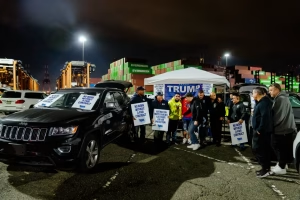
Members of the Longshoremen’s union began picketing this week.

Dockworkers typically earn a six-figure annual salary because of work rules and overtime requirements. More than half of  dockworkers at the Port of New York and New Jersey earn more than $150,000, with 1/5 earning over $250,000. Republican lawmakers have stepped up calls for the administration to invoke federal law to keep the ports open. After wages are agreed, the two sides still need to bargain over thorny issues such as expanded use of automation, which the union wants to prohibit.

The walkout shuts down some of the country’s main gateways for imports of food, vehicles, heavy machinery, construction materials, chemicals, furniture, clothes and toys. Big retailers, with their busy fall shopping season just starting to kick in, say that for now they can withstand the slowdown because they brought in products earlier than usual this year and diverted other cargoes to West Coast ports in case of a strike. (Container imports into U.S. West Coast ports expanded 22% over last month).

But a walkout lasting a week or longer would push up shipping costs and might trigger product shortages. A strike lasting even one week would tie up ships for much longer periods, which could exacerbate shipping delays, eat up capacity and drive up freight rates, leading to logistical challenges for businesses relying on East Coast and Gulf ports. About 60% of containerized trade moves through these ports where dockworkers last year unloaded about $588 billion of imports.

One Florida importer that sells asparagus to supermarkets is having to fly in vegetables that would usually arrive by containership. It is adding 50 cents a pound to the prices to cover the higher airfreight costs.

Classroom discussion questions:

  1. What can supply chain managers do in a situation such as this?
  2. What are the major issues behind the strike?


OM in the News: The UAW Strike and Supply Chain Tiers

As the United Auto Workers strike continues, risks of disruption are compounding for automotive supply chain managers, reports Supply Chain Dive (Sept. 20, 2023).

The union has already idled production lines at three plants in response to failed negotiations with Ford, GM and Stellantis. As the UAW threatens further work stoppages, supplier health may be at risk.

“Depending on how deep this strike goes, it can be really challenging for the suppliers to stay afloat. Risk is particularly focused on the Tier 2 and Tier 3 suppliers,” said one industry expert. He added: “Tier 1 firms should be talking to downstream suppliers, asking: ‘How are your financials? When we do get out of this, are you going to be able to ramp back up?’”

To be proactive, supply chain managers can streamline various processes which include order intakes, raw material and labor planning.

Order cancellations from the affected assembly plants can bottleneck the entire supply chain. Suppliers can continue to build parts regardless of canceled orders, but if the customer refuses to accept deliveries, then suppliers need to pay to store those parts. Demand for the parts and materials will decrease or even cease as the automakers cancel firm orders for parts and future orders in the coming weeks and even months, depending on the duration of the strike.

As a result, the supply chain will likely feel lingering impacts even when the strike eventually ends. For instance, suppliers who may have furloughed workers might take a while to get operations up and running. If more automaker plants get impacted, downstream suppliers may need to reboot their systems.

Ripple effects will move across the entire supply chain. Tier 1 suppliers with strong balance sheets will be fine. But Tier 2 and Tier 3 suppliers may struggle with cash flow as orders are canceled. Secondary effects are already being seen. GM is temporarily laying off employees at its Fairfax plant — which is not included in the first wave of strikes — as that facility’s operations are disrupted from a lack of stamping parts from the Wentzville facility, which is on strike. While supply chain managers may be able to keep things moving, operations get tricky if the UAW goes after engine plants. Shutting down plants where engines are built will cripple other plants across the U.S., Canada and Mexico.

Classroom discussion questions:

  1. What are Tier 2 and Tier 3 suppliers? Give an example of each.
  2. What are the issues underlying the UAW strike?

OM in the News: GM’s Strike and the Auto Supply Chain

Companies that supply parts to General Motors are being forced to idle plants and lay off workers, as a result of the national strike called by the United Auto Workers. Nearly 46,000 GM workers walked off the job last week after the UAW and GM were unable to agree on a new 4-year labor agreement. The strike is now the longest nationwide strike against GM since the 1970s.

By stopping all production at GM’s U.S. plants, the strike is also beginning to affect the web of manufacturers that produce parts that go into the company’s cars. With no vehicles being made, those companies can do little but wait until the strike ends. Every automotive assembly job impacts between 5 and 8 other jobs, reports The Wall Street Journal (Sept. 20, 2019). The companies most affected so far are those that operate on a “just-in-time” basis, delivering difficult-to-ship parts like seats and door panels to GM’s assembly plants from factories located nearby.

At least three companies around Lansing, Mich., have shut down their plants that supply the two GM assembly plants nearby. Already there are signs that the work stoppage is rippling beyond just those nearby plants and into the broader automotive supply chain. A typical finished vehicle is made from roughly 30,000 individual parts manufactured by hundreds of different companies, and companies that provide products to GM will themselves have networks of suppliers.

The strike is having cross-border implications as well. GM laid off 1,200 workers at an assembly plant in Oshawa, Ontario, on account of a shortage of necessary parts that would come from the company’s U.S. plants. In the U.S., given the importance of the automotive supply chain to the country’s Midwest, a prolonged strike of more than a month could have serious implications for the region’s economy.

Classroom discussion questions:

  1. What are the OM implications of a long strike?
  2.  Which suppliers are most affected?

OM in the News: If China is Too Expensive, Should We Locate in Vietnam ?

With China’s minimum wage at $170 a month, and rising steadily, the decision where to locate a manufacturing plant is not as clear as it was a decade ago. We discuss this issue in Chapter 8, Location Strategies, and see that low labor cost is a major factor in country selection.  The latest Businessweek (June 23-30, 2011) reports that Vietnam, until recently the low-cost alternative to China (with a minimum wage of $85 a month), was a very attractive choice. But with 20% inflation, stoked by fuel and electricity costs, multinationals are beginning to turn away in search of yet cheaper outsourcing sites. The problem is labor strikes–336 in the 1st four months of 2011–due to Vietnamese workers who say they can’t afford the higher cost of living.

Multinationals do not have to look far away–and they are turning in increasing numbers to Laos and Cambodia, the new Vietnams of cheap manufacturing. Last month, Japan’s Minebea  broke ground for a new 5,000 worker motor production plant in  Phnom Penh. “Labor is the key focus for us in choosing Cambodia”, says the company spokesman. And Srithai Superware, a Thai tableware maker, just suspended plans for an expansion of its Vietnam plant because of  economic instability. “Production costs have gone up after two salary increase this year”, says the GM.

The strikes have dented Vietnam’s 25-year-old policy of offering foreign firms a stable and low-cost workforce . “The nation is at a crossroads”, says the World Bank’s director for the country. “Vietnam can’t assume that foreign direct investment will continue. Money can go elsewhere”.

Discussion questions:

1. If manufacturers decide China is too expensive and Vietnam is in danger of following suit, how can they predict where to outsource to?

2. What other  critical factors influence the country location decision?