OM in the News: Geopolitics and Supply Chains

“Supply chain managers today are thinking more about geopolitical risk than they are about any other risk,” writes The Wall Street Journal (May 3, 2024).

The Rubymar, a bulk carrier hit in a Houthi missile attack, sank in the Red Sea in March

Companies’ top supply chain concerns until recently were how to find a reliable source for products at the lowest cost. That led many to China with its cheap labor and unparalleled ecosystem of factories, parts suppliers and raw materials. Now many firms are prioritizing a supply chain that reduces their reliance on a single country or region.

Some of the changes were spurred by the Covid factory shutdowns in China and soaring prices for ocean shipping. The changes are being accelerated by more recent geopolitical shocks as countries such as China, Russia and Iran face off against the West.

The U.S. has also raised national security concerns about its dependence on China for technologies such as semiconductors that are key to computers, electric vehicles, robots and other goods. It has banned the export of some chips to China and is stimulating domestic manufacturing of chips with incentives for new factories that limit the use of raw materials from China. These new rules, regulations and tariffs complicate trade compliance efforts, especially for larger companies that sit atop a supply chain that can include hundreds of thousands of suppliers.

Companies are having to dig deeper into their supplier networks to identify raw materials and components that could be subject to steep tariff hikes or that could violate a growing number of regulations targeting countries such as Russia and China. VW was surprised when thousands of its Audi, Porsche, Bentley and Lamborghinis were recently held up at U.S. seaports. The cars contained a magnetic component sourced from a sub-supplier blacklisted because it is in China’s Xinjiang region, suspected of using Uyghur forced labor. “We really try, but this shows how challenging it is to really know everything that is happening in complex supply chains,” said  VW.

Multinational companies cannot easily disentangle themselves from geopolitical risks. Russia is one of the world’s largest suppliers of metals such as aluminum, nickel and copper. China supplies about 75% of the rare-earths minerals that go into U.S. semiconductors.

Classroom discussion questions:

  1. Why is it difficult for manufacturers to know details about their supply chains?
  2. How does Table 11.3 in your Heizer/Render/Munson text relate to VW’s problem?

OM in the News: The EV Supply Chain and Canada

International giants are investing billions of dollars in Canada’s EV and mining sectors

Multinational companies are pumping billions of dollars into Canada’s electric-vehicle manufacturing sector, lured by government incentives, access to raw materials and cheap renewable energy. VW just announced that it had chosen a site in Ontario to build its first battery-cell plant outside Europe, citing Canada’s natural resources as one of the reasons. VW’s plan follows recent EV and battery-making project investments by GM, Stellantis, Michelin Tires, Brazilian miner Vale, U.K. mining company Rio Tinto, and German chemicals company BASF, among others.

According to The Wall Street Journal (March 23, 2023), Canada is benefiting from a push by the U.S. and its allies to reduce their dependence on China for the critical minerals used in EV batteries and military equipment.  In one example, Stellantis and South Korea’s LG are building a $4.1 billion battery plant in Windsor, Ontario, with 2,400 workers starting next year. As we discuss in Chapter 8 (Location Strategies), incentives are common and Canada has had to pay up to win the investments, scrambling to keep up with the U.S., which has unveiled a raft of subsidies meant to draw investment in its EV industry. Canada gave $732 million to land the Stellantis/LG venture.

Canada is among the most expensive countries in the world to build cars and the highest-cost market for car assembly in the North American free-trade zone. To save money, auto makers in recent decades moved thousands of manufacturing jobs and motor-vehicle assembly capacity to Mexico, dropping auto employment in Canada from 175,000 to 110,000.

The Canadian government is pitching itself as a counterweight to China in the race to develop EV technology. China leads the world in processing metals and minerals like nickel, copper, lithium and cobalt. It also is home to 78% of the world’s cell-manufacturing capacity for EV batteries. Helping Canada’s pitch: It is one of the few places in the Western Hemisphere with the raw materials companies need to make their EVs. Electra Battery Minerals Corp. is the only facility available in North America for processing battery-grade cobalt, a metal used in batteries. Rio Tinto is upgrading an iron-ore and titanium refining facility in Quebec with a $500 million investment.

Access to hydroelectricity was a key reason GM and others chose Quebec. The renewable power helps lower GM’s greenhouse-gas emissions. Quebec also offers the lowest industrial rates for power in North America.

Classroom discussion questions:

  1. Summarize the reasons more companies in this field are looking to Canada.
  2. What is China’s strength in the EV supply chain industry?


OM in the News: An Auto Parts Maker Adapts to Russia’s Invasion

Leoni’s CEO addresses staff at a town hall meeting in western Ukraine.

After Russia invaded Ukraine on Feb. 24, reports The Wall Street Journal ( April 12, 2022), many Western companies in Ukraine packed up and tried to transfer production elsewhere. The sudden stoppages raised concerns among Ukrainians that some of the factories would close for good. Leoni, which makes auto wire harnesses (simple but vital contraptions that help organize electrical and data wires in a car), came close to leaving too. Within hours of the invasion, the company shut its plants. It planned to shift production to Romania and other sites outside the country, uncertain when production would resume in Ukraine.

Some 70% of Leoni’s harnesses produced in Ukraine go to VW. So when production stopped, VW had to shut down some of its biggest plants in Germany.

After sending workers home, Leoni executives set out to duplicate the harness production lines in other countries. As well as Romania, Leoni has plants in Serbia, Slovakia and North Africa where wages and other costs are low. VW said it would assist in the effort financially and logistically, providing factory space outside of Ukraine.

But a strange thing happened.  Workers began calling their supervisors asking to return to work. Initially, Leoni thought the security situation was too precarious to restart production. In the first days of the war, Russia had launched a barrage of missiles at targets across the country. (It takes only 16 minutes for a Russian missile to reach the area).

Leoni discovered it could rent an old abandoned nuclear fallout shelter. Despite being decrepit, the bunker was close enough to get the people out of the factory, into waiting buses, and to safety within 14 minutes. So on March 2, with much of the fighting concentrated in the east and Kyiv, Leoni restarted production. When the sirens blare several times a day, the workers run for the buses. They then hole up in the freezing shelters and wait for the all-clear.

By the end of March, Leoni’s plants were operating two shifts. Raw materials arrive on trucks and finished harnesses are then taken by truck to customers in the West. VW, which had shut much production in the wake of the invasion, said it could restart its idled factories in Germany sooner than expected thanks to Leoni’s efforts. “We are all deeply impressed by the courage of the employees at Leoni,” said a VW exec.

Classroom discussion questions:

  1. Evaluate VW’s harness supply decisions and how it should handle inventory now.
  2. What do you think of Leoni’s decision?

OM in the News: VW Rethinks Globalization

VW halts EV production in Germany as Ukraine crisis hits supplies

For years, Volkswagen thrived as a global company, building its cars all around the world. We illustrate the magnitude of this approach in Figure 8.4 (see page 350 in your text). But as war, health scares and trade disputes roll back decades of globalization, the firm is changing its manufacturing approaches to adapt. VW’s goal now, writes The Wall Street Journal (March 28, 2022), is to shore up access to components and raw materials and to shorten supply chains to make its regional businesses less dependent on faraway suppliers.

Without the vast home market of its U.S. competitors, VW long ago bet on international markets for growth. As the world’s second-largest car maker, VW benefited like few other companies from decades of post-Cold War detente, falling import tariffs and JIT supply chains. But can such a global business endure as supply chains are strained by the pandemic, the semiconductor shortage, rising raw-materials prices and new geopolitical fractures?

When Covid-19 shut China down at the beginning of 2020, components built there were suddenly missing from supply chains and VW’s factories in China and Europe stood idle. By the end of the year, VW produced 18% fewer vehicles than the year before. Then came the next crisis, with the world’s supply of semiconductors drying up, VW slashed production at its global factories in 2021, just as the industry was rebounding from pandemic lockdowns. VW production fell another 7% by the end of 2021.

Even isolated incidents have highlighted the fragility of a business woven across borders. A few months ago, a fire on a cargo ship destroyed nearly 4,000 of VW’s most expensive cars including Porsche, Bentley and Lamborghini on their way to the U.S. In February, when Russia invaded Ukraine, VW found itself without Ukrainian wiring harnesses, forcing it to halt production of electric vehicles at VW, Audi and Porsche, and stop production at its biggest German factory.

Ukraine and Covid production stoppages exposed how VW could no longer focus solely on obtaining the cheapest parts, however remote or scattered their producers. Now, VW is making the uninterrupted delivery of parts a priority over competitive pricing, and looking at dual sourcing of components, a practice that the industry gave up years ago in favor of single sourcing components and JIT delivery.

Classroom discussion questions:

  1. What OM lessons has VW learned from the chip and wire harness shortage?
  2. Why will VW invest over $7 billion in the U.S. in the next 5 years?

OM in the News: The Ongoing Supply Chain Squeeze

Across the world, manufacturers of everything from cupboards to cars or computers are still grappling with a logistics crunch that has disrupted supplies of essential inputs, threatening the post-pandemic economic rebound and boosting inflation, reports The Financial Times (Sept.7, 2021). 

The demand for computer chips is oustripping supply

Furniture, the latest sector to feel the supply chain pinch, encapsulates the broader problems. Even giant companies such as Ikea have been affected. The Swedish furniture maker has said it “cannot predict” when normal supplies will resume because of a “perfect storm of issues” that includes a shortage of truck drivers.

Transport is a “nightmare” where even “a screw or small component from Asia can take 3 months”, said one French furniture exec. “We had 16 containers being shipped to the US in June and July and they still hadn’t got through by August. Lead times to the U.S. have doubled.”

Transport costs have soared. Between China and Europe, fees are 7 times higher than last year. To work round that problem, Ikea said it was diverting some supplies on to trains. “We will use rail transport from China to Europe to free up container capacity that we can use to ship more to U.S.,” the company stated. In the U.S., meanwhile, lumber supplies usually transported by truck through the southern states have been disrupted by Hurricane Ida, which created havoc on the Gulf Coast.

Nearly half of EU rubber, machinery and computer producers, and most electrical equipment makers, report supply shortages. Almost 60% of carmakers remain affected. In Germany, where car production is 30% below pre-Covid levels, Volkswagen had planned to add extra shifts to clear an order backlog. But new Asian outbreaks of the Delta variant have shut ports and semiconductor manufacturing facilities there, stymying plans. It’s a common problem throughout the sector. VW believes computer chip supplies “will remain very volatile and strained” through the third quarter of this year. But one European economist believes full normalization will not happen until 2023.

The bottom line: uncertainty remains as to how the stability of global supply chains and the handling of the coronavirus pandemic will develop, especially in China, Europe and the U.S.

Classroom discussion questions:

  1. Why is there a shortage of computer chips, and what can be done? (See Supp. 7 of your Heizer/Render/Munson text, Capacity and Constraint Management)
  2. How can companies deal with shipping backlogs?

OM in the News: Audi’s Pollution Tricks

An Audi production line in Germany.

“After more than $30 billion in fines, numerous indicted executives and a guilty plea in the U.S, you wouldn’t think there was much more to learn about the Volkswagen emissions scandal,” writes The New York Times (July 26, 2019).

Wrong. Four years after VW confessed to systematically evading pollution rules for a decade, new documents show that VW’s Audi luxury-car unit was more deeply involved in developing the emissions cheating scheme than previously known, and continued to sell vehicles with illegal software even after the scandal became public. The documents show that Audi managers and engineers were just as willing as their VW counterparts to cheat in pursuit of the company’s goal of becoming the largest carmaker in the world.

Audi execs bluntly discussed what was in effect a criminal conspiracy, using terms like “defeat device” or “cycle beating” that clearly connote illegal attempts to defeat the testing procedures used by regulators. “We won’t make it without a few dirty tricks,” wrote an employee. Trapped between corporate aspirations and the laws of physics, Audi engineers devised an ingenious but illegal workaround. They installed software in the engine that could recognize the telltale signs of an official emissions test. If regulators were looking, the software would temporarily ramp up pollution controls to be compliant. In everyday use, the cars produced emissions far above legal limits, resulting in estimates of 1,000s of pollution-influenced deaths.

A 2008 Audi Powerpoint presentation noted that the approach was a form of cycle beating, the automotive equivalent of cheating on an exam. “Highly critical in the USA!” the document warned.
As VW later admitted in a plea agreement, Audi deployed illegal software anyway. So ingrained was the use of illegal software that Audi continued to use it even after the U.S. formally accused it of emissions cheating in 2015.

Classroom discussion questions:

  1. Why is this a sustainability issue?
  2. What exactly did VW do that was wrong?

OM in the News: The Ford-VW Electric Car Alliance

(From L-R) Jim Hackett, Ford CEO, Bryan Salesky CEO of Argo AI, and Herbert Diess, VW CEO.

As we discuss in Chapter 5 (see the Product Development Continuum and Figure 5.6), alliances are often appropriate for exploiting opportunities where substantial resources and risk are involved. We now see Ford and VW investing in Argo AI to pursue the market for electric and self-driving cars.

Unprecedented shifts facing the auto industry are forcing players to consider new partnerships and potential consolidation, writes Industry Week (July 12, 2019). VW, the world’s top automaker, offers the industry’s most ambitious roll-out of electric models, while Ford, also in the top 10, is developing advanced self-driving technology with Argo. For VW, the Argo investment offers an opportunity to potentially catch up with Alphabet’s Waymo, and GM’s Cruise unit. Road tests and accumulating huge amounts of data are critical for the further development of self-driving cars, and few apart from Waymo are equipped to do it alone.

Besides sharing costs for the development of self-driving cars, Ford will use VW’s electric-car underpinnings that form to backbone of the most aggressive rollout of electric cars in the industry, with VW spending $34 billion. Adding more vehicles to production lines would help gain scale and save costs, and offer Ford a platform to better comply with tougher rules on carbon-dioxide emissions in Europe. Ford will build at least one mass-market battery car in Europe starting in 2023 and deliver more than 600,000 European vehicles based on VW’s platform, dubbed MEB, over 6 years.

“Our global alliance is beginning to demonstrate even greater promise , and we are continuing to look at other areas on which we might collaborate,” said VW’s CEO.

Classroom discussion questions:

  1. Define an alliance.
  2. What are the advantages and disadvantages of an alliance such as one described above?

OM in the News: The Future of the Auto Industry

The future of the auto industry is going to look like the history of the cell phone, writes IndustryWeek (Dec. 18, 2018). The two even share technology: the lithium-ion battery. As the world’s automakers gradually switch from combustion to charging, some of today’s dominant car companies will share the fate of a few former titans of the smartphone. Remember BlackBerry, Nokia and Palm?

This transition will play out as electric options flood showrooms. In the next 2 years, 85 more battery-powered models will be marketed, bringing the global fleet to 357. VW is near the front of the pack, promising 20 new electric models by 2020 and another 80 by 2025. VW just announced the internal combustion vehicles being designed now will be its last!

Being first, however, is no guarantee of success. Honda’s Insight promised 70 mpg as the first U.S. hybrid in 1999. Yet the Toyota Prius, which reached the market later, became the icon of greener wheels. A crowd of copycat hybrids arrived but none came close to matching the Prius.

For the next decade, old-school car executives will try to pull off a tricky financial stunt: driving returns with gasoline engines until their electric models have enough momentum to start keeping pace. They are essentially using an old technology to fund the transition to the next. Jump to the electric too soon and the whole works will grind to a halt; jump too late and lose the EV race. Startups such as Tesla don’t have to make this awkward jump. They don’t have to worry about feeding a legacy business as it slowly winds down.

Electric drivetrains and smart manufacturing systems have the potential to open up car manufacturing–and remove the stranglehold car companies have had on the business because of the high cost of capital.  And as we note as one of our 10 strategic decisions of OM, Product Design (Ch.5) is critical. Products must be designed to a dynamic market meeting sometimes harsh capital and labor requirements and time constraints. VW, like other auto manufactures is “biting the bullet.”

Classroom discussion questions:

  1. Is VW making a wise decision? (SWOT analysis)?
  2. Where would you place EV and gasoline cars on the product life cycle curve now and in 10 years? (See Figure 2.5 in the text)


OM in the News: “Greenwashing” Becomes a Corporate Ethical Dilemma

greenwashing“Until recently, Volkswagen was waging a relentless campaign to portray itself as an environmental steward, its cars on the vanguard of a clean energy revolution,” writes The New York Times (Oct. 18, 2015). It promoted diesel as a low-emissions alternative to gasoline and spent $77 million this year in the American market to advertise its diesel cars, often proclaiming their greenness. As everyone now knows, at the same time VW was waging this eco-friendly public relations offensive, engineers at the German automaker had rigged 11 million of its supposedly clean diesel engines with software that tricked emissions tests, allowing the cars to spew far more pollutants than legally allowed. No matter how hard VW works to resolve this crisis, the episode is likely to live on in infamy as the latest and perhaps most egregious example of greenwashing.

Greenwashing, when a company tries to portray itself as more environmentally minded than it actually is, has intensified in recent decades as consumers have warmed to sustainable and organic products and services. Brands, trying to capitalize on that trend, often try to outdo one another with eco-credentials. “Social and environmental responsibility should not be a competitive sport,” said a Drexel U. prof.

A recent study that 95% of the products marketed as eco-friendly had committed at least one of what it called the “seven sins” of greenwashing. Those sins include relatively benign offenses like using weak data to more deliberate deceptions like inventing bogus certifications. VW is hardly the first automaker to be called out for exaggerated claims. Last year, Kia and Hyundai paid $300 million to settle with the government after overstating the gas mileage for 1.2 million vehicles. But VW’s efforts to deceive regulators and customers while trading on the supposed cleanliness of its diesel engines make it an exemplar of the least frequent — and most serious — form of greenwashing: outright lying.

Classroom discussion questions:

  1. What are the six other sins of greenwashing?
  2. How is sustainability the purview of operations management?

OM in the News: Volkswagen and Ethics

While VW cheated behind the scenes, it publicly espoused virtue, using the Super Bowl to run a commercial showing its engineers sprouting angel’s wings.

Volkswagen just got caught cheating, writes The New York Times (Sept. 27, 2015). The global auto giant finally admitted last week that it had installed software in 11 million diesel cars that misstated emissions tests, allowing the vehicles to spew far more deadly pollutants than regulations allowed. About 500,000 of the cars were sold in the U.S., including Passats made in Chattanooga. Disabling the emissions controls brought major advantages, including much better mileage — a big selling point in the firm’s push here.

In 2013, a nonprofit group proposed testing on-road diesel emissions from cars — something never done before, teaming up with California regulators. It was only by chance that the group’s testing of 3 vehicles began with 2 VWs and a BMW. Researchers hit the road, traveling 5 routes with varying terrain and traffic. Almost immediately, the 2 VWs set themselves apart from the BMW with much higher emissions. It was difficult to know what was going on: When the two VWs were placed on a “car treadmill,” they performed flawlessly.

By 2014, the California regulators alerted the E.P.A., which opened an investigation. VW fired back. “They tried to poke holes in our study and its methods, saying we didn’t know what we were doing,” said a researcher. “They were very aggressive. Meeting after meeting, they would try to explain it away.” For a year VW continued to maintain that there was a problem with the testers.

Then the regulators changed tack, examining the company’s software. Modern cars operate using millions of lines of computer code. The regulators made a startling discovery: A subroutine, or parallel set of instructions, was secretly being sent by the computer to what seemed to be the emissions controls. The revelations were stunning and VW’s push to dominate in America may have collapsed in one big lie.

Classroom discussion questions:

  1. Discuss the ethical implications of this case.
  2. How could so many VW engineers and executives have allowed the cover up to last for so long?

OM in the News: Worker at Volkswagen Plant Killed By Robot

robot A technician was killed by a robot at a VW plant in Germany yesterday, reports The Financial Times (July 2, 2015), in a rare accident that touches on concerns about the spread of automation and its impact on jobs. The 21-year-old was installing the machine when he was struck in the chest by the equipment and pressed against a metal plate. The fatality comes as concerns spread about the effects of automation, including fears about whether robots can be controlled when they become more intelligent than humans.

Deaths in factories caused by automated equipment date back decades, but robot-related fatalities are rare as heavy robots are kept behind safety cages to prevent accidental contact with humans. In this incident, the worker was standing inside the safety cage when the accident occurred. VW said the robot did not suffer a technical defect. The machine was not one of the new generation of lightweight collaborative robots that car manufacturers are installing to work alongside workers. Collaborative robots do not have a safety cage but their force and speed can be limited by the way they are built. They also have sensors to detect human movement. Some are also designed to stop if a human gets too close.

VW said last year it planned to use more robots to cope with a shortage of new workers as baby boomers retire in coming years. These robots would take over monotonous tasks, while humans would focus on more highly skilled jobs. The car industry has by far the highest density of robots, but such automation is increasing rapidly in other industries as their cost falls and capabilities increase.

Fatality rates in manufacturing are below the average for the economy as a whole, and have been falling as automation has increased. There were 2.1 fatal injuries for every 100,000 full-time equivalent employees in manufacturing in the US in 2013, down from 2.7 in 2006. (It is about 8 times more dangerous to work in a bar  where the fatality rate there is 16.4 deaths per 100,000 employees.)

Classroom discussion questions:

1. Why are robots an important part of production at VW?

2. What is a collaborative robot?

OM in the News: Why the VW Vote to Reject a Union is Big News

vwAs we note in Chapter 8, Location Strategies, the presence of labor unions can have a major impact on a company’s decision where to locate a manufacturing plant. So when workers at the Tennessee VW auto factory voted 712 to 626 last week against joining the United Automobile Workers, it was national news. VW did not oppose unionization, reports The New York Times (Feb. 17, 2014), and seemed to give tacit approval for unionization as a step toward establishing a “works council” at the plant. A works council is a committee, common at German factories, in which white-collar and blue-collar workers elect representatives who establish policies on issues like work hours, vacations and standards for firing workers. But it would be illegal under U.S. law for a company to establish a works council unless workers first voted to have a union represent them. Had a works council been set up at the VW plant, it would have been the first in the U.S.

U.A.W. officials were stunned by the defeat; they had expected to win because VW was not fighting the effort and, just months before, a majority of the plant’s employees had signed cards saying they favored union representation. One industry expert called the loss “a very serious setback for the union, a setback that will resonate throughout the South.” The U.A.W. campaign was clearly hurt by the anti-union sentiment common in the South, as well as an intense campaign by anti-union workers inside the plant who argued that they did not need a union or union dues because VW already treated and paid them well. Wages at the plant average $19.50 an hour.

Union officials accused Tennessee Senator Bob Corker of poisoning the atmosphere and preventing a fair election before the vote. Corker had told the media that VW had assured him they would add another production line at the plant (instead of going to Mexico) to make a new SUV if the factory’s workers rejected the union. This story can make for a lively class discussion of incentives, unions, worker rights, and more.

Classroom discussion questions:

1. Why did state officials take a position against the union vote?

2. Why did VW encourage creation of a works council?

OM in the News: German Auto Makers’ Major Capacity Expansion Outside of Europe

For a bit of good news regarding manufacturing jobs in North America, The Wall Street Journal (Nov.26, 2012) writes that VW, BMW and Mercedes are all  ratcheting up capacity investments beyond the troubled European market.

vw plantTaking the lead, Volkswagen announced last week that it would invest $65 billion in its global operations over the next three years; this as Germany’s robust auto industry seeks to limit its exposure to  Europe. The move cuts a contrast to the belt-tightening of cash-strapped rivals such as France’s Peugeot and Italy’s Fiat which have shed assets or shelved model and technology changes this year as plummeting European sales push those companies deeper into the red. VW’s plan marks its efforts to step on the gas in its bid to dethrone Toyota as the world’s largest auto maker. Billions will go to a new Audi plant in Mexico. VW is likewise pouring money into Russia and China.

“Despite the challenging economic environment, we are investing more than ever before to reach our long-term goals,” says Volkswagen’s CEO.

BMW, which opened a second plant in China this year, is investing an additional €500 million with its Chinese joint-venture partner to boost production there. Meanwhile, it is spending $900 million to expand capacity at its plant in Spartanburg, S.C., and last month finalized plans to build a $261 million plant in Brazil.

Mercedes, which expanded into China later than rivals BMW and Audi, made plans last year to invest €2 billion in its venture with Chinese partner and a further $2.4 billion in expanding its Alabama plant.

Discussion questions:

1. Referring to Chapter 8’s discussion of Mercedes’ selection of Alabama for its 1st overseas plant, what are the benefits to the US of these expansions?

2. What are the dangers of major capacity expansions?

OM in the News: Volkswagen Rediscovers Manufacturing in the US

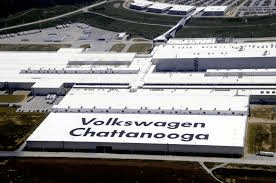
The  Wall Street Journal’s (May 25,2011) headline “VW Evaluates US Audi Plant” is more good news for American manufacturing. With its new $1 billion plant opening  2 days ago in Chattanooga, VW aims to triple its US auto sales.The complex is designed to build 150,000 Passat sedans and can be expanded to 300,000 units.

Why the American plant and why Tennessee? VW believes it cannot compete against rivals Ford, GM, and Toyota without the cost benefits from a factory here. The firm has lost money in the US for a decade (with cars made in Germany) because of unfavorable exchange rates. The new plant makes it possible to lower the price of  the mid-sized Passat by an amazing $8,000 –down to $20,000, in line with competitive vehicles. The VW plant  is paying $14.50 an hour, half of what auto workers make at older Toyota plants and at unionized Ford, GM, and Chrysler facilities. VW can now also produce 85% of its parts locally, lowering the impact of the currency translation.

With the new plant barely open, VW is already considering building its luxury Audi line in the US for the 1st time, for the same cost reasons. The firm thinks it can double Audi sales to 200,000 units with a facility closer to its customers. (Businessweek features a similar article called “VW Rediscovers America” ,May 21-27, 2011).

Discussion questions:

1. Why is VW interested in expanding its manufacturing to the US?

2. Why did it select Tennessee for its first US site?